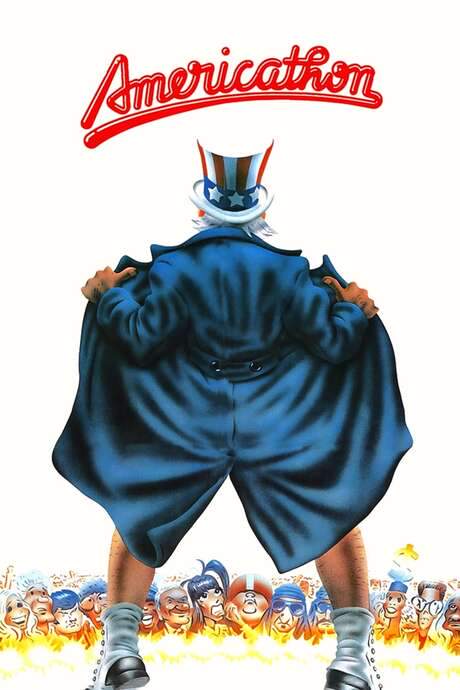
Americathon 1979

Directed by

Neal Israel
Made by
United Artists
Where to Watch Americathon
See current US streaming, rental, and purchase options for Americathon (1979) via JustWatch.






Americathon Plot Summary
Read the complete plot summary and ending explained for Americathon (1979). From turning points to emotional moments, uncover what really happened and why it matters.
In the (then-near future) year 1998, the United States confronts a drastic oil shortage that reshapes everyday life. With cars left idle, people take to jogging, cycling, and rollerskating as their primary means of movement. Tracksuits become everyday attire, paper money loses value, and gold coins become the currency of choice; even a coin-operated elevator proclaims “Gold Coins Only.” In this altered landscape, the country turns to a political figure to lead them, and the election brings forth Chet Roosevelt, John Ritter, a cosmically inspired former California governor who bears little resemblance to the classic presidents of history aside from his name. Roosevelt’s high-spirited optimism and knack for catchy affirmation slogans fuel a series of public fundraising events, all of which collapse in spectacular fashion.
As the administration flirts with grandiose plans, Roosevelt fixes his attention on Mouling Jackson, a Vietnamese American pop icon whose fame could galvanize a nation in crisis. Zane Buzby portrays Mouling, a figure at the center of political and commercial intrigue, whose star power becomes a key element in the administration’s efforts to rally support. Yet the money that keeps the government afloat seems less and less within reach. A cartel led by a billionaire named Sam Birdwater—who exercises control over Nike, under the corporate label National Indian Knitting Enterprises during the film’s release—lends billions to the government. Birdwater’s involvement raises questions about influence, leverage, and who ultimately owns the country’s future.
Across the country, the federal government—now headquartered in a sub-leased condominium known as The Western White House in Marina del Rey, California—faces the ominous threat of foreclosure. When Birdwater goes public on national television to reveal his loan, he also demands repayment, warning that the alternative would be foreclosure and a return to the country’s original owners. His blunt justification—“Hey, I have to eat, too. Does that make me a bad guy?”—speaks to a larger moral tension at the heart of the crisis and the uneasy calculus of power and necessity.
Desperation pushes Roosevelt toward creative, if risky, measures. He hires a young television consultant, Eric McMurkin, Peter Riegert, to help craft a nationwide raffle as a fundraising tool. Yet the stakes push them toward an even more ambitious plan: a national telethon designed to mobilize public support and financial backing on a scale never before seen in peacetime America. To host this unprecedented event, they enlist the vaunted but vacuous presence of Monty Rushmore, Harvey Korman, a celebrity whose appeal is as much spectacle as substance.
Behind the scenes, a covert political chess game unfolds. Presidential adviser Vincent Vanderhoff, Fred Willard, schemes to derail the telethon’s success, hoping to pave the way for a new arrangement in which the United Hebrab Republic—formed by the merger of Israel and the Arab states—would acquire whatever assets remain once Birdwater forecloses. The plan is not merely financial; it embodies a geopolitical realignment that could reshape the region and the world’s balance of power.
As the telethon looms, the film paints a portrait of a nation scrambling to adapt to a future that is at once comic and perilous. It juxtaposes satire with a sobering look at debt, dependency, and the price of democracy when money and influence cross borders. Throughout, the story keeps a careful, readable pace, balancing character moments with the broader, occasionally absurd machinery of national crisis. The path to salvation, if there is one, hinges on whether a country can rally behind a narrative strong enough to bind a fractured society together—through spectacle, persuasion, and the stubborn hope that a flawed leader might still steer a damaged republic toward a workable tomorrow.
Hey, I have to eat, too. Does that make me a bad guy?
Americathon Timeline
Follow the complete movie timeline of Americathon (1979) with every major event in chronological order. Great for understanding complex plots and story progression.
Oil runs out; US shifts to gold-based economy
In 1998, the United States runs out of oil and society adapts to life in stationary cars and nonpowered transport like jogging, cycling, and rollerskating. Paper money loses all value and gold coins become the sole currency for transactions. The economy reorganizes around scarcity and improvisation.
Chet Roosevelt elected president
Americans elect Chet Roosevelt, a cosmically inspired former California governor, to lead the country. He presents himself with a flamboyant, tracksuit-wearing persona and rapid-fire affirmations. His quirky style sets him apart from traditional presidential figures.
Roosevelt's fundraising efforts fail
Roosevelt launches a series of highly publicized fundraising events in a bid to stabilize the nation, but each effort collapses. He remains relentlessly optimistic, pursuing public support even as donors pull back. The failures deepen the sense of national crisis.
Roosevelt pursues Mouling Jackson
Roosevelt shifts his attention to Mouling Jackson, a Vietnamese American pop superstar, pursuing a romantic relationship amid political upheaval. The pursuit intertwines personal ambition with the nation's stalled leadership. The romance adds another layer of spectacle to the presidency.
Birdwater provides essential loans
A Native American-led cartel, spearheaded by Sam Birdwater, extends crucial loans to the U.S. government through Nike’s network. The loans constitute the main financial lifeline for a country teetering on bankruptcy. The deal places Birdwater in a powerful position over national policy.
The Western White House headquarters established
With the government bankrupt, operations relocate to The Western White House, a sub-leased condo in Marina del Rey, California. The move signals the severity of the crisis and the fragility of federal institutions. The presidency continues under extreme financial strain in this new setting.
Birdwater reveals the loan on national TV
Birdwater goes public on national television, confirming he lent billions to the United States and demanding repayment. The broadcast reframes the crisis as a debt default in plain terms and raises urgent questions about sovereignty. Foreclosure now feels imminent to many observers.
Telethon strategy is born
Roosevelt hires a young television consultant, Eric McMerkin, to craft a national raffle that could help save the country. The plan evolves into a full-blown telethon aimed at mobilizing citizen donations. The urgency of the moment pushes media strategy to the forefront of national politics.
Monty Rushmore signs on to host the telethon
The telethon plan recruits vapid TV celebrity Monty Rushmore to host the fundraising event. The host’s persona embodies the spectacle surrounding attempts to rally the country. Production elements focus on mass entertainment as a tool for political rescue.
Vanderhoff plots to sabotage the telethon
Presidential adviser Vincent Vanderhoff secretly schemes to ensure the telethon fails. His goal is to clear the way for foreign interests to acquire remaining U.S. assets after Birdwater forecloses. The plan reveals internal political scheming behind the public crisis.
United Hebrab Republic forms
The merger of Israel and Arab states yields the United Hebrab Republic, a new geopolitical entity ready to purchase what remains of the United States. The plan adds an international dimension to the domestic crisis. The looming sale underscores how foreign interests may shape the outcome.
Foreclosure threatens the country
As Birdwater’s repayment demands intensify and the telethon faces sabotage, the country edges closer to foreclosure. The government scrambles to retain control of assets and prevent a complete transfer of sovereignty. The crisis accelerates as lenders tighten the reins.
Possibility of sale to foreign interests
With the foreclosure unresolved, the country becomes vulnerable to sale to foreign stakeholders, potentially ending current governance. The narrative sets the stage for a dramatic political and financial transfer of power. The crisis persists as the telethon's outcome hangs in the balance.
Americathon Characters
Explore all characters from Americathon (1979). Get detailed profiles with their roles, arcs, and key relationships explained.
Chet Roosevelt (John Ritter)
The president and an irrepressibly optimistic figure who peppered speeches with positive slogans. He launches a flurry of fundraising events and seeks legitimacy through spectacle, often misreading the depth of the crisis. His naiveté contrasts with the harsh reality of a nation on the brink as he chases a romance with Mouling Jackson and relies on external loans to keep the lights on.
Mouling Jackson (Zane Buzby)
A Vietnamese American pop icon whose celebrity draws Roosevelts attention and headlines. Her star power becomes a plot fulcrum as public sentiment shifts with her appearances. She embodies the entertainment-into-politics crossover at a time of national stress.
Sam Birdwater (Chief Dan George)
A billionaire financier who controls Nike and leads a Native American loan cartel. He publicly threatens the country with foreclosure unless repaid, positioning himself as kingmaker and debtor-king. His leverage exposes the fragility of a nation depending on private wealth in a crisis.
Eric McMerkin (Peter Riegert)
A television consultant hired to orchestrate a national raffle and later the telethon. He navigates the media landscape, aiming to craft a sensational escape plan for a faltering nation. His role underscores the era’s faith in televised salvation and showbiz problem-solving.
Monty Rushmore (Harvey Korman)
A vapid TV personality hired to host the national telethon. His notoriety for empty bravado highlights the void at the heart of a broadcast-driven rescue effort. He embodies the spectacle and hollowness of celebrity-led attempted salvation.
Vincent Vanderhoff (Fred Willard)
Presidential adviser who schemes to sabotage the telethon for political/financial gain. He represents the darker side of crisis management, where cunning plans threaten the public’s chance at rescue. His machinations reveal the self-interest lurking behind national crisis responses.
Americathon Settings
Learn where and when Americathon (1979) takes place. Explore the film’s settings, era, and how they shape the narrative.
Time period
1998
In the then-near future year 1998, America faces a total oil shortage and a transformed economy where paper money is obsolete. The government operates from a portable political hub in California, as citizens jog, bike, and rollerskate to get around a nation of stalled cars. The era is defined by gold as the medium of exchange and the prominence of televised fundraising as salvation.
Location
Marina del Rey, California, The Western White House
Set primarily in Marina del Rey, the film centers on a near-future United States headquartered in a repurposed condo dubbed The Western White House. The coastal LA locale provides a satirical backdrop for national crisis, blending political farce with showbiz flavor. The setting emphasizes a nation clinging to media spectacle while resources have run dry.
Americathon Themes
Discover the main themes in Americathon (1979). Analyze the deeper meanings, emotional layers, and social commentary behind the film.
🎭
Media Satire
The Americathon world uses television as a tool for political legitimacy and rescue, lampooning the power of propaganda, press conferences, and celebrity-hosted fundraisers. Monty Rushmore and a national telethon become instruments of national identity, while public faith is placed in entertainment over policy. The film skewers how media pipelines can distort reality in a crisis.
💰
Economic Collapse
Oil runs dry and currency collapses, forcing Americans to transact in gold and accept a government bailout from reluctant lenders. A cartel-led loan system under Sam Birdwater reveals how private wealth can hold the strings of national fate. Foreclosure and debt become the new normal, threatening the country’s sovereignty. The plot hinges on whether a fundraising spectacle can avert disaster.
🤝
Power and Influence
Behind the scenes, powerful financiers and corporate players manipulate politics for leverage, offering rescue loans in exchange for influence. Birdwater’s monopoly over Nike and his public demand for repayment illustrate how economic power can supplant democratic processes. The advisers and insiders who scheme to control the telethon show how leadership is a performative game. The film questions who truly holds the leash on a country in crisis.

Coming soon on iOS and Android
The Plot Explained Mobile App
From blockbusters to hidden gems — dive into movie stories anytime, anywhere. Save your favorites, discover plots faster, and never miss a twist again.
Sign up to be the first to know when we launch. Your email stays private — always.
Explore the mobile appAmericathon Spoiler-Free Summary
Discover the spoiler-free summary of Americathon (1979). Get a concise overview without any spoilers.
In a near‑future version of 1998 the United States is humming with an uneasy, almost cartoonish survivalism. An abrupt oil shortage has turned streets into raceways for joggers, cyclists and rollerskates, while tracksuits have become a national uniform. Paper money has lost its bite and gold coins are now tapped at every turnstile—even the elevator in the lobby demands “Gold Coins Only.” The government itself has been displaced to a glossy condominium in Marina del Rey, a place humorously dubbed the “Western White House,” underscoring how the country’s institutions have been forced to adapt to absurd new realities.
At the helm of this precarious republic is the improbably named president, Chet Roosevelt. A former California governor with a boundless optimism and a penchant for catchy slogans, he embodies the film’s blend of earnest idealism and satirical excess. Faced with empty coffers and a looming threat from a coalition of affluent Native Americans eager to claim a bankrupt nation, he must devise a rescue plan that is as theatrical as it is desperate. His charisma and an uncanny ability to turn crisis into spectacle set the tone for a story that feels part political farce, part earnest love letter to American resilience.
Enter the film’s pragmatic hero, Eric McMurkin, a sharp‑witted television consultant whose career has been built on turning ideas into ratings gold. Recruited by the president, he is tasked with engineering a nation‑wide telethon that could, in theory, raise enough money to stave off the looming takeover. To give the event the necessary star power, the administration enlists the flamboyant pop icon Mouling Jackson and the glitzy, if hollow, celebrity host Monty Rushmore, whose presence promises both spectacle and a dose of self‑aware absurdity.
Against this backdrop, the movie balances a satirical edge with a genuine curiosity about how far a country will go when hope is packaged as entertainment. The telethon looms not only as a fundraising stunt but as a cultural mirror, reflecting a society scrambling to stitch together unity, humor, and desperation in the face of fiscal ruin. The premise invites viewers to wonder whether a nation can truly rally behind a shared narrative—no matter how outrageous—when the stakes are nothing less than its very existence.
Movies with Similar Twists and Themes
Uncover films that echo the narrative beats, emotional arcs, or dramatic twists of the one you're exploring. These recommendations are handpicked based on story depth, thematic resonance, and spoiler-worthy moments — perfect for fans who crave more of the same intrigue.
Featured on this page

What's After the Movie?
Not sure whether to stay after the credits? Find out!
Check out our other apps:

SAT Sphere
Build confidence for the Digital SAT.

Mori Atlas
Discover wild places worth protecting.

Luntero
Search smarter for a home in Amsterdam.

Plot Explained
Unravel movie endings and hidden clues.

Pokechamp
Dive into Pokémon data and battle logic.

Driving Theory
Get ready for your European theory test.

Movie Dust
Plan your next cinema trip with ease.

Musemap
Find art and culture as you travel.

Selkobase
Compare credentials before committing.

Local Manual
Turn an unfamiliar country into practical next steps.

Lernavi
Compare school systems before your next move.

GymRoam
Find a workout stop wherever your plans take you.
Explore Our Movie Platform
New Movie Releases (2026)
Famous Movie Actors
Top Film Production Studios
Movie Plot Summaries & Endings
Major Movie Awards & Winners
Best Concert Films & Music Documentaries
Movie Collections and Curated Lists
© 2026 What's After the Movie. All rights reserved.
Privacy Policy