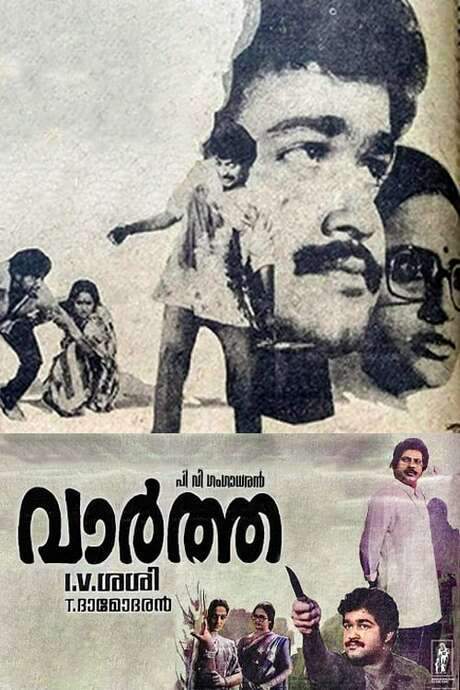



Vartha Plot Summary
Read the complete plot summary and ending explained for Vartha (1986). From turning points to emotional moments, uncover what really happened and why it matters.
Madhavankutty, Mammootty, is a determined journalist who fights against a deeply corrupt government system, risking his safety to expose the injustices that fester in the corridors of power. He comes from a family shaped by hardship, with his father Keshavan Nair and his mother Kunjulaksmi, and the personal stakes of his work ripple through his daily life. The film sets him against a landscape where power and greed often override the truth, and where a single investigative lead can become a matter of life and death for those who chase it.
Unnikrishnan, Rahman, a volatile college student who frequently vandalizes school property, harbors a long-standing hostility toward his elder sister Radha Menon, Seema, an IAS Officer. Their family dynamic adds emotional weight to the story, as a younger sister named Vasanthi watches the frictions unfold. A tense confrontation erupts when Radha slaps Unnikrishnan after learning about the trouble he and his gang caused at Madhavankutty’s home, and she commands him to apologize, a demand he reluctantly fulfills the next day. This moment foreshadows the precarious balance between authority, crime, and family ties that threads through the narrative.
Vasu, Mohanlal, known as “Parol Vasu,” is introduced as a powerful, calculating goon who works for Manikyam, a corrupt businessman with his own agenda. Hamsa is Vasu’s loyal aide who stays by his side through thick and thin. The story also follows Vasanthi, Radha and Unnikrishnan’s younger sister, whose fate becomes entwined with the men around her as she grows increasingly drawn into the orbit of Vasu and his world. The tension thickens the air with questions about love, loyalty, and the blurry line between justice and vengeance, especially as Madhavankutty’s love for Radha complicates the loyalties at play.
One night, Vasu and his goons attack Madhavankutty, setting off a chain of retaliations and shifting allegiances. In the personal sphere, Vasanthi begins to see Vasu in a new light and gradually falls for him, ultimately marrying him. Vasu then opens up about his painful past: a mother who spent time in a mental asylum, a father who is bedridden after a spell in a central jail, and a life shaped by hardship that pushed him toward crime. He recounts growing up in an orphanage and explains how those experiences helped shape the man he has become, a narrative that adds depth to his ruthless exterior and invites audiences to consider the roots of violence.
Against this turbulent backdrop, Madhavankutty offers Vasu a job. Initially, Vasu rejects the proposal, still carrying bitterness from his past, but he soon reconsiders and accepts, stepping into the role of Madhavankutty’s right-hand man. This evolution marks a significant shift in the power dynamics of the story, as an old foe becomes a key ally in the journalist’s campaign against corruption, and as the line between protector and aggressor becomes increasingly blurred.
Tragedy strikes when Hamsa is killed by Inspector Francis, a development that reverberates through the lives of all involved. Vasu moves to mete out his own form of justice, but Madhavankutty intervenes, urging him to let the court punish the culprit and to uphold the rule of law rather than taking the law into their own hands. The moment crystallizes a central theme of the film: the conflict between vigilante impulses and the formal justice system, and how even well-intentioned actions can be distorted by violence and retribution.
In the climactic sequence, both Madhavankutty and Vasu are shot dead by unknown assailants, leaving Unnikrishnan, Radha, and Vasanthi in a state of shock and grief. The film closes with a newspaper report that summarizes the investigation into their deaths, a sober reminder of the unresolved currents of power, crime, and reform that continue to ripple through their world. TheEnding leaves viewers with a reflective sting, inviting contemplation on the costs of fighting corruption and the fragile line between justice and tragedy.
Vartha Timeline
Follow the complete movie timeline of Vartha (1986) with every major event in chronological order. Great for understanding complex plots and story progression.
Madhavankutty's mission as a journalist
Madhavankutty is a fearless journalist who exposes corruption within the government. He works in a city where graft and abuse of power are routine, using his reporting to hold the powerful to account. His commitment to justice is framed by his family, with his father Keshavan Nair and mother Kunjulaksmi mentioned as his stake in a truthful society. The setup emphasizes the personal cost of standing up to corruption.
Vandalism at Madhavankutty's house
Unnikrishnan and his gang throw stones at Madhavankutty's house, signaling the reach of anti-social elements into the journalist's life. The attack endangers his family and underscores the threat he faces in his fight against corruption. Radha reacts to the incident by slapping Unnikrishnan and vowing that he must answer for his violence.
Radha demands accountability
Radha confronts Unnikrishnan the next day and forces him to apologize to Madhavankutty, underscoring her stance against hooliganism and abuse of power. The confrontation solidifies the personal stakes in their ongoing feud. The incident also hints at the growing tension between the siblings and the rival factions.
Enter Vasu and Hamsa
Vasu, known as Parol Vasu, is introduced as a ruthless goon aligned with the corrupt businessman Manikyam. Hamsa serves as his constant aide, together forming the local underworld's muscle. Their presence signals the expansion of organized crime into the political and business landscape.
Vasanthi's proposal and rejection
Vasanthi, Madhavankutty's sister, proposes marriage to him, but he declines because his heart still belongs to Radha. The moment reveals the personal costs of his anti-corruption crusade and the complexity of family relationships in this conflict.
Vasanthi's growing bond with Vasu
Vasanthi grows closer to Vasu, drawn by his power and charisma, and she eventually becomes his wife. This relationship marks a shifting alliance within the anti-corruption circle and adds a personal betrayal to the political stakes.
Vasu reveals his past
Vasu confesses his painful past to Vasanthi—his mentally ill mother, a father in a central jail, and a childhood spent in an orphanage. He explains how these hardships shaped his ruthless path and his loyalty to the system that exploited him. The backstory adds depth to his hardened persona.
Madhavankutty offers a job to Vasu
Madhavankutty offers Vasu a job, hoping to reform him and bring his loyalty into the fold. Vasu initially refuses due to bitterness but eventually accepts and becomes Madhavankutty's right-hand man. This marks a pivotal shift in the balance of power within the anti-corruption movement.
Hamsa is killed
One night, Hamsa is killed by Inspector Francis, a brutal act that escalates the violent conflict between the anti-corruption faction and the police. The murder heightens the stakes for Madhavankutty and his new ally Vasu. The event also justifies the growing digital and street-level fear in the city.
Vasu restrained, justice in court
Enraged by Hamsa's death, Vasu moves to avenge him but Madhavankutty stops him, urging that justice be left to the courts. The moment solidifies Madhavankutty's insistence on rule of law over personal vengeance. It also tensions within their alliance as violent impulses clash with political strategy.
Climax: deaths of Madhavankutty and Vasu
In the climactic finale, Madhavankutty and Vasu are shot dead by unknown shooters, cutting short their joint anti-corruption front. The double tragedy shocks Unnikrishnan, Radha, and Vasanthi, who struggle to process the loss. The city is left in a state of uncertainty about who orchestrated the killings.
Aftermath and investigation begins
Unnikrishnan, Radha, and Vasanthi are devastated by the deaths, and a newspaper reports that the case is under investigation. The public narrative suggests ongoing intrigue and unanswered questions about the violence that claimed their loved ones. The final frame leaves the door open for truth to emerge through journalism and inquiry.
Vartha Characters
Explore all characters from Vartha (1986). Get detailed profiles with their roles, arcs, and key relationships explained.
Madhavankutty (Mammootty)
A principled journalist who challenges a corrupt government system. He pursues truth at great personal risk and uses reporting to provoke accountability. His unwavering integrity makes him a target for those who profit from concealment.
Vasu (Parol Vasu) (Mohanlal)
A feared goon who becomes Madhavankutty’s right-hand man after a painful past. His loyalty is situational, balancing brutality with a sense of opportunity. The alliance reveals the moral ambiguities of crime and accountability.
Radha Menon (Seema)
An IAS officer and the elder sister who champions justice while navigating personal loyalties. She embodies resilience and a commitment to public service, often clashing with family violence and political pressure.
Unnikrishnan (Rahman)
A violent college student whose hostility toward his sister Radha drives the conflict. He remains connected to the criminal underworld through his friendship with Vasu, highlighting the pull between rage and allegiance.
Vasanthi
Madhavankutty’s younger sister who loves him and becomes entangled with Vasu, ultimately marrying him. Her choices reveal how personal relationships intersect with public battles against corruption.
Hamsa
Vasu’s loyal aide who is killed by Inspector Francis, marking a turning point in the power struggle. Her death underscores the costs of meddling in criminal politics.
Manikyam
A corrupt businessman whose influence sustains the nexus of crime and politics that Madhavankutty opposes.
Inspector Francis
A police inspector who represents the law but is entangled in the broader conflict, including involvement in the deaths of key characters.
Vartha Settings
Learn where and when Vartha (1986) takes place. Explore the film’s settings, era, and how they shape the narrative.
Time period
Late 1980s
The narrative sits in a period of heightened political tension and bureaucratic entanglements in India. Press freedom and public accountability contend with powerful interests, creating a climate ripe for investigative drama. The era’s social unrest and institutional corruption drive the protagonist’s crusade and the rise of criminal networks.
Location
Kerala, India
The story unfolds in a Kerala city where media and power collide. The setting centers on urban life—homes, schools, and government offices—where political influence shapes everyday realities. It paints a landscape marked by public scrutiny, political maneuvering, and a struggle against systemic corruption.
Vartha Themes
Discover the main themes in Vartha (1986). Analyze the deeper meanings, emotional layers, and social commentary behind the film.
📰
Investigative Journalism
A central thread follows Madhavankutty's pursuit of truth against a powerful system. The film portrays reporting as a weapon to expose corruption, risking personal safety to mobilize public opinion. It highlights the role of the media in challenging entrenched interests and inspiring accountability. The tension between transparency and censorship fuels the drama.
🤝
Shifting Alliances
Vasu's arc from feared goon to trusted ally shows how power reshapes loyalties. Partnerships form and falter as ambition and survival collide. The interactions with Vasanthi reveal how personal relationships complicate moral choices in a corrupt world. The film uses these shifts to probe the gray areas between justice and crime.
💀
Tragedy & Fate
The climax features sudden assassinations that erase the leading figures, underscoring the perilous nature of resisting a corrupt system. Violence upends lives and invites questions about accountability and the costs of opposition. The closing newspaper report suggests that truth remains elusive even amid courageous acts.

Coming soon on iOS and Android
The Plot Explained Mobile App
From blockbusters to hidden gems — dive into movie stories anytime, anywhere. Save your favorites, discover plots faster, and never miss a twist again.
Sign up to be the first to know when we launch. Your email stays private — always.
Explore the mobile appVartha Spoiler-Free Summary
Discover the spoiler-free summary of Vartha (1986). Get a concise overview without any spoilers.
In a gritty urban landscape where the clatter of typewriters competes with whispered deals in marble‑lined corridors, the film paints a world caught between the longing for a free press and the iron grip of entrenched power. The streets pulse with a restless energy, and every newsroom desk feels like a front line in a larger battle for truth. A brooding, almost theatrical tone underscores the everyday struggle, turning ordinary conversations into simmering confrontations between conscience and corruption.
At the heart of this conflict is Madhavankutty, a principled journalist whose resolve is forged by a modest upbringing and the weight of his family’s sacrifices. Raised by his parents, Keshavan Nair and Kunjulaksmi, he carries their hopes into each investigation, wielding his pen as both weapon and shield. His relentless pursuit of hidden injustices positions him as a beacon for those yearning for accountability, while also marking him as a target for those who thrive in secrecy.
The narrative’s emotional core expands through the intertwined lives of Radha Menon, a disciplined IAS officer, and her brother Unnikrishnan, a restless college student whose defiant streak often collides with his sister’s sense of duty. Their younger sister Vasanthi watches the volatile sibling dynamic unfold, caught between admiration and apprehension. Adding another layer, Vasu—known on the streets as “Parol Vasu”—emerges as a formidable presence whose calculated ruthlessness masks a past riddled with hardship. His loyalty to a shadowy patron and his complex relationship with Vasanthi hint at a world where personal histories shape present allegiances.
Together, these characters navigate a fraught environment where the desire to expose corruption contends with the seductive pull of power. The film’s tone remains taut, balancing gritty realism with moments of introspection, inviting viewers to contemplate the fragile line between heroic rebellion and the consuming darkness that surrounds it.
Movies with Similar Twists and Themes
Uncover films that echo the narrative beats, emotional arcs, or dramatic twists of the one you're exploring. These recommendations are handpicked based on story depth, thematic resonance, and spoiler-worthy moments — perfect for fans who crave more of the same intrigue.

Featured on this page

What's After the Movie?
Not sure whether to stay after the credits? Find out!
Check out our other apps:

SAT Sphere
Build confidence for the Digital SAT.

Mori Atlas
Discover wild places worth protecting.

Luntero
Search smarter for a home in Amsterdam.

Plot Explained
Unravel movie endings and hidden clues.

Pokechamp
Dive into Pokémon data and battle logic.

Driving Theory
Get ready for your European theory test.

Movie Dust
Plan your next cinema trip with ease.

Musemap
Find art and culture as you travel.

Selkobase
Compare credentials before committing.

Local Manual
Turn an unfamiliar country into practical next steps.

Lernavi
Compare school systems before your next move.

GymRoam
Find a workout stop wherever your plans take you.
Explore Our Movie Platform
New Movie Releases (2026)
Famous Movie Actors
Top Film Production Studios
Movie Plot Summaries & Endings
Major Movie Awards & Winners
Best Concert Films & Music Documentaries
Movie Collections and Curated Lists
© 2026 What's After the Movie. All rights reserved.
Privacy Policy