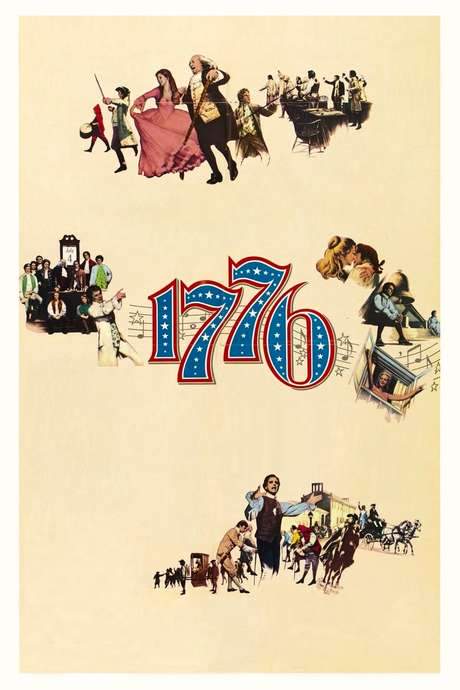
1776 1972

Directed by

Peter H. Hunt
Made by

Columbia Pictures
Where to Watch 1776
See current US streaming, rental, and purchase options for 1776 (1972) via JustWatch.









1776 Plot Summary
Read the complete plot summary and ending explained for 1776 (1972). From turning points to emotional moments, uncover what really happened and why it matters.
William Daniels as John Adams, representing Massachusetts in the Second Continental Congress in Philadelphia, laments the body’s reluctance to debate independence and instead to grind through routine matters. He leans on the steady voice of his wife, Virginia Vestoff as Abigail Adams, for both solace and strategic counsel, knowing that a personal touch could help sway wavering delegates.
Howard Da Silva as Benjamin Franklin, one of the few who shares Adams’ dream of a new, independent nation, becomes a crucial ally. He suggests that someone else should introduce the idea of independence, so they enlist Richard Henry Lee of Virginia to return home, obtain permission from the state legislature, and present the motion to break from Britain. The plan hinges on gathering enough support from the reluctant delegates, and the atmosphere in Congress grows tense as tempers flare and factions emerge.
Lee returns, proposes the resolution, and faces stiff resistance from John Dickinson of Pennsylvania, a leading conservative who seeks reconciliation with Britain. The vote to debate the question proceeds, setting off a heated contest among the delegates. A pivotal moment arrives when Caesar Rodney of Delaware, battling cancer, collapses and must retreat from the chamber, depriving Adams of a crucial Delaware vote just as momentum shifts in favor of independence. A fresh delegation from New Jersey arrives, bringing news that Franklin’s son William, the Royal Governor of New Jersey, has been arrested, adding personal stakes to the political drama.
To derail the push for independence, Dickinson moves to demand a unanimous vote—arguing that no colony should break away without its own consent. Adams counters with a plan to postpone the vote in order to draft a formal declaration of grievances. John Hancock, the President of Congress, ultimately breaks the tie in favor of moving forward and appoints a committee to draft the declaration: Rex Robbins as Roger Sherman, John Myhers as Robert Livingston, Ken Howard as Thomas Jefferson, and David Ford as John Hancock.
Jefferson, initially reluctant to take on such a monumental task, agrees to serve as the primary writer after Adams urges him to accept the duty. A full week passes without a completed draft, and Adams summons his wife to Philadelphia to lend the necessary spark, while the delegation at large begins to recognize the weight of the decision before them. The narrative unfolds with the sense that history is being shaped, not merely debated.
To secure Maryland’s support for independence, Adams and Franklin accompany Samuel Chase to the army encampment at New Brunswick, New Jersey, taking Chase with them and bringing a sense of urgency to the cause. The next day, a military courier arrives with the grim news that his two best friends were killed at Lexington, underscoring the real cost of rebellion for many who serve in the Continental Army and Congress.
After their return, the Declaration is read aloud, and Congress begins to entertain numerous amendments. Jefferson is asked to reconsider some wording, and while he agrees to many changes, he objects to striking the reference to the King as a tyrant and to the issue of slavery. Edward Rutledge of South Carolina leads the Southern members in leaving the room in protest as Chase returns with Maryland’s vote in support of independence. Adams is urged to compromise further, but Franklin reminds him that achieving independence requires embracing a broad coalition, including those with opposing views, as part of the nation they are about to create. This exchange leaves Adams visibly unsettled, yet resolute.
A key turn comes on the day of the vote: July 2, 1776. The plan to drop the slavery language is settled for the moment, and Rutledge’s bloc along with others moves toward unity. Delaware’s three representatives deliver a mixed result, and Rodney is recalled to Cast a decisive vote in favor of independence, rather than seeing his state divided. When Dickinson appears ready to vote against the measure, Franklin proposes polling the Pennsylvania delegation. William Daniels would again oversee this moment, and the result hinges on James Wilson, who finally votes for independence to avoid a lasting mark on his reputation. Dickinson resigns from Congress, vowing to join the army, while Wilson’s decisive choice helps tilt the balance toward a new nation.
Meanwhile, Morris, whose estates have been dismantled and whose family has moved to safety, signs the parchment in protest despite not being authorized, an act that adds personal drama to the formal proceedings. As the final ceremonial bell tolls, Andrew McNair, the Congressional custodian, tolls out a grim cadence. With Delaware reconciled and the remaining states poised to declare, one by one the states sign the document, marking the birth of the United States of America.
no colony be torn away from its mother country without its own consent.
In the end, the room fills with a quiet, determined energy as the delegates affirm their commitment to a new union, and the signing ceremony seals a bold, controversial, and transformative moment in history. The film deftly balances political strategy, personal sacrifice, and the quiet, stubborn courage that underpins the birth of a nation, offering a thoughtful, human-centered portrait of figures who chose to risk everything for a future they believed in.
1776 Timeline
Follow the complete movie timeline of 1776 (1972) with every major event in chronological order. Great for understanding complex plots and story progression.
Adams challenges Congress to debate independence
John Adams laments that the Continental Congress refuses to debate his motion for independence and instead focuses on trivial matters. He seeks counsel from his wife Abigail to steady his resolve and to keep his cause alive. The scene sets the pressure for a bold decision.
Franklin persuades Lee to bring independence forward
Benjamin Franklin suggests that someone else propose independence to avoid direct clashes with the Conservative faction. He convinces Richard Henry Lee to return to Virginia to seek authorization to introduce the resolution. The move signals a shift toward an official push for independence.
Lee returns with authority and proposes independence
Lee rides home to secure authorization from Virginia to propose independence, then returns to Congress with the resolution. The debate intensifies as Dickinson and the Conservative faction balk at breaking from Britain. The stage is set for a historic clash over the future of the colonies.
Caesar Rodney collapses, altering Delaware's vote
During the heated debate, Caesar Rodney of Delaware collapses from illness and must depart, depriving Adams of Delaware's timely vote. His absence jeopardizes the push for an immediate independence declaration. The moment underscores the fragility of the coalition forming around independence.
New Jersey delegation arrives and votes in favor; Franklin learns of arrest
A New Jersey delegation arrives in Congress and votes for independence, bolstering the pro-independence cause. Franklin also receives news that his son William has been arrested by the Royal Governor of New Jersey, adding a personal dimension to the political struggle.
Dickinson pushes for unanimous consent
John Dickinson proposes that independence be voted upon unanimously to appease the remaining holdouts, a tactical maneuver that risks stalling the momentum toward independence. The procedural gambit sharpens the fault lines between reconciliationists and hardliners.
Postponement ordered; a Declaration committee is formed
To salvage the motion, Adams requests a postponement to draft a declaration of grievances. Hancock breaks the tie in favor of moving forward and appoints a five-person committee to write the document, naming Adams, Franklin, Sherman, Livingston, and Jefferson. The scene marks the birth of a written justification for independence.
Jefferson becomes lead drafter; Adams enlists Martha's aid
Jefferson reluctantly agrees to be the primary author of the declaration. After a week of drafting trouble, Adams summons his wife Martha to Philadelphia; her charm helps win Jefferson's cooperation, and he completes the draft. The document finally takes shape under combined leadership.
Campaign to win Chase's support leads to New Brunswick trip
To secure Samuel Chase's support for independence, Adams agrees to visit the Continental Army encampment in New Brunswick with Franklin and Chase. The mission tightens the alliance between political leaders and the army. The group returns with renewed purpose.
Courier brings Lexington casualties back to Congress
After the New Jersey trip, a military courier arrives at Congress with grim news of two friends killed at Lexington. The casualty report underscores the high stakes of the decision before Congress. The news further galvanizes Adams and his allies.
Declaration read; amendments spark walkouts
Back in session, the Declaration is read and many members seek to amend it. Edward Rutledge leads the Southern members in a walkout in protest, while Chase returns with Maryland's vote in favor. The debate tests the unity of the coalition on language and scope.
Franklin counsels compromise; saltpeter and Georgia shift
Franklin counsels Adams that compromise is essential to securing independence, while Abigail's saltpeter shipment and Georgia's sudden decision to support independence bolster the effort. These personal and logistical supports bolster Adams's resolve.
July 2, 1776 vote on independence; slavery issue and Delaware's return
On July 2, the Congress votes to move toward independence, with key concessions and votes shifting in the balance. Delaware's Rodney is brought back to vote for independence by the three Delaware representatives, while Dickinson votes against it. Franklin and Wilson maneuver to secure a majority, setting the stage for a final declaration.
July 4, 1776 signing seals the birth of the United States
As McNair tolls the bell, one signer per state signs the Declaration, establishing the United States of America. Morris signs despite not being authorized, underscoring the personal costs involved. The moment marks the nation's birth and the culmination of years of struggle for independence.
1776 Characters
Explore all characters from 1776 (1972). Get detailed profiles with their roles, arcs, and key relationships explained.
John Adams (William Daniels)
Massachusetts’s ardent advocate for independence, Adams is principled and forceful, often clashing with peers as he pushes for action. He seeks counsel from his wife and colleagues, balancing fiery conviction with strategic patience. His resolve is tested as the vote hinges on persuasion, alliance-building, and personal sacrifice for the greater good.
Abigail Adams (Virginia Vestoff)
Abigail is a steady, intelligent influence on her husband, offering practical counsel and emotional support. Her presence underscores the domestic dimension of political life and the broader idea that personal relationships fuel public action. She embodies resilience and insight that sustains the independence movement.
Benjamin Franklin (Howard Da Silva)
Franklin is a pragmatic, witty diplomat who champions independence while maintaining diplomatic tact. He helps smooth factional tensions and nudges Adams toward broader alliance-building. Franklin’s vision and experience lend a stabilizing influence to the pursuit of a united new nation.
Thomas Jefferson (Ken Howard)
Jefferson serves as the primary drafter of the declaration, combining intellect with a sense of moral idealism. He reluctantly accepts the responsibility and works to craft language that can unite diverse interests. The process reveals his cautious stance on controversial issues like slavery, shaping the draft’s final content.
Roger Sherman (Rex Robbins)
Sherman participates in the drafting process with a practical, collaborative spirit. He helps translate broad ideals into workable, persuasive language and works toward building consensus among states. His steadiness contributes to navigating the complexities of union-building.
Edward Rutledge (John Cullum)
Rutledge leads the Southern delegates and asserts their opposition to certain terms, embodying regional interests. His firm stance triggers tensions and walkouts that test the unity of the Congress. He represents the mounting pressure from the South in shaping the final decision.
Caesar Rodney (William Hansen)
Rodney, battling illness, delivers a crucial but fragile vote for Delaware. His physical frailty at a pivotal moment highlights the personal cost behind historic decisions. His moment underscores how individual circumstances can alter the course of history.
John Hancock (David Ford)
As President of Congress, Hancock guides proceedings and ultimately breaks the tie in favor of a declaration. He embodies leadership presence and the procedural authority needed to move the process forward. His support legitimizes the move toward independence.
Robert Livingston (John Myhers)
Livingston is a key delegate from New York, contributing to the drafting committee’s work and supporting the push for independence. His role underscores the broader involvement of northern states in the decision. He helps ensure the resolution gains cross-regional backing.
Josiah Bartlett (Daniel Keyes)
Bartlett represents New Hampshire and participates in the deliberations that shape the declaration. His presence adds to the chorus of delegates weighing liberty, governance, and the future nation. He contributes to the collective effort to secure consensus.
Samuel Chase (Patrick Hines)
Chase is a Maryland delegate whose support becomes pivotal as the states negotiate, reflecting the importance of persuasive appeals to secure unity. His stance influences the direction of the debate and the eventual outcome. He embodies the calculated risk involved in aligning with independence.
Andrew McNair (William Duell)
As Congressional custodian, McNair is the steady presence who tolls the bell at the moment of signing. His role, though not political, marks the ceremonial heartbeat of the momentous decision. He bears witness to the transition from debate to a formal declaration.
Martha Jefferson (Blythe Danner)
Martha arrives to support her husband just as the draft nears completion, delivering encouragement and practical influence. Her presence underscores the domestic sphere’s contribution to a national political milestone. She embodies a stabilizing, inspiring force behind the independence movement.
1776 Settings
Learn where and when 1776 (1972) takes place. Explore the film’s settings, era, and how they shape the narrative.
Time period
1776
Set in the spring and early July of 1776, the narrative tracks the final push toward declaring independence. Delegates debate and maneuver through factions, drafting a declaration while the fate of the colonies hangs in the balance. The period is defined by ideologicalrigor, political realignment, and the urgency of a nation in birth.
Location
Philadelphia, New Brunswick, New Jersey
The story centers on the Second Continental Congress in Philadelphia. It also references the army encampment in New Brunswick, New Jersey, highlighting the geographic mix of political negotiation and military readiness that defined the era. The settings underscore the colonies’ push toward unity and independence against Britain.
1776 Themes
Discover the main themes in 1776 (1972). Analyze the deeper meanings, emotional layers, and social commentary behind the film.
🗽
Independence
Independence is the central throughline, driving heated debates and shifting alliances among delegates. The characters wrestle with the idea of breaking from Britain and forming a new nation. The process is portrayed as a mix of principled conviction and pragmatic compromise, culminating in the decision to pursue a declaration.
🤝
Persuasion & Compromise
The film emphasizes persuasion, negotiation, and the messy art of consensus. Leaders must win over skeptical colleagues and reconcile divergent interests. The narrative shows how concessions and strategic alliances are essential to achieving a common goal.
🧭
Leadership under Pressure
Delegates navigate intense pressure, time constraints, and public expectations. Choices are scrutinized, and leaders must balance vision with political reality. The story frames leadership as a test of resolve, collaboration, and the willingness to adapt.

Coming soon on iOS and Android
The Plot Explained Mobile App
From blockbusters to hidden gems — dive into movie stories anytime, anywhere. Save your favorites, discover plots faster, and never miss a twist again.
Sign up to be the first to know when we launch. Your email stays private — always.
Explore the mobile app1776 Spoiler-Free Summary
Discover the spoiler-free summary of 1776 (1972). Get a concise overview without any spoilers.
In the summer of 1776, the bustling streets of Philadelphia give way to the cramped, candle‑lit chambers of the Second Continental Congress. Within this historic hall, a fragile new nation hangs in the balance as delegates grapple with the enormity of forging a governing framework for thirteen colonies still bound to an empire. The film captures the restless energy of a city on the brink, where political discourse mixes with the urgency of an emerging revolutionary spirit, all underscored by the melodic cadence of its celebrated stage roots.
At the heart of the debate stands John Adams, a fervent Massachusetts representative whose impatience with endless procedural wrangling fuels a relentless drive toward independence. Beside him, Benjamin Franklin offers seasoned counsel, tempering Adams’ fire with wit and a keen sense of diplomacy that hints at his broader vision for the fledgling republic. Across the table, Thomas Jefferson appears as a reluctant yet brilliant Virginian, summoned to shape the words that might define a continent. Their interactions are further colored by the steady presence of Abigail Adams, whose quiet intelligence provides both emotional support and strategic insight, reminding the men that personal conviction often fuels public resolve.
The ensemble of delegates reflects a tapestry of personalities—optimists, skeptics, and pragmatists—each wrestling with the weight of history while navigating their own ambitions and anxieties. The film’s tone balances earnest gravitas with moments of levity, using song to illuminate the inner lives of these iconic figures without sacrificing the tension of their political gamble. As the congress convenes, alliances shift, and the very notion of liberty becomes a living, breathing discourse, inviting the audience to glimpse the human drama behind an epoch‑defining moment.
Through its rich period detail and an intimate focus on the characters’ hopes, doubts, and camaraderie, the story portrays a pivotal crossroads where ideals collide with reality. The atmosphere is one of cautious optimism, underscored by the knowledge that every debate, every whispered argument, could echo through the ages—yet the outcome remains tantalizingly out of reach.
Movies with Similar Twists and Themes
Uncover films that echo the narrative beats, emotional arcs, or dramatic twists of the one you're exploring. These recommendations are handpicked based on story depth, thematic resonance, and spoiler-worthy moments — perfect for fans who crave more of the same intrigue.





Featured on this page

What's After the Movie?
Not sure whether to stay after the credits? Find out!
Check out our other apps:

SAT Sphere
Build confidence for the Digital SAT.

Mori Atlas
Discover wild places worth protecting.

Luntero
Search smarter for a home in Amsterdam.

Plot Explained
Unravel movie endings and hidden clues.

Pokechamp
Dive into Pokémon data and battle logic.

Driving Theory
Get ready for your European theory test.

Movie Dust
Plan your next cinema trip with ease.

Musemap
Find art and culture as you travel.

Selkobase
Compare credentials before committing.

Local Manual
Turn an unfamiliar country into practical next steps.

Lernavi
Compare school systems before your next move.

GymRoam
Find a workout stop wherever your plans take you.
Explore Our Movie Platform
New Movie Releases (2026)
Famous Movie Actors
Top Film Production Studios
Movie Plot Summaries & Endings
Major Movie Awards & Winners
Best Concert Films & Music Documentaries
Movie Collections and Curated Lists
© 2026 What's After the Movie. All rights reserved.
Privacy Policy