Third Person 2014


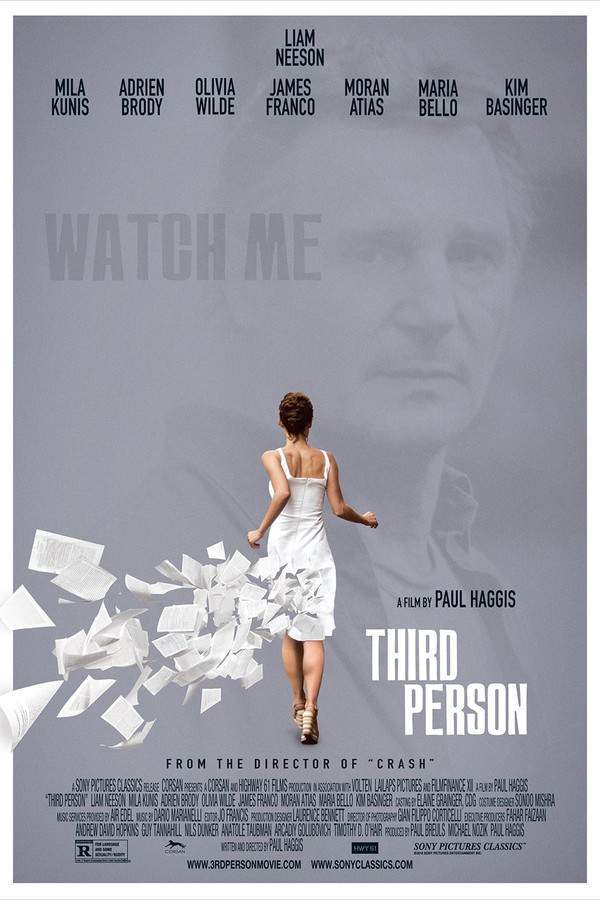
A celebrated novelist finds himself exploring the intricacies of love through three distinct stories. The film interweaves narratives of budding romance, intense passion, and heartbreaking conclusions, set against the vibrant backdrops of New York City, Paris, and Rome. Each story offers a unique perspective on the challenges and rewards of relationships, examining the moments that shape them.


Does Third Person have end credit scenes?
No!
Third Person does not have end credit scenes. You can leave when the credits roll.
Where to Watch Third Person
See current US streaming, rental, and purchase options for Third Person (2014) via JustWatch.

Howdy Amazon Channel
HD
Sony Pictures Core Amazon Channel
HD
Amazon Video
HD
Apple TV Store
HD
Fandango At Home
HD
Google Play Movies
SD
YouTube
SD Streaming availability powered by 
Meet the Full Cast and Actors of Third Person
Explore the complete cast of Third Person, including both lead and supporting actors. Learn who plays each character, discover their past roles and achievements, and find out what makes this ensemble cast stand out in the world of film and television.







External Links and Streaming Options
Discover where to watch Third Person online, including streaming platforms, rental options, and official sources. Compare reviews, ratings, and in-depth movie information across sites like IMDb, TMDb, Wikipedia or Rotten Tomatoes.










Ratings and Reviews for Third Person
See how Third Person is rated across major platforms like IMDb, Metacritic, and TMDb. Compare audience scores and critic reviews to understand where Third Person stands among top-rated movies in its genre.

38
Metascore
5.0
User Score


25%
TOMATOMETER

34%
User Score

6.3 /10
IMDb Rating
59
%
User Score

2.8
From 18 fan ratings

3.40/5
From 15 fan ratings
Full Plot Summary and Ending Explained for Third Person
Read the complete plot summary of Third Person, including all major events, twists, and the full ending explained in detail. Explore key characters, themes, hidden meanings, and everything you need to understand the story from beginning to end.
Three interconnected love stories unfold across three iconic settings—Paris, New York, and parts of Italy—each weaving romance with secrets, emotional conflict, and difficult choices. As the individual threads accumulate, it becomes clear that the film is more than a simple travelogue of relationships: most of the characters and events are imagined by a writer named Michael, who is drafting a novel while grieving the death of his son. The ideas he conjures up become a reflection of his own interior world, turning fiction and memory into a single, carefully arranged tapestry.
In Paris, Michael, a writer who has recently separated from his wife Elaine, finds himself drawn back into a fervent, complicated relationship with Anna, his lover. Their on/off dynamic is charged with passion, but Anna carries a terrible secret that complicates her capacity to commit. The allure of reunion is tempered by fear and distance, and the narrative gradually reveals that Anna is not merely a lover in Michael’s life but a character within the novel he is writing. Through their scenes, the film explores how longing can blur the lines between what is real and what is imagined, and how a writer might use an invented romance to process loss and guilt. The Paris chapters bloom with intimate conversations, silent understandings, and the ache of choices made and withheld, all set against the city’s elegant and shadowed streets that mirror Michael’s internal landscape.
Across the ocean in New York, Julia—an ex-soap opera actress who has become a hotel maid—faces a crisis that tests her strength and raises questions about truth, blame, and maternal love. She is accused of harming her young son, a charge she vehemently denies, and the drama shifts as her ex-husband Rick intensifies his fight to gain custody. The tension in this storyline stems from the precarious balance between public perception and private reality, as Julia fights to protect her relationship with her child while navigating the skepticism and legal maneuvering that accompany such accusations. The intensity of the custody battle reveals deeper themes: the fragility of trust, the resilience of a mother under siege, and the way fear can distort memory and motive. The New York episodes carry a blunt emotional honesty, contrasting with the dreamlike quality of the Paris segment yet remaining tethered to Michael’s overarching project—the way a writer returns to the same wounds from different angles to glimpse the truth beneath them.
In the Rome and Taranto sequence, Scott, an American businessman traveling through Italy, falls for Monika, a Romani woman whose world intersects with danger and a sense of urgency. The plot thickens as Scott becomes entangled in a perilous situation involving Monika’s daughter, who has been taken by an Italian gangster in Taranto and is held for ransom. As Scott is pulled deeper into this peril, the film threads questions of trust, fate, and the possibility that what he hopes to be a straightforward romance may be tested by a harsher reality. The Taranto act intensifies the mood with stakes that feel immediate and personal, foregrounding moral complexity and the emotional pull of rescue and protection in the face of coercion and crime. Yet, as with the other stories, the danger and tenderness are framed by the broader literary conceit: these experiences may be part of Michael’s fictional world, designed to probe how love can survive or unravel when threatened by secrets and manipulation.
The overarching structure binds these vignettes through a shared meditation on grief, memory, and the power of storytelling. The film continually invites viewers to question what is real and what is crafted, and it uses the different locales to reflect varied emotional tones—paradoxically intimate in Paris, raw and claustrophobic in New York, and high-stakes and cinematic in Italy. The characters’ journeys—whether about commitment with a reluctant partner, a mother’s fight for her child, or a man who chooses to risk everything for love—are presented with a steady, observational lens that favors nuance over melodrama. Emotions unfold in quiet moments of dialogue, in the tension of misunderstandings, and in the quiet resilience that surfaces when secrets come to light.
Throughout, the film maintains a neutral, contemplative mood, treating romance and danger as interconnected aspects of a single human experience. The writing-and-reality premise never veers into sensationalism; instead, it deepens the viewer’s awareness of how we assemble stories to cope with loss, and how those stories can illuminate connections between people who otherwise seem worlds apart. By the end, the audience is left with a richer understanding of Michael’s grief and creativity: a reminder that storytelling can be a bridge between memory and healing, between longing and truth, and between the lives we imagine and the lives we actually live.

Coming soon on iOS and Android
The Plot Explained Mobile App
From blockbusters to hidden gems — dive into movie stories anytime, anywhere. Save your favorites, discover plots faster, and never miss a twist again.
Sign up to be the first to know when we launch. Your email stays private — always.
Explore the mobile appWatch Trailers, Clips & Behind-the-Scenes for Third Person
Watch official trailers, exclusive clips, cast interviews, and behind-the-scenes footage from Third Person. Dive deeper into the making of the film, its standout moments, and key production insights.
Cars Featured in Third Person
Explore all cars featured in Third Person, including their makes, models, scenes they appear in, and their significance to the plot. A must-read for car enthusiasts and movie buffs alike.
Third Person Themes and Keywords
Discover the central themes, ideas, and keywords that define the movie’s story, tone, and message. Analyze the film’s deeper meanings, genre influences, and recurring concepts.
Third Person Other Names and Titles
Explore the various alternative titles, translations, and other names used for Third Person across different regions and languages. Understand how the film is marketed and recognized worldwide.
Similar Movies To Third Person You Should Know About
Browse a curated list of movies similar in genre, tone, characters, or story structure. Discover new titles like the one you're watching, perfect for fans of related plots, vibes, or cinematic styles.








Quick Links: Summary, Cast, Ratings, More

What's After the Movie?
Not sure whether to stay after the credits? Find out!
Check out our other apps:

SAT Sphere
Build confidence for the Digital SAT.

Mori Atlas
Discover wild places worth protecting.

Luntero
Search smarter for a home in Amsterdam.

Plot Explained
Unravel movie endings and hidden clues.

Pokechamp
Dive into Pokémon data and battle logic.

Driving Theory
Get ready for your European theory test.

Movie Dust
Plan your next cinema trip with ease.

Musemap
Find art and culture as you travel.

Selkobase
Compare credentials before committing.

Local Manual
Turn an unfamiliar country into practical next steps.

Lernavi
Compare school systems before your next move.

GymRoam
Find a workout stop wherever your plans take you.
Explore Our Movie Platform
New Movie Releases (2026)
Famous Movie Actors
Top Film Production Studios
Movie Plot Summaries & Endings
Major Movie Awards & Winners
Best Concert Films & Music Documentaries
Movie Collections and Curated Lists
© 2026 What's After the Movie. All rights reserved.
Privacy Policy