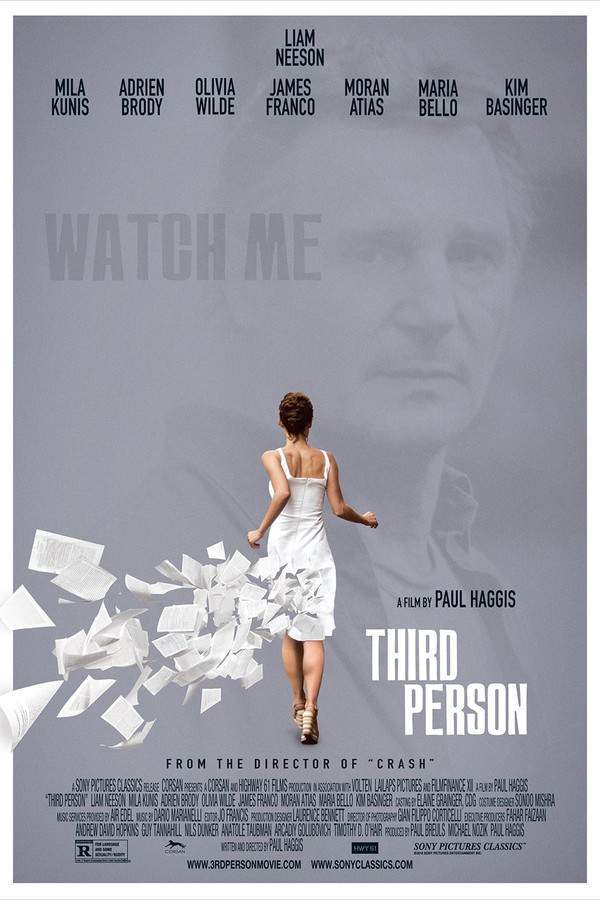
Third Person 2014


Directed by

Paul Haggis
Made by

Sony Pictures Classics
Where to Watch Third Person
See current US streaming, rental, and purchase options for Third Person (2014) via JustWatch.

Howdy Amazon Channel
HD
Sony Pictures Core Amazon Channel
HD
Amazon Video
HD
Apple TV Store
HD
Fandango At Home
HD
Google Play Movies
SD
YouTube
SD Streaming availability powered by 
Third Person Plot Summary
Read the complete plot summary and ending explained for Third Person (2014). From turning points to emotional moments, uncover what really happened and why it matters.
Three interconnected love stories unfold across three iconic settings—Paris, New York, and parts of Italy—each weaving romance with secrets, emotional conflict, and difficult choices. As the individual threads accumulate, it becomes clear that the film is more than a simple travelogue of relationships: most of the characters and events are imagined by a writer named Michael, who is drafting a novel while grieving the death of his son. The ideas he conjures up become a reflection of his own interior world, turning fiction and memory into a single, carefully arranged tapestry.
In Paris, Michael, a writer who has recently separated from his wife Elaine, finds himself drawn back into a fervent, complicated relationship with Anna, his lover. Their on/off dynamic is charged with passion, but Anna carries a terrible secret that complicates her capacity to commit. The allure of reunion is tempered by fear and distance, and the narrative gradually reveals that Anna is not merely a lover in Michael’s life but a character within the novel he is writing. Through their scenes, the film explores how longing can blur the lines between what is real and what is imagined, and how a writer might use an invented romance to process loss and guilt. The Paris chapters bloom with intimate conversations, silent understandings, and the ache of choices made and withheld, all set against the city’s elegant and shadowed streets that mirror Michael’s internal landscape.
Across the ocean in New York, Julia—an ex-soap opera actress who has become a hotel maid—faces a crisis that tests her strength and raises questions about truth, blame, and maternal love. She is accused of harming her young son, a charge she vehemently denies, and the drama shifts as her ex-husband Rick intensifies his fight to gain custody. The tension in this storyline stems from the precarious balance between public perception and private reality, as Julia fights to protect her relationship with her child while navigating the skepticism and legal maneuvering that accompany such accusations. The intensity of the custody battle reveals deeper themes: the fragility of trust, the resilience of a mother under siege, and the way fear can distort memory and motive. The New York episodes carry a blunt emotional honesty, contrasting with the dreamlike quality of the Paris segment yet remaining tethered to Michael’s overarching project—the way a writer returns to the same wounds from different angles to glimpse the truth beneath them.
In the Rome and Taranto sequence, Scott, an American businessman traveling through Italy, falls for Monika, a Romani woman whose world intersects with danger and a sense of urgency. The plot thickens as Scott becomes entangled in a perilous situation involving Monika’s daughter, who has been taken by an Italian gangster in Taranto and is held for ransom. As Scott is pulled deeper into this peril, the film threads questions of trust, fate, and the possibility that what he hopes to be a straightforward romance may be tested by a harsher reality. The Taranto act intensifies the mood with stakes that feel immediate and personal, foregrounding moral complexity and the emotional pull of rescue and protection in the face of coercion and crime. Yet, as with the other stories, the danger and tenderness are framed by the broader literary conceit: these experiences may be part of Michael’s fictional world, designed to probe how love can survive or unravel when threatened by secrets and manipulation.
The overarching structure binds these vignettes through a shared meditation on grief, memory, and the power of storytelling. The film continually invites viewers to question what is real and what is crafted, and it uses the different locales to reflect varied emotional tones—paradoxically intimate in Paris, raw and claustrophobic in New York, and high-stakes and cinematic in Italy. The characters’ journeys—whether about commitment with a reluctant partner, a mother’s fight for her child, or a man who chooses to risk everything for love—are presented with a steady, observational lens that favors nuance over melodrama. Emotions unfold in quiet moments of dialogue, in the tension of misunderstandings, and in the quiet resilience that surfaces when secrets come to light.
Throughout, the film maintains a neutral, contemplative mood, treating romance and danger as interconnected aspects of a single human experience. The writing-and-reality premise never veers into sensationalism; instead, it deepens the viewer’s awareness of how we assemble stories to cope with loss, and how those stories can illuminate connections between people who otherwise seem worlds apart. By the end, the audience is left with a richer understanding of Michael’s grief and creativity: a reminder that storytelling can be a bridge between memory and healing, between longing and truth, and between the lives we imagine and the lives we actually live.
Third Person Timeline
Follow the complete movie timeline of Third Person (2014) with every major event in chronological order. Great for understanding complex plots and story progression.
Michael leaves Elaine; Anna arrives
In Paris, Michael, a writer, has recently separated from his wife Elaine. He is visited by his lover Anna, whose presence rekindles a complicated on/off relationship. The encounter sets the stage for a story that blends past relationship dynamics with present longing.
Anna's commitment issues threaten the affair
Anna struggles to commit, driven by a terrible secret that keeps her emotionally distant. The couple's meetings become fraught with tension as promises waver and trust frays. Paris becomes a backdrop to their fragile, shifting attachment.
Michael writes Anna as a character in his novel
Michael channels his grief for his dead son by weaving Anna into a fictional world. He uses their imagined relationship to explore desire, guilt, and healing. The act of writing blurs the line between his life and the fiction he creates.
The novel reveals Anna as a fictional creation
As the story unfolds, it becomes clear that Anna is a character in Michael's own book, not a real person in his life. This revelation reframes their interactions as part of a constructed narrative. Michael confronts the possibility that his fiction mirrors his grief more than his reality.
Julia faces accusations and custody threat in New York
In New York, Julia, a former soap actress now working as a hotel maid, is accused of harming her young son. The charge casts a shadow over her ability to protect and care for him. The city watches as the case threatens to sever her parental rights.
Rick fights to keep the custody of the boy
Julia's ex-husband Rick is determined to win custody, leveraging every legal and personal angle he can. His efforts intensify the pressure on Julia and her son. The struggle highlights the fragility of trust within the broken family dynamic.
Julia strives to regain custody and prove innocence
Desperate to prove she is capable of parenting, Julia presses forward with her case and fights to clear her name. She navigates the system and the stigma of the accusation. The outcome remains uncertain as she fights for her son's future.
Scott meets Monika during an Italian trip
In Rome, an American businessman named Scott meets Monika, a Romani woman, and they fall in love amid an unfamiliar cultural landscape. The budding romance pulls Scott away from his routine and into a new emotional landscape. The relationship becomes the emotional core of the Taranto arc.
Monika's daughter is kidnapped in Taranto
Scott becomes entangled in a dangerous plot when Monika's daughter is kidnapped by an Italian gangster in Taranto. He moves to intervene, negotiating with criminals and racing against a ransom deadline. The stakes are personal and life-changing for everyone involved.
Scott questions whether the threat is real or a setup
As events escalate, Scott and the viewer wonder if the kidnapping plot is genuine or part of a larger manipulation. His fears grow as loyalties blur and trust is tested. The sense of danger is matched by his resolve to rescue Monika's daughter.
Cross-story resonance and meta awareness emerges
As the stories unfold, the film invites comparisons across Paris, New York, and Italy, suggesting shared themes of grief, love, and trust. Characters from the different settings echo each other in their struggles. The audience is nudged to look for connections beneath the surface of the three narratives.
The film reveals the imagined nature of the narratives
In a pivotal turn, it is revealed that most characters and storylines exist only in Michael's imagination as he writes a novel while grieving his son. The boundary between fiction and real life dissolves, reframing what the audience has watched. Michael confronts his own process of grieving and creation.
Third Person Characters
Explore all characters from Third Person (2014). Get detailed profiles with their roles, arcs, and key relationships explained.
Michael
A grieving writer who uses fiction to cope with the death of his son, drawing in parallel lives across Paris, New York and Italy through his novel. His on-page relationships with Anna reveal his desire to control reality as a means of processing loss. The character serves as the meta-narrator whose imagination drives the film's interconnected stories.
Anna
Michael's lover in Paris, whose relationship with him is tangled by a secret that prevents lasting commitment. She exists as a figure in Michael's novel, blurring the line between lover and fiction. Her portrayal explores desire, secrecy and the impossibility of simple trust.
Julia
An ex-soap actress turned hotel maid in New York who faces a custody battle and is accused of harming her son. Her arc examines public suspicion, motherhood, and resilience within a hostile system.
Rick
Julia's ex-husband, determined to win custody against her, representing legal and paternal anxieties in a high-stakes battle.
Scott
An American businessman traveling in Italy who falls in love with Monika and becomes entangled in a kidnapping plot that tests loyalty and trust.
Monika
A Romani woman whose relationship with Scott is tested by danger when her daughter is kidnapped by a gangster in Taranto.
Third Person Settings
Learn where and when Third Person (2014) takes place. Explore the film’s settings, era, and how they shape the narrative.
Location
Paris, New York, Rome, Taranto, Italy
The film unfolds across three major locales: Paris, New York, and Italian cities Rome and Taranto. Paris serves as the imagined stage for Michael's romance with Anna, while New York frames Julia's custody battle against a charged accusation. In Rome and Taranto, Scott's romance intersects with a dangerous kidnapping plot, creating a cross-continental tapestry that mirrors the film's themes of fiction and reality.
Third Person Themes
Discover the main themes in Third Person (2014). Analyze the deeper meanings, emotional layers, and social commentary behind the film.
🧩
Interconnected Narratives
Three love stories unfold in Paris, New York, and Italy, each reflecting different facets of desire and fear. The film positions Michael's writing as the lens through which the other stories exist, revealing that much of what we see may be imagined. The connection between fiction and life becomes a central tension as the characters cross into Michael's manuscript. The audience is invited to question what is real as the author processes his grief.
❤️
Love & Trust
Romance strains under secrecy and insecurity—Anna's inability to commit because of a terrible secret tests trust between lovers. Julia's fight to regain custody mirrors the fragility of family bonds when love is measured against law and stigma. Across the three stories, desire collides with fear, shaping choices and betrayals.
🕊️
Grief & Healing
Grief drives the narrative, with Michael using fiction to cope with the death of his son. The characters' quests for connection become attempts to fill the void left by loss. The film frames sorrow as a catalyst for transformation, forcing characters to confront what they cannot change. Healing emerges through storytelling, even as fiction blurs with reality.
🎭
Reality & Fiction
Anna appears as a character in Michael's imagined world, blurring the line between author and lover. The twist invites consideration of how narratives construct identities and motivations. The stories challenge the audience to separate truth from invention as the plot reveals its own fabrication. Ultimately, the film asks whether love can endure when the story itself is not what it seems.

Coming soon on iOS and Android
The Plot Explained Mobile App
From blockbusters to hidden gems — dive into movie stories anytime, anywhere. Save your favorites, discover plots faster, and never miss a twist again.
Sign up to be the first to know when we launch. Your email stays private — always.
Explore the mobile appThird Person Spoiler-Free Summary
Discover the spoiler-free summary of Third Person (2014). Get a concise overview without any spoilers.
In a lush tapestry of three cities, a celebrated novelist turns his own grief into a meditation on love, weaving together three distinct romances that pulse with the rhythm of Paris, New York, and Rome. The film moves between the breezy cafés of the French capital, the bustling streets and soaring skyscrapers of the American metropolis, and the sun‑kissed alleys of Italy, each setting breathing a different hue into the universal search for connection. With a tone that balances wistful introspection and vivid immediacy, the story invites the audience to feel the subtle tremors of attraction, the heat of longing, and the quiet ache of what might be lost.
In Paris, Michael finds himself tangled in a passionate on‑and‑off dance with his lover Anna. Their relationship is marked by an elusive promise and a secret that keeps them hovering at the edge of commitment. Against the backdrop of lantern‑lit boulevards and soft jazz, the pair navigate the delicate line between imagined desire and the yearning for something real, their conversations as intricate as the city’s winding streets.
Across the Atlantic, Julia, a former soap‑opera actress now working as a hotel maid, wrestles with the fragile balance of motherhood and personal redemption. Her world is one of quiet perseverance, where the looming presence of her ex‑husband Rick adds a layer of tension to her daily life. The New York setting, with its relentless energy and neon glow, mirrors the internal tug‑of‑war she feels as she strives to protect what matters most.
In Italy, Scott, an American businessman on a work trip, is drawn into an unexpected romance with Monika, a charismatic Romani woman. Their connection unfolds amid historic piazzas and the warm, chaotic heart of southern Italy, where love becomes intertwined with a sudden, urgent crisis that threatens to upend everything they thought they knew about each other. The Mediterranean backdrop accentuates a blend of fervent passion and the looming question of how far one will go when love collides with danger.
Movies with Similar Twists and Themes
Uncover films that echo the narrative beats, emotional arcs, or dramatic twists of the one you're exploring. These recommendations are handpicked based on story depth, thematic resonance, and spoiler-worthy moments — perfect for fans who crave more of the same intrigue.


Featured on this page

What's After the Movie?
Not sure whether to stay after the credits? Find out!
Check out our other apps:

SAT Sphere
Build confidence for the Digital SAT.

Mori Atlas
Discover wild places worth protecting.

Luntero
Search smarter for a home in Amsterdam.

Plot Explained
Unravel movie endings and hidden clues.

Pokechamp
Dive into Pokémon data and battle logic.

Driving Theory
Get ready for your European theory test.

Movie Dust
Plan your next cinema trip with ease.

Musemap
Find art and culture as you travel.

Selkobase
Compare credentials before committing.

Local Manual
Turn an unfamiliar country into practical next steps.

Lernavi
Compare school systems before your next move.

GymRoam
Find a workout stop wherever your plans take you.
Explore Our Movie Platform
New Movie Releases (2026)
Famous Movie Actors
Top Film Production Studios
Movie Plot Summaries & Endings
Major Movie Awards & Winners
Best Concert Films & Music Documentaries
Movie Collections and Curated Lists
© 2026 What's After the Movie. All rights reserved.
Privacy Policy