The Crime Is Mine 2023


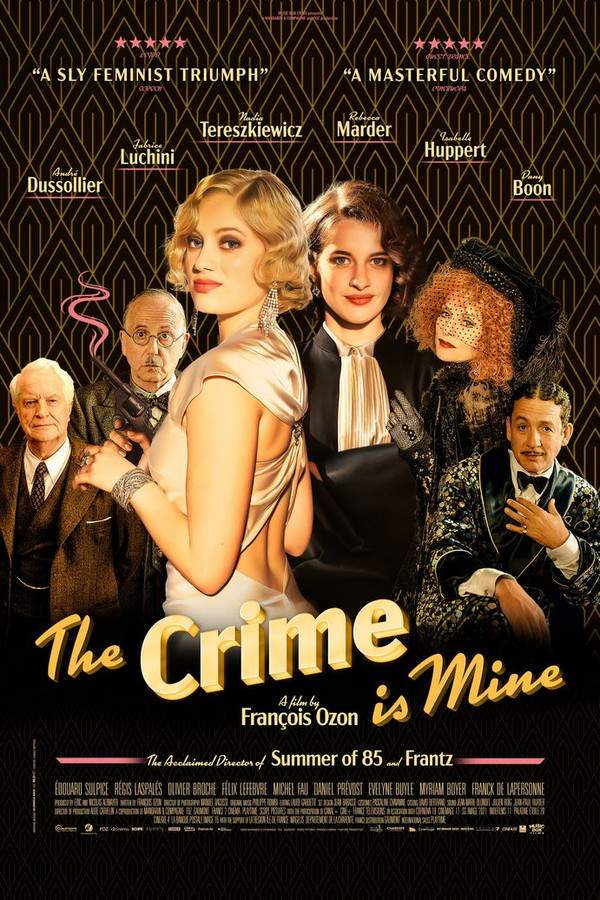
Set in 1930s Paris, the story follows Madeleine, a struggling actress, and Pauline, a talented but unemployed lawyer, as they grapple with poverty and desperation from their small apartment. Facing personal challenges, the two friends devise a plan that will challenge their morals and test their sense of humor.


Does The Crime Is Mine have end credit scenes?
No!
The Crime Is Mine does not have end credit scenes. You can leave when the credits roll.
Where to Watch The Crime Is Mine
See current US streaming, rental, and purchase options for The Crime Is Mine (2023) via JustWatch.

Amazon Prime Video
HD
Amazon Prime Video with Ads
HD
France Channel Amazon Channel
HD
OVID
SD
Darkroom
HD
Fawesome
HD
Hoopla
SD
JustWatch TV
HD
Kanopy
HD
YOW.tv
HD
Fandango at Home Free
HD
Plex
HD
Plex Channel
HD
Tubi TV
SD
Xumo Play
HD
Amazon Video
SD
Apple TV Store
HD Fandango At Home
SD
Google Play Movies
SD
YouTube
SD Streaming availability powered by 
Meet the Full Cast and Actors of The Crime Is Mine
Explore the complete cast of The Crime Is Mine, including both lead and supporting actors. Learn who plays each character, discover their past roles and achievements, and find out what makes this ensemble cast stand out in the world of film and television.

Dany Boon
Fernand Palmarède

Isabelle Huppert
Odette Chaumette

Olivier Broche
Léon Trapu, le greffier

André Dussollier
M. Bonnard

Myriam Boyer
Mme Jus, la concierge

Michel Fau
Le procureur Maurice Vrai
Félix Lefebvre
Gilbert Raton
Jean-Christophe Bouvet
Montferrand

Fabrice Luchini
Le juge Gustave Rabusset
Nadia Tereszkiewicz
Madeleine Verdier
Lucia Sanchez
Mme Alvarez

Rebecca Marder
Pauline Mauléon
Dominique Besnehard
Chef de rang restaurant
Édouard Sulpice
André Bonnard
Régis Laspalès
M. Brun
Franck de la Personne
Pistole
Evelyne Buyle
Simone Bernard
Daniel Prévost
M. Parvot, le Président des Assises
Suzanne De Baecque
Céleste, la domestique
Jean-Claude Bolle-Reddat
Emile Bouchard
External Links and Streaming Options
Discover where to watch The Crime Is Mine online, including streaming platforms, rental options, and official sources. Compare reviews, ratings, and in-depth movie information across sites like TMDb, Wikipedia, Rotten Tomatoes or Metacritic.









Ratings and Reviews for The Crime Is Mine
See how The Crime Is Mine is rated across major platforms like IMDb, Metacritic, and TMDb. Compare audience scores and critic reviews to understand where The Crime Is Mine stands among top-rated movies in its genre.

The Movie Echo Score
The Crime Is Mine delivers a stylish homage to 1930s French cinema, buoyed by vibrant costumes and a whimsical tone. While its direction and visual flair are praised, the film’s narrative often feels lightweight and its characters uneven, limiting emotional depth. Audience reactions split between delight in its frothy charm and criticism of its superficiality, resulting in a modest overall impression.
The Movie Echo Score Breakdown for The Crime Is Mine

Art & Craft
In terms of direction and visual craftsmanship, the film showcases a lively color palette and meticulous period design that evoke classic Hollywood glamour. Critics commend the polished cinematography and inventive set pieces, though some note a reliance on stylistic pastiche that can feel ornamental. The overall production values are strong, providing an appealing aesthetic framework.

Character & Emotion
When evaluating performances, Isabelle Huppert’s charismatic presence and the chemistry between the leads are frequently highlighted as strengths. Supporting actors bring a playful energy that supports the farcical tone. However, several reviewers find the characterizations shallow, with some roles reduced to single-note caricatures, diminishing emotional resonance. Consequently, acting merits are mixed, balancing notable highlights against broader inconsistency.

Story & Flow
The plot centers on a flamboyant legal farce, offering twists that aim to keep the audience engaged. Reviewers appreciate the clever situational set‑ups and occasional surprise reveals, yet many criticize the narrative as overly simplistic and at times convoluted, lacking a satisfying resolution. The storytelling therefore oscillates between entertaining bursts and uneven pacing, resulting in a mixed overall impact.

Sensory Experience
From a sensory perspective, the film’s soundtrack and sound design underscore its period setting, while the production design delivers lush costumes and detailed art direction. Critics note the effective use of vintage French musical cues that enhance the whimsical mood. Nevertheless, some feel the audio elements are occasionally over‑styled, and the visual flair can distract from narrative focus. Overall, the sensory experience is polished but not uniformly essential.

Rewatch Factor
Replay value hinges on the film’s surface charm and period aesthetics, which some viewers find endlessly enjoyable. Yet the thin plot and uneven character work limit lasting appeal, leading many to consider the movie a pleasant one‑off experience rather than a repeated viewing. Consequently, its rewatch factor is modest, offering occasional delight but lacking strong incentive for frequent returns.

74
Metascore
6.3
User Score


98%
TOMATOMETER

90%
User Score

65
%
User Score

/5
Take the Ultimate The Crime Is Mine Movie Quiz
Challenge your knowledge of The Crime Is Mine with this fun and interactive movie quiz. Test yourself on key plot points, iconic characters, hidden details, and memorable moments to see how well you really know the film.
The Crime Is Mine Quiz: Test your knowledge about the 2023 film 'The Crime is Mine' with this engaging quiz!
What year does the story take place?
Full Plot Summary and Ending Explained for The Crime Is Mine
Read the complete plot summary of The Crime Is Mine, including all major events, twists, and the full ending explained in detail. Explore key characters, themes, hidden meanings, and everything you need to understand the story from beginning to end.
In the heart of Paris during 1935, the story unfolds around Madeleine Verdier, a struggling actress mired in financial despair and living in a cramped attic with her relentless friend, Pauline Mauléon. A dedicated lawyer aiming for success, Pauline’s commitment to her career often leaves little room for a personal life. On the other hand, Madeleine’s romantic link to André Bonnard—the son of a wealthy tire magnate—is tumultuous, lacking depth and overshadowed by financial allegiance.
As luck would have it, a meeting with the influential theater producer Montferrand leads to a disastrous proposition for Madeleine: to accept a meager acting role in exchange for becoming his mistress. With courage, she declines the offer and returns to her unfulfilling relationship with André, who is fixated on marrying a wealthy heiress while casually treating Madeleine as his mistress—an arrangement that leaves her despondent.
Things take a dark turn when an unexpected visit from Brun, a stern security inspector, brings shocking news: Montferrand has been murdered, and Madeleine is named the prime suspect. Judge Gustave Rabusset immediately assumes her guilt, pressuring her to confess. Amidst this chaos, Madeleine initially maintains her innocence but finally considers a plea of self-defense when hinted by Rabusset that it might lead to her freedom.
With Pauline by her side, Madeleine’s defense transforms into an insistent criticism of the societal injustices against women. In a poignant moment, she channels her pain into a heartfelt performance of the outraged woman, a role crafted by Pauline. Captivating the courtroom, Madeleine’s emotional appeal resonates deeply, culminating in a verdict of not guilty. The audience, especially the women present, are moved to tears as the excitement fills the room.
After her acquittal, Madeleine rises to stardom, while Pauline earns respect in her legal career. They leave behind their modest living conditions for a lavish hotel in Boulogne. Meanwhile, André, infatuated with Madeleine, contemplates abandoning his wealthy fiancée to be with her, a move staunchly opposed by his father.
Just as their lives seem to stabilize, the unexpected reappearance of Odette Chaumette, a faded silent film star, disturbs their newfound peace. Odette accuses Madeleine of stealing her narrative regarding Montferrand’s murder and demands compensation for her silence. In a twist, she claims the murder for herself and threatens to expose the truth—a move that fails when Rabusset, now rising in his career, dismisses her claims unless fresh evidence arises.
As Odette’s threats intensify, Madeleine seeks the help of Fernand Palmarède, an architect who recently gained a life annuity from Montferrand’s estate. She persuades him to invest in André’s father’s floundering business, cleverly presenting it as a bail-out to get André’s family’s support for their relationship. Ultimately, the deal tempers André’s father’s opposition, allowing him to agree to the marriage proposal while silencing Odette through financial negotiation.
In a dramatic climax, Odette secures a leading role in the play that Madeleine stars in. During a performance reenacting Montferrand’s demise, she dramatically portrays his ‘murder’ to protect Madeleine, who once again is portrayed as a victim caught in an unforgiving narrative twist.

Coming soon on iOS and Android
The Plot Explained Mobile App
From blockbusters to hidden gems — dive into movie stories anytime, anywhere. Save your favorites, discover plots faster, and never miss a twist again.
Sign up to be the first to know when we launch. Your email stays private — always.
Explore the mobile appWatch Trailers, Clips & Behind-the-Scenes for The Crime Is Mine
Watch official trailers, exclusive clips, cast interviews, and behind-the-scenes footage from The Crime Is Mine. Dive deeper into the making of the film, its standout moments, and key production insights.
The Crime Is Mine Other Names and Titles
Explore the various alternative titles, translations, and other names used for The Crime Is Mine across different regions and languages. Understand how the film is marketed and recognized worldwide.
Quick Links: Summary, Cast, Ratings, More

What's After the Movie?
Not sure whether to stay after the credits? Find out!
Check out our other apps:

SAT Sphere
Build confidence for the Digital SAT.

Mori Atlas
Discover wild places worth protecting.

Luntero
Search smarter for a home in Amsterdam.

Plot Explained
Unravel movie endings and hidden clues.

Pokechamp
Dive into Pokémon data and battle logic.

Driving Theory
Get ready for your European theory test.

Movie Dust
Plan your next cinema trip with ease.

Musemap
Find art and culture as you travel.

Selkobase
Compare credentials before committing.

Local Manual
Turn an unfamiliar country into practical next steps.

Lernavi
Compare school systems before your next move.

GymRoam
Find a workout stop wherever your plans take you.
Explore Our Movie Platform
New Movie Releases (2026)
Famous Movie Actors
Top Film Production Studios
Movie Plot Summaries & Endings
Major Movie Awards & Winners
Best Concert Films & Music Documentaries
Movie Collections and Curated Lists
© 2026 What's After the Movie. All rights reserved.
Privacy Policy