Mile End Kicks 2026


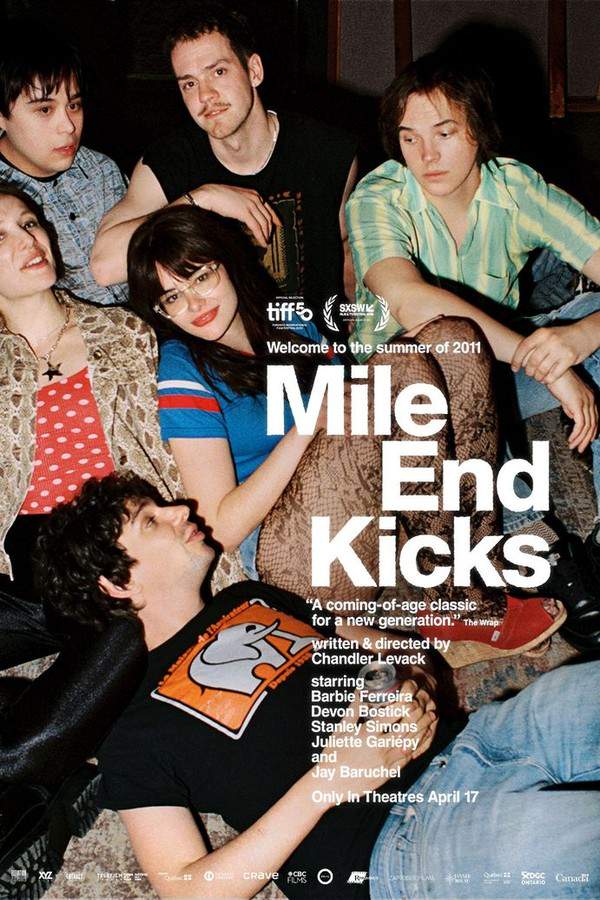
Directed by Chandler Levack, known for I Like Movies, this bright romantic comedy follows Grace (Barbie Ferreira), a budding music critic who uproots herself to Montreal in hopes of sorting out her career path and her love life, navigating the city’s artistic pulse with humor and heart.


Does Mile End Kicks have end credit scenes?
No!
Mile End Kicks does not have end credit scenes. You can leave when the credits roll.
Where to Watch Mile End Kicks
See current US streaming, rental, and purchase options for Mile End Kicks (2026) via JustWatch.

Netflix
4K
Netflix Standard with Ads
HD
Amazon Video
4K
Apple TV Store
4K
Fandango At Home
4K
Google Play Movies
SD
Plex
HD
YouTube
SD Streaming availability powered by 
Meet the Full Cast and Actors of Mile End Kicks
Explore the complete cast of Mile End Kicks, including both lead and supporting actors. Learn who plays each character, discover their past roles and achievements, and find out what makes this ensemble cast stand out in the world of film and television.




External Links and Streaming Options
Discover where to watch Mile End Kicks online, including streaming platforms, rental options, and official sources. Compare reviews, ratings, and in-depth movie information across sites like IMDb, Wikipedia, Rotten Tomatoes or Metacritic.







Ratings and Reviews for Mile End Kicks
See how Mile End Kicks is rated across major platforms like IMDb, Metacritic, and TMDb. Compare audience scores and critic reviews to understand where Mile End Kicks stands among top-rated movies in its genre.

The Movie Echo Score
Mile End Kicks presents a modestly appealing indie coming-of-age portrait that resonates more with its target demographic than with broader audiences. Critics highlight the film’s sharp script, authentic performances and nostalgic sense of 2011 Montreal, while several user reviews praise its humor and relatability. Conversely, a minority of viewers find the protagonist unlikable and the narrative uneven. The combined feedback positions the film as a solid, if slightly uneven, entry that rewards viewers attuned to its tone.
The Movie Echo Score Breakdown for Mile End Kicks

Art & Craft
In terms of direction and visual craftsmanship, the film demonstrates a confident indie sensibility. Critics commend Levack’s sharp screenplay and measured pacing, noting a cohesive aesthetic that aligns with the 2011 Montreal setting. Some user feedback points to occasional editing jumps that disrupt flow, yet overall the production design and cinematography are regarded as purposeful and supportive of the narrative.

Character & Emotion
When it comes to character work, the lead performance is widely praised for its vulnerability and relatability, with critics describing it as a devastating and believable portrayal. Supporting actors receive acknowledgment for adding depth, though a segment of viewers find the protagonist’s choices off‑putting and the character unlikable. Overall, the ensemble succeeds in delivering emotional resonance despite divergent audience reactions.

Story & Flow
The narrative blends familiar coming‑of‑age beats with a quieter, character‑driven conclusion. Critics note that while the plot can feel formulaic, it avoids a grand romantic climax, favoring a resonant ending that many find heartfelt. User comments highlight relatable themes and nostalgic references, though some point to pacing issues and a perceived messiness that hampers cohesion. In sum, the story offers an earnest but occasionally uneven journey.

Sensory Experience
Regarding sensory experience, the film captures the indie music scene of early‑2010s Montreal through its soundtrack and production design, which many viewers find evocative and nostalgic. Critics describe the visual style as familiar yet fresh, complementing the tonal shifts. Some audience members note abrupt scene transitions and occasional over‑reliance on sexual content, slightly detracting from immersion. Overall, the sensory elements reinforce the film’s mood despite minor inconsistencies.

Rewatch Factor
The rewatch factor appears strong among viewers who identify with the setting and characters, with several users explicitly stating they would watch again. Positive sentiment around humor, nostalgic world‑building and authentic performances supports repeatability. However, the polarized reactions to the protagonist and uneven pacing may limit appeal for some. Consequently, the film offers decent replay value for its fan base while remaining less compelling for broader audiences.

72
Metascore
6.5
User Score


%
TOMATOMETER

0%
User Score
Full Plot Summary and Ending Explained for Mile End Kicks
Read the complete plot summary of Mile End Kicks, including all major events, twists, and the full ending explained in detail. Explore key characters, themes, hidden meanings, and everything you need to understand the story from beginning to end.
Grace Pine, a 22-year-old music critic working for Merge Weekly in Toronto, heads to Montreal for the summer to write a quirky, intimate 33 1/3 book about Alanis Morissette’s Jagged Little Pill. She finds a cluttered apartment in the Mile End neighborhood with a roommate named Madeleine, a local DJ who shares the space with her boyfriend, Hugo Côté, the drummer for the rising indie rock band Bone Patrol. Grace pitches her project to New York editor Phoebe Reilly via Skype, and a publishing deal soon follows, along with a modest $500 advance that she cautiously accepts as a foothold in a city that feels both thrilling and overwhelming. The arrangement sets a rhythm for the summer that will test her ambitions, her finances, and her tolerance for the messy realities of artistic pursuit.
On Grace’s first night in Montreal, Madeleine invites her to a loft party where she is DJing. There, Grace meets Archie Webber, the sensitive, winsome guitarist for Bone Patrol, and they spark a quick, hazy bond after they share some marijuana. Grace watches Bone Patrol perform and is immediately drawn to Chevy Olsen, the band’s lead singer, whose pretentious veneer irritates as much as it fascinates. The two strike up a hesitant, awkward conversation after the show, and despite Madeleine’s warning that Chevy is far from easy, Grace is unable to ignore the pull she feels toward him. After the party, Grace and Archie head home together and discover they are next-door neighbors, a coincidence that adds a new layer of tension to Grace’s otherwise careful, professional plan for Montreal.
Grace invites Archie to become more than a bystander in her life, hoping for a familiar, almost cinematic connection. Archie, however, is celibate for personal reasons, and his restraint introduces a balancing edge to their growing proximity. Meanwhile, Grace’s day-to-day life in Mile End expands as she wanders into the neighborhood, including a quick stop at the nearby Kicks shoe store, where Chevy works a day job. When Chevy mentions Bone Patrol’s debut EP, Grace offers to take on the role of publicist, a proposition that Chevy accepts with a measured optimism that hints at trouble ahead.
The narrative then shifts to Grace’s financial reality. With no money in her bank account, she emails Jeff—the former Merge editor she had a complicated past with—about the $4,000 he owes her. A flashback reveals their complicated relationship, including an affair, which adds an embittered layer to her current professional anxieties. For a while, Grace sets aside her Alanis Morissette project to craft a review of Bone Patrol’s debut EP for the Montreal Mirror, using the piece to test how far she can push her voice in a male-dominated music scene. She even tries to spark something with Chevy in her apartment, but their chemistry remains fraught; he suggests keeping things strictly professional, a boundary that Grace is reluctant to honor.
The tension spikes at a loft party where Grace is meant to read an excerpt from her Alanis book as part of a poetry reading. Archie quietly advises her to proceed with confidence, but Grace reads nothing and instead leaves with Chevy, stepping into a different kind of risk. The moment has consequences back home: a voicemail from Phoebe informs Grace that her contract has been terminated due to poor communication, and the sting of that message lands hard as she listens in tears. Madeleine scolds her for being selfish, reminding Grace that she owes rent for two months. The emotional weight of the rejection and the rent ultimatum hits Grace at once, and she finds herself at a crossroads between pursuit and practicality.
Archie later explains that he is celibate because of an oral herpes diagnosis, but he also confesses his lingering feelings for Grace. When she reveals that she has been seeing Chevy, Archie blurts out the biting truth that Chevy had called her a “cum dumpster” during the poetry reading. The blunt insult lands with a wrenching clarity, and the moment crystallizes the cost of Grace’s pursuit of romance in a city where power dynamics often blur ethical lines. The confrontation leaves Grace feeling defeated, prompting her to return to Toronto and confront Jeff about both his treatment of her and the unpaid funds she’s owed.
Yet the story doesn’t end there. Grace returns to Montreal for Bone Patrol’s EP launch, where she makes amends with Madeleine, paying off the rent she owed. Chevy makes a last, awkward romantic gesture, but Grace pushes back, telling him to “fuck off” and asserting a hard-won boundary. In a quieter, more intimate moment, she delivers a reading about her experiences as a female music critic navigating a field dominated by men, a piece that reframes her journey as much as it reveals the toll of ambition on personal life.
Before she heads home to Toronto for the final time, Grace spends a day with Archie, riding around in the Bone Patrol van as they drift toward a sense of possibility. The two share a kiss and a charged moment of potential, leaving their future open but rooted in the honest, messy momentum of what they’ve just endured together. The summer in Montreal, with its blend of creative fever, romance, disappointment, and resilience, leaves Grace listening to the music she’s chasing with new ears and a more tempered sense of what it means to write about life as it unfolds.
“cum dumpster”
The season’s hot mess and bright discoveries collide in this observant, candid portrait of a young critic trying to chart her own voice while negotiating love, jealousy, debt, and the unpredictable tempo of a creative city.

Coming soon on iOS and Android
The Plot Explained Mobile App
From blockbusters to hidden gems — dive into movie stories anytime, anywhere. Save your favorites, discover plots faster, and never miss a twist again.
Sign up to be the first to know when we launch. Your email stays private — always.
Explore the mobile appDiscover Film Music Concerts Near You – Live Orchestras Performing Iconic Movie Soundtracks
Immerse yourself in the magic of cinema with live orchestral performances of your favorite film scores. From sweeping Hollywood blockbusters and animated classics to epic fantasy soundtracks, our curated listings connect you to upcoming film music events worldwide.
Explore concert film screenings paired with full orchestra concerts, read detailed event information, and secure your tickets for unforgettable evenings celebrating legendary composers like John Williams, Hans Zimmer, and more.


Mile End Kicks Other Names and Titles
Explore the various alternative titles, translations, and other names used for Mile End Kicks across different regions and languages. Understand how the film is marketed and recognized worldwide.
Articles, Reviews & Explainers About Mile End Kicks
Stay updated on Mile End Kicks with in-depth articles, critical reviews, and ending explainers. Explore hidden meanings, major themes, and expert insights into the film’s story and impact.

Quick Links: Summary, Cast, Ratings, More

What's After the Movie?
Not sure whether to stay after the credits? Find out!
Check out our other apps:

SAT Sphere
Build confidence for the Digital SAT.

Mori Atlas
Discover wild places worth protecting.

Luntero
Search smarter for a home in Amsterdam.

Plot Explained
Unravel movie endings and hidden clues.

Pokechamp
Dive into Pokémon data and battle logic.

Driving Theory
Get ready for your European theory test.

Movie Dust
Plan your next cinema trip with ease.

Musemap
Find art and culture as you travel.

Selkobase
Compare credentials before committing.

Local Manual
Turn an unfamiliar country into practical next steps.

Lernavi
Compare school systems before your next move.

GymRoam
Find a workout stop wherever your plans take you.
Explore Our Movie Platform
New Movie Releases (2026)
Famous Movie Actors
Top Film Production Studios
Movie Plot Summaries & Endings
Major Movie Awards & Winners
Best Concert Films & Music Documentaries
Movie Collections and Curated Lists
© 2026 What's After the Movie. All rights reserved.
Privacy Policy