Churchill 2017


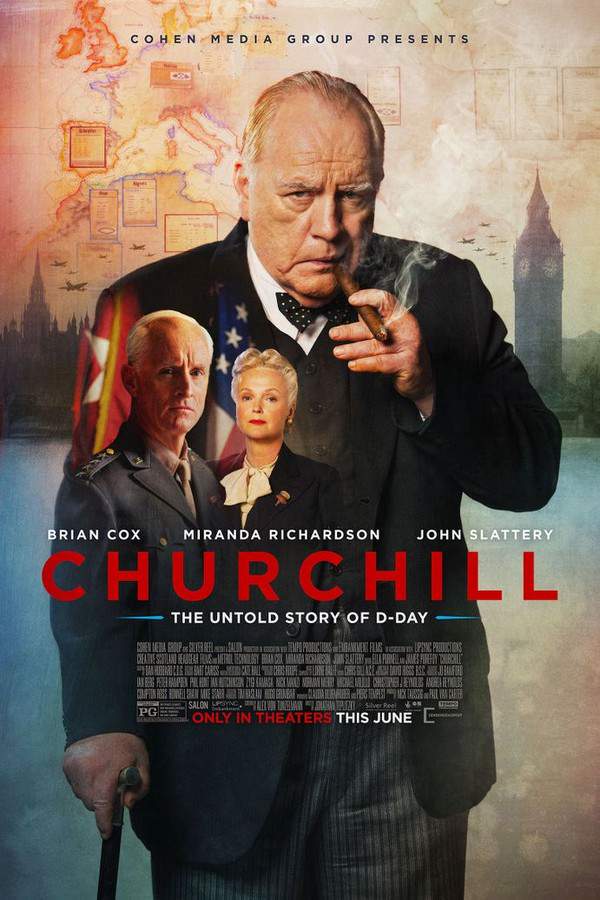
In June 1944, as Allied forces planned the invasion of Europe, a weary Winston Churchill faced a critical moment. Haunted by the disastrous Gallipoli campaign and battling depression and exhaustion, he grappled with doubts that threatened to derail the mission and define his legacy. Supported by his wife Clementine, Churchill wrestled with a momentous decision that would determine the fate of countless lives and shape his place in history.

Does Churchill have end credit scenes?
No!
Churchill does not have end credit scenes. You can leave when the credits roll.
Where to Watch Churchill
See current US streaming, rental, and purchase options for Churchill (2017) via JustWatch.

Amazon Prime Video
HD
Amazon Prime Video with Ads
HD
Cohen Media Amazon Channel
HD
Fawesome
HD
Kanopy
HD
Fandango at Home Free
HD
The Roku Channel
HD
Tubi TV
SD
Amazon Video
SD
Apple TV Store
HD Fandango At Home
SD
Google Play Movies
SD
YouTube
SD Streaming availability powered by 
Meet the Full Cast and Actors of Churchill
Explore the complete cast of Churchill, including both lead and supporting actors. Learn who plays each character, discover their past roles and achievements, and find out what makes this ensemble cast stand out in the world of film and television.








External Links and Streaming Options
Discover where to watch Churchill online, including streaming platforms, rental options, and official sources. Compare reviews, ratings, and in-depth movie information across sites like IMDb, TMDb, Wikipedia or Rotten Tomatoes.










Ratings and Reviews for Churchill
See how Churchill is rated across major platforms like IMDb, Metacritic, and TMDb. Compare audience scores and critic reviews to understand where Churchill stands among top-rated movies in its genre.

The Movie Echo Score
Overall, Churchill delivers a compelling central performance and polished visual presentation but is hindered by a simplistic narrative and uneven pacing. Critics and viewers alike note Brian Cox’s commanding portrayal and the film’s thoughtful use of composition and period detail. However, the screenplay’s limited scope and repeated debates create a somewhat stagebound feel that curtails dramatic momentum. The sensory elements add polish, yet the overall engagement and rewatch potential remain modest. In sum, a mixed but occasionally rewarding experience.
The Movie Echo Score Breakdown for Churchill

Art & Craft
In terms of art and craft, Churchill benefits from controlled visual compositions and period-appropriate design. Observers highlight strong cinematography with balanced contrast and an understated color palette that underscores narrative tension. Production design effectively evokes the war era without distracting from character focus. While the editing maintains clarity in dialogue scenes, the overall staging sometimes feels static. Overall, the film’s visual execution is polished yet occasionally restrained.

Character & Emotion
When it comes to character and emotion, the film is anchored by Brian Cox’s nuanced turn as Churchill. Reviewers consistently praise his portrayal of both defiance and doubt, lending depth to the subject. Supporting performances and character interactions receive moderate acknowledgment but rarely match the lead’s intensity. Emotional resonance is present but is unevenly distributed across scenes. In total, the character work shines primarily through its central performance.

Story & Flow
In terms of story and flow, Churchill struggles with a narrow focus and episodic structure. Critics note a script that relies heavily on repeated debates and simplified backdrops, lending the film a stagebound atmosphere. Pacing is often described as stately but lacking urgency, which impacts engagement. While thematic points about leadership emerge, narrative momentum falters. Ultimately, the plot coherence and originality remain limited.

Sensory Experience
When it comes to sensory experience, Churchill offers a restrained yet effective audiovisual presentation. The score and soundtrack are described as elegant without overwhelming the drama. Cinematography frequently uses contrast and depth to highlight emotional stakes, and sound design supports rather than distracts. Visual style remains cohesive, with measured use of lighting and composition. Overall, the film’s sensory elements are polished and complementary to the narrative.

Rewatch Factor
In terms of rewatch factor, Churchill presents a mixed proposition. Brian Cox’s performance and select visual moments hold appeal for repeat viewing, but the narrative’s limited scope and deliberate pacing reduce overall replay value. The scarcity of dramatic high points and the film’s stagebound feel may deter further viewings for general audiences. On balance, rewatch potential is modest, confined primarily to performance enthusiasts.

44
Metascore
6.1
User Score


49%
TOMATOMETER

54%
User Score

6.0 /10
IMDb Rating

62
%
User Score

3.5
From 504 fan ratings

4.14/5
From 14 fan ratings
Take the Ultimate Churchill Movie Quiz
Challenge your knowledge of Churchill with this fun and interactive movie quiz. Test yourself on key plot points, iconic characters, hidden details, and memorable moments to see how well you really know the film.
Winston Churchill: D-Day Decisions: Test your knowledge on the complex leadership of Winston Churchill during the critical days leading up to the D-Day invasion.
Who played the role of Winston Churchill in the movie?
Full Plot Summary and Ending Explained for Churchill
Read the complete plot summary of Churchill, including all major events, twists, and the full ending explained in detail. Explore key characters, themes, hidden meanings, and everything you need to understand the story from beginning to end.
June 1944 marks a pivotal moment. The Allied Forces are on the edge of a major operation, amassing a colossal force on the southern shores of Britain, ready to reclaim Nazi-occupied Europe. Yet, one individual stands as a formidable barrier: Winston Churchill (Brian Cox).
Behind the legendary leader’s inspiring speeches lies a man grappling with political mockery, military setbacks, and a speech impediment. Burdened by impulsivity and a domineering nature, Churchill is racked with fear and obsession over the ghosts of past failures, particularly the catastrophic events at Gallipoli in 1915, where countless young lives were lost on the beaches.
Assisting him through this tumultuous period is his secretary, Helen Garrett (Ella Purnell). Consumed by the hope of securing a legendary legacy, Churchill suffers from the weight of his own ambitions. The years of war have drained him, leaving behind a shadow of the fearless figure who once stood against Hitler’s onslaught. With the looming threat of D-Day, he is haunted by the idea that if the mission fails, history may label him as the orchestrator of disaster.
As opposition mounts, General Eisenhower (John Slattery) and Field Marshal Montgomery (Julian Wadham) grow increasingly exasperated with Churchill’s interventionist tactics. Churchill argues passionately that to secure the beaches of Normandy, Allied forces must commit 250,000 men, 7,000 ships, and numerous aircraft, aware that an unsuccessful invasion could lead to Germany setting its sights on Britain. However, as Alan Brooke (Danny Webb), the chief of staff for British forces, finds himself needing to arrange a discussion between Churchill and Eisenhower, the tension escalates.
The discourse between the two men quickly devolves into a verbal sparring match, with Eisenhower bluntly stating that Churchill’s strategies are out of step with modern warfare. Disheartened by his diminishing authority, Churchill’s frustration is palpable, especially as he takes his ire out on those closest to him, including his wife, Clementine (Miranda Richardson). It ultimately falls to King George VI (James Purefoy) to intervene, reminding Churchill that only Clementine’s steadfast support can prevent his personal and professional unraveling.
As the countdown to the World War II invasion of Normandy ticks ominously—only 96 hours remain—Churchill battles intense doubts regarding Operation Overlord and his waning influence in military strategy. His prompts to Eisenhower and Brooke are ignored, leading to an eruption of frustration towards his staff and loved ones. Faced with opposition, Churchill proposes a dramatic gesture: he and the King should accompany the troops aboard HMS Belfast for the invasion, a suggestion that riles Eisenhower.
With only 48 hours to go before D-Day, a critical meeting unfolds—deciding whether to proceed or postpone based on unpredictable weather conditions. The Navy is determined to launch, while the Air Force hesitates due to the stormy forecast. Ultimately, Eisenhower opts for a 24-hour delay, hoping for better conditions.
Clementine plays a crucial role in keeping Churchill grounded, preventing him from spiraling further into despair and jeopardizing his legacy. Amidst his growing bitterness and objections to the invasion, a poignant moment arrives when Helen expresses her heartbreak over the potential death of her fiancé, who is among the D-Day participants. This heartfelt plea resonates with Churchill, prompting a significant shift in his perspective.
As the dawn of D-Day arrives with a favorable forecast, Churchill rises to the occasion, delivering one of his most stirring speeches, honoring the heroism of Allied forces and reaffirming his commitment to lead England through the impending dangers, including the new threat of V-8 rockets from Germany. In a touching resolution, he reconciles with Clementine, and they cherish the remainder of their lives together, highlighting the profound bond that fueled his remarkable endeavors during one of history’s most critical junctures.

Coming soon on iOS and Android
The Plot Explained Mobile App
From blockbusters to hidden gems — dive into movie stories anytime, anywhere. Save your favorites, discover plots faster, and never miss a twist again.
Sign up to be the first to know when we launch. Your email stays private — always.
Explore the mobile appWatch Trailers, Clips & Behind-the-Scenes for Churchill
Watch official trailers, exclusive clips, cast interviews, and behind-the-scenes footage from Churchill. Dive deeper into the making of the film, its standout moments, and key production insights.
Cars Featured in Churchill
Explore all cars featured in Churchill, including their makes, models, scenes they appear in, and their significance to the plot. A must-read for car enthusiasts and movie buffs alike.
Churchill Themes and Keywords
Discover the central themes, ideas, and keywords that define the movie’s story, tone, and message. Analyze the film’s deeper meanings, genre influences, and recurring concepts.
Churchill Other Names and Titles
Explore the various alternative titles, translations, and other names used for Churchill across different regions and languages. Understand how the film is marketed and recognized worldwide.
Similar Movies To Churchill You Should Know About
Browse a curated list of movies similar in genre, tone, characters, or story structure. Discover new titles like the one you're watching, perfect for fans of related plots, vibes, or cinematic styles.






Quick Links: Summary, Cast, Ratings, More

What's After the Movie?
Not sure whether to stay after the credits? Find out!
Check out our other apps:

SAT Sphere
Build confidence for the Digital SAT.

Mori Atlas
Discover wild places worth protecting.

Luntero
Search smarter for a home in Amsterdam.

Plot Explained
Unravel movie endings and hidden clues.

Pokechamp
Dive into Pokémon data and battle logic.

Driving Theory
Get ready for your European theory test.

Movie Dust
Plan your next cinema trip with ease.

Musemap
Find art and culture as you travel.

Selkobase
Compare credentials before committing.

Local Manual
Turn an unfamiliar country into practical next steps.

Lernavi
Compare school systems before your next move.

GymRoam
Find a workout stop wherever your plans take you.
Explore Our Movie Platform
New Movie Releases (2026)
Famous Movie Actors
Top Film Production Studios
Movie Plot Summaries & Endings
Major Movie Awards & Winners
Best Concert Films & Music Documentaries
Movie Collections and Curated Lists
© 2026 What's After the Movie. All rights reserved.
Privacy Policy