Logo What's After the Movie

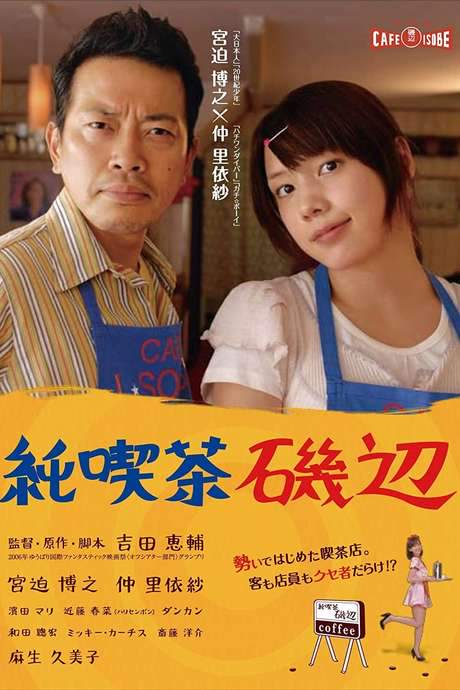
Cafe Isobe 2008

Runtime

113 mins

Language

Japanese

Japanese

Sakiko, a typical teenage girl, despises her divorced, womanizing father. When he unexpectedly inherits a fortune and becomes lazy, he opens a café, forcing Sakiko to work there. As they navigate eccentric customers and attractive waitresses, their strained father‑daughter relationship is tested, blending humor with coming‑of‑age tension.

Sakiko, a typical teenage girl, despises her divorced, womanizing father. When he unexpectedly inherits a fortune and becomes lazy, he opens a café, forcing Sakiko to work there. As they navigate eccentric customers and attractive waitresses, their strained father‑daughter relationship is tested, blending humor with coming‑of‑age tension.

Does Cafe Isobe have end credit scenes?

No!

Cafe Isobe does not have end credit scenes. You can leave when the credits roll.

Meet the Full Cast and Actors of Cafe Isobe

Explore the complete cast of Cafe Isobe, including both lead and supporting actors. Learn who plays each character, discover their past roles and achievements, and find out what makes this ensemble cast stand out in the world of film and television.


Take the Ultimate Cafe Isobe Movie Quiz

Challenge your knowledge of Cafe Isobe with this fun and interactive movie quiz. Test yourself on key plot points, iconic characters, hidden details, and memorable moments to see how well you really know the film.


Cafe Isobe Quiz: Test your knowledge of the 2008 film Cafe Isobe with these 10 questions ranging from easy to difficult.

What is Yujiro's occupation before he opens the coffee shop?

Full Plot Summary and Ending Explained for Cafe Isobe

See more

Read the complete plot summary of Cafe Isobe, including all major events, twists, and the full ending explained in detail. Explore key characters, themes, hidden meanings, and everything you need to understand the story from beginning to end.


Yujiro Isobe, [Hiroyuki Miyasako](/ actor/hiroyuki-miyasako) is a 39-year-old steeplejack who carries the weight of a broken family. Divorced, he coexists with his daughter Sakiko Isobe, Riisa Naka, a diligent high school junior who handles most of the housework and quietly absorbs her father’s drifting habits. Mugiko, Mari Hamada, Yujiro’s ex-wife, lives nearby and works at a bar, and Sakiko often sneaks in for a glimpse of the mother she loves. The family dynamics are tender and frayed, grounded in care even as friction threads grow thicker.

When Yujiro’s father dies, a hidden inheritance appears, the amount left unspecified in the records but enough to unsettle the ordinary logic of responsibility. The shock loosens Yujiro’s grip on his routine: he stops going to work and instead spends each night at a cabaret club, where the clock seems to slow and the world narrows to the neon glow and the conversations that keep him company. This pivot unsettles Sakiko, who has always believed in both her father’s steadiness and a future built on steady work, discipline, and shared meals.

One evening at the dinner table, Sakiko’s question cuts through the haze: “Hey, Dad, aren’t you going to work?” The line is simple, but it exposes the widening gulf between Yujiro’s improvisation and Sakiko’s desire for a predictable life. He evasively answers, “I’m thinking about it…,” a phrase that sounds almost affectionate in its vagueness but carries a hollow ring. In a moment of quiet, a chance encounter at a coffee shop plants a seed: Yujiro notes the owner’s confident ease with a customer, and the idea to open his own coffee shop takes root with a steady, almost stubborn clarity.

Motivated by a blend of necessity and curiosity, Yujiro dives into the project, and Sakiko, though surprised, becomes swept up in the possibility of a fresh start. She even offers thoughtful suggestions, including catchy English names that might lend the shop an air of cosmopolitan charm. Yet the plan immediately runs into a counterpoint: Sakiko’s insistence that the shop’s name must resonate with authenticity clashes with Yujiro’s more pragmatic, if not misjudged, marketing instincts. When Motoko Sugawara, Kumiko Aso, arrives as a prospective part-timer, the dynamics sharpen. Sakiko views Motoko through the lens of risk and compatibility, and Yujiro’s decision to hire Motoko—despite Sakiko’s protests—signals a deeper drift between them.

As the shop begins to take shape, Yujiro enlists the help of an old friend to produce flyers. Sakiko and Motoko bravely take to the streets to distribute them, but the response is tepid. Motoko, it turns out, isn’t fully committed to the flyer campaign and surreptitiously wastes time elsewhere, casually discarding most of the effort. The turning point arrives when Yujiro unveils a bold, controversial strategy: a revealing outfit, a red miniskirt designed to draw attention and customers. Sakiko is outraged by what she sees as a commodification of women, even as Motoko emerges from the back room wearing the outfit and begins distributing flyers to a crowd that responds with startled, sometimes respectful, curiosity and in some cases harassment. The result is an immediate and dramatic spike in cafe traffic, as attention turns into footfall and the business finally starts to hum.

The rapid success brings Yujiro a sense of pride and a chance at a new life. He begins to vie for Motoko’s affection, inviting her to an izakaya (a Japanese pub) and learning that she does not have a boyfriend. A cautious proximity deepens into a more intimate rapport, and Yujiro begins to imagine marriage with Motoko. He even carries the engagement ring inherited from his father, tucking it into his pocket as the two share close moments and a growing sense of possibility.

But the trajectory shifts abruptly when Sakiko and Motoko share a private moment that reveals Motoko’s past experiences with OZAWA, a customer who has been harassing her. The revelation is a jolt that shatters Yujiro’s confidence and bleeds into the cafe. When OZAWA returns to the shop with Motoko in hand, Yujiro reacts with anger, slapping OZAWA and triggering a tense confrontation that draws the attention of the police. Motoko, in a quiet, decisive moment, tells Yujiro that she is quitting the cafe, and his muted response—“Yeah, please”—signals the beginning of a painful unraveling.

Motoko’s departure leaves a tangible void in the cafe’s rhythm; customer numbers drop as the energy Motoko fueled fades. Yujiro tries to salvage the business by bringing back Asami Egashira, a slightly overweight part-timer, to fill the role Motoko vacated. Yet the numbers don’t rebound, and the shop’s atmosphere fails to regain its earlier spark.

Weeks later, Sakiko and Motoko reconnect in a coffee shop, with Motoko delivering a letter for Yujiro and sharing the plan to return to Hokkaido. Motoko explains that she is pregnant and intends to marry a JR employee who helped her with a ticket issue that night. The cafe Isobe, once a beacon of possibility, closes its doors soon after Motoko leaves. A wave of nostalgia pulls Sakiko back to the “site” of Cafe Isobe, where the memory of both conflict and warmth lingers. As she stands by the shuttered storefront, tears rise, and Yujiro—now a man returning to the life of a steeplejack—passes by on his bicycle. He looks at Sakiko and asks if she’s crying, a small but intimate moment that hints at a reconciliation that remains just out of reach.

A year passes, and Sakiko, now a senior in culinary school, encounters Motoko again in the street. Motoko is visibly pregnant, explaining that a missed train ticket forced her to stay in town and that she has since begun a life with the JR employee who helped her. The encounter is bittersweet and honest: it confirms the distance that time and circumstance created between father and daughter, even as it preserves a memory of what their small, stubborn family once tried to achieve. Sakiko’s walk culminates at the old cafe site, where the sign is gone and the interior has faded into memory. She weeps, then looks up to see Yujiro—still a steady, working man—riding by on his bicycle. He notices her tears and calls out softly, sparking a final, quiet exchange that leaves the future ambiguous but full of quiet, shared emotion.

In the end, the story traces a family trying to retool itself around change: a father who seeks renewal, a daughter who longs for stability, a mother who has moved on, a former flame who becomes a possibility and then a memory, and a cafe that becomes a symbol of the risks and rewards of chasing a new life. The emotional core remains, even as the cafe closes and the characters drift along their separate paths, leaving behind the echo of what might have been and the enduring pull of family ties.

Uncover the Details: Timeline, Characters, Themes, and Beyond!

Mobile App Preview

Coming soon on iOS and Android

The Plot Explained Mobile App

From blockbusters to hidden gems — dive into movie stories anytime, anywhere. Save your favorites, discover plots faster, and never miss a twist again.

Sign up to be the first to know when we launch. Your email stays private — always.

Discover Film Music Concerts Near You – Live Orchestras Performing Iconic Movie Soundtracks

Immerse yourself in the magic of cinema with live orchestral performances of your favorite film scores. From sweeping Hollywood blockbusters and animated classics to epic fantasy soundtracks, our curated listings connect you to upcoming film music events worldwide.

Explore concert film screenings paired with full orchestra concerts, read detailed event information, and secure your tickets for unforgettable evenings celebrating legendary composers like John Williams, Hans Zimmer, and more.

Concert Film CTA - Music Note
Concert Film CTA - Green Blue Wave

Cafe Isobe Other Names and Titles

Explore the various alternative titles, translations, and other names used for Cafe Isobe across different regions and languages. Understand how the film is marketed and recognized worldwide.


Jun kissa Isobe 카페 이소베

© 2026 What's After the Movie. All rights reserved.