What's After the Blog?
news • analysis • Streaming
Furious Season 1 Ending Explained: Alice's Dark Twist
The Hulu crime drama "Furious" concluded its debut season with a shocking turn that redefines protagonist Alice Black. Showrunner Liz Meriwether and star Emmy Rossum discuss the finale's implications and what may lie ahead in Season 2.
September 3, 2026
Furious Season 1 Ending Explained: Alice’s Dark Twist
The first season of Hulu’s crime drama “Furious” closed with a finale that reframes everything viewers thought they knew about protagonist Alice Black. Created by showrunner Liz Meriwether, the series wrapped its debut run with an ending that doubles as both character study and commentary on how justice functions, or fails to function, for survivors of sexual violence. The conclusion has sparked fresh discussion about Alice’s trajectory and what a potential second season could look like.
Meriwether, known for comedy-driven projects like “New Girl” and the limited series “The Dropout” and “Dying for Sex,” delivered her first crime drama with “Furious.” The show tracks Alice, a former NYPD detective turned low-level FBI agent, as she investigates a serial killer linked to sex trafficking crimes. The finale, titled “Hart Island,” pulls several of these threads together inside the Easton family mansion, ending on a twist that puts the audience squarely in Alice’s point of view.
How the Season 1 Finale Sets Up the Twist
The final episode, “Hart Island,” moves most of its action inside the Easton estate, where FBI agent Alice Black (Emmy Rossum) comes face to face with multiple figures tied to a sprawling web of abuse. Among them is Catherine Grace (Lola Petticrew), a serial killer and trafficking survivor who has been hunting men who exploited her. Alice also confronts Jay Easton (Peter McRobbie), a wealthy patriarch implicated in decades of assaults, and his daughter Emma Easton (Hope Davis), who has long enabled his behavior.
Structuring that convergence was no small task, Meriwether told Vulture’s Roxana Hadidi. The showrunner described drafting a long dialogue scene in which one character holds another at gunpoint and wondering how a comedy writer ended up there. The finale balances that tonal shift by leaning into the confrontation between Catherine, Emma, and Alice, then widening the lens to show what those revelations mean for the rest of the ensemble.
What Actually Happens in the Final Scenes
A brief recap helps frame the closing moments. Throughout Season 1, Alice has been working with her former NYPD partner Danny Kelly (Scoot McNairy) and the head of the FBI’s sex crimes unit, Nora Washington (Quincy Tyler Bernstine), to investigate a string of killings. Catherine turns out to be the perpetrator, using drug overdoses to kill men who brutalized her during her trafficking years. The victim the show spends the most time with, Oliver Charles (Rob Delaney), insists he did not know Catherine was underage, a denial the show treats as plainly false.
By the end of the finale, several plot threads resolve in unexpected ways:
- Catherine is imprisoned after an explosive showdown with Emma and Alice, during which it is revealed she mercy-killed fellow trafficking survivor Isabel following catastrophic childbirth injuries.
- Jay Easton dies of respiratory failure, seemingly of natural causes.
- Marshall Connelly (Jake Lacy), Alice’s physically abusive former NYPD partner, is paralyzed after a confrontation with Alice, Catherine, and a firearm, but is later given a promotion for bravery.
- Alice and Danny begin a romantic relationship as she transitions into the sex crimes unit alongside Nora.
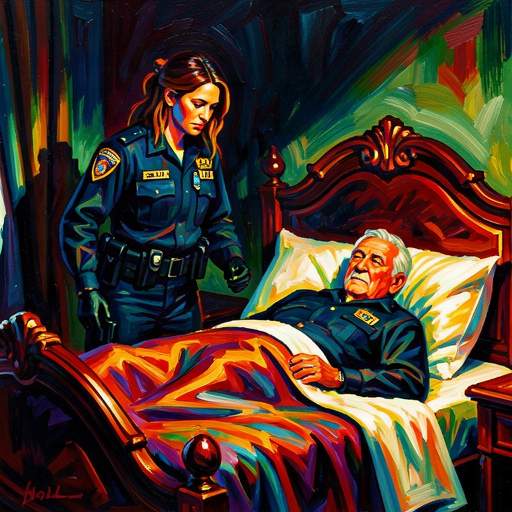
The closing sequence then reframes two earlier scenes. Viewers first see Alice entering Jay’s bedroom appearing to call for help; the second time, they watch her stand on his oxygen line and kill him. Back at the FBI, Alice watches a video Jay possessed, child sexual abuse material featuring her, then begins checking the list of people who have downloaded it.
What the Twist Actually Means
The final reveal positions Alice not just as an investigator but as someone willing to act outside the system she serves. Jay’s crimes are not exposed through evidence alone; they are buried by Special Agent Ed George (Danny McCarthy), who helps cover them up. Marshall, despite his own violent history, is rewarded rather than punished. The implication is that institutional channels repeatedly fail the people they are meant to protect.
Meriwether has pointed to this dynamic as central to the show’s thesis. Catherine, for her part, voices it directly in a prison visiting room scene intercut with the killing. “Did you like the way it felt?” she asks Alice twice. Alice’s response, a small, knowing smile, signals that the answer is yes. The show frames the moment less as triumph than as a hard-won reckoning.
Rossum has connected the ending to Alice’s larger arc, telling Variety that Alice has just gotten what she wanted by transferring into the sex crimes unit, but that her discovery of the video suggests she is already preparing for what comes next. “When your worst fears are confirmed that that tape exists and that 50,000 people have watched your childhood trauma, I think there’s almost a peace at knowing you were right,” Rossum said. “But I think that you know she’s on the next mission.”
Meriwether on Writing a Second Season
In her Vulture interview, Meriwether admitted she had not initially planned a renewal. Both “The Dropout” and “Dying for Sex” were limited series, and she has not had to return to a story in progress in some time. “It’s fun to go out and be like, I don’t have to make the decisions. You get to take away from it what you want to take away from it. Season two, you have to come down on one side of it more,” she said.
That uncertainty extends to Alice herself. In the Variety conversation with Rossum, Meriwether framed the show’s central tension as a swapping of trajectories between its two leads. “Alice is becoming Catherine, Catherine is becoming Alice,” she told the outlet. “Catherine’s heart is opening up, and in some ways Alice is closing off, and getting darker and stronger. That was the dream.”
The trajectory points toward a Season 2 that picks up the question the finale leaves open: whether Alice will pursue the men who watched her abuse, what accountability might look like when the system protects them, and how her new role in the sex crimes unit shapes her choices.
Where to Watch and What Comes Next
“Furious” is streaming now on Hulu in the United States. The series marks Meriwether’s first extended return to a continuing TV universe since “New Girl,” and Rossum’s first regular series role since “Shameless” concluded. Both have signaled openness to continuing the story, even if the shape of a second season remains undefined.
For viewers catching up before any renewal news lands, the Season 1 finale is designed to function both as a conclusion and as a launching point. The final minutes do not wrap Alice’s story so much as they open a darker, more complicated chapter of it.
If you or someone you know is dealing with domestic abuse, you can call the National Domestic Violence Hotline at 1-800-799-7233. If you or anyone you know has been a victim of sexual assault, help is available through the Rape, Abuse & Incest National Network (RAINN) National Helpline at 1-800-656-HOPE (4673).
What’s After the Movie
For more coverage of streaming releases, cast updates, and deep dives into the shows everyone’s talking about, What’s After the Movie is a one-stop resource. The site offers movie summaries and endings explained, along with the latest industry news and reviews, making it easy to keep up with both new releases and the conversations surrounding them.
Continue reading




What's After the Movie?
Not sure whether to stay after the credits? Find out!
Check out our other apps:

SAT Sphere
Build confidence for the Digital SAT.

Mori Atlas
Discover wild places worth protecting.

Luntero
Search smarter for a home in Amsterdam.

Plot Explained
Unravel movie endings and hidden clues.

Pokechamp
Dive into Pokémon data and battle logic.

Driving Theory
Get ready for your European theory test.

Movie Dust
Plan your next cinema trip with ease.

Musemap
Find art and culture as you travel.

Selkobase
Compare credentials before committing.

Local Manual
Turn an unfamiliar country into practical next steps.

Lernavi
Compare school systems before your next move.

GymRoam
Find a workout stop wherever your plans take you.
Explore Our Movie Platform
New Movie Releases (2026)
Famous Movie Actors
Top Film Production Studios
Movie Plot Summaries & Endings
Major Movie Awards & Winners
Best Concert Films & Music Documentaries
Movie Collections and Curated Lists
© 2026 What's After the Movie. All rights reserved.
Privacy Policy