What's After the Blog?
Reviews
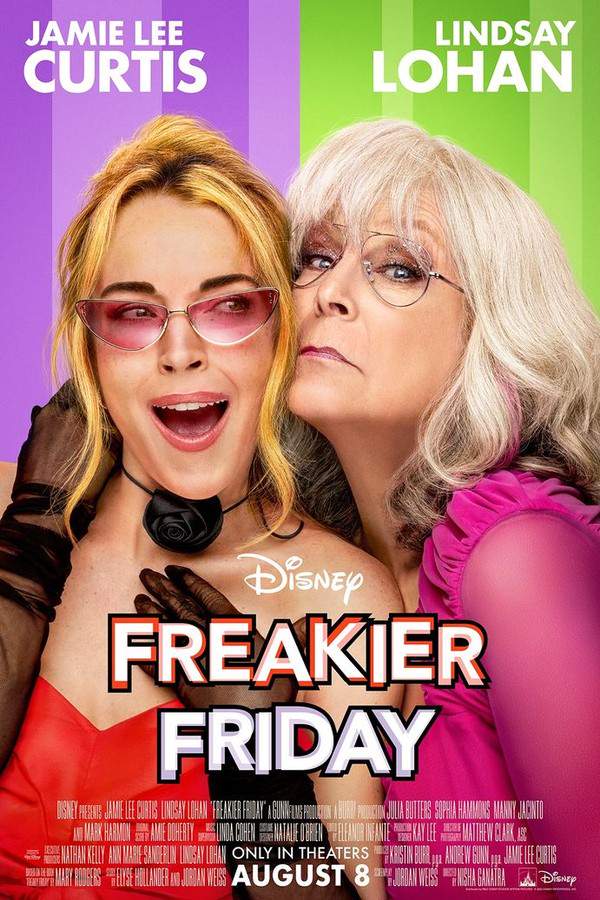
Freakier Friday (2025) Review: Lindsay Lohan’s Lighthearted Comeback in a Nostalgic Body-Swap Romp
A frothy yet heartfelt sequel, Freakier Friday gives Lindsay Lohan a charming comeback amid body-swap chaos. With its multigenerational twist, cameos, and pop-culture nods, it delivers nostalgia with a modern family feel.
August 8, 2025

Movies mentioned in this article
This review contains spoilers.
Every few years Hollywood rediscovers the simple, evergreen pleasure of a body-swap comedy, and Freakier Friday proves the formula still works—especially when you hand the keys back to Lindsay Lohan and Jamie Lee Curtis. Set two decades after the 2003 smash, the sequel is less a reinvention than an affectionate remix: bigger cast, messier logistics, and a tone that oscillates between fizzy family farce and millennial-memory lane. It’s also, unmistakably, a warm-hearted showcase for Lohan, whose easy comic timing and lived-in presence anchor the movie whenever the contrivances threaten to wobble.
Director Nisha Ganatra stages the opening act like a light rom-com: Anna Coleman (Lohan), retired rocker turned hyper-competent manager, is raising teen surfer Harper (Julia Butters) with a tag-team assist from therapist-grandma Tess (Curtis), now a podcasting, advice-dishing minor celebrity. Enter Eric (Manny Jacinto), a London restaurateur whose chic self-assurance is matched only by his daughter Lily’s (Sophia Hammons) unapologetic fashion-princess attitude. Anna and Eric fall fast; Harper and Lily clash faster. The screenplay by Jordan Weiss leans into the familiar gears—bachelorette chaos, a kooky séance courtesy of Vanessa Bayer, and then the switch—but complicates them with an audacious four-way scramble: Anna↔Harper, Tess↔Lily. If the first film felt like a tidy parlor trick, this one is a carnival booth with spinning plates.
The multi-swap premise pays dividends in individual moments even when the movie occasionally loses the thread. Lohan’s Harper-inside-Anna is a delight of micro-adjustments—watch how she greets office staff with overeager bravado, then recoils at adult responsibilities she doesn’t fully grasp. Butters, meanwhile, finds something poignant in the reverse: a teenager suddenly carrying her mother’s history, disappointments, and dormant creativity. Their push-pull culminates in a music-driven catharsis that avoids mawkishness because the film actually lets Harper discover Anna’s interior life rather than merely lecture about it. When Pink Slip re-emerges and Anna’s guitar comes out, the movie earns its euphoric swell.
Curtis, for her part, gamely plays Tess possessed by a posh teen, mining broad comedy from drugstore aisles, passport-photo glam, and a pickleball bit that reminds you how lethal her deadpan still is. The film rarely interrogates the mechanics of voice and accent in a way that heightens the joke—an odd missed opportunity in a body-swap farce—but Curtis compensates with physical business that sells Lily’s prickly bravado hiding adolescent insecurity. Hammons, saddled with the trickier assignment of playing a teen channeling a sixty-something therapist, gets funnier as the movie loosers its grip, especially once her Lily-as-Tess learns the power of disarming sincerity.
Ganatra’s direction favors buoyant pacing and bright, glossy compositions; she cuts set piece to set piece with sitcom briskness, which keeps the energy up even as the narrative occasionally skips connective tissue. A mid-film run of capers—detention hijinks, lab mishaps, and a handsome blast-from-the-past—plays like a matinee reel of “best-of” modules. Some jokes land as affectionate cross-generational ribbing (millennial cringe, Gen-Z slang, the peculiar magnetism of pickleball), others flutter by on the breeze. The tonal thermostat is calibrated for intergenerational viewing, and that’s both the point and the ceiling: whenever the movie could get weirder or sharper, it chooses sweet.
Still, sweetness suits Lohan. The film knows exactly what it’s doing in positioning Freakier Friday as a Lohanaissance vehicle: she reads as a woman who’s lived, then chooses lightness without denying the shadows. That quality gives real ballast to the movie’s mother-daughter arc. You feel it in the way Harper-as-Anna fumbles a flirtation or bungles a crisis management call; you feel it again when Anna reclaims an old part of herself onstage. It’s crowd-pleasing, yes, but not counterfeit.
The ensemble builds out the nostalgia in satisfying ways. Chad Michael Murray breezes through with the comfortable charm of a record-shop daydream, a cameo that doubles as a time-warp callback. Maitreyi Ramakrishnan brings a savvy, pop-star spark as Ella, the client whose career tether keeps yanking Anna out of domestic harmony and back into the industry churn. Even the quick glances at returning faces function less like boxes to tick and more like a wry acknowledgement: we’re all older, and some things—first crushes, old bands, the urge to make good choices—echo anyway.
Where the film struggles is clarity. Four bodies swapping means constantly tracking not just who’s who, but why each choice matters to that relationship. The editing occasionally papers over motivation with momentum, and a few scenes feel reverse-engineered to set up the next bit rather than deepening character. A small but persistent irritation: the film flirts with the comic gold of voices and mannerisms crossing wires, then largely sidesteps it, depriving Curtis in particular of the accent-play that could have detonated the second swap. The result is a movie that’s never less than pleasant—and often very funny—but rarely as dizzyingly clever as its premise invites.
Aesthetically, Freakier Friday keeps the Los Angeles canvas crisp and pop-polished: clean daylight interiors, saturated night exteriors, and a costuming palette that quietly maps the characters’ growth—from surfer nonchalance to stage-ready glam, from therapy-cardigan warmth to fashion-mag ice. The soundtrack is cannily deployed, saving its biggest dopamine hits for late when the feelings and the needle-drops can fuse. If you grew up with the 2003 film’s guitar-riffing defiance, the new set pieces land like a fond reprise rather than a hollow cover.
As a legacy sequel, the movie threads a narrow needle. It honors the spirit of Mary Rodgers’ premise, nods liberally to the 2003 film’s iconography, and updates the family dynamics without lecturing. Most importantly, it remembers that the body-swap conceit isn’t merely a gimmick; it’s a machine for empathy. When the dust settles, Freakier Friday argues—sincerely, and with enough wit—that understanding another person’s burdens makes room for their joy. It’s hardly radical, but it plays.
If you’re looking to dive deeper, What’s After the Movie has a dedicated Freakier Friday page with a full plot summary, interactive quizzes, and curated links to other providers; this review will live on our blog alongside more coverage. For a snapshot of critical and audience sentiment, see the film’s pages on Metacritic and Rotten Tomatoes; for cast and production details, IMDb, TMDB, and Wikipedia are useful second stops. Completists can check Media Stinger to see if there’s anything tucked after the credits, JustWatch for current viewing options, Box Office Mojo for performance context, Letterboxd for diary-style reactions, and Fandango if you’re buying tickets.
Verdict: frothy, funny, and fundamentally kind. Freakier Friday may not squeeze every last drop of comic potential out of its four-way switcheroo, but it nails the vibe it’s chasing: a gentle, intergenerational crowd-pleaser that lets Jamie Lee Curtis cut loose, gives Julia Butters and Sophia Hammons room to spar and soften, and—most gratifyingly—sets the stage for a Lindsay Lohan comeback that feels earned rather than engineered. Sometimes the familiar melody is exactly what you want; this one plays it with a confident grin.
Continue reading




What's After the Movie?
Not sure whether to stay after the credits? Find out!
Check out our other apps:

SAT Sphere
Build confidence for the Digital SAT.

Mori Atlas
Discover wild places worth protecting.

Luntero
Search smarter for a home in Amsterdam.

Plot Explained
Unravel movie endings and hidden clues.

Pokechamp
Dive into Pokémon data and battle logic.

Driving Theory
Get ready for your European theory test.

Movie Dust
Plan your next cinema trip with ease.

Musemap
Find art and culture as you travel.

Selkobase
Compare credentials before committing.

Local Manual
Turn an unfamiliar country into practical next steps.

Lernavi
Compare school systems before your next move.

GymRoam
Find a workout stop wherever your plans take you.
Explore Our Movie Platform
New Movie Releases (2026)
Famous Movie Actors
Top Film Production Studios
Movie Plot Summaries & Endings
Major Movie Awards & Winners
Best Concert Films & Music Documentaries
Movie Collections and Curated Lists
© 2026 What's After the Movie. All rights reserved.
Privacy Policy