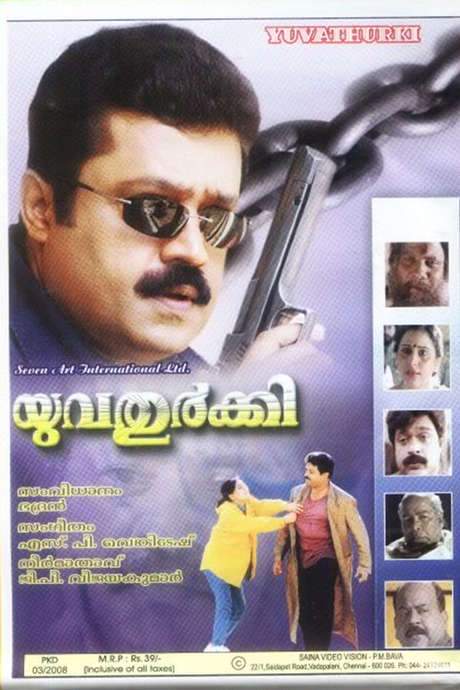


Where to Watch Yuvathurki
See current US streaming, rental, and purchase options for Yuvathurki (1996) via JustWatch.

Streaming availability powered by 
Yuvathurki Plot Summary
Read the complete plot summary and ending explained for Yuvathurki (1996). From turning points to emotional moments, uncover what really happened and why it matters.
Sidhardha, a Delhi-based youth wing leader of the ruling party, finds himself jailed after being accused of murdering Ambikaratnam, a prominent woman leader within the same political circle. Inside the grim confines of Tihar jail, he becomes a witness to the harsh realities of incarceration, where vulnerable prisoners are subjected to brutal treatment while those with political clout enjoy special privileges. The jail’s power dynamics are controlled by Kalimulla, the superintendent, and his loyal lieutenants, who run a covert crime syndicate from the heart of the facility. This stark exposure plants a seed of disillusionment in Sidhardha, revealing a system where justice often bends to power.
When a Supreme Court directive orders a reinvestigation into Ambikaratnam’s murder, a new path opens for the case. Akhila, a forceful and resourceful officer from the CBI, is assigned to re-examine Sidhardha’s case with a fresh eye. She approaches the hostile suspect with persistence, determined to uncover the truth. Despite his initial resistance and his hard-earned rancor toward the police and the entire system, Akhila presses on and slowly begins to see through the façade of guilt that has been built around Sidhardha. Her investigation kicks off a chain of revelations that challenge the surface narrative and hint at a much larger web of corruption.
At the same time, Justice Varma, a retired Supreme Court judge, is compiling a book that he claims will lay bare the dark underbelly of bureaucracy and politics in Delhi. Titled “The Bleeding Nation,” the manuscript sketches how Jyothikrishna, known as J. K., a powerful aspiring prime minister, is entangled in dangerous defense deals and political maneuvering that threaten national security. J. K. and his loyal lieutenant Dharman try to buy influence by offering Varma powerful positions, but the judge remains unyielding, choosing to stand by his convictions rather than yield to pressure.
As the narrative unfolds, Sidhardha escapes from jail and seeks out Varma to share the harsh truths he has witnessed inside the central prison. He refuses Varma’s advice to surrender and instead hints at a plan to avenge those who framed him. This encounter deepens the tension between the two men and underscores the theme that truth and justice may require a dangerous, personal path to emerge.
Sidhardha’s earlier life as an upstart political figure is sketched through his associations with a circle of young reformists who challenge J. K.’s policies. Among them are Ambikaratnam and others who dared to question the status quo. The opposition grows bolder, and J. K. responds by enlisting Dharman to shield and advance his own position. In a calculated move, J. K. engineers a bomb plot that erupts at Ambikaratnam’s birthday party, leaving her dead and casting Sidhardha in the role of the accused. Dharman’s swift climb within the party further entrenches the sense that the ruling faction will go to any lengths to protect its power.
Meanwhile, Swami Somendra of Tapovan Ashram emerges as a shadowy conspiracy architect, plotting to topple the government from the fringes of his own religiously tinged network. He is portrayed as J. K.’s mentor and an underworld node with his Ashram as a nerve center. The conspiracy theory thickens as Akhila’s probe uncovers that even senior CBI officials may be entangled with J. K.’s circle, hinting at a corrupt power structure that reaches into the heart of state institutions. Somendra’s attempts to sway Akhila prove ineffective, but they reveal the breadth of the struggle between reformers and entrenched interests.
Facing the ultimate threat of political upheaval ahead of elections, Sidhardha and a coalition of younger party figures decide to take decisive action. They hatch a bold, if controversial, plan to confront the system head-on through violence, aiming to safeguard the nation in its hour of vulnerability. A clandestine jail operation is set in motion, during which they seize control of a group of criminals and compromised politicians, dispensing rough justice and creating a climate of fear that unsettles the ruling establishment. In a climactic confrontation, Sidhardha pushes J. K. and Somendra to confess their crimes, and he eliminates them, delivering a controversial yet undeniable form of justice.
The film threads together themes of political ambition, corruption, loyalty, and the fragile line between justice and vengeance. It presents a tense, high-stakes panorama of how power can shape truth, how investigations can uncover uncomfortable realities, and how a determined movement within a party can tilt the balance of accountability. Through Sidhardha’s journey—from a jailed agitator to a figure who challenges the system—the story probes the price of reform and the complexities of enacting change in a landscape where politics and crime intertwine.
Yuvathurki Timeline
Follow the complete movie timeline of Yuvathurki (1996) with every major event in chronological order. Great for understanding complex plots and story progression.
Sidhardha is sentenced to jail for Ambikaratnam murder
Sidhardha, a Delhi-based youth-wing leader, is convicted and sent to Tihar Jail for the murder of Ambikaratnam. The sentence marks the start of a brutal period where he faces interrogation and isolation. The case sets off a chain of investigations and power struggles inside the system.
Jail torture and syndicate exposed
Inside Tihar, Kalimulla and his henchmen run a crime syndicate that thrives on brutality. Sidhardha witnesses the brutal atrocities inflicted on poor inmates while politically connected criminals enjoy immunity. The environment shows the depth of corruption in custody.
Supreme Court orders reinvestigation
On a court intervention, the Supreme Court orders a reinvestigation into Ambikaratnam's murder. The move signals doubts about the initial proceedings and opens space for a broader inquiry. It sets the stage for new players to challenge the status quo.
Akhila assigned to re-probe and visits Sidhardha
Akhila, a sharp CBI officer, is assigned to re-probe the murder case. She visits Sidhardha in jail, where he initially resists cooperation, citing systemic corruption. Her persistence foreshadows a wider investigation into crime, politics, and law enforcement.
Akhila uncovers Sidhardha's innocence
As Akhila digs deeper, she uncovers evidence pointing to Sidhardha's innocence and implicating others. She suspects the case was manipulated to frame him. The investigation begins to tilt away from Sidhardha despite his earlier confession.
Justice Varma writes The Bleeding Nation
Justice Varma, a retired Supreme Court judge, writes a book The Bleeding Nation that exposes the black realities of bureaucracy and politics. His chapters reveal underworld ties of J. K., the aspiring Prime Minister with checkered defense deals. The revelations rattle the corridors of power.
J.K. and Dharman offer bribes; Varma refuses
J. K. and his lieutenant Dharman approach Varma with lucrative bribes to sway the book's portrayal. Varma refuses to be bought, standing firm on integrity. The encounter signals widening rift between reformists and corrupt power.
Sidhardha escapes jail; seeks Varma
Sidhardha escapes from jail and travels to Varma to reveal truths from inside the central prison. He refuses Varma's advice to surrender, declaring his intent to avenge those who framed him. This marks a shift from seeking justice to planning retribution.
Sidhardha explains his side to Akhila
Sidhardha meets Akhila again to present his side of the story, hoping the truth will reach beyond biased narratives. He warns that the system is compromised and hints at a broader conspiracy. Akhila remains focused on uncovering the larger web of corruption.
Sidhardha's rise and anti-J.K. movement
Sidhardha, an emerging youth leader, bands with Dharman and Ambikaratnam's memory to challenge J.K.'s policies. They represent a wave of reformers who want change but face entrenched power. The movement gathers momentum among other young politicians.
Ambikaratnam killed by bomb; Sidhardha framed
Ambikaratnam is killed by a bomb planted at her birthday party, orchestrated by J. K. with Dharman's help. Sidhardha is accused of murdering her and is arrested, showing how dissent is crushed. The murder triggers a cascade of investigations and political maneuvers.
Swami Somendra's conspiracy and the ashram network
Swami Somendra, mentor to J.K., plans a conspiracy to topple the government and runs an underworld with Tapovan Ashram as base. His influence extends into politics and law enforcement as the network grows. Akhila's probe starts hinting at the reach of this conspiracy.
Akhila uncovers JK's coterie within CBI
Akhila's investigation reveals that even top CBI officers are part of J.K.'s coterie, suggesting systemic capture. The finding widens the scope of corruption beyond politicians to the highest echelons of investigative power. Her resolve to expose these ties heightens the danger she faces.
Secret jail killings and pre-election violence
Sidhardha and the young Turks decide to take matters into their own hands, opening a secret jail and killing several criminals and political leaders to create a panic before the elections. The act blurs the line between justice and vigilante violence. It marks a brutal turn in their campaign against entrenched power.
Final confrontation and killing of JK and Somendra
Sidhardha confronts J.K. and Somendra, forcing them to confess their crimes. He kills them, delivering justice and signaling a brutal but decisive retribution. The climactic act seals his transformation from jailed reformist to avenger of the system.
Yuvathurki Characters
Explore all characters from Yuvathurki (1996). Get detailed profiles with their roles, arcs, and key relationships explained.
Sidhardha
A Delhi-based youth wing leader of the ruling party who is jailed for Ambikaratnam's murder. He witnesses brutalities inside the jail and grows disillusioned with the system. After escaping, he seeks to reveal the truth and aligns with drastic means to avenge those who framed him.
Ambikaratnam
A female leader of the ruling party whose murder triggers a high-stakes re-investigation. Her death exposes the interplay of politics, crime, and power within the party and the state, and motivates others to challenge the status quo.
Akhila (Vijayashanti)
A determined CBI officer assigned to re-probe Siddhardha's case. She pursues the truth despite pressure from within the agency and political figures, and uncovers Siddhardha's innocence while revealing a broader web of corruption.
Jyothikrishna (J.K.)
An ambitious aspiring Prime Minister involved in dubious defense deals who uses political influence to hide criminal activities. He manipulates others and escalates the conspiracy against Siddhardha.
Dharman
A shrewd politician and Jyothikrishna's lieutenant who orchestrates plots against Siddhardha. He leverages political clout and opportunism to advance his boss’s agenda and consolidate power.
Swami Somendra
Head of Tapovan Ashram who runs an underworld network and tries to influence Akhila. He mentors J.K. and orchestrates schemes that intertwine religion, politics, and crime.
Justice Varma
A retired Supreme Court judge working on a book titled The Bleeding Nation, detailing bureaucratic and political corruption. He resists bribery attempts and confronts the black realities of governance.
Kalimulla
The jail superintendent who, with his henchmen, runs a crime syndicate inside Tihar Jail and tortures inmates for information and control. He embodies the collusion between state power and criminal networks.
Yuvathurki Settings
Learn where and when Yuvathurki (1996) takes place. Explore the film’s settings, era, and how they shape the narrative.
Location
Delhi, Tihar Jail
The narrative unfolds in Delhi, the political heart of India, and moves between the rally crowds and the claustrophobic corridors of Tihar Jail. Tihar Jail is depicted as a hotbed of power plays where crime syndicates operate under the protection of influential figures. The setting highlights the collision between public politics and private corruption, shaping the characters' choices.
Yuvathurki Themes
Discover the main themes in Yuvathurki (1996). Analyze the deeper meanings, emotional layers, and social commentary behind the film.
🗳️
Power and Politics
Power struggles drive the plot, linking youthful political activism with violence and the inertia of a corrupted system. The film exposes how party bosses, defense deals, and the underworld intersect to influence policies and outcomes. The narrative uses investigations, betrayals, and public action to reveal the true costs of power.
⚖️
Justice and Corruption
Akhila’s probe uncovers entrenched corruption within police and bureaucracy, echoing warnings about systemic rot. The investigation navigates between legal procedure and political pressure, seeking truth amid obfuscation. The Bleeding Nation within the story frames these revelations as a broader indictment of governance.
🔥
Vigilantism and Reckoning
With a broken system, Siddhardha and allies resort to drastic means to seek justice, including targeting corrupt figures. The film questions whether violence can truly reform a system or merely perpetuate cycles of vengeance. It presents a tense moral debate between idealism and pragmatism.

Coming soon on iOS and Android
The Plot Explained Mobile App
From blockbusters to hidden gems — dive into movie stories anytime, anywhere. Save your favorites, discover plots faster, and never miss a twist again.
Sign up to be the first to know when we launch. Your email stays private — always.
Explore the mobile appYuvathurki Spoiler-Free Summary
Discover the spoiler-free summary of Yuvathurki (1996). Get a concise overview without any spoilers.
In the turbulent heart of mid‑1990s Indian politics, a restless city pulses with the clamor of elections, caste loyalties, religious fervor, and shadowy underworld currents. The atmosphere is thick with whispered deals and public unrest, a backdrop that feels both intimate and far‑reaching. This world is rendered in a gritty, almost tactile style, where every street corner and council hall seems poised to reveal the hidden levers that steer the nation’s destiny.
At the centre of this volatile tableau is Sidhardha, a hardened figure haunted by the loss of his beloved. Driven by an unyielding need for answers, he walks a razor‑thin line between the law and the lawless, confronting a maze of power that constantly shifts beneath his feet. His determination is matched only by the weight of his grief, turning personal vendetta into a quest that drags him deeper into the corridors of authority.
The film explores the uneasy dance between idealism and corruption, offering a lens onto a bureaucracy where influence often eclipses justice. As Sidhardha moves through a landscape riddled with political ambition and hidden agendas, the tone remains taut and brooding, inviting the audience to feel the pressure of every hidden pact and the ever‑present threat of betrayal. Relationships are forged and tested against this backdrop, highlighting the fragile balance between loyalty to a cause and the lure of personal gain.
Through its relentless pacing and stark visual language, the story promises a compelling blend of political thriller and personal revenge, inviting viewers to linger on the uneasy questions of power, morality, and the cost of seeking truth in a world where every truth is contested.
Featured on this page

What's After the Movie?
Not sure whether to stay after the credits? Find out!
Check out our other apps:

SAT Sphere
Build confidence for the Digital SAT.

Mori Atlas
Discover wild places worth protecting.

Luntero
Search smarter for a home in Amsterdam.

Plot Explained
Unravel movie endings and hidden clues.

Pokechamp
Dive into Pokémon data and battle logic.

Driving Theory
Get ready for your European theory test.

Movie Dust
Plan your next cinema trip with ease.

Musemap
Find art and culture as you travel.

Selkobase
Compare credentials before committing.

Local Manual
Turn an unfamiliar country into practical next steps.

Lernavi
Compare school systems before your next move.

GymRoam
Find a workout stop wherever your plans take you.
Explore Our Movie Platform
New Movie Releases (2026)
Famous Movie Actors
Top Film Production Studios
Movie Plot Summaries & Endings
Major Movie Awards & Winners
Best Concert Films & Music Documentaries
Movie Collections and Curated Lists
© 2026 What's After the Movie. All rights reserved.
Privacy Policy