What Is Viva la Libertà About?
The premise of Viva la Libertà in 386 words, with nothing given away. The full story follows below.
In the days leading up to a pivotal national election, Italy’s political arena crackles with tension and restless ambition. The country feels like a grand stage where speeches echo through marble halls and street cafés alike, each word measured for its power to sway a fickle electorate. The film captures this atmosphere with a blend of stark realism and a slightly absurd, almost theatrical edge—light and shadow playing across bustling piazzas, the hushed corridors of power, and the intimate, smoke‑filled rooms where personal histories linger. The tone is simultaneously urgent and contemplative, inviting the audience to sense the weight of a democracy on the brink of change while hinting at the fragile humanity underneath the polished façade.
At the heart of this volatile landscape is Enrico Oliveri, the charismatic yet increasingly isolated leader of the opposition party. Once a beacon of hope for a disillusioned public, his charisma is now eroding under the pressure of slipping polls and personal doubts. His disappearance triggers a crisis that reverberates through the party’s hierarchy, exposing the uneasy reliance on image over substance. Enrico’s inner turmoil is subtly reflected in his strained relationships, especially with his wife Anna and his elusive past love Danielle, whose off‑screen lives add layers of quiet longing and unresolved tension.
Enter Andrea Bottini, Enrico’s devoted aide, whose loyalty borders on obsession. Bottini moves through the political machinery with a pragmatic calm, ever‑watchful for a solution that can preserve the party’s fragile standing. When the improbable idea of a twin surfaces—a man who looks identical but carries a completely different psyche—Bottini becomes the catalyst for a daring, morally ambiguous plan. His calculated pragmatism contrasts sharply with the idealism that once drove Enrico, setting up a compelling dynamic of duty versus authenticity.
The unexpected counterpart is Giovanni Ernani, the estranged brother who has just emerged from confinement in a psychiatric facility. Though physically identical, Giovanni embodies a restless intellect and a raw, unfiltered energy that starkly opposes Enrico’s measured politicking. As Giovanni begins to inhabit his brother’s public persona, his unconventional insights and spontaneous charisma hint at a revolution of discourse, unsettling both allies and adversaries. The film teases the tension between identity and performance, leaving viewers to wonder how far a façade can be stretched before it reshapes the very reality it was meant to conceal.
What Happens in Viva la Libertà?
The complete story of Viva la Libertà, from the first scene to the last, in 481 words (about 2 minutes). Spoilers throughout.
Spoilers ahead
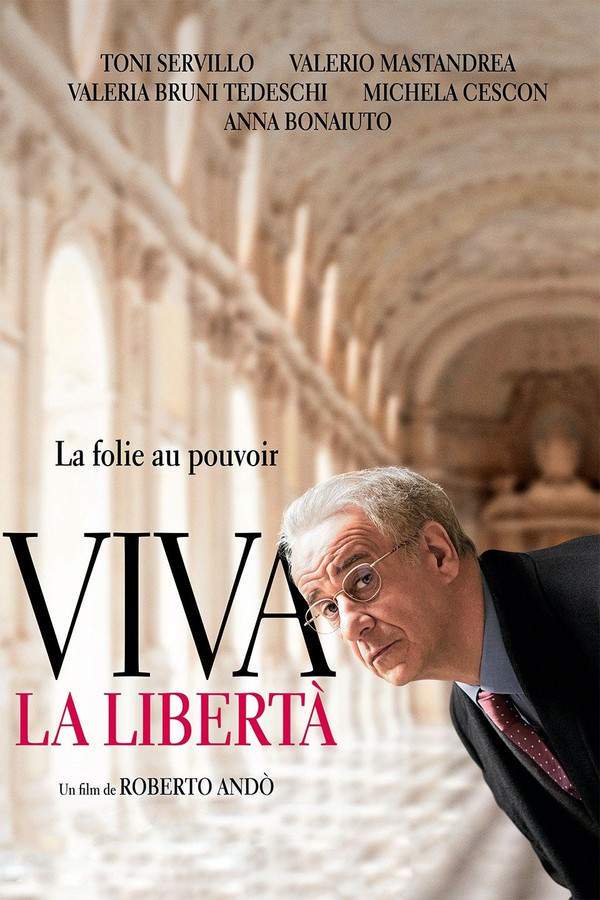
In this compelling narrative about global politics, Toni Servillo delivers a stunning performance, showcasing his talent by stepping into two distinct roles. First, he captures the essence of Enrico Oliveri, a party leader who reflects the tragic failure of political ideals. Next, he transforms into Giovanni Ernani, Enrico’s unhinged twin brother who seizes control in the wake of Enrico’s mysterious disappearance. Each portrayal is rich in complexity, highlighting Servillo’s remarkable attention to detail.
As the nation prepares for a national election, Enrico finds himself plummeting in the polls, prompting both allies and opponents to anticipate his inevitable downfall. In an act of desperation, driven by an inability to confront his party’s decline, he vanishes into the night. The party officials attempt to manage the crisis by obscuring Enrico’s absence with clever maneuvers. Meanwhile, his loyal aide, Andrea Bottini, makes a fateful decision to locate Enrico’s look-alike, his estranged twin brother, Giovanni, who has just been released from a psychiatric facility.
As Giovanni gradually immerses himself in Enrico’s public life, he begins to mimic his brother’s mannerisms and behaviors with a remarkable yet subtly flawed mastery. Surprisingly, Giovanni’s approach surpasses Enrico’s political savvy; he possesses an uncanny ability to captivate crowds with bold and inspiring speeches that reflect an innovative spirit. The juxtaposition of Enrico’s intellectual failures against Giovanni’s audacious rise creates a narrative that questions the underlying motivations of modern political landscapes.
In a poignant exploration of identity and power, the film digs deep into the struggles faced by individuals caught between the public and private spheres. Enrico, the secretary of the main opposition party, grapples with nostalgic memories while battling bouts of depression exacerbated by unflattering opinion polls. Unbeknownst to his wife, Anna, and Bottini, Enrico takes off one night to reconnect with Danielle, a woman from his past who now leads a different life in Paris, married to the renowned Chinese director, Mung, and raising their twelve-year-old daughter, Hélène.
Back in Italy, Anna and Bottini scramble to rectify the unexpected predicament by enlisting Giovanni. Despite their physical similarities, the twins embody two radically different personas. Giovanni assumes Enrico’s role, engaging in interviews, giving public speeches, and leading conferences with a revolutionary zeal that shocks opponents and inspires the electorate. He embodies a fresh, creative wave in politics, turning the tide in ways that leave critics and supporters alike in awe.
This mesmerizing tale unfolds as a mysterious duet, intertwining the public lives of two brothers with their personal emotions, both vying for the affection of the same woman. It becomes a strategic game of distance, where the stakes concern the nature of truth and deception within the realm of power. The film raises profound inquiries, inviting viewers to reflect on the driving forces shaping today’s political realities through a rich tapestry of human experiences and ideological divides, ultimately rendering it a provocative thriller that resonates in our contemporary world.
Viva la Libertà Timeline: Every Key Event in Order
13 key events in the order they happen, from “Enrico Oliveri's Political Decline” to “The Unraveling Chaos”. 9 events name a place, across 2 locations.
- 1
Enrico Oliveri's Political Decline
Enrico Oliveri, the leader of the main opposition party, faces a steep decline in the polls as the national election approaches. His supporters and adversaries begin to recognize that his political career is nearing its end, leaving him in a state of despair.
Where:Italy
- 2
Enrico's Disappearance
Overwhelmed by the impending failure, Enrico Oliveri decides to vanish into the night, leaving behind a frantic political turmoil. His wife, Anna, and his aide, Andrea Bottini, are left scrambling to conceal his absence from the public and the media.
Where:Italy
- 3
Journey to Paris
In a moment of nostalgia, Enrico travels to Paris to reconnect with Danielle, a woman with whom he had a passionate affair twenty years ago. This trip symbolizes his search for solace and escape from the pressures of his political life.
Where:Paris
- 4
Danielle's New Life
Danielle, now married to the famous Chinese director Mung, leads a life filled with artistic pursuits and has a twelve-year-old daughter named Hélène. This new reality contrasts sharply with Enrico's troubled political career, highlighting the choices they both made.
Where:Paris
- 5
The Search for Giovanni Ernani
Meanwhile in Italy, Anna and Bottini devise a plan to resolve the crisis by locating Enrico's twin brother, Giovanni Ernani. Recently released from a psychiatric hospital, Giovanni possesses a sharp intellect and an understanding of philosophy that could manipulate public opinion.
Where:Italy
- 6
Giovanni's Transformation
Despite their similar appearances, Giovanni and Enrico are fundamentally different individuals. Giovanni begins to embrace Enrico's public persona, meticulously adopting his brother's mannerisms, which is both unsettling and captivating to those around him.
Where:Italy
- 7
Taking Over Enrico's Role
Giovanni Ernani steps into Enrico's shoes, taking over his political duties by giving interviews, delivering passionate speeches, and leading conferences. His innovative approach introduces a revolutionary spirit into the political arena that begins to win over the electorate.
Where:Italy
- 8
Giovanni's Magnetic Public Persona
As Giovanni rallies the masses with his fearless oratory, he quickly outshines his brother's previous political prowess. His eloquence and charisma ignite a sense of hope among the voters, creating a divide between the failed leader and his unhinged but inspiring twin.
Where:Italy
- 9
Exploration of Truth and Power
The film delves into the complexities of truth and falsity within political power, as Enrico's failure contrasts sharply with Giovanni's rise. This duality creates an intriguing narrative about identity, authority, and the nature of leadership in contemporary politics.
- 10
A Dance Between Brothers
As Giovanni continues to impersonate Enrico, a mysterious connection forms between the lives of the two brothers, each intertwined with the same woman, Danielle. Their relationship complicates the narrative, ultimately questioning where loyalty and ambition intersect.
Show the other 3 events of Viva la Libertà Hide the last 3 events
- 11
Political and Personal Stakes
This story also serves as a psychological thriller, exploring the pressures of public life on personal relationships. The tension escalates as the stakes grow higher for both Giovanni and Enrico, leading to a dramatic confrontation of identities.
- 12
Public Versus Private Life
As Giovanni gains fame and authority, the lines between his public persona and private struggles blur, emphasizing the challenges faced by individuals in power. The narrative raises questions about integrity and the authenticity of political leaders in a turbulent environment.
- 13
The Unraveling Chaos
The final act reveals the chaotic consequences of Giovanni's impersonation as the party confronts the realization of Enrico's absence. This culminates in a critical moment of reckoning that will redefine each character's fate and the future of their political landscape.
Where:Italy
Who Are the Main Characters in Viva la Libertà?
5 characters, among them Enrico Oliveri, Giovanni Ernani and Anna: who each one is and the part they play in the story.
- EO
Enrico Oliveri
Enrico Oliveri is a once-prominent political figure facing a crisis of confidence as his party's fortunes decline. His character reflects the internal struggles of a leader grappling with the weight of expectations, failure, and the desire to reclaim his place in the political arena.
- 💔 Disillusionment
- 🎭 Identity
- 📉 Political Failure
- GE
Giovanni Ernani
Giovanni Ernani, Enrico's twin brother, emerges as a charismatic and unconventional presence in the political sphere following his release from an asylum. His bold speeches and imaginative approach rejuvenate the party’s image, yet his own identity and motivations remain deeply complex and intriguing.
- 🌪️ Charisma
- 🎉 Revolutionary
- 🧠 Philosophy
- A
Anna
Anna is Enrico's wife, who remains oblivious to her husband's despair and his drastic actions. Her character represents the personal stakes involved in the political turmoil, emphasizing the impact of leadership crises on family and personal relationships.
- 💔 Loyalty
- 🏠 Family
- 🔍 Search for Truth
- AB
Andrea Bottini
Andrea Bottini serves as Enrico's right-hand man, embodying the tension between loyalty and ambition. His willingness to recruit Giovanni signifies the desperation within the political party as they seek to preserve their grip on power amidst uncertainty.
- 🤝 Loyalty
- ⚖️ Ambition
- 🔍 Search for Control
- D
Danielle
Danielle is the woman from Enrico's past, representing a connection to his earlier, more passionate life. Her current circumstances add layers to Enrico's character, highlighting his longing for lost love and the personal stakes intertwined with his political struggles.
- 💕 Nostalgia
- 🎭 Duality
- 🔄 Choices
Where and When Is Viva la Libertà Set?
Viva la Libertà is set in Italy and Paris (Contemporary). Here is why the time and place matter to the story.
When
Contemporary
The events of the film unfold in contemporary times, reflecting the complexities and challenges of modern political landscapes. It showcases the turmoil and shifting dynamics that can occur in political arenas, making the narrative resonate with viewers facing similar struggles in today's world.
Where
Italy, Paris
The movie takes place in Italy, known for its rich political history and vibrant culture, which serves as the backdrop for the unfolding drama. Paris, a city renowned for its romantic ambiance and artistic legacy, becomes a crucial setting as Enrico Oliveri seeks to reconnect with a past love, providing an emotional depth to the narrative.
- 🇮🇹 Italy
- 🇫🇷 France
What Are the Themes of Viva la Libertà?
3 ideas the story keeps returning to, among them Identity, Power and Love.
-
01
Identity
The theme of identity is central to the film, as Enrico's twin brother Giovanni must navigate the complexities of impersonating him while grappling with his own struggles. This exploration of personal versus public identity raises questions about authenticity, self-worth, and the masks people wear in both politics and personal life.
-
02
Power
Power dynamics play a significant role in the story as Giovanni's unconventional approach to leadership challenges traditional political strategies. The film delves into the seductive nature of power and its impact on human relationships, illustrating how political ambition can blur the lines between personal and public motivations.
-
03
Love
Love is intricately woven into the narrative, particularly through Enrico's past relationship with Danielle. This theme highlights the emotional ties that influence the characters' decisions, illustrating that personal relationships can profoundly affect one's public life and ambitions.
What Kind of Film Is Viva la Libertà?
Tense in tone, with steady pacing and a moderate story, going by the plot summary.
- Tone
- Tense
- Pacing
- Steady
- Story
- Moderate
- Intensity
- Medium
- Ending
- Ambiguous
A tense and satirical political drama that explores identity and sanity through a high-stakes deception, creating an anxious yet reflective atmosphere as a fragile substitute captivates the public.
- anxious
- satirical
- melancholic
- cerebral
- unsettling
- reflective
- political deception
- identity crisis
- twin swap
- mental illness
Content notes: mental instability, nervous breakdown.
Quiz
How well do you remember Viva la Libertà? Test yourself on the story.