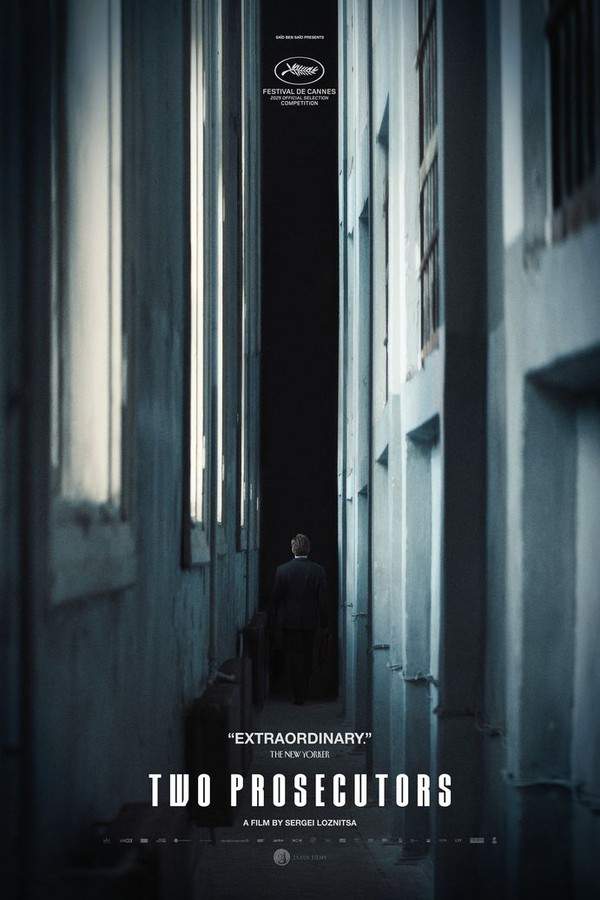
Two Prosecutors 2026


Directed by

Sergey Loznitsa
Made by

SBS Productions
Where to Watch Two Prosecutors
See current US streaming, rental, and purchase options for Two Prosecutors (2026) via JustWatch.







Two Prosecutors Plot Summary
Read the complete plot summary and ending explained for Two Prosecutors (2026). From turning points to emotional moments, uncover what really happened and why it matters.
In 1937, against the backdrop of Joseph Stalin’s Great Purge, a young Soviet prosecutor named Kornev Aleksandr Kuznetsov has just finished law school and is eager to prove himself in a system gripped by fear and suspicion. His first reflections on justice are drawn into sharper focus when he discovers a letter written by a prisoner in Bryansk. The document hints at corruption and abuse within the NKVD, suggesting that innocent loyalties to the party could be crushed by a powerful, unnamed force. Motivated by a belief that he can uncover truth and shield loyal citizens, Kornev seeks permission to investigate the case and travels to Bryansk to observe the prison firsthand, operating under his official capacity in the local prosecutor’s office.
Inside the bleak walls of the Bryansk prison, Kornev encounters Stepniak [Aleksandr Filippenko], an imprisoned Old Bolshevik and long-standing local party stalwart. The encounter tests Kornev’s resolve and his confidence in the prevailing order. To win the old man’s trust, Kornev recounts a memory from law school—an event in which Stepniak delivered a stark speech about truth and Bolshevism, a moment that binds the two men across the gulf of imprisonment and fear. Stepniak’s wounds tell a harsher story—torture marks earned after he refused to confess to crimes he knew were false. He urges Kornev to broadcast the truth higher up the chain of command, to tell Stalin or members of the Politburo about the wrongful convictions and illegal acts that have twisted the system against loyal citizens who resist or learn of the NKVD’s corruption. As Kornev prepares to depart, a prison official who has been quietly observing him makes a phone call and dismissively insults his intelligence, underscoring how surveillance and mistrust permeate every corner of the system.
Kornev’s journey continues to Moscow by train, a trip that becomes an uneasy rhythm of sleep and interruption. He attempts to rest, but a peglegged World War I veteran of the Battle of Kowel keeps interrupting his attempt to find quiet. The veteran’s stories—about once meeting Vladimir Lenin in Smolny and now seeking alms from Stalin—layer the narrative with a sense of history echoing through the present day’s repression. The train becomes a moving stage where memory and fear mingle, hinting at a larger pattern of state control that transcends Bryansk.
Arriving in the capital, Kornev confronts the maze of the Procurator General’s office, where he must navigate a bureaucracy that often seems indifferent to individual ideals. His pleading and persistence, however, eventually earn him a fragile chance at an appointment after an earnest plea to Andrey Vyshinsky [Anatoliy Belyy], whose secretary holds the key to access. When the moment arrives, Kornev presents the bloody letter from Stepniak and details the conditions in Bryansk, laying out his belief that the local prosecutor’s office is cowed by NKVD influence. Vyshinsky listens, then presents a chilling verdict: without strong documentary evidence, his office cannot open a formal inquiry. He sends Kornev back to Bryansk with documents that authorize further investigations, a reminder that even the highest authorities are bound by procedural constraints in a system that thrives on fear and opacity.
On the return leg, Kornev shares a carriage with Vasily and Petya, engineers who toast to Soviet law and even perform a guitar-driven number—an odd pastoral counterpoint to the grimness of their surroundings. Their casual bravado feels like a brief, dangerous spark of camaraderie in a climate where trust is scarce and danger lurks behind every closed door. When they drop Kornev off near his destination, a tense exchange unfolds: Petya probes into Kornev’s private life, an intrusion that mirrors how people are scrutinized in this climate. As the car pulls away from the station, Vasily announces that Kornev is under arrest, and the vehicle carries him toward the prison facility once more, closing the circle of his trip with a brutal sense of inevitability.
The film’s culmination returns to a hard, sobering truth. Kornev’s belief that he could confront isolated aberrant conduct within a local apparatus proves tragically naïve. Rather than a few rogue figures, the policy of suppression emanates from the top—an order that originates with Stalin and is carried out with the complicity of key figures like Vyshinsky. The story reframes a single prosecutor’s mission as a window into a broader mechanism of control, where official channels, fear, and political calculus intersect in ways that silence dissent and consolidate power. In this environment, even earnest attempts to reveal truth are subsumed by a system designed to protect its own at any cost, leaving Kornev to face the consequences of confronting a structure that is larger and more perilous than any one individual might suppose.
Note: the first mentions of Kornev, Stepniak, and Andrey Vyshinsky are linked to their respective actors:
- Kornev Aleksandr Kuznetsov
- Stepniak Aleksandr Filippenko
- Andrey Vyshinsky Anatoliy Belyy
Two Prosecutors Timeline
Follow the complete movie timeline of Two Prosecutors (2026) with every major event in chronological order. Great for understanding complex plots and story progression.
Kornyev uncovers a plea from Bryansk prisoner
Kornyev, a young Soviet prosecutor, discovers a letter from a Bryansk prisoner that suggests NKVD corruption and wrongful convictions. Believing the man may be a victim, he visits the Bryansk prison as part of his oversight duties to investigate. The encounter sets him on a path to challenge the local authorities.
Stepniak's testimony and wounds
Kornyev meets Stepniak, an imprisoned Old Bolshevik, who shows torture wounds he suffered after refusing to confess falsely. Stepniak begs Kornyev to tell Stalin or the Politburo about the wrongful actions. He urges action to reveal the corruption against loyal citizens.
Prison official interrupts with a phone call
As Kornyev leaves, a prison official observing him makes a phone call and insults his intelligence. The moment signals deeper complicity and surveillance around the case. It hints at a broader system at work beyond one prison.
Train to Moscow; peglegged veteran's Lenin tale
Kornyev travels by train to Moscow to press his case. On the journey, a peglegged WWI veteran tells stories about meeting Lenin in Smolny and seeking alms from Stalin, keeping him awake and underscoring the political atmosphere. The veteran's tale mirrors the era's propaganda and fear.
Appointment pursuit at the Procurator General's Office
In Moscow, Kornyev endures a long wait attempting to secure an appointment. He hopes to escalate his Bryansk findings to higher authorities and gain attention for the case. The bureaucracy itself becomes an obstacle to exposure.
Vyshinsky meeting; letter presented
Kornyev finally meets Procurator General Andrey Vyshinsky and presents Stepniak's bloody letter, explaining the situation in Bryansk and the local NKVD's influence. Vyshinsky warns that without solid documentary evidence, an inquiry cannot be opened. The encounter highlights the limits of evidence-based action in a repressive system.
Vyshinsky's authorization and return to Bryansk
Vyshinsky gives Kornyev documents authorizing him to conduct further investigations, but stresses the need for substantial evidence. Kornyev prepares to return to Bryansk to continue digging into the case and gather needed proof. The formal authorization signals a procedural route that may still fail under political pressure.
Return train conversation with Vasily and Petya
On the return journey, Kornyev is seated with Vasily and Petya, engineers who toast to Soviet law and play the counterplan song on guitar. Their camaraderie reveals how ordinary people navigate the regime's rhetoric. The encounter adds a layer of social normalcy to the oppressive atmosphere.
Bryansk station ride; Petya's probing
In Bryansk, the three share a ride from the train station. Petya aggressively questions Kornyev about his virginity, signaling the menacing casualness with which people are swept into the state’s machinery. They drive past Kornyev's destination, hinting at a trap or control point.
Under arrest; car to the prison
Vasily tells Kornyev that he is under arrest as their car moves toward the prison facility. The sudden shift from travel companions to detainee demonstrates the regime's reach and the fragility of individual safety. The arrest underscores the pervasiveness of state power.
Kornyev realizes the system's reach
Kornyev recognizes that his belief in local aberrant conduct was a tragic miscalculation. He understands that the pattern he uncovered reflects a policy originating from Stalin and implemented across the Soviet Union, with Vyshinsky as a key collaborator. The realization exposes the centralization of repression.
Systemic repression confirmed; no safe channels
The narrative emphasizes that appealing to central leadership does not guarantee justice, as state repression is systemic and widespread. Kornyev’s arrest demonstrates that the policy is broader than any single local office. The ending underscores the futility of resisting the machine.
Two Prosecutors Characters
Explore all characters from Two Prosecutors (2026). Get detailed profiles with their roles, arcs, and key relationships explained.
Kornev — Aleksandr Kuznetsov
A young Soviet prosecutor who believes in the ideal of justice but discovers how the system weaponizes fear and expediency. He remains determined to push for truth, yet he quickly learns that central directives override local concerns. His initial optimism gives way to a harsher understanding of state power.
Stepniak — Aleksandr Filippenko
An imprisoned Old Bolshevik and loyal party member who has endured torture for refusing to confess a false crime. He embodies the moral plea for truth and integrity against a system bent on expediency. He urges the prosecutor to reveal wrongful convictions, even at great personal risk.
Andrey Vyshinsky — Anatoliy Belyy
The Procurator General who embodies centralized authority and blunt practicality. He sets the limits of what investigations can occur without documentary evidence and emphasizes loyalty to the state over individual cases. He represents the state's willingness to suppress inconvenient truths for political reasons.
Two Prosecutors Settings
Learn where and when Two Prosecutors (2026) takes place. Explore the film’s settings, era, and how they shape the narrative.
Time period
1937
Set in 1937, during Stalin's Great Purge, the narrative unfolds in a climate of political terror and coercive justice. The state leverages the NKVD to enforce loyalty, while prosecutors operate under the suspicion of local complicity and fear. The period is defined by denunciations, show trials, and pressure to conform to an official narrative.
Location
Bryansk prison, Moscow
The story moves between Bryansk, where a provincial prison becomes the arena for suspected miscarriages of justice, and Moscow, the seat of the Procurator General's office where power is centralized. Bryansk's prison is depicted as a harsh environment where prisoners bear the scars of political repression, while Moscow's bureaucracy looms as a gatekeeper to potential investigations. The contrast highlights how local corruption collides with centralized authority during the Great Purge.
Two Prosecutors Themes
Discover the main themes in Two Prosecutors (2026). Analyze the deeper meanings, emotional layers, and social commentary behind the film.
🔎
Power and Fear
The film places a young prosecutor at the mercy of a system where power is exercised through surveillance and coercion. Fear shapes every interaction, coloring how truth is pursued and how loyalty to the state is demanded. The story shows how fear can erode moral judgment and distort the justice process.
⚖️
Truth vs State
Kornev's quest to uncover Stepniak's letter and expose corruption collides with the state's demand for a controlled narrative. Central authorities offer limited room for inquiry, underscoring how official truth is often crafted to protect those in power. The tension reveals the fragility of evidence under a regime that prizes allegiance over accuracy.
🏛️
Bureaucracy and Suppression
The bureaucracy acts as an opaque barrier to reform, where paperwork and position shield the guilty and hinder the innocent. Procedural hurdles and pressure from higher offices throttle genuine investigations. In this climate, even well-intentioned actors can become complicit in suppression.

Coming soon on iOS and Android
The Plot Explained Mobile App
From blockbusters to hidden gems — dive into movie stories anytime, anywhere. Save your favorites, discover plots faster, and never miss a twist again.
Sign up to be the first to know when we launch. Your email stays private — always.
Explore the mobile appTwo Prosecutors Spoiler-Free Summary
Discover the spoiler-free summary of Two Prosecutors (2026). Get a concise overview without any spoilers.
In the winter‑gray chill of 1937 Soviet Union, a climate of suspicion and fear hangs over every street and office. The Great Purge has turned ordinary institutions into mechanisms of control, and whispers of injustice are quickly silenced. Within this austere tableau, rows of letters—testimonies of countless detainees—are reduced to ash, a stark reminder of how truth can be smothered beneath the weight of bureaucracy and terror.
Enter Alexander Kornev, a newly appointed local prosecutor freshly graduated from law school and eager to prove his worth in a system that rewards conformity. Still bright‑eyed yet aware of the heavy expectations placed upon him, he carries the ideals he once heard in revolutionary speeches, hoping to reconcile his legal training with the grim reality of an increasingly paranoid state. His position grants him a unique, if precarious, angle from which to observe the inner workings of power, and his earnestness sets him apart from the more jaded officials around him.
One unburned letter, slipped onto Kornev’s desk, bears the desperate hand of a survivor from a prison cell where countless pleas were incinerated. The note hints at a hidden story of injustice, prompting Kornev to question the official narrative and consider what lies beneath the surface of sanctioned authority. The mere presence of this fragment ignites a quiet determination within him, tugging at his conscience and urging him to look beyond the sanctioned files and paperwork that dominate his daily routine.
The film moves with a tense, almost claustrophobic rhythm, echoing the oppressive atmosphere of an era where law and terror intertwine. As Kornev navigates the labyrinthine corridors of Soviet bureaucracy, his quest becomes a study in moral courage—an exploration of how a single voice, however faint, might challenge a system designed to hush it. The mood is sober and introspective, inviting the audience to feel the weight of history pressing on each decision, while the promise of uncovered truth hangs just out of reach, drawing viewers deeper into the unsettling world of the era.
Featured on this page

What's After the Movie?
Not sure whether to stay after the credits? Find out!
Check out our other apps:

SAT Sphere
Build confidence for the Digital SAT.

Mori Atlas
Discover wild places worth protecting.

Luntero
Search smarter for a home in Amsterdam.

Plot Explained
Unravel movie endings and hidden clues.

Pokechamp
Dive into Pokémon data and battle logic.

Driving Theory
Get ready for your European theory test.

Movie Dust
Plan your next cinema trip with ease.

Musemap
Find art and culture as you travel.

Selkobase
Compare credentials before committing.

Local Manual
Turn an unfamiliar country into practical next steps.

Lernavi
Compare school systems before your next move.

GymRoam
Find a workout stop wherever your plans take you.
Explore Our Movie Platform
New Movie Releases (2026)
Famous Movie Actors
Top Film Production Studios
Movie Plot Summaries & Endings
Major Movie Awards & Winners
Best Concert Films & Music Documentaries
Movie Collections and Curated Lists
© 2026 What's After the Movie. All rights reserved.
Privacy Policy