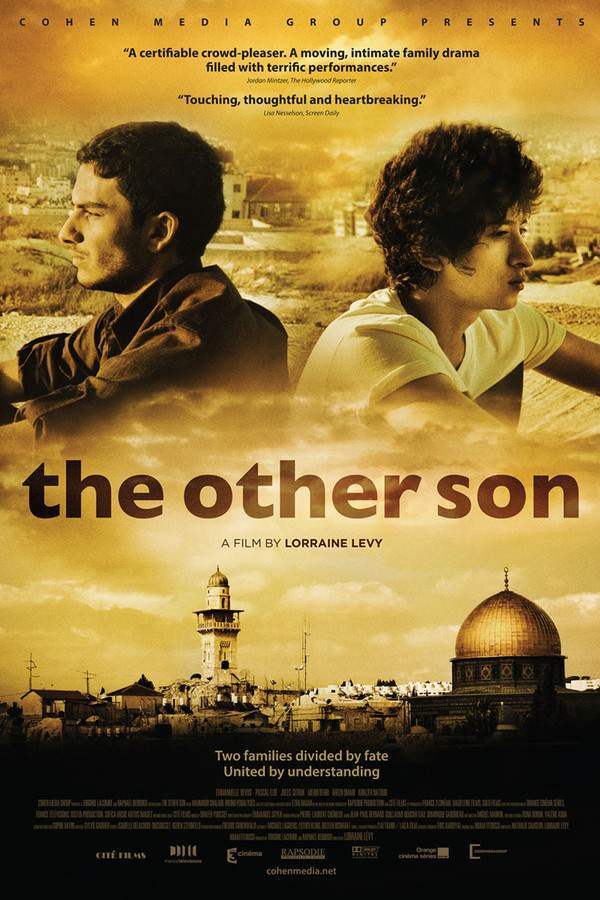
The Other Son 2012

Directed by

Lorraine Levy
Made by

Cohen Media Group
Where to Watch The Other Son
See current US streaming, rental, and purchase options for The Other Son (2012) via JustWatch.







The Other Son Plot Summary
Read the complete plot summary and ending explained for The Other Son (2012). From turning points to emotional moments, uncover what really happened and why it matters.
Joseph Silberg is a young man on the brink of adulthood, preparing to embark on his mandatory service in the Israeli Defense Forces. In the routine process that accompanies this moment, a surprising medical detail surfaces: his blood type doesn’t match his family. A deeper dive into his lineage through DNA testing uncovers a truth that shatters the notion of kinship as he has known it—Joseph is not his parents’ biological son.
The investigation that follows centers on the hospital where Joseph was born. On the night of his birth, a bombing forces chaos and forces two newborns to be relocated to shelters for safety. In the turmoil, a grave error occurs: the infants are swapped. The hospital administrator reaches out to the family of the other child, a family that belongs to Palestinian roots, and they learn of a boy named Yacine Al Bezaaz who shares the same birth night as Joseph.
As the families grapple with this extraordinary revelation, the film threads together the personal and political tensions of the Israeli–Palestinian conflict. The two fathers resist accepting the swapped son as part of their household, clinging to familiar identities and loyalties, while the mothers show more openness to the possibility of embracing a child who carries their biological connection, even if the circumstances are fraught with competing loyalties and trauma.
Amid the suspicion and grief, the two boys form a cautious friendship that becomes the emotional heart of the story. Their growing bond challenges their families to reexamine long-held beliefs and fears, pushing everyone to confront their own prejudices and the fragile nature of identity. The film uses this intimate drama to illuminate the ways in which a single misstep at a vulnerable moment can ripple outward, forcing both sides to reconsider what it means to belong, what it means to be family, and how trust can emerge even in the shadow of conflict.
Throughout the narrative, the theme of belonging weighs heavily as each character negotiates loyalty to blood, to country, and to the person who calls them family. The result is a moving, thought-provoking exploration of reconciliation, empathy, and the human costs of division, told through the parallel journeys of two boys who share a birth night but were raised in different worlds.
The Other Son Timeline
Follow the complete movie timeline of The Other Son (2012) with every major event in chronological order. Great for understanding complex plots and story progression.
Birth of Joseph Silberg
Joseph Silberg is born into a family in Israel. The night carries a bomb attack that disrupts the hospital, setting the stage for a life-altering event.
Bombing and shelter swap
During the bombing, the newborns are evacuated to shelters and swapped by mistake. The mix-up binds Joseph to a different family despite his early life together with his biological parents.
Reveal of the switch
The hospital administrator informs the families that a switch occurred and the babies were raised by the mistaken families. The discovery triggers an investigation into the newborns' identities.
DNA tests expose the truth
Routine tests reveal a blood type discrepancy, and DNA testing confirms that Joseph is not the son of his birth family. The shocking realization prompts further inquiry into the baby's origins.
Hospital investigates the swap
A formal investigation is launched by the hospital to trace the swap and determine who is the biological parent for each child. The process lays bare personal and political tensions.
Meet the other family
The hospital administrator contacts Yacine Al Bezaaz's family, the Palestinian couple, to inform them about the swapped baby. The revelation introduces a cross-cultural dialogue within crisis.
Parents' initial reactions
The Israeli father and the Palestinian father are reluctant to accept the reality, clinging to their own versions of the truth. Their wives, meanwhile, show a willingness to consider a future with their biological children.
The boys form a bond
As the two boys, Joseph and Yacine, grow up, they become friends and discover shared humanity despite their parents' distrust. Their friendship becomes a bridge between two families.
Families re-evaluate beliefs
The growing friendship prompts the families to re-examine their xenophobia and the broader Israeli-Palestinian conflict. They begin to question long-held assumptions about identity and loyalty.
Facing the true identities
The families confront the reality of the biological children and what it means for their sense of belonging. The narrative weighs emotional ties against national and ethnic boundaries.
Option to connect with biological children
The parents consider how or whether to connect with their true biological children. The idea challenges divisions rooted in the conflict and opens space for potential reconciliation.
New bonds and a fragile future
The families begin to cultivate new relationships informed by shared humanity rather than inherited divisions. The film closes with a cautious sense of hope as the truth becomes a catalyst for connection.
The Other Son Characters
Explore all characters from The Other Son (2012). Get detailed profiles with their roles, arcs, and key relationships explained.
Joseph Silberg (Jules Sitruk)
On the verge of his 18th birthday and military conscription, Joseph is torn between the life he’s known and the truth that challenges his origin. He grapples with belonging to a family that isn’t entirely his and with the duty to serve in the IDF. His journey is defined by a quiet, introspective search for identity amid cultural and political tension.
Yacine Al Bezaaz
Born the same night as Joseph, Yacine grows up within a Palestinian family and later learns that his origins are linked to a different homeland. His quest for belonging runs parallel to Joseph’s, challenging assumptions about nationality, lineage, and loyalty. He symbolizes how personal history can reshape communal lines.
The Other Son Settings
Learn where and when The Other Son (2012) takes place. Explore the film’s settings, era, and how they shape the narrative.
Time period
Early 21st century
Set in contemporary times, the events reflect ongoing tensions between Israelis and Palestinians. With DNA testing and modern medical facilities, the story unfolds in a period when technology integrates into deeply personal questions of identity. The atmosphere mirrors a time of fragile calm shadowed by persistent conflict.
Location
Israel, Palestinian territories
The story unfolds across Israeli and Palestinian communities after a hospital baby-switch during a bombing. Most scenes are set in urban and medical environments within Israel, while the Palestinian family lives in proximity to the same conflict-ridden area. The film uses the shared space of a hospital and the broader landscape of the Israeli-Palestinian borderlands to explore how identities are formed under political strain.
The Other Son Themes
Discover the main themes in The Other Son (2012). Analyze the deeper meanings, emotional layers, and social commentary behind the film.
🧬
Identity
Joseph and Yacine confront the truth of their birth and the labels assigned by their communities. The discovery forces both families to reassess what makes someone 'family' beyond blood. The film examines how identity can be influenced by heritage, nationality, and the stories families choose to tell. It shows that personal sense of self can emerge from the crossfire of conflicting loyalties.
👨👩👧👦
Family
The swapped babies reveal how fragile family bonds are when tested by external politics. Mothers show openness and the possibility of bridging divides, while fathers cling to inherited suspicions. The narrative uses parallel family journeys to highlight love as a counterforce to xenophobia. The bond between the two families evolves as they navigate shared heartbreak and hope.
🤝
Reconciliation
Friendship between the boys becomes a vehicle for healing across the conflict divide. The film suggests that understanding grows when individuals meet beyond labels. It portrays reconciliation as a slow process, requiring empathy from both sides' communities and leaders. Ultimately, it proposes that recognizing a shared humanity can soften entrenched prejudices.

Coming soon on iOS and Android
The Plot Explained Mobile App
From blockbusters to hidden gems — dive into movie stories anytime, anywhere. Save your favorites, discover plots faster, and never miss a twist again.
Sign up to be the first to know when we launch. Your email stays private — always.
Explore the mobile appThe Other Son Spoiler-Free Summary
Discover the spoiler-free summary of The Other Son (2012). Get a concise overview without any spoilers.
In the tense, sun‑baked landscape of modern Israel, a young man poised on the brink of adulthood prepares for the familiar rite of service in the Israeli Defense Forces. Joseph Silberg has lived his whole life under the expectations of his family and community, his future mapped out in the familiar cadence of school, home, and the looming call‑up. The discovery that his blood type does not match his parents’ and the subsequent DNA results upend that certainty, unveiling a hidden truth that his birth was intertwined with a night of chaos and loss.
The revelation points to another infant born in the same hospital—a boy named Yacine Al Bezaaz, raised in a nearby Palestinian household. The two families, one Israeli and one Palestinian, are suddenly drawn together by a bureaucratic mistake born of a wartime bombing. The film settles into a contemplative rhythm, letting the everyday textures of each household—shared meals, whispered worries, quiet corners of the home—speak louder than any overt spectacle. It captures the subtle, often unspoken barriers that separate the two cultures while also exposing the thin threads of common humanity that link them.
Against this backdrop, the story follows the delicate dance of fathers wrestling with pride and denial, while mothers, more instinctively, reach toward the possibility of new connections. As the two boys, now aware of each other’s existence, begin to bridge the gap between their worlds, the narrative invites viewers to consider how identity is shaped by blood, upbringing, and the fragile choices of history. The tone remains intimate and resonant, blending the ordinary rhythms of family life with the weighty, unresolved questions that the revelation brings to the surface.
Featured on this page

What's After the Movie?
Not sure whether to stay after the credits? Find out!
Check out our other apps:

SAT Sphere
Build confidence for the Digital SAT.

Mori Atlas
Discover wild places worth protecting.

Luntero
Search smarter for a home in Amsterdam.

Plot Explained
Unravel movie endings and hidden clues.

Pokechamp
Dive into Pokémon data and battle logic.

Driving Theory
Get ready for your European theory test.

Movie Dust
Plan your next cinema trip with ease.

Musemap
Find art and culture as you travel.

Selkobase
Compare credentials before committing.

Local Manual
Turn an unfamiliar country into practical next steps.

Lernavi
Compare school systems before your next move.

GymRoam
Find a workout stop wherever your plans take you.
Explore Our Movie Platform
New Movie Releases (2026)
Famous Movie Actors
Top Film Production Studios
Movie Plot Summaries & Endings
Major Movie Awards & Winners
Best Concert Films & Music Documentaries
Movie Collections and Curated Lists
© 2026 What's After the Movie. All rights reserved.
Privacy Policy