
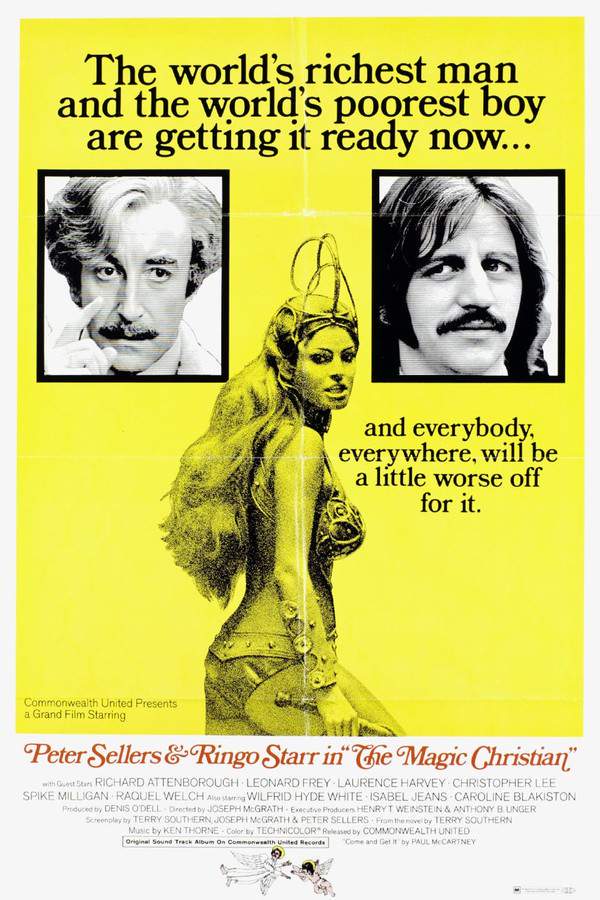
The Magic Christian 1969


Directed by

Roman Polanski

Where to Watch The Magic Christian
See current US streaming, rental, and purchase options for The Magic Christian (1969) via JustWatch.










The Magic Christian Plot Summary
Read the complete plot summary and ending explained for The Magic Christian (1969). From turning points to emotional moments, uncover what really happened and why it matters.
Sir Guy Grand, Peter Sellers — an eccentric billionaire — teams up with his newly adopted heir, Youngman Grand, a homeless man sleeping in the park, to stage a string of elaborate pranks designed to test a provocative notion: that everyone has their price, and the amount it takes to reveal it will vary with the stakes and the audience. Their scheme unfolds as a gradual, increasingly audacious social experiment meant to educate the world in Grand’s own peculiar way, all while maintaining an outward air of composed politeness and charm.
The duo starts with smaller, sharper jests that graze social pretensions before escalating to bolder calls for cash and consent. They bribe a Shakespearean actor to undress during a live performance of Hamlet and coax a traffic warden to revoke a parking ticket—and even to consume the torn ticket itself, delighted by the bribe and the absurdity of the act. These early capers set the tone: mischief with a utilitarian veneer, a show designed to demonstrate a cynical economic principle, all conducted with a calm, almost ceremonial restraint that keeps the pair’s cool perception intact even as the reactions around them melt into farce.
The first major confrontation with the art world arrives at Sotheby’s, where an ostensibly valuable Rembrandt School portrait is discussed as an asset that might fetch around £10,000. In a bold, almost surgical move, Grand places a pre-auction bid of £30,000, then—once the painting is secured—slashes the nose from the canvas with a pair of scissors. The shocked director at the auction house, Mr. Dugdale, is left speechless as the act transforms from a purchase into an assault on the painting itself. The shock reverberates through the room, and the incident becomes a stark illustration of Grand’s philosophy: the price of art—indeed of anything—may be altered by audacity and money, if one is bold enough to wield them.
As the pranks broaden to the dining room and the public square, Grand and Youngman Grand inhabit different social spheres with the same casual ease. In a fashionable restaurant, Grand eats with theatrical excess, becoming perhaps the loudest, most conspicuous patron in the establishment. Then the pair shift to sport and spectacle: during the annual Boat Race, Grand manipulates the Oxford Crew to ram the Cambridge boat, securing an outrageously unfair victory, while a pheasant hunt culminates in the dramatic use of an anti-aircraft gun to bring down a single bird. The tone remains wry and cool, even as the actions become increasingly provocative and politically unsettling.
Their eventual ascent into the world of luxury travel brings them aboard The Magic Christian, a floating microcosm of the upper crust. The voyage features lookalikes of real luminaries, including John Lennon, Yoko Ono, Jacqueline Kennedy, and Aristotle Onassis, a theatrical mirror held up to the excess and performative glamour of a closed social circle. Among the passengers, a transgressive, almost surreal atmosphere unfolds: a solitary drinker at the bar is approached by a transvestite cabaret singer [Yul Brynner], a ship’s waiter is joined by a chessboard of oddities in the form of a vampire in waiting, and a cinema reel presents a controversial head transplant—an unspoken indictment of the boundaries between science, spectacle, and ethics. A captain—Captain Reginald K. Klaus—presides over the gathering with a drunk blunder that seems to mock the entire enterprise from the helm.
The voyage’s crescendo arrives in a hidden, almost ceremonial ritual: the Priestess of the Whip, aided by two topless drummers, commands a vast cadre of enslaved performers. They are bound and choreographed in a way that mirrors a ship’s decked theater, a grotesque tableau that underscores Grand’s belief that the most intimate boundaries of society can be publicly tested and exposed. The passengers gradually realize that the ship is not at sea at all but a colossal structure built inside a warehouse, a stage set that looks convincing enough to fool even the most jaded observer. Inside, a dramatic inscription—SMASH CAPITALISM—appears on the warehouse wall, underscoring the film’s satirical indictment of wealth and power, as the Grands observe with studied calm.
As the spectacle concludes, Grand escalates his act of public “education” by filling a huge vat with urine, blood, and animal excrement, then dumping thousands of banknotes into the liquid. He broadcasts a loud invitation: “Free money!” and entices a crowd of city workers to dive in and reclaim the cash that sinks below the surface of the vat. The moment is punctuated by Thunderclap Newman’s propulsive anthem, Something in the Air, lending a jubilant, anarchic energy to the climactic mass gathering.
Throughout it all, Guy Grand and Youngman Grand maintain a composed, almost serene demeanor, even as the world around them spirals into chaos and revelation. When the last scene returns them to the park where the film began, they bribe the park warden Wilfrid Hyde-White to let them lie down and sleep there, arguing, in effect, that this quiet, unremarkable act is a more direct route to their aims than any grand spectacle could be. The film closes on a note of cool detachment, inviting the audience to reflect on the nature of price, value, and the price of simply existing within a system that constantly tests the limits of what money can buy.
The Magic Christian Timeline
Follow the complete movie timeline of The Magic Christian (1969) with every major event in chronological order. Great for understanding complex plots and story progression.
Theatre prank during Hamlet
Guy Grand and his newly adopted heir bribe a Shakespearean actor to strip during a live performance of Hamlet. The audacious moment tests social boundaries and exposes how people react when money is involved. It establishes the film's central joke that everyone has their price, given enough incentive.
Traffic warden bribery and ticket consumption
Grand persuades a traffic warden to cancel a parking ticket and even devour the ticket's plastic covering. The warden eagerly complies, savoring the bribe and the absurdity of the request. The scene underscores the film's satirical attack on bribery as social currency.
Rembrandt portrait auction and nose cutting
At Sotheby's, Grand learns a Rembrandt School portrait might fetch around £10,000, but he makes a pre-auction bid of £30,000 to secure it. After the purchase, he cuts the nose from the canvas with scissors, shocking the bewildered director Mr. Dugdale. The act demonstrates his view that value is arbitrary and purchasable.
Restaurant gluttony show
In an elegant restaurant, Grand stages a loud display of gluttony, becoming the institution's most conspicuous patron. He orders extravagant dishes and dominates the scene with an ostentatious appetite. The moment satirizes excess as a form of performance and control.
Bribed Boat Race victory
During the annual Oxford rowing race, Grand bribes the Oxford coach to have their boat ram the Cambridge shell. Cambridge's crew is unfairly defeated, and the spectators react with a mix of disbelief and amusement. The prank illustrates his belief that sport and society can be steered by money.
Pheasant hunt disruption
In a traditional pheasant hunt, Grand uses an anti-aircraft gun to down a bird, turning a rural ritual into a spectacle of power. The gun's whistle cuts through the hunt, leaving the participants both horrified and amused. The episode broadens the scope of his social experiments.
Boarding The Magic Christian
Guy and Youngman purchase tickets for the luxury liner The Magic Christian and join the ship's richest passengers. They present themselves as observers of high society, ready to test its values. The voyage is cast as a controlled stage for their moral theater.
Onboard mischief and surreal encounters
On board, a solitary drinker is approached by a flamboyant cabaret singer who may be a transvestite, provoking uneasy reactions. A vampire poses as a waiter, adding to the surreal disruption of normal service. The ship's atmosphere turns into a carnival of outrageous social provocations.
Unsettling cinema scene: head transplant
A cinema sequence aboard the ship shows the unsuccessful transplant of a black person's head onto a white body, provoking distress and disbelief among the guests. The sensational scene is another extreme test of social boundaries under pay. It reinforces the film's critique of commodification and racial boundaries.
Captain drunkenness and gorilla intervention
The ship's captain appears in a drunken stupor and is carted off by a gorilla, amplifying the sense that everything aboard is unraveling. Panic spreads as guests realize something is terribly wrong with their voyage. The moment escalates the satire toward its climax.
Machine room ritual and spectacle
A crowd is directed to the machine room where the Priestess of the Whip, aided by topless drummers, conducts a ritual with hundreds of slave girls chained to the ceiling. The scene is visually shocking and deliberately dehumanizing. It crystallizes the film's critique of spectacle and power.
Warehouse reveal and 'SMASH CAPITALISM'
Passengers break out into daylight only to discover the ship is actually a structure inside a warehouse and that they have never left London. A large painted sign reading 'SMASH CAPITALISM' appears on the interior wall as the crowd stumbles to freedom. The reveal reframes the voyage as a meticulously staged social experiment.
Free money vat spectacle
Grand fills a huge vat with urine, blood, and animal excrement and saturates it with thousands of banknotes. He entices crowds of workers by shouting 'Free money!' and they dive in to recover the cash. The chaotic scene culminates in a riotous display of greed and release.
Ending back in the park
Back in the park where the story began, Grand and Youngman bribe the park warden to let them sleep there, suggesting this simple act is a more direct method to achieve their ends. They remain calm and collected, mirroring the earlier coolness of their social experiments. The film closes on their unwavering, amused expressions.
The Magic Christian Characters
Explore all characters from The Magic Christian (1969). Get detailed profiles with their roles, arcs, and key relationships explained.
Sir Guy Grand (Peter Sellers)
An eccentric, supremely confident billionaire who treats wealth as a scientific tool for social reform. He engineers elaborate pranks with chilling calm, deriving amusement from the disruption of others' certainties. His philosophy that 'everyone has a price' guides the film's escalating stunts and exposes the fragility of social morals under wealth's pressure.
Youngman Grand (Ringo Starr)
The homeless man taken in as Guy Grand's adoptive heir, a cynical observer who gradually reveals a curious, perceptive innocence. He becomes the moral barometer of the story, asking whether society's rules apply when money speaks loudly enough. His perspective grounds the satire in human vulnerability rather than mere farce.
Director in Sotheby's (John Cleese)
The curator-like figure who witnesses the Rembrandt's nose being cut and the pre-auction bravura. He embodies the cultivated rationality of the art world suddenly confronted by profiteering performance; his shock exposes the fragility of institutions when money talks.
Oxford Coach (Richard Attenborough)
The commanding coach of the Oxford rowing team who agrees to a bribe to ram the Cambridge boat. His willingness to manipulate a classic athletic contest demonstrates how deeply wealth and status can infiltrate even traditional, revered institutions. His actions become a crucial hinge in the satire of privilege and competition.
Dame Agnes Grand (Isabel Jeans)
A matriarch of the Grand clan, embodying the aristocratic self-assurance and social gatekeeping that the pranks critique. She benefits from the spectacle as a symbol of established privilege, and her presence underscores the class-centered lens through which the jokes unfold.
Priestess of the Whip (Raquel Welch)
A provocative figure in the ship-bound sequence who leads the ceremonial slave-girl tableau. Her appearance amplifies the film's surreal, carnival-like atmosphere and comments on the exploitation and spectacle associated with power.
Solitary Drinker (Roman Polanski)
A lone patron at the ship's bar who embodies the crowd's complicity and detachment as the chaos unfolds. His presence punctuates the film's themes of loneliness within public excess and the ease with which ordinary people become part of an extravagant spectacle.
The Magic Christian Settings
Learn where and when The Magic Christian (1969) takes place. Explore the film’s settings, era, and how they shape the narrative.
Time period
1960s
The events take place in the late 1960s London milieu, a period of counterculture and media spectacle. Real-world icons and lookalikes appear as part of a satirical panorama of wealth and fame. The narrative treats contemporary institutions—art houses, universities, and luxury liners—as stages for social experiments, reflecting the era's curiosity about money, status, and mass media.
Location
London, The Magic Christian (Ship), Sotheby's Auction House, Thames River (London), Park (London)
The story unfolds across a London-centric stage: the upscale world of Sotheby's and high society aboard the luxury liner The Magic Christian, as well as everyday city spaces like parks and public quays along the Thames. The shipboard misadventure is staged as a self-contained illusion within a warehouse, revealing how the city's famous locations can double as stages for spectacle. The settings juxtapose elegant interiors with crowded urban spaces, highlighting wealth's reach and the performative nature of modern life.
The Magic Christian Themes
Discover the main themes in The Magic Christian (1969). Analyze the deeper meanings, emotional layers, and social commentary behind the film.
💸
Capitalism Satire
The film treats money as a social lever, testing how far people will go for a bribe and what they will sacrifice to maintain appearances. Guy Grand's orchestration exposes how consumer culture and wealth steer behavior, often erasing ethical boundaries. The Rembrandt nose-cut, the boat race manipulation, and the burial of cash reveal a spectrum of incentives that reduce humans to market transactions.
🎭
Spectacle of Society
Pranks and staged vignettes turn public spaces into theaters where social roles are mocked and probed. The film uses lookalikes, outrageous performances, and ritualistic debauchery to critique fame, media sensationalism, and the voyeuristic appetite of audiences. By presenting serious scenes as mass entertainment, it questions what is considered art, entertainment, and acceptable spectacle.
👑
Aristocracy and Power
The elite and their rituals—gilded restaurants, auctions, and yacht-like fantasies—are exposed as fragile façades that money can subvert. Grand's patronage and the assembled wealth reveal how privilege shapes reality, control, and social norms. The closing signs of 'SMASH CAPITALISM' inside a warehouse underscore the tension between wealth, power, and genuine societal progress.

Coming soon on iOS and Android
The Plot Explained Mobile App
From blockbusters to hidden gems — dive into movie stories anytime, anywhere. Save your favorites, discover plots faster, and never miss a twist again.
Sign up to be the first to know when we launch. Your email stays private — always.
Explore the mobile appThe Magic Christian Spoiler-Free Summary
Discover the spoiler-free summary of The Magic Christian (1969). Get a concise overview without any spoilers.
In a world where wealth and propriety sit atop a fragile façade, Sir Guy Grand—an eccentric billionaire with a penchant for the theatrical—finds his curiosity sparked by an unlikely companion: Youngman Grand, a drifter rescued from a park bench. Together they form an odd partnership that seeks to expose the hidden price tags attached to every corner of society. Their shared belief is simple yet provocative: given the right incentive, anyone—or anything—can be bought, and the amount required will shift with the stakes and the audience.
The film unfolds as a satirical tour through the glittering, pretentious and often absurd layers of modern life. From high‑brow cultural institutions to everyday public spaces, the duo drifts with a calm, almost ceremonial poise, treating each encounter as a social experiment. Their demeanor remains cool and courteous, drawing a stark contrast with the increasingly far‑cical reactions they provoke. This juxtaposition amplifies the film’s anti‑establishment, anti‑war, anti‑trust spirit, turning ordinary interactions into a commentary on greed, power, and the ever‑present lure of profit.
Stylistically, the movie balances dead‑pan wit with surreal, larger‑than‑life set‑pieces, letting absurdity bloom within a meticulously composed visual language. The tone is both wry and unsettling, inviting the audience to laugh while feeling the sting of a critique that never loses its composure. Through a series of escalating, yet deliberately restrained, antics, Guy and Youngman test the elasticity of morality, challenging viewers to question where the line between value and exploitation truly lies. The journey promises a blend of humor and provocation, all delivered with a genteel veneer that masks a deeper, subversive agenda.
Movies with Similar Twists and Themes
Uncover films that echo the narrative beats, emotional arcs, or dramatic twists of the one you're exploring. These recommendations are handpicked based on story depth, thematic resonance, and spoiler-worthy moments — perfect for fans who crave more of the same intrigue.


Featured on this page

What's After the Movie?
Not sure whether to stay after the credits? Find out!
Check out our other apps:

SAT Sphere
Build confidence for the Digital SAT.

Mori Atlas
Discover wild places worth protecting.

Luntero
Search smarter for a home in Amsterdam.

Plot Explained
Unravel movie endings and hidden clues.

Pokechamp
Dive into Pokémon data and battle logic.

Driving Theory
Get ready for your European theory test.

Movie Dust
Plan your next cinema trip with ease.

Musemap
Find art and culture as you travel.

Selkobase
Compare credentials before committing.

Local Manual
Turn an unfamiliar country into practical next steps.

Lernavi
Compare school systems before your next move.

GymRoam
Find a workout stop wherever your plans take you.
Explore Our Movie Platform
New Movie Releases (2026)
Famous Movie Actors
Top Film Production Studios
Movie Plot Summaries & Endings
Major Movie Awards & Winners
Best Concert Films & Music Documentaries
Movie Collections and Curated Lists
© 2026 What's After the Movie. All rights reserved.
Privacy Policy