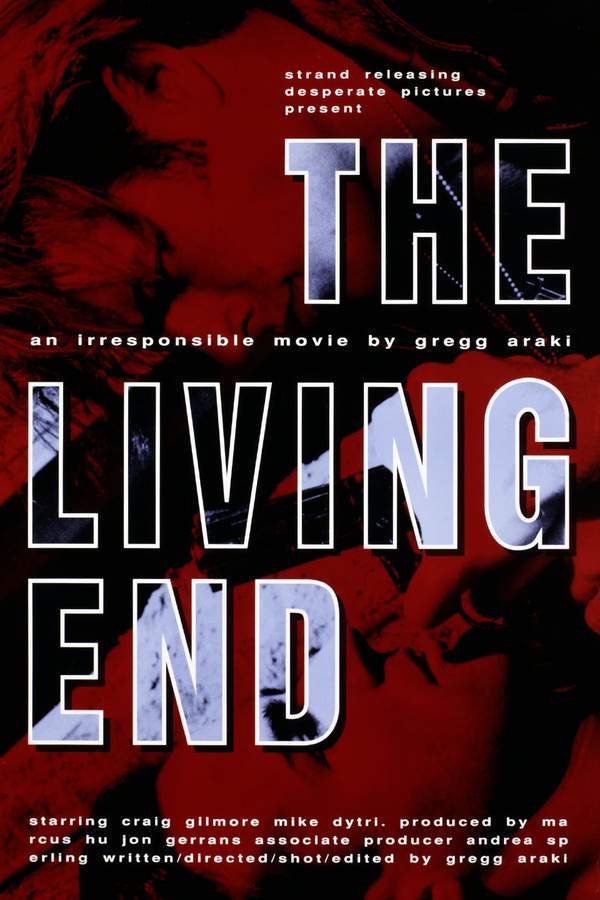
The Living End 1992

Directed by

Gregg Araki
Made by

Cineplex Odeon Films
Where to Watch The Living End
See current US streaming, rental, and purchase options for The Living End (1992) via JustWatch.

Metrograph
HD
MUBI
HD
MUBI Amazon Channel
HD
Strand Releasing Amazon Channel
HD
Kanopy
HD
Amazon Video
HD
Apple TV Store
HD
Google Play Movies
SD
YouTube
SD Streaming availability powered by 
The Living End Plot Summary
Read the complete plot summary and ending explained for The Living End (1992). From turning points to emotional moments, uncover what really happened and why it matters.
In the gritty depths of Los Angeles, the story follows Jon, a young film critic who is grappling with profound depression following his diagnosis with HIV. His emotional turmoil sets a somber tone as he navigates a city filled with chaos and uncertainty. Simultaneously, we meet Luke, a reckless drifter whose impulsive nature leads him into a series of dangerous encounters, starting with a violent attempt to steal a car from a pair of lesbians, Fern and Daisy. After they stop to use the bathroom, Luke hijacks their vehicle but soon finds himself stranded with a punctured tire, forcing him to continue hitchhiking to his destination.
One night, Luke is picked up by a man named Ken, whose hospitality takes an unexpected turn when they share an intimate moment at his house. Unfortunately, Luke’s presence is short-lived as Barbie, Ken’s wife, discovers them in bed and reacts with lethal violence, stabbing Ken to death. Fleeing the scene, Luke’s night spirals further out of control as he is confronted by three gay bashers wielding baseball bats. In a desperate act of self-defense, Luke shoots at them with the gun he stole earlier from Fern and Daisy, managing to escape the danger but leaving a trail of chaos behind.
In a chance encounter, Luke flags down a passing motorist, who turns out to be Jon. Reluctantly, Jon invites Luke to stay for the night. As they spend time together, they discover they share a common and devastating secret — both are HIV-positive. Their connection deepens as they share an intimate night, where Luke boldly claims that their shared infection means they have nothing to lose, leading to a passionate and daring encounter. The following morning, they indulge in reckless spending, using a stolen credit card from Ken to go shopping. Their freedom is short-lived when a neo-Nazi verbally assaults them with homophobic slurs, and Luke’s anger erupts violently, killing him with a large portable cassette player.
This act of violence causes Jon to become uneasy, and he decides to eject Luke from his life. Nonetheless, Jon confides in his closest friend Darcy that he can’t stop thinking about Luke, revealing the complex and unhealthy attachment forming between them. One night, Jon awakens to find a bloodied Luke in his bedroom, threatening self-harm and confessing that he might have killed a police officer. Distressed, Luke urges Jon to leave town with him, hinting at a desire for escape and absolution. Agreeing, Jon drives Luke north to California, hoping for a fresh start.
Their journey leads them to San Francisco, but Luke’s supposed friend there turns him away without a word, leaving them to search for shelter. As they travel, they continue to use stolen money to stay in motels. Tensions rise after Luke almost shoots a police officer during a traffic stop, reflecting his increasing volatility. Jon begins to regret their union, wishing he had never met Luke, but Luke insists they should seize whatever fleeting moments of happiness they can find, revealing his dark wish to die during sex and asking Jon to be the one to end his life. As Luke’s health deteriorates, marked by a harsh cough, tensions flare further. Luke robbing a bank at gunpoint — unable to withdraw cash — underscores his spiraling instability.
Jon, overwhelmed by everything, decides to return home to Los Angeles, telling Darcy he’s coming back and ending their road trip. However, Luke’s grip on reality slips completely as he declares that Jon will never find someone who cares for him as much as he does. In a tense confrontation, Luke threatens Jon with a gun and pistol-whips him into unconsciousness during a struggle over the weapon. When Jon awakens, he finds himself tied to a beach, where Luke, holding the gun to his own mouth, rapes him.
The climax intensifies when Luke pulls the trigger, but the gun is empty. Luke discards the weapon and releases Jon, who then hits Luke and leaves. Yet, in a moment of complicated tenderness, Jon returns to Luke, leaning on his shoulder as the sun sets, revealing the complex, layered emotions—love, pain, and despair—that define their tumultuous relationship.
The Living End Timeline
Follow the complete movie timeline of The Living End (1992) with every major event in chronological order. Great for understanding complex plots and story progression.
Jon is diagnosed with HIV in Los Angeles
Jon, a withdrawn young film critic, struggles with depression after being diagnosed with HIV. This event establishes his emotional state and sets the tone for his journey. The diagnosis marks a pivotal moment in his life, prompting reflection and a sense of vulnerability.
Luke hitches a ride and steals a car
Reckless drifter Luke is picked up by a pair of lesbians, Fern and Daisy. When they stop for a bathroom break, Luke steals their car amidst a tense confrontation. He resumes hitchhiking after a flat tire leaves him stranded.
Luke is picked up by Ken and has sex
That night, Luke is picked up by Ken, who takes him to his home. They engage in sexual activity, which introduces Luke’s complex relationships and behavior. Things take a dark turn when Ken's wife Barbie catches them and kills Ken in a fit of rage.
Luke flees after Ken's murder
Following Barbie's murder of Ken, Luke escapes the scene, becoming a fugitive. His flight signifies a turning point as he tries to evade authorities and confront his chaotic life, emphasizing his reckless behavior.
Luke is attacked by gay bashers and shot
Luke is assaulted by three gay bashers with baseball bats. Using the stolen gun, he defends himself by shooting them, highlighting his violent and desperate response to threats. His survival marks a violent confrontation with his environment.
Jon picks up Luke and they discover they are both HIV-positive
Jon, a reluctant stranger, picks up Luke and invites him to stay the night. They learn they share the same HIV status, which deepens their connection. Their emotional vulnerability leads to a sexual relationship.
Jon and Luke go shopping and encounter homophobic slurs
After their night together, Jon and Luke go shopping with a stolen credit card. They face homophobic slurs from a neo-Nazi, prompting Luke to violently attack and kill him. This incident underscores the violence and hatred surrounding them.
Jon throws Luke out and struggles with his feelings
Nervous about Luke's violent temper, Jon ejects him from his house. Despite this, Jon confides in his friend Darcy about his persistent thoughts of Luke, revealing his internal conflict and attachment.
Luke confronts Jon, shares suicidal thoughts, and they travel to California
Luke, disturbed and suicidal, threatens to shoot himself. He urges Jon to leave with him, and they embark on a road trip to Northern California in search of Luke's friend. Their journey becomes an exploration of desperation and connection.
Luke's friend rejects him in San Francisco
In San Francisco, Luke’s friend rejects him without explanation, forcing Luke and Jon to keep searching for refuge. This rejection leaves Luke feeling isolated and intensifies their unstable situation.
Luke and Jon continue their road trip, using stolen credit cards
The duo continues traveling, paying for motels with stolen credit cards. During the trip, Luke nearly shoots a police officer after receiving a parking ticket, revealing his impulsive and volatile nature.
Jon wishes he had never met Luke; Luke seeks to die
Tensions rise as Jon expresses regret about their relationship, wishing he had never met Luke. In response, Luke proposes that Jon kill him, sharing his desire to die, which highlights the depth of his despair and emotional turmoil.
Luke robs a bank after falling ill
Luke becomes sick, coughing heavily, and in a tormented state, he robs a bank at gunpoint with Jon. This act of desperation underscores his downward spiral and increasing recklessness.
Jon plans to leave; Luke threatens and rapes him
Jon decides to return to Los Angeles, but Luke, holding a gun, threatens Jon and their relationship reaches a breaking point. Luke then forces Jon into a sexual assault while holding the gun to his own head, symbolizing the destructive nature of their bond.
Luke's gun misfires, and the film ends with their complicated relationship
Luke attempts to shoot himself, but the gun misfires, leaving him alive. He unties Jon, who eventually leaves after punching Luke. Later, Luke leans on Jon, and they share a moment of ambiguous intimacy at sunset, ending the story on a complex note.
The Living End Characters
Explore all characters from The Living End (1992). Get detailed profiles with their roles, arcs, and key relationships explained.
Jon (young film critic)
Jon is a withdrawn, depressed young man battling HIV. His character embodies vulnerability, introspection, and the search for connection. Despite his emotional scars, he seeks solace and meaning through his relationship with Luke, grappling with love and mortality.
Luke (reckless drifter)
Luke is impulsive, violent, and emotionally unstable, often acting out in destructive ways. His reckless demeanor masks inner pain and a desire for self-destruction. His complex relationship with Jon highlights themes of obsession, loss, and the quest for acceptance.
The Living End Settings
Learn where and when The Living End (1992) takes place. Explore the film’s settings, era, and how they shape the narrative.
Time period
Late 20th century (likely the 1980s or early 1990s)
The film is set during a period characterized by the AIDS crisis, homophobia, and social upheaval. This era saw increasing awareness of HIV/AIDS, with significant social stigmas and activism. The time period influences the characters' experiences and the societal reactions they face.
Location
Los Angeles, San Francisco
The movie takes place primarily in Los Angeles and San Francisco, two iconic Californian cities. Los Angeles is known for its entertainment industry and vibrant urban life, while San Francisco is famous for its hilly landscape, LGBTQ+ community, and historic landmarks. Both cities serve as dynamic backdrops that reflect the characters' struggles and journeys.
The Living End Themes
Discover the main themes in The Living End (1992). Analyze the deeper meanings, emotional layers, and social commentary behind the film.
🔥
Self-Destruction
The film explores themes of self-destruction through the characters' reckless behaviors and violence. Luke’s violent temper and impulsive actions contrast with Jon’s internal struggle with depression and illness. The narrative highlights the destructive consequences of despair and the search for meaning amidst chaos.
💔
Love and Pain
A central theme is the tumultuous relationship between Jon and Luke, marked by passion, violence, and vulnerability. Their connection underscores the complexity of intimacy amidst emotional and physical turmoil. The film examines how love can be both a source of comfort and pain in the face of mortality.

Coming soon on iOS and Android
The Plot Explained Mobile App
From blockbusters to hidden gems — dive into movie stories anytime, anywhere. Save your favorites, discover plots faster, and never miss a twist again.
Sign up to be the first to know when we launch. Your email stays private — always.
Explore the mobile appThe Living End Spoiler-Free Summary
Discover the spoiler-free summary of The Living End (1992). Get a concise overview without any spoilers.
In the sun‑bleached sprawl of Los Angeles, a city that feels simultaneously endless and suffocating, Jon drifts through his days as a film critic haunted by quiet desperation. His world is one of sharp wit and restless intellect, yet it is shadowed by a recent, life‑changing diagnosis that forces him to confront the fragility of his future. Across town, the open road calls to Luke, a free‑spirited drifter whose restless energy is matched only by the reckless abandon with which he lives. Both men carry the same invisible weight, a diagnosis that isolates them even in a city full of strangers.
Their paths intersect in a chance encounter that feels both inevitable and startlingly serendipitous. The moment they recognize their shared condition, a fragile connection forms, pulling them out of their solitary routines and onto an impulsive, uncharted journey. The road ahead beckons with the promise of possibility, offering them a space to explore the raw, unfiltered edges of life away from the familiar confines of Los Angeles. As they set out, the landscape shifts from urban glare to the expansive, ever‑changing horizons of the California highway, reflecting the internal transformation they both seek.
The tone of their odyssey is gritty yet lyrical, balancing moments of dark humor with poignant introspection. The film invites viewers into a world where love, fear, and desire intertwine, and where the characters grapple with the urgency that comes from knowing time may be limited. Their evolving bond is grounded in candid conversation, shared silences, and the unspoken yearning for acceptance. As they navigate the open road, the audience is drawn into a meditation on mortality, freedom, and the unexpected ways two strangers can become each other’s most vital compass.
Movies with Similar Twists and Themes
Uncover films that echo the narrative beats, emotional arcs, or dramatic twists of the one you're exploring. These recommendations are handpicked based on story depth, thematic resonance, and spoiler-worthy moments — perfect for fans who crave more of the same intrigue.

Featured on this page

What's After the Movie?
Not sure whether to stay after the credits? Find out!
Check out our other apps:

SAT Sphere
Build confidence for the Digital SAT.

Mori Atlas
Discover wild places worth protecting.

Luntero
Search smarter for a home in Amsterdam.

Plot Explained
Unravel movie endings and hidden clues.

Pokechamp
Dive into Pokémon data and battle logic.

Driving Theory
Get ready for your European theory test.

Movie Dust
Plan your next cinema trip with ease.

Musemap
Find art and culture as you travel.

Selkobase
Compare credentials before committing.

Local Manual
Turn an unfamiliar country into practical next steps.

Lernavi
Compare school systems before your next move.

GymRoam
Find a workout stop wherever your plans take you.
Explore Our Movie Platform
New Movie Releases (2026)
Famous Movie Actors
Top Film Production Studios
Movie Plot Summaries & Endings
Major Movie Awards & Winners
Best Concert Films & Music Documentaries
Movie Collections and Curated Lists
© 2026 What's After the Movie. All rights reserved.
Privacy Policy