What Is The Emperor's New Clothes About?
The premise of The Emperor's New Clothes in 321 words, with nothing given away. The full story follows below.
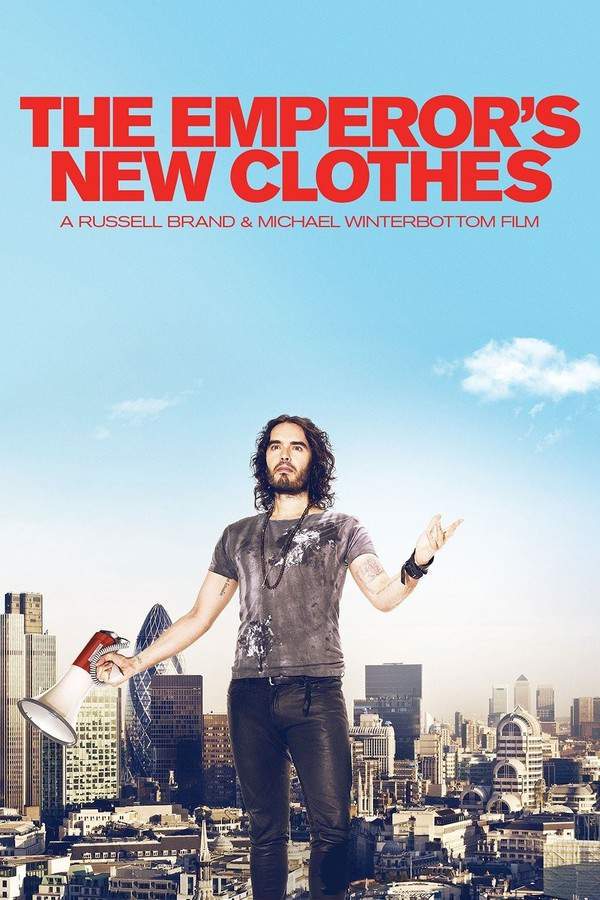
Michael Winterbottom’s documentary turns the 2008 financial crisis into a lens for examining a world where economic power feels both abstract and painfully personal. Through Russell Brand, the film moves between archival images of market turmoil and the polished centers of finance in London and New York, creating a tone that is playful, confrontational, and increasingly uneasy. The result is neither a conventional lecture nor a neat investigative thriller; it is an immersive argument about how policy, wealth, and social responsibility shape everyday life.
Brand serves as the documentary’s central guide, though not as a conventional on-screen protagonist. His restless energy and instinct for parody allow him to approach weighty subjects from unexpected angles, transforming economic systems into questions that can be felt, questioned, and challenged. The contrast between his comic performances and the seriousness of the material gives the film its distinctive rhythm: humor becomes a way to expose distance, arrogance, and the absurd extremes of a deeply unequal society.
The focus is on the widening gap between the wealthy few and everyone else, particularly the question of why so little appears to have changed since the global financial crisis. As Brand inhabits spaces associated with powerful institutions and privileged elites, the documentary broadens the meaning of inequality. It connects abstract decisions about markets and taxation with the human realities of people who have little protection from those decisions. Archival footage lends historical weight, while the present-day material keeps the consequences immediate and difficult to ignore.
Rather than reducing economics to a detached series of figures, the film presents it as a force that organizes lives, opportunities, and power. Brand’s visible curiosity and indignation invite viewers to look more closely at the systems surrounding them. The documentary’s world is one of stark contrasts—financial grandeur beside private struggle, comic provocation beside moral frustration—leaving the audience invited to consider who benefits, who bears the cost, and why the divide continues to grow.
What Happens in The Emperor's New Clothes?
The complete story of The Emperor's New Clothes, from the first scene to the last, in 177 words (about 1 minute). Spoilers throughout.
Spoilers ahead
This documentary blends archival footage from the 2008 financial crisis and the Great Recession with a series of comedic send-ups led by Russell Brand, filmed across the financial hubs of New York and London. The film seeks to examine the persistence of systemic inequality, questioning why so little has changed since the economic collapse.
One notable sequence involves Brand attempting to confront Lord Rothermere, the billionaire owner of the Daily Mail, regarding his “non-dom” tax status used to avoid UK taxes. While ringing the bell at Rothermere’s London mansion, Brand is informed via intercom that the billionaire does indeed reside there.
Director Ben Winterbottom explains the core motivation behind the project:
“It’s about inequality and why the 1 percent (of the world’s wealthy) seem to have so much and the rest of us not quite so much… the idea is to point out the ludicrous extremes of our society.”
The project, which began filming in October, marks a collaboration between Winterbottom and Brand, who had previously considered—but eventually scrapped—a cinematic adaptation of Brand’s memoir, My Booky Wook.
The Emperor's New Clothes Timeline: Every Key Event in Order
13 key events in the order they happen, from “The 2008 Financial Crisis” to “Assembling the Finished Film”. 5 events name a place, across 4 locations.
- 1
The 2008 Financial Crisis
The global financial system collapses in 2008, triggering one of the most severe economic downturns in modern history. Banks fail, markets tumble, and ordinary people are left to bear the fallout. The documentary draws on archival footage from this period to ground its story in real events.
When:2008
- 2
The Great Recession Follows
The financial crisis leads into the Great Recession, an extended period of economic hardship felt around the world. The documentary incorporates archival footage from this era to show the lasting damage done to ordinary citizens. This material serves as the backdrop against which the film measures how little has changed.
When:Late 2000s
- 3
A 'My Booky Wook' Film Is Considered
Director Michael Winterbottom and Russell Brand previously discussed producing a film version of Brand's first memoir, 'My Booky Wook'. The pair weighed how to bring Brand's autobiography to the screen. Ultimately, the idea was abandoned as the two moved in a different creative direction.
- 4
A New Direction: Tackling Inequality
Rather than adapting the memoir, Winterbottom and Brand turn their attention to a documentary about wealth and inequality in the aftermath of the 2008 financial crisis. The project takes aim at why the world's financial systems remain unchanged despite widespread hardship. This new concept becomes the foundation of the film.
- 5
Winterbottom Talks to the BBC
In October 2014, Winterbottom tells the BBC that the film will explore why 'nothing has changed' since the 2008 financial crisis. He frames the documentary as a direct response to the stagnation that followed the crash. The statement offers an early preview of the film's central argument.
When:October 2014
- 6
Exposing the 'Ludicrous Extremes' of Society
Winterbottom explains that the film is about inequality and why the 1 percent of the world's wealthy seem to have so much while the rest of the world has not quite so much. He argues that everyone already knows what is going on in the world, so the idea is to point out the ludicrous extremes of society. This framing becomes the mission statement of the production.
When:October 2014
- 7
Shooting Begins
The documentary begins shooting in October, marking the official start of production. With Winterbottom directing and Brand fronting the film, the crew sets out to capture both historical context and present-day commentary. Filming combines archival material with newly staged segments.
When:October 2014
- 8
Comedic Send-Ups in London's Financial District
Russell Brand performs comedic send-ups in the financial districts of London, using humor to confront the world of high finance. The sketches blend satire with genuine criticism of the banking industry. These comedic segments become a signature element of the documentary.
Where:Financial district, London
- 9
Comedic Send-Ups in New York's Financial District
The production also stages Brand's comedic send-ups in the financial district of New York. Like the London segments, these pieces juxtapose playful provocation with serious questions about wealth and power. Filming in both cities underscores the global nature of the financial system being critiqued.
Where:Financial district, New York
- 10
Targeting Lord Rothermere's 'Non-Dom' Tax Status
In one of the film's key scenes, Brand attempts to confront Lord Rothermere, the billionaire owner of the Daily Mail. The subject of the confrontation is Rothermere's 'non-dom' tax status, through which he avoids paying taxes in the United Kingdom by claiming residence elsewhere. Brand takes this grievance directly to the media mogul's doorstep.
Where:London
Show the other 3 events of The Emperor's New Clothes Hide the last 3 events
- 11
Ringing the Bell at Rothermere's Mansion
Brand arrives at Lord Rothermere's London mansion and rings the front doorbell. Through the intercom, he asks to speak with Rothermere in person, hoping to press the billionaire directly on his tax arrangements. The moment captures Brand's confrontational approach to the film's subject matter.
Where:Lord Rothermere's mansion, London
- 12
An Answer Through the Intercom
An unseen person responds to Brand's request through the intercom at Rothermere's mansion. He is told that Rothermere does indeed live there, confirming the billionaire's presence at the property. The brief exchange underscores how inaccessible the billionaire remains, even to someone standing at his own front door.
Where:Lord Rothermere's mansion, London
- 13
Assembling the Finished Film
The completed documentary pairs archival footage from the 2008 financial crisis and the Great Recession with Brand's comedic send-ups. By mixing historical record with satire, the film builds a portrait of a system that has continued unchecked. The final cut embodies Winterbottom's goal of showing why nothing has changed since the crash.
Who Are the Main Characters in The Emperor's New Clothes?
Russell Brand: who they are and the part they play in the story.
- RB
Russell Brand
Russell Brand plays a pivotal role in the documentary, using his comedic talents to expose the absurdities of wealth and inequality. His confrontational style adds a dynamic layer to the narrative, as he engages directly with figures representing the elite. Brand's wit and charm balance the serious tone of the documentary, making the heavy topic more accessible to viewers.
- 🎤 Comedian
- 📢 Activist
Where and When Is The Emperor's New Clothes Set?
The Emperor's New Clothes is set in New York and London (2008). Here is why the time and place matter to the story.
When
2008
The movie captures the aftermath of the 2008 financial crisis, a significant event that led to a global recession. This period was characterized by widespread economic hardship, the collapse of major financial institutions, and increased scrutiny of the wealth distribution. The documentary seeks to highlight how little has changed in terms of systemic inequality since that pivotal moment in history.
Where
New York, London
The film is set in two major financial hubs, New York and London, known for their influential role in the global economy. Both cities are pivotal in the discussion of systemic inequality, especially in the context of the financial crisis. Their bustling streets and financial districts symbolize the stark contrast between the wealthy elite and the struggling masses.
- 🏙️ City
- 📈 Finance
What Are the Themes of The Emperor's New Clothes?
2 ideas the story keeps returning to, among them Inequality and Satire.
-
01
Inequality
The central theme of the documentary is inequality, exploring the vast disparity between the wealthy and the impoverished in society. It raises critical questions about wealth distribution and power structures, particularly focusing on the top 1% who seem insulated from the challenges faced by the majority. Through humorous commentary and serious inquiry, the film invites viewers to reflect on the persistence of these issues.
-
02
Satire
Utilizing comedic send-ups, the film employs satire to critique the structures that perpetuate financial inequality. Russell Brand's humorous approach serves as a vehicle to highlight the absurdities of the economic system. This blend of humor and serious commentary engages audiences, encouraging them to think critically about societal norms and the status quo.
What Kind of Film Is The Emperor's New Clothes?
Dark in tone, with variable pacing and a moderate story, going by the plot summary.
- Tone
- Dark
- Pacing
- Variable
- Story
- Moderate
- Intensity
- Medium
- Ending
- Ambiguous
A darkly comic economic polemic that pairs sharp comedy and confrontational stunts with grim archival evidence of financial collapse, leaving inequality exposed as an urgent, unresolved crisis.
- darkly comic
- satirical
- thought-provoking
- witty
- grim
- confrontational
- economic inequality
- global financial crisis
- bank bailouts
- tax avoidance
Content notes: financial crisis imagery, economic hardship, economic exploitation, tax avoidance discussion.
Quiz
How well do you remember The Emperor's New Clothes? Test yourself on the story.