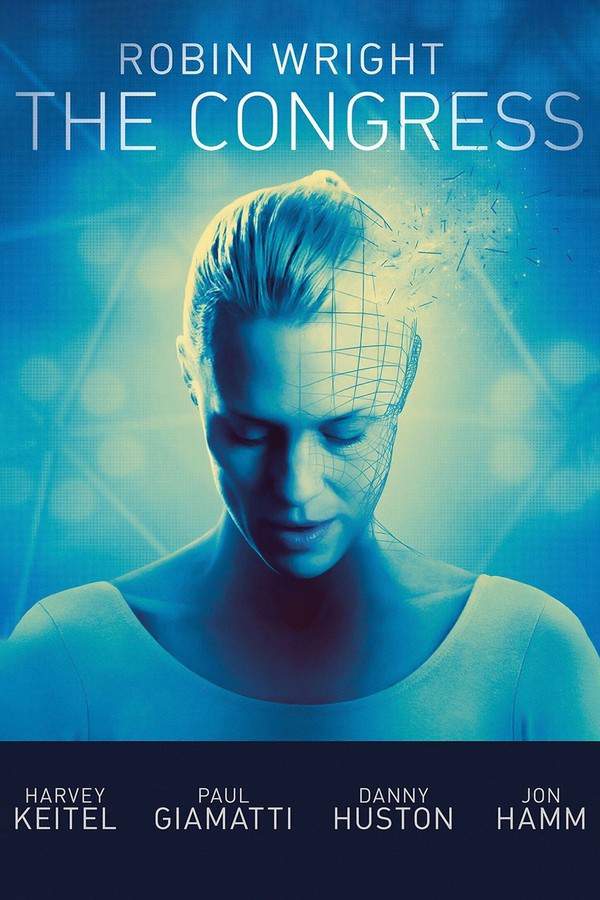
The Congress 2014


Made by

Independent
Where to Watch The Congress
See current US streaming, rental, and purchase options for The Congress (2014) via JustWatch.

Fandor
HD
Hoopla
SD
Kanopy
HD
Pluto TV
SD
The Roku Channel
HD
Xumo Play
HD
Amazon Video
SD
Apple TV Store
HD
Fandango At Home
SD
Google Play Movies
SD
YouTube
SD Streaming availability powered by 
The Congress Plot Summary
Read the complete plot summary and ending explained for The Congress (2014). From turning points to emotional moments, uncover what really happened and why it matters.
Robin Wright is the aging star at the center of a story about fame, memory, and the price of technology that treats actors as consumable assets. Her career has faltered under a reputation for erratic behavior and unreliability, even as she battles personal heartbreak. Her son, Aaron Kodi Smit-McPhee, suffers from Usher syndrome, a condition that slowly robs him of sight and hearing, and she struggles to slow his decline with the help of Dr. Barker as his condition advances toward a terminal stage. Her longtime agent, Al Harvey Keitel, sets up a meeting with Jeff Green Danny Huston, the head of Miramount Studios, a company eager to buy her likeness and digitize her into a computer-generated shell. The offer comes with a stark demand: she must never act again. After her body is scanned, Miramount can produce films starring a CGI version of her, with no need for the real actress on set.
Twenty-something years slip by, and Robin travels to Abrahama City to speak at the Futurological Congress, Miramount’s dazzling entertainment conference. Abrahama City is a surreal, animated utopia born from the imaginations of its inhabitants, a place where anyone can become an avatar, provided they ingest hallucinogenic drugs to enter a mutable, illusory state. In the decades since the scan, her digital persona has become the lead in a blockbuster franchise, Rebel Robot Robin, making her and a certain real-life star one of the last enduring emblems of cinema. As she negotiates a new contract, Miramount unveils a chilling development: a technology that could allow anyone to devour her identity or transform themselves into her using the hallucinogen. She agrees to the deal, yet a steady wave of conscience gnaws at her, convinced that no one should be reduced to a product.
When she is asked to address the Congress, Robin speaks with bold, provocative candor, upsetting fans and executives alike before security moves in. The gathering is attacked by rebels who oppose the industry’s reach, and the assault culminates in the apparent assassination of the Congress’s head. During the chaos, she is rescued by Dylan Truliner Jon Hamm, Miramount’s lead animator, and the two escape only to be captured by Miramount Police. In a shocking moment, Robin appears to be executed by Jeff Green, a punishment for defying the corporation, but doctors later reveal this to be a hallucination born of the hallucinogen’s grip. The medical team concludes that she has become so intoxicated by the drug that she must be frozen until a cure can be found.
Two decades pass, and Robin is revived while still living within a hallucinatory landscape. She reconnects with Dylan, who explains that the hallucinogenic technology is now widespread, letting people take on any form and transforming society in myriad ways—both wondrous and troubling. The two fall in love and roam through a vivid, colorful animated world, yet Robin clings to the desire to return to the real world to be with Aaron. The only path back is a capsule that blocks all hallucinogenic effects, a device in this world that functions as a suicide capsule. Dylan, who negotiated a retirement package with Miramount, arranges one and hands it to her.
Back in reality, Robin discovers a dystopian environment where a tiny, privileged elite hovers above ruined cities in vast airships, while most people have chosen life inside the animated realm. Aaron vanished only six months earlier, having likely created a new identity within that world, and there seems to be no way to locate him. Dr. Barker provides an inhalation ampoule that would let Robin re-enter the animated world, but warns that her experiences will have shifted and she may never be able to re-enter the same world again. With the drug in hand, Robin’s memories of Aaron surge to the fore, and she finally locates him in the middle of an expansive, animated desert.
The Congress Timeline
Follow the complete movie timeline of The Congress (2014) with every major event in chronological order. Great for understanding complex plots and story progression.
Robin's career decline and Aaron's illness
Robin Wright, aging actress, faces a fading career due to erratic behavior and a reputation for being fickle. Her son Aaron suffers from Usher syndrome, gradually losing his sight and hearing. Dr. Barker helps monitor his condition and search for ways to slow its progression.
Miramount proposes digital immortality
Robin meets Miramount's CEO Jeff Green and her agent Al, who propose digitizing her likeness for a new form of stardom. The contract would let Miramount control her image forever and require that she never act again.
The scan and the birth of a CG star
Robin agrees to the deal and undergoes a full body scan so Miramount can create a computer-generated version of her. The studio plans to produce films starring her CG likeness, effectively replacing the living actress.
Twenty years later: Abrahama City and the Congress
Robin travels to Abrahama City for Miramount's Futurological Congress. The city is a surreal animated utopia where avatars are created via hallucinogenic drugs. Rebel Robot Robin, her digital persona, has become a franchise star, and Miramount unveils tech that would allow others to devour or transform into her.
Moral crisis over the new technology
Robin contemplates the deal and experiences a moral crisis, worrying that turning people into products undermines autonomy. She wrestles with the idea of allowing others to inhabit her likeness.
Robin speaks out, faces pushback
Asked to address the public, Robin voices counter to Miramount's direction, upsetting attendees. Security intervenes, and she is pulled away as the Congress becomes unsettled.
Congress attacked; Dylan rescues Robin
The Congress is disrupted by rebels, and its head is seemingly assassinated. Dylan Truliner, Miramount's lead animator, rescues Robin and helps them escape the chaotic scene.
Captured and a staged execution
Robin and Dylan are captured by Miramount Police. Jeff appears to execute Robin as punishment for rebelling, and she is shown on a hospital bed, presumed dead by many.
The truth revealed: the execution was a hallucination
Doctors reveal that the 'execution' was a hallucinatory episode caused by the hallucinogenic environment. Robin's condition is stabilized only by freezing her until a cure can be found.
Two decades pass and Robin is revived
Twenty years elapse and Robin is revived, still living within an animated reality. Dylan explains that hallucinogenic technology is now widespread and shapes everyday life.
Love and a world of imagined possibilities
Robin and Dylan fall in love and journey through vibrant imagined landscapes. Robin longs to return to the real world to be with Aaron, seeking a path back to reality.
A path back: the suicide capsule is secured
To exit the hallucinogenic world, Dylan arranges a capsule that blocks the hallucinogens, effectively a suicide capsule in the animated reality. He negotiates this as part of his retirement package from Miramount.
Back to a dystopian real world
Robin returns to the real world and discovers a dystopian city where a tiny corporate elite rules from airships. Most people have fled to the animated world, and Aaron left six months earlier, likely adopting a new identity.
The final act: finding Aaron in the desert
Robin takes the inhalation ampoule to re-enter the animated world, and her experiences shift as she witnesses Aaron's life flash before her. She ultimately locates Aaron in the middle of an expansive animated desert.
The Congress Characters
Explore all characters from The Congress (2014). Get detailed profiles with their roles, arcs, and key relationships explained.
Robin (Robin Wright)
An aging actress whose career has suffered due to erratic behavior, she agrees to digitize her likeness to secure a financial future. Her arc centers on the tension between continuing fame and preserving humanity, as she confronts the moral costs of becoming a permanent CGI persona.
Aaron
Robin's son who suffers from Usher syndrome, a degenerative condition that gradually robs him of sight and hearing. His life unfolds between the real world and the animated realm, illustrating the personal stakes behind the corporate deal.
Dr. Barker
A medical professional who helps stave off Aaron's decline, but is entangled with Miramount's interests. He embodies the tension between care for a patient and compliance with the corporation's agenda.
Al
Robin's longtime agent who negotiates with Miramount, enabling the digitization deal. He represents the industry’s push toward monetizing star power at any cost.
Jeff Green
CEO of Miramount Studios, a charismatic yet ruthless figure driving the expansion of digital likeness and control over the film industry. He embodies corporate ambition and the thrill of new technology.
Dylan Truliner
Miramount's lead animator who rescues Robin and later becomes a romantic ally in the animated world. He helps bridge the gap between the corporate machine and the human cost of their experiments.
The Congress Settings
Learn where and when The Congress (2014) takes place. Explore the film’s settings, era, and how they shape the narrative.
Time period
Near future
The film unfolds in a near-future era where digital likenesses can be licensed and animated into CGI stars. It follows a twenty-year arc: from the initial digitization of Robin's persona to a later revival in a world dominated by synthetic realities. The time frame blends contemporary industry ambitions with speculative technology, illustrating how memory and identity can be manipulated over decades. The story uses this timeline to explore the erosion of personal autonomy when fame becomes a programmable asset.
Location
Abrahama City, Miramount Studios, the real world (dystopian)
Abrahama City is an animated, surreal utopia born from imagination, accessible through hallucinogenic states that let users become avatars. The city blends dreamlike landscapes with real-world pressures, creating a mutable reality where identity can be reshaped at will. Miramount Studios sits as the dominant real-world power behind the digitization of Robin's likeness, turning actors into perpetual, programmable performances. The two settings intersect as a critique of corporate control over art and the commodification of celebrity.
The Congress Themes
Discover the main themes in The Congress (2014). Analyze the deeper meanings, emotional layers, and social commentary behind the film.
🪙
Identity & Commodification
The movie centers on Robin's sale of her own likeness, transforming a living person into a marketable asset. It probes what happens to individuality when art becomes a tradable commodity. The ethical implications of digital copying, ownership, and consent are questioned as the line between actor and product blurs. The story asks whether true identity can survive when memories, voice, and appearance are monetized.
🌀
Reality vs Illusion
A hallucinogenic, animated world offers an escape from a deteriorating real life, challenging what is considered 'real.' Characters navigate shifting boundaries between dreamlike avatars and tangible consequences. The film uses disorienting visuals to question authenticity and the nature of experience. It suggests that illusion can be both seductive and dangerous.
✊
Resistance & Control
Robin confronts Miramount's monopoly over art and the surveillance of creative labor. Rebels interrupt the Congress, representing broader resistance against corporate domination. The narrative contrasts a utopian fantasy with a dystopian real world ruled by elite power. It explores the costs of defying a system that treats art as property.
🎭
Ethics of Art & Consent
The film raises questions about consent in a world where a person can be re-cast as a digital character without ongoing participation. Robin's crisis of conscience centers on whether transforming herself into a product can ever be justified. The consequences of unchecked technological advancement are weighed against the freedom art can offer. The story warns that the pursuit of perpetual stardom may erode fundamental human rights.

Coming soon on iOS and Android
The Plot Explained Mobile App
From blockbusters to hidden gems — dive into movie stories anytime, anywhere. Save your favorites, discover plots faster, and never miss a twist again.
Sign up to be the first to know when we launch. Your email stays private — always.
Explore the mobile appThe Congress Spoiler-Free Summary
Discover the spoiler-free summary of The Congress (2014). Get a concise overview without any spoilers.
In a near‑future where technology can capture a person’s very essence, a celebrated actress named Robin Wright finds herself balancing a precarious financial reality with the urgent care of her son Aaron, who is slowly losing his sight and hearing. Desperate to secure a future for both of them, she makes a hauntingly modern bargain: she will allow herself to be scanned and turned into a permanent digital avatar, relinquishing any further work in the flesh in exchange for a sizable contract that promises stability for her family.
Two decades later, the avatar that bears her likeness has blossomed into an unstoppable cultural icon, headlining blockbuster franchises and filling stadium‑sized auditoriums with adoring fans. The corporation that birthed this synthetic star now faces the end of its agreement and summons Robin to a surreal convening where the boundaries between tangible reality and imagined constructs begin to blur. The atmosphere is a shimmering mix of glossy corporate spectacle and uncanny, hallucinogenic visual poetry, hinting at a world where identity can be bought, altered, and consumed at will.
The film drifts between stark, intimate moments of a mother’s quiet desperation and the dazzling, otherworldly vistas of a society that has chosen to live inside mutable, drug‑induced fantasies. Its tone is contemplative yet unsettling, inviting viewers to ponder the cost of immortality when it is reduced to pixels and profit. As Robin steps into this liminal space, the story poses a profound question: what remains of the self when the very image that defines you is no longer yours to own?
Movies with Similar Twists and Themes
Uncover films that echo the narrative beats, emotional arcs, or dramatic twists of the one you're exploring. These recommendations are handpicked based on story depth, thematic resonance, and spoiler-worthy moments — perfect for fans who crave more of the same intrigue.




Featured on this page

What's After the Movie?
Not sure whether to stay after the credits? Find out!
Check out our other apps:

SAT Sphere
Build confidence for the Digital SAT.

Mori Atlas
Discover wild places worth protecting.

Luntero
Search smarter for a home in Amsterdam.

Plot Explained
Unravel movie endings and hidden clues.

Pokechamp
Dive into Pokémon data and battle logic.

Driving Theory
Get ready for your European theory test.

Movie Dust
Plan your next cinema trip with ease.

Musemap
Find art and culture as you travel.

Selkobase
Compare credentials before committing.

Local Manual
Turn an unfamiliar country into practical next steps.

Lernavi
Compare school systems before your next move.

GymRoam
Find a workout stop wherever your plans take you.
Explore Our Movie Platform
New Movie Releases (2026)
Famous Movie Actors
Top Film Production Studios
Movie Plot Summaries & Endings
Major Movie Awards & Winners
Best Concert Films & Music Documentaries
Movie Collections and Curated Lists
© 2026 What's After the Movie. All rights reserved.
Privacy Policy