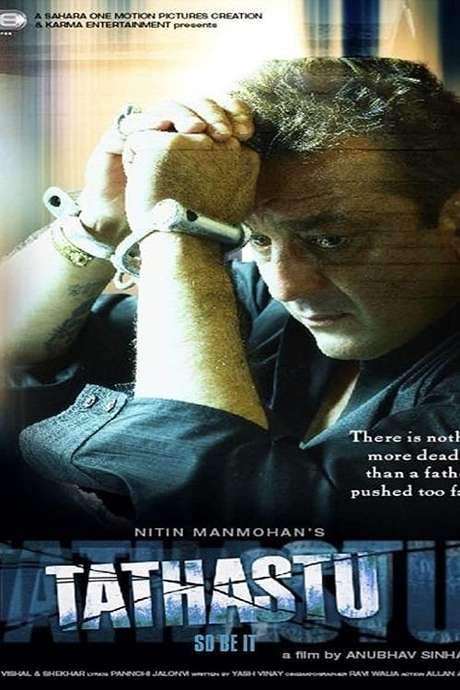
Tathastu 2006

Directed by

Anubhav Sinha
Made by

Karma Entertainment
Where to Watch Tathastu
See current US streaming, rental, and purchase options for Tathastu (2006) via JustWatch.

Streaming availability powered by 
Tathastu Plot Summary
Read the complete plot summary and ending explained for Tathastu (2006). From turning points to emotional moments, uncover what really happened and why it matters.
Ravi Rajput hails from a struggling family; his father worked as a mill foreman and vocational schooling was a luxury they could not afford. He grows up attending a municipal school, takes a job at the same mill, and marries Saru. Together they welcome a son, Gaurav, whose milestones—first steps, first words—fill the couple with pride. Yet the quiet joy of parenthood is crushed when Gaurav suddenly faints during a game of cricket, a moment that upends their lives and sets off a chain of desperate choices.
The family rushes Gaurav to the nearest hospital in Bandra, where two doctors, Dr. Nita and Dr. Sen, reveal the grim truth: their son’s only chance is a heart transplant, but the procedure requires a payment of 15 lakhs in short order. A heart is allegedly available, but the hospital will not operate without the funds. Ravi’s search for support begins with his insurance policy, which is abruptly refused renewal on an obscure clause, and his longtime employer, who declines to authorize more than Rs. 75,000. With time slipping away, Ravi’s options shrink rapidly, and the doctor warns that Gaurav could be discharged soon and may not survive long after.
Driven to the brink, Ravi takes a drastic step and weaponizes his desperation, taking hostage roughly thirty people inside the hospital. The situation attracts the attention of the police, led by DCP Rane, who is instructed to neutralize the threat at all costs. As the siege unfolds, the hostages come to see Ravi not as a monster but as a man fighting for his child—an image reinforced by his unselfish acts: he ensures a pregnant woman can give birth with proper care, helps a woman escaping domestic abuse, and aids an elderly man whose son prioritizes money over family. The public, watching the hostage drama unfold in the media, begins to rally around Ravi, casting him in the role of a dark but principled hero who fights a broken system to save a child.
Inside the hospital, a glimmer of hope appears when, after a tense stand-off, doctors tell Ravi that Gaurav will soon receive the transplant. He decides to release the hostages, thinking his son’s life will be saved. But a shock awaits him: the surgery underway is not for his son but for an elderly politician—the President of the ruling party, Narayan Swami. In a moment of fevered resolve, Ravi contemplates ending his own life to donate his heart to his son. He steps out with the hostages and his wife, vowing to sacrifice everything for Gaurav, in front of a crowd that has grown immensely supportive.
Before he can pull the trigger, a deputy leader from the party interrupts, claiming to have spoken with the President. The President has supposedly agreed to sacrifice his own life so that the heart can go to Ravi’s child. The deputy assures Ravi that the government will cover all surgical expenses, and the crowd erupts in applause. But a whispered question from the deputy leader’s assistant—“what about the President?”—unmasks the manipulation: this is politics. The deputy admits as much: if the President’s sacrifice were real, the public’s support would translate into a political windfall; by fabricating it, they imagined a powerful surge at the polls.
Ravi is arrested and brought to court, where the judge shows leniency based on the hostages’ testimony and grants him a relatively light sentence of six months. Outside the courtroom, the spectacle of politics continues to unfold, even as Ravi’s supporters cheer for what they believe he stood for. The film closes on a quietly hopeful note: Gaurav is seen playing cricket again, while [Ravi] and [Saru] watch him from a distance, their lives forever marked by a choice born of love, desperation, and the harsh truth of a system that can blur moral lines in the name of power.
Tathastu Timeline
Follow the complete movie timeline of Tathastu (2006) with every major event in chronological order. Great for understanding complex plots and story progression.
Ravi's humble beginnings and family
Ravi Rajput grows up in a struggling family in Mumbai. His father works as a mill foreman, and vocational schooling is a luxury they can't afford. He eventually takes a job at the same mill, marries Saru, and starts a family.
Gaurav's milestones and growing pride
Ravi and Saru welcome their son Gaurav, whose milestones—first steps and first words—fill the couple with pride. The family cherishes these small joys and the sense of normalcy they provide. Financial strain remains a quiet obstacle in their happiness.
Gaurav faints and a grim prognosis
During a game of cricket, Gaurav suddenly faints, sending the family into panic. They rush him to the nearest hospital in Bandra, where doctors break the devastating news that a heart transplant is their only option. The procedure requires 15 lakhs in a short window to stand any chance.
Insurance denial and breaking news
Ravi discovers his life insurance policy will not renew due to an obscure clause, slamming shut one potential lifeline. The administration also refuses to extend coverage or authorize needed funds. The clock keeps ticking as hope narrows.
Employer limits and dwindling options
Ravi's longtime employer refuses to authorize more than 75,000 for the transplant, leaving a massive shortfall. He tries contacting others, but options keep shrinking as medical urgency increases. The family faces mounting pressure and fear for Gaurav's survival.
The hospital siege begins
With time running out, Ravi takes drastic action and weaponizes his desperation, taking around thirty people hostage inside the hospital. The tense standoff draws the attention of police and the public alike. Inside the walls, fear blends with sympathy as hostages realize the motive is love, not crime.
Police siege led by DCP Rane
The police, led by DCP Rane, strategize to neutralize the threat while trying to minimize harm to the hostages. The siege unfolds with a mix of negotiations, flashes of violence, and media scrutiny. Rane's team works to balance duty with the growing public sympathy for Ravi.
Ravi's acts of humanity during captivity
Even as a hostage-taker, Ravi demonstrates selfless acts: ensuring a pregnant woman can deliver safely, helping a woman escaping domestic abuse, and aiding an elderly man whose son values money over family. The hostages begin to see him as a principled fighter against a broken system. These moments reshape public perception.
Public comes to see Ravi as a hero
News coverage and social chatter turn Ravi into a dark yet principled symbol, admired by many who feel the system failed Gaurav. The hostage drama becomes a stage for broader anger against the medical and political establishment. The divide between the law and the public mood grows wider.
Doctors reveal hope and Ravi contemplates release
Doctors inform Ravi that Gaurav will soon be eligible for the transplant, prompting him to decide to release the hostages in the hope of saving his son. He orders the release with Saru by his side, believing the crisis might end on a hopeful note. The crowd gathers, equal parts stunned and relieved.
Twist: transplant destined for the elderly politician
In a shocking turn, the doctors reveal the transplant slots are allocated to an elderly politician, Narayan Swami, not Gaurav. Ravi's resolve intensifies, even as the reality sinks in that the system has betrayed his trust. He considers donating his own heart to save his child.
Political manipulation comes to light
A deputy leader fabricates a claim that the President would sacrifice his life for Ravi's child to win political capital. The assistant's whispered doubt exposes the deception: the President's sacrifice was a political ruse. Public perception shifts from sympathy to cynicism.
Ravi's arrest and court leniency
Ravi is arrested and brought to court, where the judge shows leniency due to the hostages' testimony and assigns a relatively light sentence of six months. The legal outcome appears to reward his intent to save a child while condemning the violent method. The crowd's fickle support continues to echo in the background.
Ending: cricket, hope, and a changed family
The film closes on a note of quiet hope as Gaurav is seen playing cricket again, and Ravi and Saru watch from a distance. Their lives are forever marked by a choice born of love and the harsh truth that power can blur moral lines. The final image lingers on a family trying to move forward.
Tathastu Characters
Explore all characters from Tathastu (2006). Get detailed profiles with their roles, arcs, and key relationships explained.
Ravi Rajput (Sanjay Dutt)
Ravi is a devoted husband and father from a struggling family who fights to save his son, Gaurav. Cornered by medical bills and closed doors from insurers and his employer, he escalates to taking hostages to force a life-saving transplant. His choices reveal a morally complex man driven by love, sacrifice, and a desperate hope for his child.
Sarita R. Rajput (Ameesha Patel)
Saru stands by Ravi through the crisis, offering strength and support as the situation spirals. She navigates the perilous line between loyalty and the danger surrounding the hostage situation. Her presence embodies the resilience and hope of a family facing impossible odds.
Gaurav Rajput
Gaurav is Ravi and Saru's young son whose heart condition triggers the crisis. His illness is the catalyst for the moral dilemma at the hospital, and his fragile vitality fuels the parents' determination to secure a transplant. He represents innocence and the stakes of life itself in the story.
Dr. Nita (Jaya Prada)
Dr. Nita is one of the surgeons who informs the family of Gaurav's need for a heart transplant and the money required. She becomes a voice of medical reality in the chaos, balancing urgency with professional judgment. Her presence underscores the ethical and logistical pressures on healthcare providers.
DCP Rane (Gulshan Grover)
DCP Rane leads the police response to the hostage situation, tasked with neutralizing the threat while managing the safety of bystanders. His role places him at the intersection of law, order, and the public narrative, highlighting the pressures faced by law enforcement in a media-saturated crisis.
Surgeon (Darshan Jariwala)
The Surgeon is part of the medical team negotiating the transplant and navigating the ethical complexities of a life-or-death operation under financial strain. His expertise is crucial to the outcome of Gaurav's fate, illustrating the fragile line between medicine and money.
Tathastu Settings
Learn where and when Tathastu (2006) takes place. Explore the film’s settings, era, and how they shape the narrative.
Location
Bandra, Mumbai, India
The events unfold around a hospital in Bandra, a busy suburb of Mumbai. The setting highlights crowded corridors, urgent medical crises, and the constant presence of media attention. The hospital becomes a focal point where medical urgency clashes with financial desperation.
Tathastu Themes
Discover the main themes in Tathastu (2006). Analyze the deeper meanings, emotional layers, and social commentary behind the film.
💖
Family
The central force in the narrative is a father's fierce love for his son and a family's unwavering resolve. Desperation drives drastic actions, yet the story repeatedly highlights the protective, selfless choices made for Gaurav. The film explores how love can push people toward morally gray decisions, while still aiming to do right by those they cherish.
⚖️
Systemic
The plot exposes bureaucratic and financial barriers to life-saving medical care, from insurance denials to insufficient employer support. It scrutinizes how systemic obstacles can force ordinary people to gamble with others’ lives. The tension between need and policy reveals the fragility of access to healthcare in a money-driven environment.
🗳️
Power & Politics
A political machine exploits the hostage crisis to manipulate public opinion, casting a shadow over genuine human suffering. The supposed sacrifice of a President becomes a calculated ploy to win votes, illustrating how crowds can be swayed by narratives rather than truth. The film ends by showing how power and politics can blur moral lines in the pursuit of advantage.

Coming soon on iOS and Android
The Plot Explained Mobile App
From blockbusters to hidden gems — dive into movie stories anytime, anywhere. Save your favorites, discover plots faster, and never miss a twist again.
Sign up to be the first to know when we launch. Your email stays private — always.
Explore the mobile appTathastu Spoiler-Free Summary
Discover the spoiler-free summary of Tathastu (2006). Get a concise overview without any spoilers.
In the bustling streets of Mumbai, a modest mill worker wrestles with the harsh realities of a system that rarely bends for the vulnerable. Ravi Rajput lives a simple life with his wife Saru and their young son, finding joy in everyday moments that feel hard‑won. Their world is one of modest hopes, tight budgets, and a community that leans on each other while the larger institutions—especially healthcare—keep their doors firmly shut for those who cannot pay.
When their son’s health takes a sudden, frightening turn, the family is thrust into a maze of bureaucratic red tape and staggering medical costs. The urgency of a life‑saving procedure collides with the inflexibility of insurance clauses and an employer’s limited support, leaving Ravi with a crushing sense of powerlessness. The film paints this struggle with a stark, realistic palette, emphasizing the grinding pressure of everyday survival against an indifferent backdrop.
Driven by love and desperation, Ravi chooses a path that shatters the quiet routine of his life. He arms himself and stages a bold protest inside a crowded hospital, forcing the institution and its observers to confront the human story behind the numbers. The tension that builds is a study in quiet resolve meeting public outcry, as the ordinary man becomes an unexpected focal point for collective empathy. Around him, the hospital’s corridors hum with the ordinary—patients, doctors, and staff—each caught in the ripple of his desperate act.
The narrative balances gritty social commentary with an emotionally charged atmosphere, letting the audience feel the weight of a father’s love and the fragile line between law and justice. Against a realistic urban canvas, the film invites viewers to question how far one might go when every avenue for help seems barred, setting the stage for a tense, thought‑provoking drama that lingers long after the screen fades.
Movies with Similar Twists and Themes
Uncover films that echo the narrative beats, emotional arcs, or dramatic twists of the one you're exploring. These recommendations are handpicked based on story depth, thematic resonance, and spoiler-worthy moments — perfect for fans who crave more of the same intrigue.


Featured on this page

What's After the Movie?
Not sure whether to stay after the credits? Find out!
Check out our other apps:

SAT Sphere
Build confidence for the Digital SAT.

Mori Atlas
Discover wild places worth protecting.

Luntero
Search smarter for a home in Amsterdam.

Plot Explained
Unravel movie endings and hidden clues.

Pokechamp
Dive into Pokémon data and battle logic.

Driving Theory
Get ready for your European theory test.

Movie Dust
Plan your next cinema trip with ease.

Musemap
Find art and culture as you travel.

Selkobase
Compare credentials before committing.

Local Manual
Turn an unfamiliar country into practical next steps.

Lernavi
Compare school systems before your next move.

GymRoam
Find a workout stop wherever your plans take you.
Explore Our Movie Platform
New Movie Releases (2026)
Famous Movie Actors
Top Film Production Studios
Movie Plot Summaries & Endings
Major Movie Awards & Winners
Best Concert Films & Music Documentaries
Movie Collections and Curated Lists
© 2026 What's After the Movie. All rights reserved.
Privacy Policy