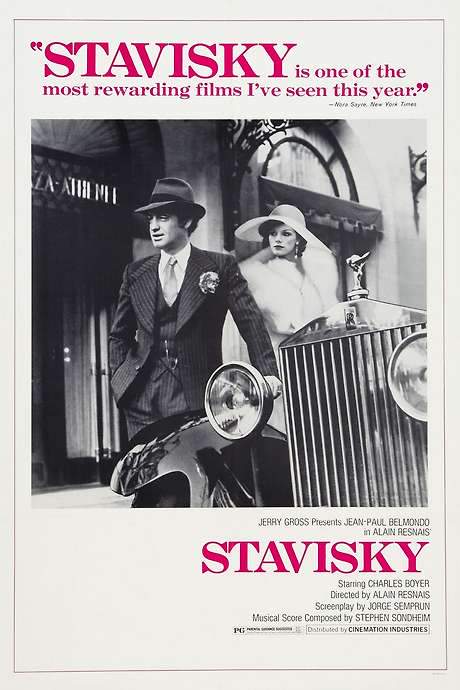
Stavisky… 1974

Directed by

Alain Resnais
Made by

Simar Films
Where to Watch Stavisky…
See current US streaming, rental, and purchase options for Stavisky… (1974) via JustWatch.

Streaming availability powered by 
Stavisky… Plot Summary
Read the complete plot summary and ending explained for Stavisky… (1974). From turning points to emotional moments, uncover what really happened and why it matters.
Set in the final months from late 1933 to January 1934, the film follows Serge Alexandre Stavisky, a controversial figure whose public image as a savvy financier masks a sprawling scheme. He operates as a “financial consultant,” founding a shadowy company that trades in international bonds, while secretly laundering stolen jewellery and shuffling funds to keep fraudulent bonds—sold through the Crédit Municipal in Bayonne—from being exposed. He also acts as a theatre impresario in Paris, gambles in casinos, and buys influence with the press, the police, and politicians, all while sustaining a lifestyle that aims to dazzle and intimidate.
At the center of the narrative is his devotion to his glamorous wife Arlette, and his use of her beauty to draw in funds from a Spanish revolutionary fascist. He tells his friends different versions of his past, mixing hints of a genuine political idealism with calculated self-justifications designed to keep his web of deception intact.
Between these strands, the film inserts brief flashes backward to his teenage awakening to a life of excess, a 1926 arrest as the petty crook Stavisky, and the suicide of his father after the family honor is tarnished. It also offers glimpses of his later rise and fall, punctuated by flash-forwards to his funeral and to the parliamentary inquiry into the Stavisky affair, where friends and allies testify with varying degrees of candor.
Parallel to the Stavisky saga are scenes portraying the arrival of Trotsky in France, seeking asylum, and his stay in country houses and hotels while left-wing activists visit him. These passages initially feel tangential, connected only by a police inspector who monitors Trotsky and later investigates Stavisky—until the end ties them more closely to the broader political tremors of the era. As Stavisky’s crimes unravel, Trotsky’s position becomes precarious, and ultimately he is expelled as a new government of national unity takes the stage.
The film closes on the unresolved death of Serge Alexandre Stavisky in a chalet in Chamonix, leaving the viewer with a stark question: was it a suicide akin to his father’s act, or an assassination carried out to silence him for good?
Stavisky… Timeline
Follow the complete movie timeline of Stavisky… (1974) with every major event in chronological order. Great for understanding complex plots and story progression.
Stavisky's youth and early hedonism
The film opens with flashbacks to Stavisky's teenage years, hinting at a life of pleasure and self-justification that foreshadows his later schemes. These glimpses establish the personality behind his public persona and reveal an appetite for thrill that will drive his decisions. They set the tone for a life spent chasing spectacle and advantage.
1926 arrest as a petty crook
In 1926, Stavisky is arrested as a petty crook, a turning point that marks the end of his innocent youth and the beginning of his willingness to bend rules. The incident haunts him as he constructs a narrative of resilience to justify his later actions. The event provides a lens on how he packages misdeeds into a larger personal myth.
Father's suicide after family dishonour
The film flashes to his father's suicide following family dishonour, a trauma that casts a long shadow over Stavisky's choices. This tragedy helps explain his obsession with control, reputation, and image management. It also frames his relentless need to avoid scandal at all costs.
Late 1933: setting up a bonds business
In the waning days of 1933, Stavisky operates as a 'financial consultant', launching a mysterious company to handle international bonds. He secretly launders stolen jewellery and shuffles funds to cover up fraudulent bonds sold via the Crédit Municipal in Bayonne. The operation sits at the crossroads of legality and deception, driving the plot's core danger.
Paris as theatre impresario and gambler
Simultaneously he stars as a theatre impresario in Paris, gambles in casinos, and uses his charisma to draw in supporters. His extravagant lifestyle and appetite for spectacle blur the lines between art, business, and crime. These performances are as much about influence as they are about entertainment.
Influence over press, police, and politicians
The film shows him buying influence among the press, the police, and politicians, cementing a web of protection around his activities. He understands that visibility and connections can delay detection of his frauds. This network becomes the backbone that sustains his sprawling deceptions.
Exploiting Arlette to lure funds from a Spanish fascist
Stavisky exploits his wife Arlette's beauty to lure funds from a Spanish revolutionary fascist, using personal leverage to facilitate money flows. The arrangement illustrates how he intertwines personal life with financial schemes. It signals the depth of his manipulation and the risks hidden behind his charm.
Contradictory accounts about his past
Friends hear contradictory accounts of his past as he presents different versions to different audiences. These shifting narratives reveal a pattern of deception designed to keep his true history hidden. The inconsistencies deepen the audience's suspicion about his character and motives.
Trotsky arrives in France seeking asylum
Interjected scenes depict Trotsky arriving in France to seek political asylum and staying in country houses and hotels. The moments are juxtaposed with Stavisky's world, highlighting a broader political backdrop of tension and exile. Left-wing activists visiting Trotsky show the era's volatile atmosphere.
Police inspector tracks Trotsky and Stavisky
A police inspector monitors Trotsky's movements and later turns his attention to Alexandre, blurring the lines between international intrigue and domestic crime. The inspector's investigations connect the two plot threads and foreshadow a crackdown. The tension between surveillance and secrecy becomes a driving motif.
Stavisky's fall and exposure
Stavisky's web collapses as he is exposed as a Ukrainian immigrant, a Jew, and a confidant of members of the left-of-centre government. The revelation unsettles allies and undermines public trust in the government. The exposure rattles the era's fragile political balance and reshapes the story's stakes.
Trotsky expelled and a government of national unity forms
Following Stavisky's exposure, Trotsky is expelled from the country and a new 'government of national unity' is formed. The political landscape shifts, underscoring how international events ripple through domestic power plays. The film uses this to frame the era as a turning point in both politics and personal fate.
Stavisky's death in a Chamonix chalet
The final mystery centers on Stavisky's death in a chalet in Chamonix, with uncertainty whether it was a suicide like his father or an assassination to silence him. The ambiguous death mirrors the film's themes of deceit and opacity. It leaves the audience pondering culpability and consequence.
Funeral and parliamentary enquiry
Flash-forwards show Stavisky's funeral and a parliamentary enquiry into the Stavisky affair, where friends and associates provide varying testimonies. The enquiry reframes his life as a public scandal rather than a private crime. The film closes with questions about accountability, truth, and the legacies of power.
Stavisky… Characters
Explore all characters from Stavisky… (1974). Get detailed profiles with their roles, arcs, and key relationships explained.
Serge Alexandre Stavisky (Jean-Paul Belmondo)
A flamboyant financier and impresario whose life blends audacious criminality with political charm. He capably weaves a veneer of legitimacy around fraudulent bonds, using wealth and stagecraft to seduce allies and suppress scrutiny. His contradictions—idealism, greed, and dependency on appearance—drive the web of deception until exposure and death.
Arlette (Anny Duperey)
Stavisky's glamorous wife, whose beauty is weaponized to attract funds from various backers. She moves within elite circles, financing schemes through charm and social influence. Her role probes how personal allure can be entangled with political and financial scheming.
Docteur Mézy (Michael Lonsdale)
A doctor within Stavisky's orbit who participates in or witnesses the scheming environment surrounding scams and social circles. He embodies the rational, clinical gaze in a world of glamour and fraud. His presence hints at the normalizing of illicit activity through professional networks.
Inspecteur Bonny (Claude Rich)
A police inspector tracking the Stavisky affair and the cross-currents with Trotsky's movements. He embodies law and investigation, balancing skepticism with political realities. His investigations uncover the depths of deceit and the obstacles to accountability.
Léon Trotski (Yves Peneau)
The visiting exiled leader seeking asylum, a figure who brings international political tension into France. His presence intersects with the domestic scandal and exposes how leftist politics intersect with national concerns. His expulsion marks the shifting geopolitical mood of the period.
Le jeune inventeur (Gérard Depardieu)
A young inventor character in the Stavisky orbit, representing the era's curiosity, innovation, and possibly opportunistic experimentation. His role hints at the broader industrial and technological milieu touched by the corruption and social change. He embodies the restless, aspiring energy of the time.
L'huissier (Paul Villé)
A court usher representing the procedural side of the Stavisky world—enforcement and the looming reach of authorities. His presence grounds the legal dimensions of the affair, serving as a reminder of law's shadow in the scheme.
Stavisky… Settings
Learn where and when Stavisky… (1974) takes place. Explore the film’s settings, era, and how they shape the narrative.
Time period
Late 1933 – January 1934
The events are set in the last months of 1933 into early 1934, a period of political turbulence in France during the late Third Republic and the Great Depression. The film traces the Stavisky affair as it reaches a parliamentary inquiry and public scandal. Flashbacks span earlier misdeeds, while the end foreshadows shifts in government amid crisis.
Location
Paris, Bayonne, Chamonix
The story unfolds across iconic 1930s France: the cultural hub of Paris, the financial pulse of Bayonne through municipal bonds deals, and the Alpine chalet in Chamonix where Stavisky's fate is sealed. Paris serves as the orbit of media, politics, and spectacle; Bayonne anchors the finance-and-swindle network; Chamonix provides the enigmatic backdrop for the final, murky death. The settings underscore a nation grappling with corruption, luxury, and political scandal.
Stavisky… Themes
Discover the main themes in Stavisky… (1974). Analyze the deeper meanings, emotional layers, and social commentary behind the film.
🕵️♂️
Deception
Stavisky's operations revolve around fraudulent bonds, money laundering, and manipulating buyers and the press. The narrative threads reveal how appearances are manufactured to obscure his fraud and to keep creditors at bay. Deception permeates his relationships with allies, lovers, and officials, driving the plot toward exposure and downfall.
🏛️
Politics
The film ties finance, media, and police to the political machinery of France in the 1930s. It shows how influence is traded among politicians, journalists, and investigators, shaping public perception and policy. The Trotsky subplot intersects with shifts in government, ultimately highlighting a fragile 'government of national unity' formed in response to scandal.
💰
Wealth & Influence
Stavisky's extravagant lifestyle—palaces of entertainment, acquisitions of power, and lavish glamour—functions as a tool to attract funds and admiration. Wealth serves as both shield and weapon, financing schemes and buying influence among elites. The narrative ties personal luxury to systemic corruption, questioning wealth's role in political manipulation.

Coming soon on iOS and Android
The Plot Explained Mobile App
From blockbusters to hidden gems — dive into movie stories anytime, anywhere. Save your favorites, discover plots faster, and never miss a twist again.
Sign up to be the first to know when we launch. Your email stays private — always.
Explore the mobile appStavisky… Spoiler-Free Summary
Discover the spoiler-free summary of Stavisky… (1974). Get a concise overview without any spoilers.
In the glittering yet unsettled world of 1933 Biarritz, the story unfolds against a backdrop of restless politics and a society teetering on the brink of upheaval. The coastal resort, with its sun‑kissed promenades and smoky casino rooms, hides a network of whispers, favors, and hidden ambitions. Beneath the genteel veneer, the nation’s institutions quiver, sensing that the delicate balance of power could shatter at any moment.
At the centre of this delicate dance moves Serge Alexandre Stavisky, a charismatic swindler whose effortless charm and razor‑sharp talent allow him to glide between the worlds of high finance, theatre, and the glittering salons of Paris. With a reputation for bending rules and a gift for making allies out of the powerful, he navigates a labyrinth of bribes, media attention, and political connections, all while maintaining a flamboyant lifestyle that dazzles and intimidates in equal measure. His devotion to his glamorous wife Arlette adds a personal sparkle to his public façade, and together they become a striking emblem of allure and ambition in a city eager for spectacle.
Running parallel to Stavisky’s ascent, the film introduces the enigmatic presence of Trotsky, whose exile in France brings an air of ideological tension to the already fraught atmosphere. Their intersecting circles—politicians, journalists, and secret police—create a sense of perpetual surveillance and whispered intrigue. The tone remains a moody, atmospheric blend of historical drama and sly noir, inviting the audience to linger over the seductive pull of power and the uneasy feeling that beneath the surface, something fragile is about to crack.
Movies with Similar Twists and Themes
Uncover films that echo the narrative beats, emotional arcs, or dramatic twists of the one you're exploring. These recommendations are handpicked based on story depth, thematic resonance, and spoiler-worthy moments — perfect for fans who crave more of the same intrigue.




Featured on this page

What's After the Movie?
Not sure whether to stay after the credits? Find out!
Check out our other apps:

SAT Sphere
Build confidence for the Digital SAT.

Mori Atlas
Discover wild places worth protecting.

Luntero
Search smarter for a home in Amsterdam.

Plot Explained
Unravel movie endings and hidden clues.

Pokechamp
Dive into Pokémon data and battle logic.

Driving Theory
Get ready for your European theory test.

Movie Dust
Plan your next cinema trip with ease.

Musemap
Find art and culture as you travel.

Selkobase
Compare credentials before committing.

Local Manual
Turn an unfamiliar country into practical next steps.

Lernavi
Compare school systems before your next move.

GymRoam
Find a workout stop wherever your plans take you.
Explore Our Movie Platform
New Movie Releases (2026)
Famous Movie Actors
Top Film Production Studios
Movie Plot Summaries & Endings
Major Movie Awards & Winners
Best Concert Films & Music Documentaries
Movie Collections and Curated Lists
© 2026 What's After the Movie. All rights reserved.
Privacy Policy