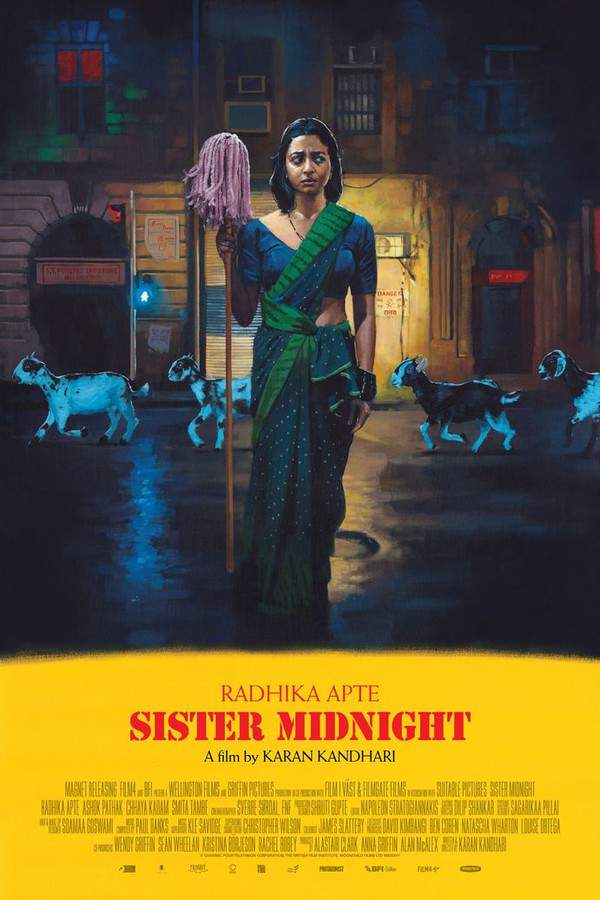
Sister Midnight 2025


Directed by

Karan Kandhari
Made by

Wellington Films
Where to Watch Sister Midnight
See current US streaming, rental, and purchase options for Sister Midnight (2025) via JustWatch.







Sister Midnight Plot Summary
Read the complete plot summary and ending explained for Sister Midnight (2025). From turning points to emotional moments, uncover what really happened and why it matters.
Uma, Radhika Apte, enters an arranged marriage with Gopal, Ashok Pathak, a man seen by many in the village as the least desirable match for a daughter’s future. The film follows a young woman whose spirit clashes with the claustrophobic rules of a life she never asked for. From the moment she steps into the cramped room in the Mumbai slums, Uma’s world feels suffocating: the constant clamor of the streets, the lack of sunlight, and a husband who seems more afraid of her than affectionate. The marriage is supposed to be a new start, but it reads like a quiet sentence, and Uma finds herself drifting between a sense of duty and a growing craving for air, space, and autonomy.
The daily grind tightens its grip. Uma can’t imagine a life spent cooking and pleasing others, a routine she can barely bear. She tries to connect with Gopal, but even simple intimacy eludes them, and his evenings are often spent with the bottle after a long day. When she summons the courage to speak of travel, he agrees, and together they set off on a journey that quickly proves poorly planned and unsatisfying, leaving them back at home with a hollow sense of defeat.
A spark of companionship appears in Sheetal, a neighbor who shares Uma’s ennui. Sheetal, Chhaya Kadam, becomes a practical ally as Uma learns to cook and begins to see a way to navigate life beyond the apartment’s shut windows. The two women trade stories of confinement and small escapes, and Uma’s resolve grows stronger. Yet the dream of freedom remains elusive, and she keeps searching for a way to break the hold of tradition.
Uma’s restlessness pushes her toward little acts of rebellion. She takes a job at a nearby office, where she playfully boasts that she is “the goddess of cleaning,” a line that hides a deeper hunger to prove she can contribute to the world outside her door. The new routine gives her brief breath—moments when she can step away from Gopal and the stifling environment at home. But the weight of her marriage and the sense that she is slowly dissolving inside it only intensifies.
As time passes, Uma’s health falters in ways that cannot be dismissed as mere nerves. She stops eating and suspects nothing more than a bad meal from a wedding, yet the sickness deepens into something unexplainable. The story hints at a metamorphosis—whether it is a feral turn of illness or a symbolic transformation commenting on the suffocating practice of marrying a stranger and becoming a passive spectator of one’s own life. Uma’s silhouette grows gaunt, her vitality drains away, and she begins to move through the night with a hunger that leaves no room for the daylight she was promised.
Her new identity emerges in the darkness: Uma becomes a predator, a creature who hunts not just for food but for agency. She embraces this shift with a fierce determination, using her nocturnal life to resist a world that would keep her in a passive role. The office job becomes a foothold for a little independence, even as she is drawn back into the dangerous margins of her own nature.
When Uma finally reveals the truth of what she is, the moment destabilizes the life she has, and the couple’s fragile bond is torn apart. A day at the beach with Gopal and the neighbor’s company ends in an act of passion that costs him his life. His death leaves Uma to grapple with guilt and the stark reality that her transformation has irrevocably changed her fate. She weaves flowers and lights around his decomposing body, trying to turn it into something quasi‑divine, a shrine that can be seen and understood by the others around her.
Neighbors become unsettled as the scent and the sounds of a strange ritual rise from the home. When a curious neighbor presses for answers, Uma defends herself in the only way she knows how, and the consequences escalate, culminating in the chilling act of a murder. With the help of a group of friends who admire Uma, several of whom are transgender, she moves the body away from the house and toward a more private resting place in the woods, eventually returning to the ritual of cremation that feels like a final rite of passage in a world that refuses to accept her.
An ascetic approaches Uma and rubs his own ashes onto her face as a stark, penetrating moment of contact with mortality. This odd exchange is followed by a quiet solidarity as he helps collect the ashes and shares a moment of reverent stillness with her. Yet the tranquility is short-lived; Uma’s body fails again, and she is found by Buddhist nuns who nurture her with meals, warm clothes, and a new sense of belonging in a monastery. This shelter feels like a respite from the world’s fear and suspicion, a space where women have chosen to redefine their relationship with faith, ritual, and the self.
Upon returning to her neighborhood, Uma encounters a mob of men with torches—an act of retribution that confirms the peril she faces for simply existing on her own terms. The burning house scene is brutal and frightening, but birds flying from the ruined home signal a form of defiant survival. She seeks help from Sheetal, but the response is delayed, and she finds herself caught between police, the religious authority, and the relentless superstition that surrounds her.
In a moment of crisis, Sheetal and a circle of friends intervene, arriving with fresh clothes and a promise of protection. The mob surrounds their car, threatening to end Uma’s tour of life there and then. Uma recognizes that her enemies fear her more than they want to harm her, and she leans into that fear, turning herself into a figure that unsettles the crowd rather than one they can easily pin down. They drive away, and when the car finally reaches the railway station, Uma steps onto the Himalayan Express with a new sense of purpose.
On the train, a question about her appearance prompts a quiet bravado: she tells a fellow passenger that she’s simply got a new face and walks on. In that moment, and as the journey unfolds, Uma fully embraces her transformed self. She chooses to cast off the expectations of others, to live as a vampire, witch, or monster if that is what freedom requires. She adopts a dramatic look—draped in a black saree, with black nails and black lipstick, her fangs bared to the world—an unapologetic declaration that she will no longer seek approval.
The film closes on a note of radical self-possession, a woman who has moved from captivity to sovereignty, from fear to a deliberately chosen ferocity. The transformation is not merely physical; it is a reclamation of identity in the face of a society that would rather she be quiet, compliant, and unseen. Uma’s journey—one of suffering, awakening, and defiance—resonates as a meditation on gender, power, and the peril and promise of choosing one’s own path.
Sister Midnight Timeline
Follow the complete movie timeline of Sister Midnight (2025) with every major event in chronological order. Great for understanding complex plots and story progression.
Arranged marriage in the slums
Uma enters into an arranged marriage with Gopal, a shy and meek man deemed undesirable by her family. The decision is framed as duty, not choice, and her childhood dream of a different life fades. The couple's home in the Mumbai slums becomes a claustrophobic prison where loud streets and thin walls suffocate her.
Confinement of the new home
Uma moves into Gopal's tiny room and immediately senses the confinement of her new life. She notes that her husband is afraid of her and that the room lacks sunlight, draining her spirit. The walls feel like watching eyes and the sense of entrapment hardens.
Escape plan and failed trip
Driven by a longing for freedom, Uma tells Gopal that she wants to travel. They set out on a poorly planned excursion and quickly realize they are unprepared for what lies ahead. The trip ends in disappointment as they return home defeated.
Friendship with Sheetal and cooking lessons
Uma befriends Sheetal, her bored neighbor, and learns cooking from her. Sheetal becomes a confidante who understands Uma all too well. The new skill gives Uma a small sense of agency within an oppressive routine.
Working to escape marriage
To escape the monotony, Uma takes a clerical job at a nearby office and jokes about being the goddess of cleaning. The job helps her physically separate from Gopal and find space in the day for herself. It marks a small but meaningful step toward independence.
Illness and metamorphosis begins
Uma’s health deteriorates; she stops eating and grows gaunt, confusing those around her as food poisoning or illness. As her strength wanes, a strange hunger gnaws at her and hints at a vampire like transformation. The change signals a new power awakening beyond ordinary life.
Night predator emerges
By night, Uma becomes a predator, feeding on birds and other creatures to quell her hunger. The birth of her vampiric nature becomes undeniable as hunger guides her actions. She learns to survive by embracing this nocturnal hunger.
Gopal death during intimacy
Uma and Gopal spend a day together exploring Mumbai and their bond deepens. During their lovemaking, Uma’s vampiric nature surfaces and Gopal dies. The loss devastates Uma and forces her to confront the consequences of her transformation.
Decomposition and planning to hide the death
Gopal's death leaves Uma terrified as his body begins to decompose. She decorates him with flowers and lights to turn the corpse into a divine idol and hide the crime. The fear of discovery drives her to isolate herself from the neighborhood.
Neighbor curious and killed
An inquisitive neighbor is killed when they press for answers; Uma chops the body and throws it into the woods. The act marks a darker turning point as she becomes a killer to protect her secret. The neighborhood whispers grow louder as she tries to vanish.
Cremation aided by trans friends
With the help of a group of trans friends who adore Uma, they move the body out of the house and help her cremate Gopal. The act gives Uma a sense of belonging and practical support in her harsh world. It also demonstrates a community that accepts her despite the fear she inspires.
Rescue by Buddhist nuns
Uma collapses on the road and is rescued by female Buddhist monks. They patch her wounds, feed her, and tell stories of choosing freedom from social norms. The encounter offers shelter and a glimpse of a path beyond fear.
House attacked by mob and burned
Back in her neighborhood, men with flaming torches surround her house and burn it down. Birds escape from the inferno as the crowd wrongly believes she is inside. The destruction forces Uma to flee once more into the city.
Rescue and departure to the Himalayas
Sheetal and a few friends arrive in a car with fresh clothes and supplies to help Uma. They drive her to a railway station where she boards the Himalayan Express, claiming a new face and a new identity. The group shows her that she can choose her own fate even if it means leaving behind her old life.
Final transformation and freedom
On the Himalayan Express, Uma fully embraces her true identity. She reveals a new face and drapes herself in a black saree with black lipstick and fangs. She chooses to be a vampire and monster rather than a powerless wife, signaling a complete transformation and new freedom.
Sister Midnight Characters
Explore all characters from Sister Midnight (2025). Get detailed profiles with their roles, arcs, and key relationships explained.
Uma (Radhika Apte)
Uma starts as a trapped, intelligent young woman suffocated by an arranged marriage. Her street smarts emerge as she fights back against a patriarchal life, gradually transforming into a fearless, vampiric figure who reclaims her agency. Her arc blends vulnerability with ferocity as she navigates love, violence, and stigma.
Gopal (Ashok Pathak)
Gopal is portrayed as the meek, shy husband who contradicts conventional masculine expectations. He becomes a quiet, fragile partner in Uma's world, whose death triggers the final act of Uma's reclamation of power and identity.
Sheetal (Chhaya Kadam)
Sheetal is Uma's neighbor and confidante who provides a route to practical knowledge like cooking and later allies with Uma in a broader community, helping her at crucial moments and offering a lifeline when she resists societal pressures.
Sister Midnight Settings
Learn where and when Sister Midnight (2025) takes place. Explore the film’s settings, era, and how they shape the narrative.
Location
Mumbai slums, Marine Drive, Mumbai, India
Mumbai's dense slums and bustling coastline frame Uma's claustrophobic, oppressive living conditions. The city’s crowded rooms, constant noise, and limited sunlight depict a harsh urban landscape that drives her urge to escape. Landmarks like Marine Drive illustrate the contrast between her confined home life and the wider world beyond.
Sister Midnight Themes
Discover the main themes in Sister Midnight (2025). Analyze the deeper meanings, emotional layers, and social commentary behind the film.
🕊️
Freedom
Uma's arranged marriage traps her in a suffocating routine; she dreams of escaping and making her own choices. Her journey from a quiet, compliant wife to a forceful, autonomous seeker shows a fierce desire for personal liberation. The story frames freedom as a dangerous, exhilarating act in a patriarchal society.
🪞
Identity
Uma's transformation—literal as a vampire and symbolic as breaking the social mask—marks her reinvention. Her changing appearance and demeanor challenge neighbors' expectations and the limits placed on women. By embracing her true self, she redefines what it means to be human or monster.
🧭
Community & Survival
Sheetal and Uma's urban sisterhood offer a tentative refuge from male scrutiny. The support from trans friends and Buddhist monks provides practical care and spiritual spaces away from judgment. The looming threat of persecution heightens the sense that solidarity is a lifeline in a hostile world.

Coming soon on iOS and Android
The Plot Explained Mobile App
From blockbusters to hidden gems — dive into movie stories anytime, anywhere. Save your favorites, discover plots faster, and never miss a twist again.
Sign up to be the first to know when we launch. Your email stays private — always.
Explore the mobile appSister Midnight Ending Explained
Unravel the ending of Sister Midnight (2025) with our detailed explanation. Understand the final scenes, character fates, and unresolved questions.
The ending of Sister Midnight is both surreal and symbolic, emphasizing Uma’s complete transformation and her rejection of societal norms. After enduring a series of bizarre and horrific events—she becomes a vampire, kills her husband Gopal, and fights her way through fear and superstition—Uma finally sheds her former self and embraces her monstrous identity. When she boards the Himalayan Express train, she nonchalantly claims she has a “new face,” symbolizing her liberation from conventional standards of beauty and normalcy. Her physical transformation into a vampire, with fangs, dark attire, and a defiant stance, signifies her rejection of the patriarchy, societal expectations, and her own suppressed emotions. The absurdity of the CGI goats trailing her on the train adds a humorous, almost parody-like touch to her metamorphosis, illustrating that she has become a creature of chaos and rebellion. Ultimately, the film suggests that Uma has accepted her true self—wild, powerful, and unapologetically monstrous—standing as a metaphor for breaking free from oppressive cultural constraints and embracing one’s authenticity, no matter how bizarre or frightening it may seem.
Sister Midnight Spoiler-Free Summary
Discover the spoiler-free summary of Sister Midnight (2025). Get a concise overview without any spoilers.
In the crowded slums of Mumbai, Uma arrives with hopes of a fresh start, only to find herself trapped in a life she never imagined. Married to Gopal through an arrangement that feels more like a sentence than a union, she struggles to navigate the suffocating confines of domestic expectations. The relentless noise of the streets, the cramped quarters, and the weight of traditions she never asked for all press against her restless spirit. A rebellious young woman from a small town, Uma finds the city overwhelming and her new circumstances unbearable, leaving her desperate for an escape.
Her husband, timid and meek, offers little companionship, and the cultural demands placed upon her feel like an erasure of her identity. She finds brief solace in an unexpected friendship with Sheetal, a neighbor who shares her frustration with the roles they’ve been assigned. Yet even this connection cannot fully ease her growing sense of alienation. As Uma attempts to carve out a small space of independence through work and fleeting moments of joy, she remains at odds with a world that seems designed to confine her.
The film blends gritty realism with an unsettling, otherworldly atmosphere, creating a mood that is both darkly humorous and deeply disquieting. Uma’s internal struggle mirrors the external pressures closing in around her, and the story walks a fine line between the mundane and the surreal. The urban landscape becomes a character in itself—relentless, unforgiving, and indifferent to one woman’s quiet rebellion.
As tensions simmer beneath the surface, Uma faces a choice: submit to the path laid out for her or forge a new one entirely on her own terms. The narrative builds with a sense of impending transformation, hinting that something within her is shifting, something that may upend everything she thought she knew about herself and the world around her. What unfolds is a meditation on freedom, identity, and the courage it takes to break free from the chains of expectation.
Movies with Similar Twists and Themes
Uncover films that echo the narrative beats, emotional arcs, or dramatic twists of the one you're exploring. These recommendations are handpicked based on story depth, thematic resonance, and spoiler-worthy moments — perfect for fans who crave more of the same intrigue.









Featured on this page

What's After the Movie?
Not sure whether to stay after the credits? Find out!
Check out our other apps:

SAT Sphere
Build confidence for the Digital SAT.

Mori Atlas
Discover wild places worth protecting.

Luntero
Search smarter for a home in Amsterdam.

Plot Explained
Unravel movie endings and hidden clues.

Pokechamp
Dive into Pokémon data and battle logic.

Driving Theory
Get ready for your European theory test.

Movie Dust
Plan your next cinema trip with ease.

Musemap
Find art and culture as you travel.

Selkobase
Compare credentials before committing.

Local Manual
Turn an unfamiliar country into practical next steps.

Lernavi
Compare school systems before your next move.

GymRoam
Find a workout stop wherever your plans take you.
Explore Our Movie Platform
New Movie Releases (2026)
Famous Movie Actors
Top Film Production Studios
Movie Plot Summaries & Endings
Major Movie Awards & Winners
Best Concert Films & Music Documentaries
Movie Collections and Curated Lists
© 2026 What's After the Movie. All rights reserved.
Privacy Policy