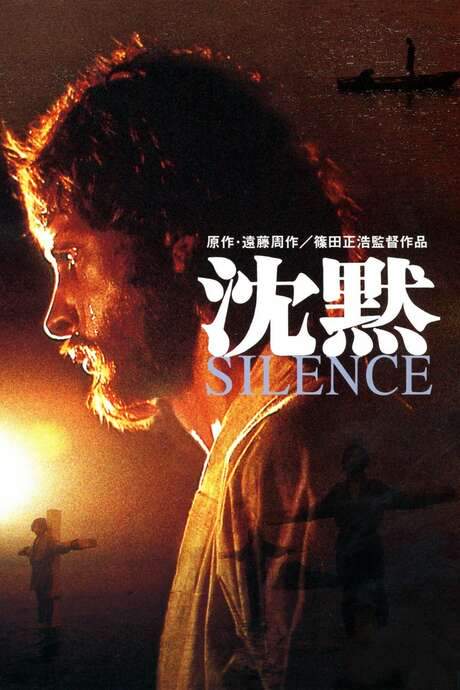
What Is Silence About?
The premise of Silence in 352 words, with nothing given away. The full story follows below.
In the early 1600s Japan stands at a crossroads of faith and authority, its streets cloaked in a quiet tension that pulses beneath the orderly veneer of shogunal rule. The country’s once‑tolerant landscape has turned hostile to foreign belief, turning every whispered prayer into an act of defiance. Within this stark world, two Portuguese Jesuit priests arrive, driven by a potent mix of missionary zeal and personal longing. Rodrigo carries a warm, self‑assured presence that masks the harsh realities he will face, while his companion Francisco Garrpe moves with cautious deliberation, his every step measured against the unknown dangers that loom. Together they are bound by a singular purpose: to spread the teachings of Christianity and to locate their vanished mentor, Cristóvão Ferreira, who has been silent for years and whose fate haunts their journey.
The film paints a brooding, almost painterly portrait of a nation caught between ancient customs and the sudden intrusion of foreign doctrine. Quiet villages and bustling ports alike whisper of hidden believers who cling to their faith in secret, their practices a delicate thread woven through daily life. The priests’ arrival awakens a blend of awe, fear, and yearning among these covert communities, each longing for the familiar rituals and reassurance that their overseas comrades might bring. Yet the ever‑present watchful eyes of officials and samurai cast long shadows, reminding everyone that any expression of the new faith could invite swift and severe retribution.
At its core, the story explores the fragile balance between conviction and survival, and the ways in which personal faith can both illuminate and endanger those who bear it. Rodrigo and Francisco must navigate not only the physical hazards of a foreign land but also the internal pull of duty, hope, and doubt. Their contrasting temperaments create a dynamic partnership, each offering the other a mirror for reflection as they confront the stark reality of a world where belief is both a source of comfort and a catalyst for conflict. The tone remains solemn and meditative, inviting the audience to contemplate the cost of devotion against the relentless march of an unyielding regime.
What Happens in Silence?
The complete story of Silence, from the first scene to the last, in 905 words (about 4 minutes). Spoilers throughout. Names in the text link to 3 cast member pages.
Spoilers ahead
In the 17th century, two Portuguese Jesuit priests, Rodrigo and Francisco Garrpe, undertake a perilous journey to Japan to spread Christianity despite a formal crackdown on the faith. They are determined to rendezvous with their mentor, Cristóvão Ferreira, whom they have not heard from in five years and who they believe may be imprisoned. One priest exudes a self-assured warmth, while the other moves with caution; together they navigate a land where their beliefs are met with warning glances and painful restraint. Their arrival is met with a mixture of awe and fear from a community of persecuted Japanese Christians who long for support, comfort, and the familiar rituals of home, and the priests find themselves pulled between duty, hope, and the harsh realities of their hosts’ fear.
They head toward a coastal village where they first encounter a fisherman named Kichijiro, who had helped smuggle them into the country. The welcome is tangled with danger, as a detachment of Japanese officials and samurai descends in search of the two priests. With most of their flock already scattered, tortured, or forced to renounce their faith, the priests decide to retreat, only to be separated in the chaos that follows. The man named Kichijiro reconnects with Rodrigo, admitting his own frailties and revealing that his family was slaughtered for practicing Christianity. The weight of betrayal rises when Nagasaki’s magistrate, Inoue, and his men confront the priests, and money is tossed like a grim symbol—three hundred pieces of silver given to Kichijiro, a gesture that echoes old betrayals and stirs guilt later shared with a prostitute seeking solace.
The authorities haul Rodrigo to Nagasaki for a formal trial, and the mood darkens as a public humiliation unfolds: a Christian samurai family is forced to renounce their faith and endure degradation, while Kiku—the wife in the marriage—recants under pressure, and the husband is executed for defiance. Kichijiro, now burdened by guilt for his treachery, slips back into the cell and begs Rodrigo’s forgiveness, explaining that shame from renouncing faith has driven his actions more than fear itself.
In a private exchange, Inoue, through his interpreter, presses Rodrigo to consider the fate of Christianity in Japan. He argues that the Church is unwanted in the country, likening the Catholic faith to a disruptive concubine that unsettles the conscience of the state. Rodrigo counters with a vision of universality—the belief that truth transcends borders and that the happiness of love between a couple mirrors a larger harmony that the state should not sever. The two men debate, each stubborn but occasionally swayed by the other’s convictions. Yet, bound by the shogunal law, Inoue maintains the ban on Christianity.
Soon after, Rodrigo learns that Garupe has been taken prisoner alongside his Japanese companions. The interpreter reveals a grim choice: if Rodrigo refuses to witness Garupe apostatize, the hidden converts will face death. Garupe’s peers are drowned one by one as he refuses to yield; he resists, frees himself, and plunges into the sea to save others, only to be pierced by spears and to drown. The sacrifice is profound and haunting, underscoring the conflict between faith, loyalty, and survival.
Later, Rodrigo is brought to a Buddhist temple where he meets Inoue’s confidant, known as Sawano, who turns out to be Ferreira under a different name. Ferreira—now an apostate in service to the state—urges Rodrigo to renounce his beliefs and renormalize the church’s role in society. Ferreira’s long arc of preaching has hollowed his own faith, he claims, painting Japan as an inhospitable swamp for Christianity where a native inculturation would rot the seedlings of faith. Rodrigo rebukes him, invoking the memory of Saint Xavier and the original call to faith, even as Sawano’s arguments press on with a chilling logic.
The tide of suffering rises when Rodrigo is subjected to brutal punishment: he is suspended upside down in a pit, while Sawano explains that others who refused to recant have already endured the same fate. The tortures are synchronized with Rodrigo’s internal struggle between love, fidelity, and the presence (or absence) of God amid human pain. Sawano hints that if Rodrigo would renounce his faith for the sake of those who suffer, the others might be spared. Rodrigo maintains that those who suffer find a different, enduring happiness, and he remains steadfast in his beliefs, even as the pressure intensifies.
An ailing test arrives with the fumi-e, a pictorial icon meant to expose hidden faith. The interpreter brings it before Rodrigo, who ultimately steps on it in a moment echoing both denial and defiance. A rooster crows twice, a symbolic echo of biblical betrayal that taunts the moment with memory and consequence. From this point, Rodrigo is seen bending to the demands of the authorities, aiding Inoue’s officers in identifying contraband Christian objects carried by foreigners. Asked to comment on a cup, he notes a subtle difference in form that betrays an authorial eye for ritual detail, a small but telling sign of his compromised stance.
The story culminates in a grim transformation: Rodrigo is made into a samurai and given Kiku as his wife, adopting her late husband’s name, Sanemon Okada, just as Ferreira had once been labeled Lord Sawano. The film closes on a quiet, unsettling note that contrasts the outward accomplishment with the inner cost—an image of Kichijiro, now shown sweeping the surroundings, a silent witness to the long, arduous journey of faith under occupation, doubt, and endurance.
Silence Timeline: Every Key Event in Order
13 key events in the order they happen, from “Mission to Japan and search for Ferreira” to “Ending image: Kichijiro's quiet survival”. 13 events name a place, across 9 locations.
- 1
Mission to Japan and search for Ferreira
Rodrigo and Garupe arrive in Japan to proselytize despite a formal ban on Christianity. They vow to continue their mission and search for their mentor Ferreira, whom they fear is imprisoned. The two priests face a fragile welcome from persecuted Christians while recognizing the danger ahead.
Where:Nagasaki region, Japan
- 2
Warm reception from persecuted Christians in Kichijiro's village
They are overwhelmed by the warmth and hospitality of the persecuted Japanese Christians they meet in the village of Kichijiro. The locals offer shelter and small comforts, including cravings for home-cooked food. The welcome provides a brief sense of hope before the reality of danger closes in.
Where:Kichijiro's village, Japan
- 3
Detachment arrives, separation and return to danger
A detachment of Japanese officials and samurai arrives in search of the missionaries, forcing the two priests to reconsider their presence. Most of their flock are taken into custody or tortured for refusing to betray their faith. The two priests attempt to leave, but they become separated; Kichijiro later joins Rodrigo.
Where:Nagasaki region, Japan
- 4
Rodrigo captured; 300 silver coins cast to Kichijiro
Inoue's men capture Rodrigo in Nagasaki and publicly brand him as a target of the crackdown. They throw 300 pieces of silver at Kichijiro, a Judas-like gesture that haunts him for his previous betrayal. The silver is later spent by Kichijiro seeking emotional support.
Where:Nagasaki, Japan
- 5
Rodrigo's trial and the public humiliation of Christians
Rodrigo is taken to Nagasaki for trial while the authorities force a Christian samurai family to witness public humiliation and threats for practicing their faith. The wife Kiku recants under pressure, and the husband is executed for defiance. The scene underscores the crushing power of the regime and the cost of faith.
Where:Nagasaki, Japan
- 6
Kichijiro seeks forgiveness in the holding cell
Inside the holding cell, Kichijiro, guilt-ridden, sneaks to Rodrigo and asks for forgiveness for betraying the faith. Rodrigo grapples with mercy and the weight of his friend's betrayal, illustrating the personal toll of persecution. The moment foreshadows the deeper decisions still to come.
Where:Holding cell, Nagasaki
- 7
Private talk: Inoue challenges faith; Rodrigo responds
Inoue invites Rodrigo to a private talk, attempting to persuade him that Catholicism has no place in Japan. Rodrigo defends the universal truth of the Church, arguing that the happiness of people and the conscience of the state cannot be separated. The exchange highlights a clash between faith and political power, with Inoue wavering but bound by law.
Where:Private room in Nagasaki
- 8
Garupe's capture and death at sea
Rodrigo learns that Garupe has been captured with his Japanese companions and is to witness apostasy. Garupe resists, dives into the sea to help the drowning, and is killed by spears as he fights to save others. His sacrifice underscores the brutal choices faced by the priests.
Where:Sea near Nagasaki
- 9
Ferreira revealed as Lord Sawano; apostasy urged
Rodrigo is brought to see Ferreira, who is revealed as Lord Sawano and has apostatized, working as an astronomy scholar under Inoue. Sawano urges him to renounce the Church, claiming Christianity cannot take root in Japan. Rodrigo rebukes him, insisting on the sincerity of Saint Xavier's mission.
Where:Buddhist temple (Nagasaki)
- 10
Rodrigo endures torture in the pit
Rodrigo is imprisoned and hung upside down in a pit, with a small incision behind his ear to drain blood. Sawano explains that other recanted believers have been hung nearby for hours. Rodrigo endures the torment and clings to his belief in aid for those who suffer.
Where:Prison pit, Nagasaki
Show the other 3 events of Silence Hide the last 3 events
- 11
The fumi-e test and Peter's denial echo
An interpreter brings a fumi-e before Rodrigo and urges him to step on it to prove his renunciation. Rodrigo complies, and a rooster crows twice—an echo of Saint Peter's denial. The moment marks his public capitulation to the regime.
Where:Prison courtyard
- 12
Rodrigo becomes a samurai and marries Kiku
After stepping on the fumi-e, Rodrigo is allowed to live as a samurai and is given Kiku as his wife, taking the name Sanemon Okada. Ferreira becomes Lord Sawano, reflecting Rodrigo's private betrayal in public life. The transformation underscores the painful costs of faith under persecution.
Where:Nagasaki, Japan
- 13
Ending image: Kichijiro's quiet survival
The film closes with a quiet image of Kichijiro sweeping the surroundings, symbolizing a fragile, uneasy survival for those left behind. The broader questions about faith, endurance, and the costs of truth remain in tension with state power.
Where:Nagasaki, Japan
Who Are the Main Characters in Silence?
7 characters, among them Sebastião Rodrigues (Rodrigo) – David Lampson, Francisco Garrpe (Garrpe) – Don Kenny and Kichijiro (Mako): who each one is and the part they play in the story. Every profile links to the actor’s page.
- SR
Sebastião Rodrigues (Rodrigo) – David Lampson
Played by David Lampson
A Portuguese Jesuit priest who travels to Japan to proselytize and search for Ferreira. He begins as confident and occasionally patronizing, but the brutal reality of persecution forces him to confront the limits of faith under torture. Over time, his resolve is tested as he witnesses suffering and faces the demand to recant.
- 🕯️ Jesuit priest
- ⚖️ Persecution
- 🧭 Faith under pressure
- FG
Francisco Garrpe (Garrpe) – Don Kenny
Played by Don Kenny
The other Jesuit priest, more cautious and compassionate toward the persecuted Christians. He shares Rodrigo's mission but is wary of the dangers they face. His perspective shifts as he witnesses the consequences of the regime's crackdown and the fragility of faith under coercion.
- 🕯️ Jesuit priest
- 🗡️ Persecution
- 🧭 Faith under pressure
-

Kichijiro (Mako)
Played by MAKO
A fisherman who helps smuggle the priests into Japan but is marked by recurring treachery and guilt. He seeks forgiveness yet repeatedly yields to fear and pressure, embodying the struggle between self-preservation and faith. His actions haunt the narrative as a complex study of repentance.
- 🪙 Betrayal
- 🧭 Survival
- 🕯️ Guilt
-

Kiku (Shima Iwashita)
Played by Shima Iwashita
The wife of a Christian samurai who recants under pressure to spare her family. Her choice illustrates the social and personal costs of staying faithful in a hostile environment. She represents the human consequences of the broader conflict between faith and state.
- 🗡️ Pressure
- 🕊️ Faith under threat
- 🧭 Family
- IC
Inoue Chikugonokami (Eiji Okada)
Played by Eiji Okada
Nagasaki magistrate who orchestrates the crackdown on Christianity. He engages in private dialogue with Rodrigo, illustrating the conflict between law, duty, and personal conscience. His actions reveal how state power seeks to control faith through coercion and public spectacle.
- 🗡️ Authority
- ⚖️ Law vs Faith
- 🕯️ Persecution
- CF
Cristóvão Ferreira (Tetsuro Tamba)
Played by Tetsuro Tamba
A former Jesuit who has apostatized and works under Inoue as an intellectual opponent of Christianity. His arguments about inculturation and the state of faith in Japan challenge Rodrigo's beliefs. He embodies the tragedy of faith compromised for worldly advantage.
- 🕯️ Apostasy
- 🧭 Intellectual critique
- 🗺️ Cultural clash
- I(
Interpreter (Rokk-toura)
Played by Rokkō Toura
The linguistic mediator who translates the clash between Japanese officials and Christian prisoners. He helps shape Rodrigo's understanding of the proceedings and the pressure to renounce. His role highlights how language can influence power dynamics and personal decisions.
- 🗣️ Language
- 🧭 Mediation
- 🕊️ Cultural tension
Where and When Is Silence Set?
Silence is set in Nagasaki and Japan (17th century). Here is why the time and place matter to the story.
When
17th century
Set during the Tokugawa shogunate, when Christianity was banned and foreigners were tightly controlled. Christians faced public humiliation, torture, and pressure to renounce their faith. The era is defined by secrecy, state surveillance, and the risk of apostasy.
Where
Nagasaki, Japan
The story unfolds primarily in Nagasaki, a port city in 17th-century Japan. It features fishing villages and urban centers where authorities hunt for hidden Christians. The setting highlights the clash between a cloistered, harsh regime and a discreet, persecuted faith.
- 🗺️ Historical Japan
- 🗡️ Religious persecution
- 🧭 Isolationist policy
What Are the Themes of Silence?
3 ideas the story keeps returning to, among them Faith vs State, Suffering and Guilt & Betrayal.
-
01
Faith vs State
Rodrigo's conviction is tested as the state demands renunciation of Christianity. The authorities frame faith as a private matter that threatens social order. The contrast between spiritual truth and political power drives the core conflict of the story. The characters wrestle with whether belief can survive under institutional pressure.
-
02
Suffering
The narrative centers on the brutal toll of persecution, with Christians tortured and forced to endure public shaming. Rodrigo and Garrpe confront the pain of witnessing others suffer for their beliefs. Suffering becomes a measure of faith and a test of personal resolve. The endurance of pain is presented as a battleground for spiritual integrity.
-
03
Guilt & Betrayal
Kichijiro's treachery under pressure exposes the fragility of loyalty in extremis. The film weighs forgiveness against memory, as Rodrigo grapples with betrayal and the burden of absolution. Trust is fragile in a world of coercion, and each character weighs what it costs to stay true. The interplay of guilt and mercy underscores the human cost of conviction.
What Kind of Film Is Silence?
Dark in tone, with slow pacing and a moderate story, going by the plot summary.
- Tone
- Dark
- Pacing
- Slow
- Story
- Moderate
- Intensity
- High
- Ending
- Bleak
A bleak, slow-burning historical drama that immerses the viewer in the harrowing spiritual journey of priests facing brutal persecution, creating an atmosphere of profound moral conflict and existential dread.
- oppressive
- somber
- spiritual crisis
- harrowing
- meditative
- morally complex
- crisis of faith
- religious persecution
- martyrdom
- spiritual doubt
Content notes: torture, execution, religious persecution, psychological torment, martyrdom.
Quiz
How well do you remember Silence? Test yourself on the story.