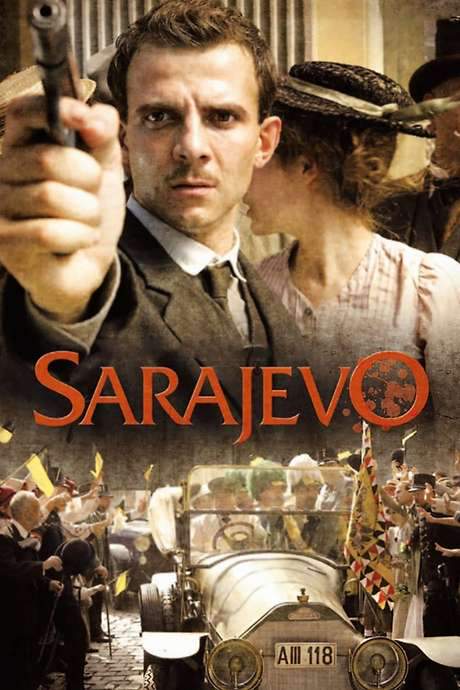
Sarajevo 2014

Directed by

Andreas Prochaska
Made by

Beta Film
Where to Watch Sarajevo
See current US streaming, rental, and purchase options for Sarajevo (2014) via JustWatch.


Streaming availability powered by 
Sarajevo Plot Summary
Read the complete plot summary and ending explained for Sarajevo (2014). From turning points to emotional moments, uncover what really happened and why it matters.
This German film, set in June 1914, offers a provocative alternate take on the assassination of Archduke Franz Ferdinand, the event that sparked World War I. While the official account pins the crime on six Bosnian Serb separatists connected to the Serbian government, this movie pushes a different hypothesis, weaving a darker web of motives that reach beyond a single conspiracy.
Dr. Leo Pfiffer, Florian Teichtmeister, a district magistrate for the Austrian administration in Sarajevo who is ethnically Hungarian and Jewish, is tasked with interrogating the young men accused of the deed. At first, he clings to the belief that the Serbian government ordered the assassination to reclaim Bosnia and other territories annexed by Austria. But as the interrogations unfold, he starts to doubt this simplified version. The suspects struggle to recount their journeys from Serbia across the mountains into Sarajevo, including a confessed route that seems inconsistent with what they described. Pfiffer also notes the oddly sparse police presence—only 36 officers on the day of the royal procession—and questions why the parade route was made public in newspapers, all within a volatile and politically charged environment.
As Pfiffer travels deeper into the case, he encounters shadowy figures from both Austria and Germany who seem to pull strings behind the scenes. He begins to suspect that the six youngsters acted more out of local nationalist fervor than direct orders from a distant government. Yet there is a broader design at play: the film argues that wealthy industrialists envision a railroad from Berlin to Baghdad crossing Serbia, and that both Austria and Germany would seize the opportunity to shape Serbia as a buffer against Russia. With every step, Pfiffer uncovers clues suggesting that the assassination was used as a pretext to advance a larger geopolitical agenda.
The narrative tightens around the question of who really benefits from such upheaval. Pfiffer discovers that the motive behind the plot may lie not merely in nationalist fervor but in a calculated, high-stakes plan to redraw power in the region. The film suggests that Germany’s military strength helped set the wheels in motion, potentially sacrificing Archduke Ferdinand to justify swift annexation of Serbia. In a striking closing turn, Pfiffer is warned by a German military doctor—an ally he has come to trust—that Germany intends to overtake Paris within a month, underscoring how quickly war ambitions could unfold once set in motion.
Amid the political intrigue runs a poignant romance: Pfiffer becomes involved with a wealthy Serbian heiress, Melika Foroutan portraying Marija Jeftanović, who lives with her father in Sarajevo. Their clandestine relationship deepens Pfiffer’s humanity amid the murky moral calculus around power, loyalty, and national interest. The couple’s happiness is interrupted by the harsh realities of war, as Marija and her father are forced to return to Paris after discovering she is married to a man there, all while the German army closes in.
The cast threads a web of tense performances that anchor the story. Heino Ferch embodies Dr. Herbert Sattler, a pivotal figure who looms large in Pfiffer’s investigations. The investigators and officials Pfiffer encounters—including Erwin Steinhauer as Oskar Potiorek, Friedrich von Thun as Sektionsrat Wiesner, Edin Hasanović as Danilo Ilic, Juraj Kukura as Stojan Jeftanovic, and Martin Leutgeb as Schimpf—paint a portrait of a world where personal ambition, political maneuvering, and the fate of nations intersect.
The film is presented in both German and Serbian, with English subtitles to guide viewers through its multilingual, historically charged dialogue. Its atmosphere is tense, methodical, and contemplative, inviting audiences to weigh competing narratives while considering how information can be shaped to justify broader imperial ambitions. The result is a thoroughly modern historical drama that stays true to its core events while offering a thought-provoking reinterpretation of a watershed moment in world history.
Sarajevo Timeline
Follow the complete movie timeline of Sarajevo (2014) with every major event in chronological order. Great for understanding complex plots and story progression.
Opening life in wartime Sarajevo (June 1914)
June 1914 finds Sarajevo under Austrian occupation, with life continuing beneath the shadow of empire. The city feels tense, yet daily routines persist as rumors swirl about politics and looming conflicts. This setting frames the upcoming royal procession and the assassination that will ripple outward.
Dr. Leo Pfiffer is tasked with interrogations
Dr. Leo Pfiffer, a district magistrate for the Austrian government, is assigned to interrogate the six young assassins. He is an ethnically Hungarian and Jewish official navigating loyalty and suspicion in a contested city. Initially, he believes the Serbian government orchestrated the plot to reclaim territory, but his investigation begins to fracture that belief.
Initial belief: Serbian government behind the plot
Pfiffer's early theory pins the murder on Belgrade's orders to push Serbia's influence and redraw borders. The notion frames the assassination as a state-directed strike rather than a random act. This belief drives his early questions and interrogations.
Gaps in the confessions reveal unspoken parts
During interrogations, the six men cannot recount their journeys from Serbia across the mountains into Sarajevo. The missing, unspoken parts of their stories cast doubt on the official account. Pfiffer suspects a cover story hiding a different motive.
Questions about security and the parade route
He asks why there were only 36 policemen on the royal procession day and why the parade route was published in newspapers. These details reveal a potential premeditated exposure of the route. The questions hint at deeper planning and local scheming rather than a simple foreign directive.
Encounters with shadowy figures from Austria and Germany
As the investigation deepens, Pfiffer encounters shadowy figures from both Austria and Germany. These interactions pull him toward a broader conspiracy with powerful, unseen hands. He begins to suspect a domestic nationalist movement woven into continental schemes.
The localist explanation gains traction
Pfiffer gradually concludes the assassins were acting as pawns of a local nationalist group, not direct agents of the Serbian government. The idea that a small clique pulled the strings grows stronger, yet proof remains elusive. The thread of truth widens to a murkier battlefield of interests.
Industrialists' Berlin-Baghdad railroad plan emerges
Across the murk, Pfiffer learns of a plan by wealthy industrialists to build a railroad from Berlin to Baghdad through Serbia. The murder becomes a tool in a larger scheme to reshape regional power and economic routes. The vision hints at motives beyond national politics, involving control of resources and strategic transit.
Austria and Germany use the event to secure Serbia
Austria and Germany leverage the assassination’s narrative to secure Serbia as a buffer against Russia and to advance their aims in the Balkans. The plot shows how economic and strategic interests steer political actions beneath official statements. The investigation threads crime, commerce, and empire together.
Germany plans to overtake Paris come into view
In a chilling turn, a German military doctor informs Pfiffer that Germany intends to overtake Paris within a month. The revelation reframes the assassination as a catalyst for a broader war plan. It underscores how personal loyalties and imperial maneuvering intersect with the onset of global conflict.
Romance blooms amid the political storm
Pfiffer begins a romance with a wealthy Serbian heiress living in Sarajevo. The affair brings warmth amid tension but becomes complicated by her status and loyalties. She learns she is married to a man in Paris, adding personal stakes to the unfolding political drama.
Escape to Paris as the German army advances
Fearing the advancing German army, the heiress and her father return to Paris to seek safety. The romance is sidelined as personal danger takes precedence and Paris becomes their refuge. The move ties intimate lives to the looming continental conflict.
Closing implications and lingering questions
The film closes with lingering questions about who truly pulled the strings and how deeply powers manipulated events in Sarajevo. Pfiffer's journey exposes a web of conspiracy, ambition, and impending war. The audience is left to interpret responsibility within a rapidly evolving European crisis.
Sarajevo Characters
Explore all characters from Sarajevo (2014). Get detailed profiles with their roles, arcs, and key relationships explained.
Leo Pfeffer (Florian Teichtmeister)
A district magistrate for the Austrian government in Sarajevo, ethnically Hungarian and Jewish. He is tasked with interrogating the assassins but gradually questions the official narrative. As he probes, he uncovers ties between local nationalist actors and broader imperial schemes, complicating his view of guilt and responsibility.
Danilo Ilic (Edin Hasanović)
One of the six young assassins, part of a local nationalist impulse. He and his companions cannot fully explain their journey into Sarajevo, hinting at a deeper, orchestrated plan. His participation exposes how ordinary youths can be drawn into a much larger political game.
Dr. Herbert Sattler (Heino Ferch)
A German military doctor who befriends Pfeffer and supplies crucial insights about German aims. He reveals that Berlin’s plans extend beyond Sarajevo, framing the assassination as a pretext for broader expansion. His perspective accelerates Pfeffer’s unraveling of the conspiracy.
Oskar Potiorek (Erwin Steinhauer)
A senior Austrian official in Bosnia who embodies imperial authority. His presence and decisions reflect the orchestration of occupation and governance in the region. He serves as a link between local administration and the larger imperial agenda at play.
Sektionsrat Wiesner (Friedrich von Thun)
A high-ranking security official within the Austrian system, involved in the interrogation process and the political machinery surrounding the investigation. He represents the bureaucratic side of empire that seeks to control the narrative around the events.
Marija Jeftanović (Melika Foroutan)
A wealthy Serbian heiress living in Sarajevo who becomes Pfeffer’s lover. Her relationship adds a personal dimension to the political tension and foreshadows how private loyalties are tested by the encroaching conflict.
Stojan Jeftanović (Juraj Kukura)
Marija’s father, a wealthy Serbian figure whose presence underscores the regional rivalries at the heart of Sarajevo’s social fabric. His status and decisions reflect the push-and-pull between Serbian interests and Austro-Hungarian authority.
Schimpf (Martin Leutgeb)
An Austrian officer/police figure involved in the local investigation, illustrating the enforcement arm of the occupying power. His role hints at the friction between law, order, and the political manipulation surrounding the events.
Sarajevo Settings
Learn where and when Sarajevo (2014) takes place. Explore the film’s settings, era, and how they shape the narrative.
Time period
June 1914
The film is anchored in the heat of June 1914, just before the outbreak of World War I. It situates a society on edge, with the Archduke’s procession and the surrounding rumors shaping every interaction. The June timeframe highlights the collision of personal lives with imperial strategies and dangerous political gambits.
Location
Sarajevo, Bosnia and Herzegovina (then part of the Austrian Empire)
The story unfolds in Sarajevo, a city under Austrian occupation after annexation of parts of Bosnia. The urban backdrop blends imperial bureaucracy with local streets, where officials interrogate suspects while ordinary life goes on. The period is defined by imperial maneuvering, nationalist fervor, and the looming question of where power truly lies.
Sarajevo Themes
Discover the main themes in Sarajevo (2014). Analyze the deeper meanings, emotional layers, and social commentary behind the film.
🕵️
Conspiracy
The narrative threads a web of interests—industrialists, states, and clandestine networks—whose actions suggest the assassination is more than a local act of violence. Private profit and imperial ambitions intertwine to create a pretext for larger strategic moves. As the investigation deepens, the line between truth and manipulation becomes increasingly blurred.
🇷🇸
Nationalism
Local nationalist passions drive the six young assassins, yet their actions appear to be leveraged by broader agendas. The film probes how raw ethnic pride can be harnessed by powerful actors to destabilize borders and advance geopolitical goals. Individual loyalties clash with the pressure of a larger, impersonal game.
🧭
Truth vs Narrative
Dr. Leo Pfeffer seeks an alternative to the official version of events, uncovering gaps and inconsistencies in the proclaimed justifications for the assassination. The pursuit of truth pushes him to question who benefits from presenting a simplified story. The plot reveals how narratives can be manufactured to serve imperial interests.
❤️
Romance
A romance develops between Pfeffer and a wealthy Serbian heiress living in Sarajevo, adding emotional complexity to the political tumult. Their relationship is tested by hidden marriages and the encroaching German advance, highlighting how personal lives collide with historic upheaval. The affair complicates loyalties as the city braces for war.

Coming soon on iOS and Android
The Plot Explained Mobile App
From blockbusters to hidden gems — dive into movie stories anytime, anywhere. Save your favorites, discover plots faster, and never miss a twist again.
Sign up to be the first to know when we launch. Your email stays private — always.
Explore the mobile appSarajevo Spoiler-Free Summary
Discover the spoiler-free summary of Sarajevo (2014). Get a concise overview without any spoilers.
In June 1914, the Ottoman‑shaped streets of Sarajevo pulse with a restless energy, a city caught between imperial ambition and simmering nationalism. Austrian troops occupy the hills and avenues, yet daily life continues under a veil of uneasy lawlessness, where whispers of an impending tragedy linger in cafés and market stalls alike. The film bathes the capital in a chiaroscuro palette—fog‑filtered alleys, crowded squares, and the stark formality of military parades—creating a tense, almost palpable atmosphere that feels both intimate and on the brink of catastrophe. Dialogue drifts between German and Serbian, reminding the viewer that this is a place of intersecting cultures, loyalties, and hidden agendas.
At the heart of the story is Dr. Leo Pfeffer, a district magistrate of Hungarian‑Jewish descent tasked by the Austro‑Hungarian authorities to untangle the mystery surrounding Archduke Franz Ferdinand’s assassination. Pfeffer’s methodical mind and principled sense of justice clash with the chaotic reality of a city where truth is as fragmented as the cobblestones beneath his feet. Amid his investigation, he is drawn to Marija, a spirited Serbian heiress whose father is a respected merchant; their budding affection offers a fragile sanctuary against the storm of political intrigue surrounding them. Their relationship hints at the personal stakes that weigh on Pfeffer, forcing him to balance his official duties with the desire to protect the people he has come to love.
As the magistrate delves deeper, the straightforward case of a political murder begins to feel like a gateway to larger, more opaque forces. The film hints at a web of shadowy figures—industrialists with grandiose railway dreams, distant military strategists, and colonial interests—that may be shaping events far beyond Sarajevo’s walls. This sense of a hidden, expansive game amplifies the thriller’s mood, suggesting that the city’s fate is entangled with ambitions that could ignite a continent. The story invites viewers to wonder how far a single man’s pursuit of justice can go when the world around him is already on the edge of a far greater conflict.
Featured on this page

What's After the Movie?
Not sure whether to stay after the credits? Find out!
Check out our other apps:

SAT Sphere
Build confidence for the Digital SAT.

Mori Atlas
Discover wild places worth protecting.

Luntero
Search smarter for a home in Amsterdam.

Plot Explained
Unravel movie endings and hidden clues.

Pokechamp
Dive into Pokémon data and battle logic.

Driving Theory
Get ready for your European theory test.

Movie Dust
Plan your next cinema trip with ease.

Musemap
Find art and culture as you travel.

Selkobase
Compare credentials before committing.

Local Manual
Turn an unfamiliar country into practical next steps.

Lernavi
Compare school systems before your next move.

GymRoam
Find a workout stop wherever your plans take you.
Explore Our Movie Platform
New Movie Releases (2026)
Famous Movie Actors
Top Film Production Studios
Movie Plot Summaries & Endings
Major Movie Awards & Winners
Best Concert Films & Music Documentaries
Movie Collections and Curated Lists
© 2026 What's After the Movie. All rights reserved.
Privacy Policy