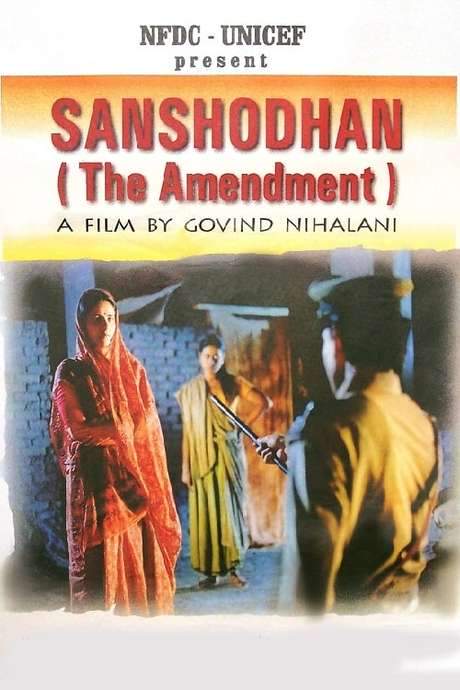
Sanshodhan 1996

Directed by

Govind Nihalani

Sanshodhan Plot Summary
Read the complete plot summary and ending explained for Sanshodhan (1996). From turning points to emotional moments, uncover what really happened and why it matters.
The film opens with a national moment of change: a new Amendment that reserves one-third of every Village Panchayat seat for women, a rule that promises representation but also stirs deep local tensions. In Parmino, the village council has long been an all-male enclave, where voices and votes are controlled by a tight circle. The news of the Amendment arrives like a ripple that could become a wave, especially for those waiting to test the limits of power in a small community.
Ratan Singh, the village head, Anupam Shyam, and the other council members react with careful calculations. Rather than inviting a broad debate, they decide to let women from their own families contest the reserved seats, hoping to preserve influence while giving the appearance of progress. The plan rests on a delicate balance between tradition and reform, and it puts family dynamics at the center of political strategy. Ratan Singh’s authority is underscored as he turns to his own son, Inder Singh, to help orchestrate the moves that will bring these new candidates into the fold.
Inder Singh, Lalit Parimoo, is pressed to recruit Manju, his wife, to take one of the contested spots. But the other council members push their own wives into the race as well, expanding the circle of influence and testing whether the women can challenge a system built on entrenched control. The atmosphere in the village grows charged as campaigns begin to unfold, with the men articulating strategies while the women start to articulate what governance could look like under the new rules.
Among the contenders is Vidya, Vanya Joshi, the newly married wife of Bhanwar, a poor store owner who is deeply in debt to the village head. Vidya’s entry into the race adds another layer of tension, because her background and marriage connect her to the very people shaping the political moment. Bhanwar’s stake in the outcome is not merely personal; it reflects the wider web of obligations and debts that tie villagers to the powers that be.
As the campaigns advance, Vidya challenges the process from within, demanding accountability for the funds allocated to the partially built school. Her insistence to account for the money unsettles the assumed arrangements and pushes the story toward a confrontation about transparency and fairness. The others in the village—men who once controlled the purse strings—find themselves facing a different kind of scrutiny, one that isn’t just about who wins an election but about where the government money actually ends up.
Against this backdrop, the film examines how intermediaries siphon much of the allotted funds, leaving the rightful beneficiaries with scant resources. The tension between ambition, gender representation, and real-world corrupt practices is drawn with a measured, neutral tone that invites viewers to weigh the complexities of reform in a tightly knit community. The drama unfolds with a quiet intensity, showing that progress can be messy and that accountability can emerge in surprising, hard-fought ways.
In the end, the narrative centers on the interplay between tradition and reform, the personal costs of political maneuvering, and the enduring question of who finally benefits when power is redistributed. The village of Parmino becomes a microcosm for broader debates about women’s leadership, financial transparency, and the stubborn persistence of old networks, all told through the lived experiences of its residents and the choices they make under pressure.
Sanshodhan Timeline
Follow the complete movie timeline of Sanshodhan (1996) with every major event in chronological order. Great for understanding complex plots and story progression.
Amendment announced reserving one-third seats for women
The government reveals an amendment that reserves one-third of village panchayat seats for women. In Parmino, the news sparks surprise and curiosity, with villagers pondering how this change will reshape local power dynamics and governance.
Male council decides to manipulate the plan
The all-male village committee contemplates the new rule but chooses a strategy aimed at preserving influence. They decide to let women in their families contest the seats so they can guide decisions from behind the scenes. The men hope to maintain control while outwardly complying with the amendment.
Ratan assigns Inder to recruit Manju
Ratan asks his son Inder to secure Manju, his wife, as a candidate. This move is framed as supporting women’s participation, yet it clearly serves to keep leadership within familiar hands. The plan blends appearances of empowerment with a desire for continued authority.
Other members organize their wives
The rest of the council members arrange for their wives to contest as well. This coordinated effort creates a multi-front challenge to the status quo while masking the underlying motive of sustaining male dominance. Campaigns begin to take shape across the village.
Vidya enters the race
Vidya, newly married to Bhanwar, signs up as a candidate. Her entry represents a direct challenge to traditional expectations and signals a shift toward female participation in local power structures. She becomes a focal point of the election narrative.
Vidya challenges fund distribution
Vidya raises questions about the funds allocated for the partially built school. She insists on transparent accounting and accountability from those handling the money. Her stance puts pressure on the leaders and questions the legitimacy of the project.
Intermediaries skim government funds
As the campaign unfolds, it becomes evident that intermediaries siphon much of the development money. Vidya’s scrutiny threatens the entrenched scheme and prompts calls for reform. The village witnesses a clash between corruption and newly empowered voices.
Campaign dynamics intensify
Tensions rise as women push back against male resistance and traditional norms. The men attempt to undermine the female candidates, while Vidya remains persistent and vocal about accountability. Public meetings become arenas for contested power.
Election votes cast
Voters in Parmino head to the polls to decide the race, with female candidates challenging long-standing norms. The atmosphere is charged as people weigh representation, accountability, and the prospect of real change. The result hinges on both persuasion and skepticism toward reform.
Women win reserved seats
The results show women securing the reserved seats, marking a turning point in Parmino’s governance. The new female councilors begin to shape discussions and set expectations for transparency and responsiveness. This victory reframes how the village approaches development.
Power dynamics shift in the council
With women in office, the balance of power begins to shift and male leaders are compelled to engage more openly. They must answer questions and justify decisions, signaling a move toward shared responsibility. The council starts to function with greater scrutiny and accountability.
Vidya’s accountability stance sets a precedent
Vidya’s insistence on transparent accounting becomes a model for future governance and anti-corruption efforts. The village learns that representation alone is not enough without oversight and public scrutiny. The episode leaves a lasting impact on how Parmino handles funds and projects.
Sanshodhan Characters
Explore all characters from Sanshodhan (1996). Get detailed profiles with their roles, arcs, and key relationships explained.
Inder Singh (Lalit Parimoo)
Inder Singh is the son of the village head, pulled between family loyalty and a growing sense of justice. He is told to mobilize Manju to contest the reserved seats, revealing his compliance with traditional power structures but also his internal conflict. His choices reveal a tension between preserving an inherited order and embracing reform.
Ratan Singh (Anupam Shyam)
Ratan Singh is the long-standing village head who guards traditional authority. He navigates a sudden constitutional shift by steering his family to contest, hoping to preserve influence under the new rules. He embodies the resistance of entrenched elites to gender-based reform.
Vidya (Vanya Joshi)
Vidya is the newly married wife of Bhanwar, a poor store owner deeply in debt to the village head. She sues the system by demanding accountability for government funds and uses the reserved-seat debate to push for transparency. Her actions flip the power dynamic, turning a passive beneficiary into an active challenger of corruption.
Manju (Kavita Rayirath)
Manju is the wife of Ratan Singh who steps into the electoral arena as a contesting candidate. She navigates skepticism from male peers while leveraging her position as a woman under the new rule. Her participation tests the limits of patriarchal control and reshapes village politics.
Bhanwar (Manoj Bajpayee)
Bhanwar is a poor store owner indebted to the village head, representing the vulnerability of ordinary people in the political game. His financial strain makes him a focal point for the manipulation by elites, but his wife Vidya's actions begin to alter his view of power and accountability. He embodies the human cost of governance and reform.
Sanshodhan Settings
Learn where and when Sanshodhan (1996) takes place. Explore the film’s settings, era, and how they shape the narrative.
Time period
Present-day India
Set in present-day India, the story unfolds as the government enacts a constitutional amendment to reserve one-third of Panchayat seats for women. The timeframe reflects contemporary political processes, public discourse, and media scrutiny around rural governance. The events demonstrate how reform collides with longstanding social hierarchies.
Location
Parmino Village
Parmino Village is a rural community where the Panchayat governs daily life and local affairs. The setting highlights a close-knit, tradition-bound society facing reform from a constitutional amendment. Intermediaries and local power brokers are central to the drama as funds from government schemes are diverted away from ordinary residents.
Sanshodhan Themes
Discover the main themes in Sanshodhan (1996). Analyze the deeper meanings, emotional layers, and social commentary behind the film.
♀️
Gender Representation
The amendment introduces women into a space long dominated by men, challenging established authority in Parmino. Female candidates such as Manju and Vidya confront skepticism, intimidation, and traditional expectations. The theme explores how representation can shift power dynamics and expose systemic barriers. It also questions whether mere presence in leadership translates into real influence.
💰
Corruption & Accountability
Behind the scenes, intermediaries siphon government funds, weakening institutional accountability. The reserved-seat experiment becomes a test of transparency as candidates demand explanations for misused resources, such as funds for a partially built school. The story examines how corruption persists and what it takes for ordinary people to demand accountability.
🗳️
Civic Participation
Residents, especially women, begin to exercise their political agency by contesting seats and questioning leaders. The narrative tracks the rise of grassroots voice, from debates to election campaigns, showing how democratic participation reshapes village leadership. It highlights the power of collective action to redefine local governance and policy outcomes.

Coming soon on iOS and Android
The Plot Explained Mobile App
From blockbusters to hidden gems — dive into movie stories anytime, anywhere. Save your favorites, discover plots faster, and never miss a twist again.
Sign up to be the first to know when we launch. Your email stays private — always.
Explore the mobile appSanshodhan Spoiler-Free Summary
Discover the spoiler-free summary of Sanshodhan (1996). Get a concise overview without any spoilers.
In the dusty lanes of a typical Indian village, a newly‑mandated amendment reshapes the political landscape: one‑third of every Gram Panchayat seat must now be held by women. The law, meant to amplify voices that have long been muted, lands amid a community where power has traditionally been an exclusively male domain. This sudden shift creates a palpable undercurrent, a mixture of cautious optimism and entrenched suspicion that colors every conversation in the town square.
Ratan Singh, the long‑standing sarpanch, watches the change with a calculating eye. Though he publicly embraces the reform, his strategy is to preserve the familiar hierarchy by encouraging the women in his own circle to occupy the reserved seats. He enlists his son Inder to persuade his wife and other council members to field their spouses, hoping that these familiar faces will remain pliable extensions of the existing authority. The atmosphere thickens with unspoken negotiations, as the council members weigh loyalty against the promise of genuine representation.
Into this calculated tableau steps Vidya, the newly married, educated wife of a modest shopkeeper, Bhanwar Singh. Unlike the other candidates, whose ambitions are tethered to the men who placed them there, Vidya arrives with a keen awareness of the inequities that underpin village life. She quickly perceives the tokenism behind the reservation and feels an emerging responsibility to challenge the status quo. Her presence introduces a fresh, inquisitive energy that unsettles the comfortable complacency of the entrenched power structure.
The film’s tone balances earthy realism with a quiet, simmering resolve. It captures the textures of rural life—the clang of a construction site, the chatter of market stalls, the rustle of prayer flags—while foregrounding the subtle, yet powerful, struggle for agency. As the village grapples with the promise and the paradox of forced inclusion, the story asks what true empowerment looks like when old habits refuse to yield without a fight.
Featured on this page

What's After the Movie?
Not sure whether to stay after the credits? Find out!
Check out our other apps:

SAT Sphere
Build confidence for the Digital SAT.

Mori Atlas
Discover wild places worth protecting.

Luntero
Search smarter for a home in Amsterdam.

Plot Explained
Unravel movie endings and hidden clues.

Pokechamp
Dive into Pokémon data and battle logic.

Driving Theory
Get ready for your European theory test.

Movie Dust
Plan your next cinema trip with ease.

Musemap
Find art and culture as you travel.

Selkobase
Compare credentials before committing.

Local Manual
Turn an unfamiliar country into practical next steps.

Lernavi
Compare school systems before your next move.

GymRoam
Find a workout stop wherever your plans take you.
Explore Our Movie Platform
New Movie Releases (2026)
Famous Movie Actors
Top Film Production Studios
Movie Plot Summaries & Endings
Major Movie Awards & Winners
Best Concert Films & Music Documentaries
Movie Collections and Curated Lists
© 2026 What's After the Movie. All rights reserved.
Privacy Policy