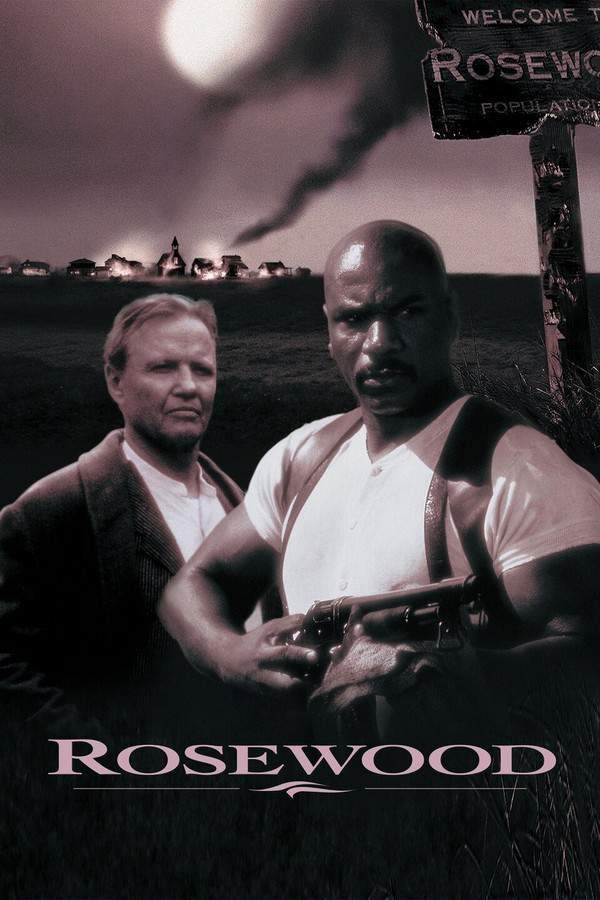
Rosewood 1997


Directed by

John Singleton
Made by

Warner Bros. Pictures
Where to Watch Rosewood
See current US streaming, rental, and purchase options for Rosewood (1997) via JustWatch.

Howdy Amazon Channel
HD
Kanopy
HD
YouTube Free
HD
Amazon Video
HD
Apple TV Store
HD
Fandango At Home
HD
Google Play Movies
SD
Spectrum On Demand
HD
YouTube
SD Streaming availability powered by 
Rosewood Plot Summary
Read the complete plot summary and ending explained for Rosewood (1997). From turning points to emotional moments, uncover what really happened and why it matters.
Mann is a quiet, enigmatic World War I veteran who arrives in Rosewood, a small Florida town with a strong Black community soul, to scout land that might become his new home. The town is defined by the Carrier family, an upwardly mobile Black clan led by the steadfast matriarch Aunt Sarah and her proud, headstrong son, Sylvester Carrier. The Carriers embody a sense of ambition and dignity that contrasts with the tensions simmering on the town’s edges, and Mann finds himself drawn into their world even as he guards his own concealed past and purpose.
As the days unfold, Mann meets Beulah “Scrappie” Carrier, Sylvester’s cousin, and the two form a tentative, quickly blossoming bond. The romance unfolds under the gaze of a community trying to protect itself while navigating a harsh social landscape where visibility equals vulnerability. Aunt Sarah works as a housekeeper for a white couple, James Taylor and his wife Fanny, who live in the white town of Sumner. Fanny’s restless, complicated life becomes a catalyst for the escalating crisis: she has a long history of infidelity, she hides her injuries behind a fragile veneer of resilience, and she confides in few people. When a violent confrontation with her lover turns deadly, she leaves her home in distress and seeks help, muttering a story that she hopes will shield her from further harm.
The moment the white townspeople hear Fanny’s claim that she was beaten by a Black man, the spark of fear, rumor, and prejudice is fanned into action. An escaped Black convict, Jesse Hunter, becomes a focal point for the mob’s suspicions, and a posse from Sumner and neighboring towns rides toward Rosewood to ferret out the supposed threat. The Black residents brace for danger, and Mann, a stranger in a tense place, fears being accused of assault and lynched. He contemplates leaving, even as local residents gather in a church to discuss defense strategies and the possibility of protecting their community from a wider attack.
Outside the church, a friction-filled encounter with John Wright—a Navy veteran and owner of a general store, one of the few white residents who seems to grasp the stakes—underscores the fragility of trust across racial lines. Wright is entangled in a torrid extramarital affair with Jewel, Sylvester’s cousin, adding another layer of personal peril to the already volatile situation. Mann exits the scene, wary of where loyalties may lie as rumors swirl and the mob’s hunger for retribution grows louder.
The situation erupts when the mob arrives at the Carrier home. Aunt Sarah, attempting to calm the crowd, reveals that Fanny’s attackers were white men, but a shot rings out and she is killed as she pleads for calm. The violence explodes: Sylvester shoots and kills two members of the posse, and the mob retaliates with brutal force. The settlement comes under assault, and Rosewood becomes a battlefield. Mann, initially planning an exit, experiences a turning point as he witnesses the lynching of a Black blacksmith, Sam Carter, and realizes that his own fate may be sealed by the crowd’s rage if he stays silent.
With danger closing in, the situation spirals into a broader crisis that spills into nearby towns. The posse’s reach grows as more white men descend with guns and authority, turning roads into chokepoints and forcing many to seek safety elsewhere. Wright, who had once opposed the mob in part, chafes under the escalating violence and tensions between the communities. In a tense turn, he helps arrange a train escape for surviving members of the Carrier family, a moment that crystallizes the thin thread of humanity still operating within a scene of collective fear. Scrappie and Mann share a heartfelt kiss before he leaves with Sylvester, a quiet moment of tenderness amid the chaos, hinting at a future where memory and longing persist beyond immediate danger.
In the aftermath, James Taylor confronts Fanny and confronts the truth she has long avoided: her injuries were the result of her own deception and her extramarital life, not the act of a Black attacker. The sheriff, the town’s officials, and the mob all reckon with the consequences of their actions, even as the landscape of Rosewood and its surrounding communities remains scarred by the violence. The body count is officially recorded as eight—six Black residents and two white—but survivor accounts and Black newspapers offer far higher figures, suggesting a massacre with a reach beyond the town’s borders and a violence that reverberates through the region.
What unfolds in Rosewood is a paradox of fear and courage, of a community’s determination to defend itself against a threat amplified by rumor and racial hatred, and of individuals who must decide whether to stand and fight or to flee. Mann’s presence in this story acts as a quiet counterweight to the mob’s fury, a reminder that the human impulse toward protection and solidarity can endure even in the face of overwhelming hostility. The Carrier family’s resilience—Aunt Sarah’s leadership, Sylvester’s defiant stance, and Beulah Scrappie’s loyalty—remains at the heart of the narrative, even as the town is reduced to ashes and echoes of names that once defined a vibrant community.
In the end, the tragedy portends a truth about the era: the official tally may be humble, but the legacy of Rosewood looms large, with memories and newspaper reports offering divergent accounts of what happened. The story holds up a mirror to a country wrestling with its own contradictions, a reminder that history is written in the voices of survivors and witnesses who must carry forward the memory of those who were harmed, even as the last train carries away those who dared to hope for safety, dignity, and a place to call home.
Rosewood Timeline
Follow the complete movie timeline of Rosewood (1997) with every major event in chronological order. Great for understanding complex plots and story progression.
Mann arrives in Rosewood and meets Scrappie
World War I veteran Mann arrives in Rosewood, a small Black town in Florida, as he scouts land to buy. He quickly notices Scrappie Carrier and the two form a tentative, forbidden romance as their paths cross. The town's tense atmosphere foreshadows the conflict to come.
Fanny's injuries lead to a baseless black-attack claim
In Sumner, Fanny reveals she was beaten after an affair with a white lover, but Aunt Sarah and Lee Ruth overhear only the aftermath. Fanny tells townspeople a Black man attacked her, and the white residents readily believe her story. This rumor seeds the mob mentality that later engulfs Rosewood.
The alert: Jesse Hunter's escape spurs a posse to Rosewood
News spreads about an escaped Black convict, Jesse Hunter, prompting a posse from Sumner and nearby towns to head toward Rosewood to 'investigate'. Black residents brace for danger as suspicions mount. The stage is set for violence beyond Rosewood's borders.
Town defense meeting at the church
The Rosewood community convenes in a church to discuss defending their town against the perceived threat. Mann clashes with John Wright, a white veteran who runs a general store, outside the meeting. The tense exchange foreshadows the polarized loyalties that will explode soon.
Aunt Sarah confronts the mob and is shot
When the mob arrives at the Carrier home, Aunt Sarah tries to calm the crowd and insists there is a white attacker. A shot mortally wounds her, and she dies from the injuries. The murder catalyzes the riot and escalates the town's violence.
Sylvester's stand and the shootout erupts
Sylvester Carrier shoots two members of the posse in defense of his family, triggering a broader shootout. The confrontation quickly spirals into widespread violence as the mob retaliates and Rosewood erupts in chaos. Tensions between Black residents and white aggressors reach a fever pitch.
Mann chooses to stay and fight after witnessing a lynching
Mann initially contemplates leaving town to avoid accusation, but he witnesses the lynching of Sam Carter, a Blacksmith, and changes his mind. He returns to Rosewood to join the defense alongside the residents. The decision marks a turning point in the community's resistance.
James Carrier targeted; Carrier is shot amid the mob pressure
The mob seeks James Carrier, and Sheriff Walker agrees to detain him for questioning. When Carrier insists he has no information, a mob member shoots him, marking another deadly blow to the Carrier family. Wright is angry at the mob's actions, while the town descends further into chaos.
Violence spills to neighboring towns and border blocks
The violence spreads beyond Rosewood into neighboring towns, prompting authorities to block roads at the border of Alachua County. Deputized white men and a sheriff enforce the blockade to prevent further escalation. The trajectory of the massacre seems unstoppable as tensions flare.
The Carrier family escapes by train; Scrappie and Mann kiss
Survivors of the Carrier family escape Rosewood aboard a train arranged by Wright, seeking safety beyond Florida. Scrappie and Mann share a heartfelt kiss before Mann departs with Sylvester, agreeing to reunite later. The image captures both relief and sorrow as the community fragments amid flight.
The aftermath: Fanny's deception exposed; Taylor confronts Fanny
In Sumner, James Taylor confronts his wife, Fanny, and exposes her lies about the assault. He learns of her affairs, unraveling the social web that helped fuel the violence. The truth undercuts the narrative used to justify the bloodshed.
Death toll and memory of Rosewood
Officials report a final death toll of eight, while survivor accounts suggest many more. The town of Rosewood bears the scars of the massacre, and the event lives on in newspapers and memory. The film ends with a somber reflection on the tragedy and the long shadow it casts.
Rosewood Characters
Explore all characters from Rosewood (1997). Get detailed profiles with their roles, arcs, and key relationships explained.
Mann (Don Cheadle)
A mysterious World War I veteran who arrives in Rosewood to scout land. His outsider status makes him cautious about accusations, but he grows into a defender of the community and a personal ally to Scrappie.
James Taylor (Jon Voight)
A white landowner in Sumner, husband to Fanny, and a central figure in the town's social order. His interactions with both Black residents and law enforcement reveal the complexities of power and prejudice in the period.
Sylvester Carrier (Ving Rhames)
A proud, headstrong member of the Carrier family who is protective of his kin and becomes entangled in the fight to defend Rosewood. His resolve tests the limits of loyalty and courage.
Aunt Sarah
Matriarch of the Carrier family and a housekeeper for James Taylor's household. She acts as a community elder, trying to calm tensions even as violence erupts.
Beulah "Scrappie" Carrier
Sylvester's young cousin who shares a budding romance with Mann, symbolizing hope and human connection amid chaos.
Fanny Taylor
James Taylor's wife whose false claims spark the initial violence; her later revelations expose deception and double standards within the town.
Sam Carter
The Blacksmith who is lynched as part of the mob violence, representing the brutal consequences of the massacre.
Rosewood Settings
Learn where and when Rosewood (1997) takes place. Explore the film’s settings, era, and how they shape the narrative.
Time period
1923
The events unfold in the early 1920s, culminating in the 1923 Rosewood Massacre. The era’s racial codes and extralegal violence defined daily life for Black families and their white neighbors. Mobs mobilized quickly, and law enforcement struggled to protect Black residents. The film places the tragedy within a community that is both intimate and volatile.
Location
Rosewood, Florida, Sumner, Florida
Rosewood is a small, predominantly Black town in rural Florida. It sits near the white town of Sumner, where fear and prejudice threaten daily safety. The two communities’ proximity and shared spaces amplify mistrust and danger amid escalating violence. The setting highlights how geography can intensify racial animosity and collective vulnerability.
Rosewood Themes
Discover the main themes in Rosewood (1997). Analyze the deeper meanings, emotional layers, and social commentary behind the film.
⚖️
Racial Injustice
The town's Black residents are scapegoated when a white woman lies about an assault. Rumors and fear override due process, revealing how justice can be compromised by racism and mob mentality. The incident exposes how swiftly prejudice can override reason and safety. The film uses this to critique systemic racism and the fragility of Black life under threat.
🤝
Community Resilience
Rosewood residents organize, meeting in churches and homes to discuss how to defend their community. They stand together against intimidation, risking arrest and death to protect their families. The portrayal emphasizes solidarity, mutual aid, and courage in the face of terror. The events test loyalty and reveal the cost of standing together.
🩸
Violence and Loss
The violence escalates as the mob grows and spills into neighboring towns. Aunt Sarah is killed, and the tragedy includes the lynching of Sam Carter. The devastation shows the brutal consequences of prejudice and mob rule. The massacre leaves a lasting scar on the community and on historical memory.

Coming soon on iOS and Android
The Plot Explained Mobile App
From blockbusters to hidden gems — dive into movie stories anytime, anywhere. Save your favorites, discover plots faster, and never miss a twist again.
Sign up to be the first to know when we launch. Your email stays private — always.
Explore the mobile appRosewood Spoiler-Free Summary
Discover the spoiler-free summary of Rosewood (1997). Get a concise overview without any spoilers.
In the summer of 1923, the small Florida town of Rosewood sits quietly beneath swaying palms, its streets humming with the everyday rhythm of a close‑knit Black community. The town’s charm masks an undercurrent of unease, as whispers of prejudice from neighboring white towns linger on the breeze. Against this backdrop, the film unfolds with a measured, almost lyrical cadence, inviting the viewer to feel the heat of the sun, the scent of magnolia, and the simmering tension that threatens to erupt at any moment.
When Mann, a reserved World War I veteran, arrives to scout land for a fresh start, he is drawn into the lives of the town’s residents. He meets Sylvester, a passionate music teacher whose love for rhythm reflects the heartbeat of Rosewood, and quickly becomes entangled in the community’s quiet aspirations. Across the aisle of the general store, John—a Navy‑veteran turned grocer—stands as a reluctant bridge between worlds, his conscience pulling him toward protecting the women and children who call the town home. Their interactions are marked by tentative trust, unspoken histories, and a shared sense of responsibility that deepens as the shadows outside grow longer.
The tone remains taut and immersive, blending the dignity of everyday life with the looming specter of racial violence. The cinematography captures both the sun‑drenched beauty of the Southern landscape and the oppressive weight of fear that hangs over the town’s future. As rumors stir and the possibility of a hostile mob looms, the story hangs on the fragile balance between hope and dread, urging the audience to wonder how far courage can stretch when a community is pressed to its limits.
Movies with Similar Twists and Themes
Uncover films that echo the narrative beats, emotional arcs, or dramatic twists of the one you're exploring. These recommendations are handpicked based on story depth, thematic resonance, and spoiler-worthy moments — perfect for fans who crave more of the same intrigue.





Featured on this page

What's After the Movie?
Not sure whether to stay after the credits? Find out!
Check out our other apps:

SAT Sphere
Build confidence for the Digital SAT.

Mori Atlas
Discover wild places worth protecting.

Luntero
Search smarter for a home in Amsterdam.

Plot Explained
Unravel movie endings and hidden clues.

Pokechamp
Dive into Pokémon data and battle logic.

Driving Theory
Get ready for your European theory test.

Movie Dust
Plan your next cinema trip with ease.

Musemap
Find art and culture as you travel.

Selkobase
Compare credentials before committing.

Local Manual
Turn an unfamiliar country into practical next steps.

Lernavi
Compare school systems before your next move.

GymRoam
Find a workout stop wherever your plans take you.
Explore Our Movie Platform
New Movie Releases (2026)
Famous Movie Actors
Top Film Production Studios
Movie Plot Summaries & Endings
Major Movie Awards & Winners
Best Concert Films & Music Documentaries
Movie Collections and Curated Lists
© 2026 What's After the Movie. All rights reserved.
Privacy Policy