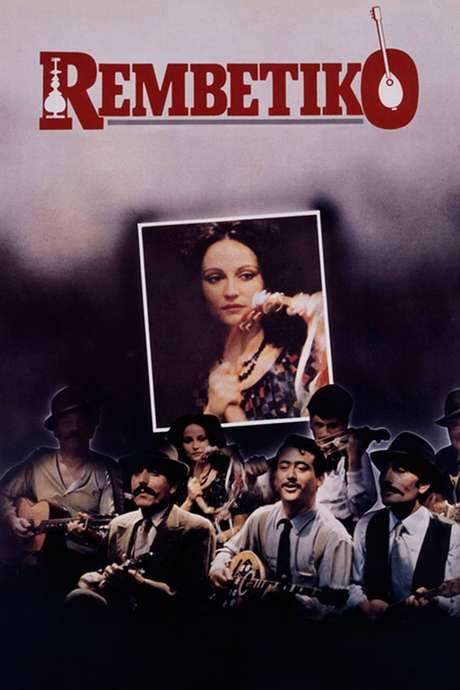


Rembetiko Plot Summary
Read the complete plot summary and ending explained for Rembetiko (1983). From turning points to emotional moments, uncover what really happened and why it matters.
This musical drama sweeps through a turbulent four-decade span in the life of Marika Sotiria Leonardou, a celebrated Greek singer whose public ascent mirrors the changing tides of her homeland. Born in Smyrna, Asia Minor, in 1917, Marika’s early years are shaped by displacement when she is seven and deported to Greece along with countless others from her community. Her parents soon forge a path in music, building a nightclub life that will foreshadow Marika’s own future on stage. In flashbacks, a younger Marika appears on stage in early life, portrayed by Popi Katsabani, hinting at the talent and determination that will define her career.
In the following decade, tragedy and ambition collide. Marika watches her father murder her mother, a moment that scars her and drives a complicated path forward. She runs away, becomes a mother, and returns to the nightclub world to sing in a show with her childhood friend Yorgos and a bouzouki player named Babis Nikos Kalogeropoulos. The circle of performers around her grows, and the stage becomes a proving ground where she can carve out a name for herself.
The ascent comes with a brutal cost: the club is shaken by the suicide of another female singer named Roza Vicky Vanita. The tragedy reverberates through the crew, and political upheaval follows as Yorgos is exiled for reasons beyond the club’s lights. Marika and Babis keep moving from venue to venue, their professional partnership deepening even as personal harmony between them remains elusive.
Although Marika harbors strong feelings for Babis, their romance never fully finds its footing. The couple’s bond is tested by time, war, and shifting loyalties as Greece endures upheaval before and after World War II. After years of turbulence, Marika sends her daughter away to a convent school, hoping for safety or a better future, only to discover that the daughter will later become a cabaret dancer—a development that sits uneasily with Marika. A tour in America marks another chapter in her life, an outward journey that contrasts with the intimate costs borne at home.
When Marika returns to Greece, she finds herself unexpectedly supplanted by a younger singer named Matina Lina Babatsia, who has captured Babis’s attention and a share of the spotlight. The dynamic of the stage and the heart grows even more complex as time presses on, and the audience watches a star confront aging, relevance, and the changing soundscape of Greek popular music.
The film’s closing act is both tragic and ceremonial. On the night of a reunion concert, Marika is stabbed in the stomach, and she dies from her wounds. Her close collaborators gather at the cemetery to sing in memory of the life they shared on stage, a testament to the power of music to sustain memory even after a performer is gone.
Scholars and observers have debated the film’s possible foundation in the life of Marika Ninou, with Babis interpreted as a stand-in for Vasilis Tsitsanis in a composite portrait rather than a strict biographical reconstruction. Yet the film makes deliberate departures from history, notably in the sequence of events after World War II and in the real-life dynamics of who accompanied Ninou on her American sojourn. The narrative emphasizes the emotional and artistic beats rather than presenting a literal, documentary chronology.
The story also nods to a suggested conflict with a singer named Roza, but the film itself flags that there is no documented incident to support that exact clash in the historical record. What remains clear is the emotional arcs—the rise, the heartbreak, and the enduring pull of the stage—that drive Marika’s long, searching career and its ultimate, poignant farewell.
Rembetiko Timeline
Follow the complete movie timeline of Rembetiko (1983) with every major event in chronological order. Great for understanding complex plots and story progression.
Birth in Smyrna
Marika is born in Smyrna, Asia Minor, in 1917. The bustling border city life frames her early years, and she grows up amid a rich mix of cultures and music. From the start, the stage and song feel like a possible path for her.
Deportation to Greece
At around age seven, Marika and thousands of Greeks are deported from Smyrna to Greece after the city and region are destabilized. The family loses its homeland but gains a foothold in Greek society through a new diaspora. This displacement colors her later artistic sensibility.
Parents begin nightclub careers
A few years after the move, Marika's parents begin a career as musicians and a singer in a Greek nightclub. Their performances pull Marika into the world of live entertainment and stage life. The household becomes a training ground for her future as a performer.
The family tragedy
In the turbulent decade that follows, Marika witnesses her father murder her mother. The violence shatters her family and forces her to navigate danger at a young age. This trauma plants the seeds of resilience that inform her later career.
Marika runs away and becomes a mother
Marika runs away from home, seeking independence amid turmoil. She also becomes a mother, adding personal responsibility to her already fraught life. These events push her further into the world of performance as a means of survival.
Return to nightclub with Yorgos and Babis
Marika returns to the nightclub to perform in an act with her childhood friend Yorgos and a bouzouki player, Babis. The trio's dynamic anchors her emergence as a popular star. Their collaboration becomes the launching pad for a lasting musical arc.
Rosa's suicide ushers in Marika's rise
A rival singer at the club, Rosa, dies by suicide after a performance. The tragedy reverberates through the venue and becomes a catalyst for Marika's rising fame. The public mourns Rosa as Marika gains attention and momentum.
Yorgos exiled; Marika and Babis move on
Political conflict forces Yorgos into exile, and Marika, along with Babis, leaves for other venues. They tour different clubs and cities, adapting to shifting demands of the entertainment scene. The duo's personal relationship remains strained by circumstance.
World War II era and family choices
Years pass through World War II, transforming Greece and its music industry. Marika sends her daughter to a convent school and embarks on a tour in America. The war era accelerates departures and reconfigurations in her life and career.
Return from America and new rival
After the war, Marika returns to Greece to discover a younger singer, Matina, who has drawn attention from Babis. The rise of Matina signals a changing landscape and questions about Marika's place in the scene. She grapples with aging, relevance, and longing for the past.
Reunion plans and legacy
Marika plans a reunion concert, seeking to reconnect with audiences and former collaborators. The prospect carries both promise and tension as she confronts a shifting musical world. The deal is rooted in her decades-long legacy.
Tragic end and burial
On the night of her reunion concert, Marika is stabbed in the stomach and dies from her wounds. Her colleagues sing at the cemetery, honoring the woman who defined an era. Her death seals a dramatic conclusion to a life spent turning personal pain into song.
Rembetiko Characters
Explore all characters from Rembetiko (1983). Get detailed profiles with their roles, arcs, and key relationships explained.
Marika
The central figure, a powerful singer whose life mirrors the turbulence of 20th-century Greece. Her career rises in the nightclub scene, she endures tragedy and political upheaval, and her personal relationships test her professionally. She embodies resilience, ambition, and a willingness to push through adversity for art.
Matina
A younger singer who captivates audiences and ultimately challenges Marika’s status. Her rise creates competition and intergenerational shift within the Greek music world. Matina represents a new generation and the evolving sound of the era.
Babis
A bouzouki player and romantic focal point, whose relationship with Marika weaves through the film’s emotional landscape. His artistry and loyalties are tested by fame, jealousy, and changing times. He embodies the musician’s viewpoint on love, craft, and spectacle.
Roza
A rival or colleague singer whose fate becomes a catalyst for the story’s darker moments. Her tragedy amplifies the film’s themes of competition, danger in show business, and the cost of success. Roza's arc comments on female agency within the era’s musical scene.
Thomas (Yorgos)
Marika’s childhood friend and a fellow musician who experiences exile for political reasons. Their bond reflects the era’s political tensions and the personal costs of upheaval. His path intersects with Marika’s career, influencing both her life decisions and artistic direction.
Rembetiko Settings
Learn where and when Rembetiko (1983) takes place. Explore the film’s settings, era, and how they shape the narrative.
Time period
1917–1950s
The narrative spans roughly four decades, from Marika’s birth in 1917 through interwar Greece, World War II, and the postwar era. It uses these eras to show how politics, migration, and social change shape a musician’s career. The period is defined by upheaval, resilience, and the rise of rebetiko as a national sound.
Location
Smyrna (Izmir, Asia Minor), Greece, United States
The story begins in Smyrna, Asia Minor, and follows the family’s deportation to Greece after 1917. It relocates to Greek nightclub culture and later takes the characters to America during a touring period. The settings reflect displacement, cultural exchange, and the evolving Greek musical scene across continents.
Rembetiko Themes
Discover the main themes in Rembetiko (1983). Analyze the deeper meanings, emotional layers, and social commentary behind the film.
💔
Love & Betrayal
Marika’s passions anchor the emotional arc, with complicated relationships driving both personal longing and professional tension. Rivalries and unfulfilled love complicate her friendships, especially with Babis and Yorgos. The death of a rival singer and the strains of fame underscore the cost of devotion and ambition. The theme examines how intimate bonds collide with public life.
🎶
Music & Identity
Rebetiko clubs and the Greek music scene are the heartbeat of the film, shaping Marika’s ascent and public image. Music serves as both livelihood and cultural language for a diaspora navigating exile and belonging. The soundtrack traces how sound mirrors shifting loyalties, eras, and personal transformation. It portrays music as a force that sustains identity amid upheaval.
🌍
Exile & Migration
From Smyrna’s upheaval to a touring life in America, migration drives the narrative and personal choices. The movement between places highlights opportunity, loss, and the struggle to maintain roots. Exile becomes a catalyst for artistic reinvention and intergenerational change. The theme underscores how displacement reshapes both life and art.

Coming soon on iOS and Android
The Plot Explained Mobile App
From blockbusters to hidden gems — dive into movie stories anytime, anywhere. Save your favorites, discover plots faster, and never miss a twist again.
Sign up to be the first to know when we launch. Your email stays private — always.
Explore the mobile appRembetiko Spoiler-Free Summary
Discover the spoiler-free summary of Rembetiko (1983). Get a concise overview without any spoilers.
In the early decades of the twentieth century, a restless Greece pulses with the raw, soulful sounds of rembetiko—the country’s answer to the blues. In cramped nightclubs and smoky taverns, displaced communities forge a musical culture that is both a lament and a celebration, echoing the hopes and sorrows of refugees who have trekked from Asia Minor to the mainland. The film invites the audience to wander this world through the observant eyes of a young female vocalist, whose quiet narration stitches together the era’s shifting tides of politics, migration, and the unyielding heartbeat of song.
At the heart of the story stands Marika, a gifted singer whose journey from a war‑scarred childhood in Smyrna to the bright lights of Greek nightclubs mirrors the nation’s own quest for identity. Raised amid the rhythms of a family that lives and breathes music, she discovers her voice amid the clatter of tables and the strum of bouzouki strings, her ambition amplified by the vibrant, if unforgiving, stage that promises both fame and longing.
Surrounding her are companions whose own passions intertwine with hers: a childhood friend named Yorgos, whose loyalty and dreams echo the collective yearning of a displaced generation; the enigmatic bouzouki player Babis, whose melodies become a counterpoint to her own; and other notable singers such as Roza, whose presence hints at the fierce, competitive spirit that fuels the scene. Together they navigate a landscape where personal desire and historical upheaval collide, each performance a delicate balance between art and survival.
The film’s tone is rich and immersive, blending the melancholy of rembetiko with moments of fierce hope. Its lyrical cinematography and resonant soundtrack draw the viewer into a world where music serves as both refuge and revelation, and where the narrator’s gentle guidance promises that beneath the smoky venues lies a story of endurance, love, and the timeless pursuit of a voice that can never be silenced.
Movies with Similar Twists and Themes
Uncover films that echo the narrative beats, emotional arcs, or dramatic twists of the one you're exploring. These recommendations are handpicked based on story depth, thematic resonance, and spoiler-worthy moments — perfect for fans who crave more of the same intrigue.

Featured on this page

What's After the Movie?
Not sure whether to stay after the credits? Find out!
Check out our other apps:

SAT Sphere
Build confidence for the Digital SAT.

Mori Atlas
Discover wild places worth protecting.

Luntero
Search smarter for a home in Amsterdam.

Plot Explained
Unravel movie endings and hidden clues.

Pokechamp
Dive into Pokémon data and battle logic.

Driving Theory
Get ready for your European theory test.

Movie Dust
Plan your next cinema trip with ease.

Musemap
Find art and culture as you travel.

Selkobase
Compare credentials before committing.

Local Manual
Turn an unfamiliar country into practical next steps.

Lernavi
Compare school systems before your next move.

GymRoam
Find a workout stop wherever your plans take you.
Explore Our Movie Platform
New Movie Releases (2026)
Famous Movie Actors
Top Film Production Studios
Movie Plot Summaries & Endings
Major Movie Awards & Winners
Best Concert Films & Music Documentaries
Movie Collections and Curated Lists
© 2026 What's After the Movie. All rights reserved.
Privacy Policy