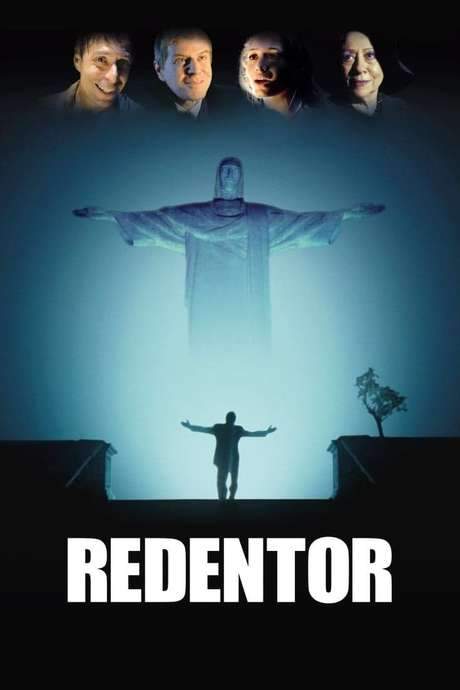
Redeemer 2004

Directed by

Cláudio Torres
Made by

Conspiração Filmes
Redeemer Plot Summary
Read the complete plot summary and ending explained for Redeemer (2004). From turning points to emotional moments, uncover what really happened and why it matters.
In the 1970s Rio de Janeiro, the district of Barra da Tijuca is painted as a kind of promised land, where a luxury project whispers of a brighter future. At the heart of this dream stands the Paradise Condominium, a gleaming vision meant to rise around the building marked as number 808. The project is spearheaded by the contractor of Dr. Sabóia José Wilker, a figure whose ambition helps drive the fragile promise forward. His son Otávio [Miguel Falabella] shares the stage with a wide-eyed child named Celio [Pedro Cardoso], who is instantly hooked by the sleek model of the development presented by Otávio, and who watches, wide-eyed, as the future seems to unfold in miniature before him.
With the boy’s excitement, Celio’s parents decide to buy an apartment in the Paradise Condominium. The choice appears to seal a fateful dream: a home in a new world, a symbol of upward mobility, a sign that the family’s fortunes might finally turn. But the dream is built on shifting ground. Despite years of payments and promises, the family never gets to occupy the unit. Dr. Sabóia’s enterprise unravels as he sells the same apartment multiple times, the project becomes tangled in bankruptcy, and the work is left incomplete. The cool confidence of the promises fades as reality intrudes, and the Paradise Condominium becomes a hollow emblem of a vision that could not survive the pressures of money, power, and time.
Fifteen years pass, and the landscape around the Paradise Condominium has shifted. The very workers who labored on the building form a makeshift community, a slum that grows beside the luxury project. They decide to take possession of the apartments and organize a peaceful invasion, turning the gleaming dream into a boned-in-the-world truth of everyday life. The public scandal surrounding the real estate venture explodes into view, and Dr. Sabóia ultimately takes his own life, leaving the messy, morally fraught business in the hands of Otávio [Miguel Falabella].
Into this turbulence steps Celio [Pedro Cardoso], now working as a reporter assigned to cover the case. The case draws him back toward Otávio, forcing a difficult reconnection with the man who now holds the reins of the project and the fortune once tied to the Paradise Condominium. In a high-stakes turn, Celio agrees to become Otávio’s stooge in exchange for a staggering sum—$5 million—an arrangement that pulls him deeper into a world where ambition and desperation collide and where the line between justice and complicity grows ever thinner.
As the plot intensifies, Celio begins to realize the true cost of the deal he’s struck. He experiences a growing sense of remorse and a profound hunger for meaning, turning toward something larger than wealth. Desperate and searching for guidance, Celio finds a path that looks toward salvation. He receives a mission that promises to be both perilous and redemptive: persuade Otávio to give his entire fortune to the poor, a challenge that tests his conscience and his faith in equal measure.
What unfolds is a meditation on greed, community, and the possibility of personal transformation in the face of powerful incentives. The film traces how a young reporter’s encounter with a gilded dream—and the man who built it—unfolds into a journey toward compassion and justice. Through Celio’s evolving choices, the story examines the tension between individual gain and collective need, and it asks what a person might truly owe to a community that built, and was then broken by, such a dream.
Redeemer Timeline
Follow the complete movie timeline of Redeemer (2004) with every major event in chronological order. Great for understanding complex plots and story progression.
Paradise Condominium dream begins
In the 1970s, Barra da Tijuca in Rio de Janeiro is presented as a promised land. Celio, still a child, is impressed when Otávio, son of Dr. Sabóia, shows him a model of the Paradise Condominium. Encouraged by the dream, his parents decide to buy apartment 808.
Purchase of apartment 808
The family pays for the apartment for years, clinging to the hope of moving in. Yet they never get to occupy the unit. The dream of Paradise remains unfulfilled.
Bankruptcy and unfinished work
Dr. Sabóia sells the same apartment several times, goes bankrupt, and leaves the construction unfinished. The Paradise Condominium project remains incomplete, tarnishing the dream. The family’s investment collapses with the building’s fate.
Fifteen years later: a slum grows beside the project
Fifteen years after the initial purchase, workers who built the building form a slum beside Paradise and decide to take possession of the apartments, organizing a peaceful invasion. The area’s power dynamics shift as the occupation unfolds. The original dream is replaced by new tensions between residents and developers.
Real estate scandal goes public
With the real estate scandal coming to light, the fraudulent dealings around Paradise become public knowledge. The community is rocked as trust collapses and the future of the project hangs in the balance. The revelation intensifies the conflict surrounding the building.
Sabóia’s downfall and Otávio’s rise
Dr. Sabóia commits suicide amid the scandal, and Otávio steps in to take control of the troubled enterprise. The power shift places Otávio at the center of the ongoing battle over Paradise. The community’s fate again hinges on Otávio’s decisions.
Célio, the reporter, returns to the case
Célio, now working as a reporter, is assigned to cover the Paradise affair and is forced to reconnect with Otávio. The reunion rekindles old tensions and personal stakes. The investigation becomes entangled with past loyalties.
Célio becomes Otávio’s stooge for a fortune
Obsessed with the apartment and the fortune at stake, Célio accepts Otávio’s proposal to be his stooge in exchange for 5 million dollars. The arrangement binds him to the conflict and its consequences. The moral line between journalist and participant becomes blurred.
The scheme spirals out of control
What began as a strategic move escalates beyond control, and Célio starts to regret the path he has chosen. The conflict intensifies as the stakes rise and the moral cost becomes clearer. The situation grows more dangerous for everyone involved.
Desperation leads to a spiritual search
Desperate and seeking guidance, Célio embarks on a personal quest for God. This spiritual journey contrasts with the moral ambiguity of the surrounding real estate saga. His faith becomes a lens through which he reassesses his choices.
A mission that could change everything
Célio receives a mission that could be his salvation: persuade Otávio to give his entire fortune to the poor. The revelation reframes the conflict as a test of character and devotion. The outcome depends on whether he can influence Otávio’s path.
Salvation through a radical choice
The mission stands as a turning point, offering the possibility of redemption for Célio and a transformative act for Otávio. The narrative bridges personal conscience with a larger social conscience. The future of Paradise hangs on the decision that lies ahead.
Redeemer Characters
Explore all characters from Redeemer (2004). Get detailed profiles with their roles, arcs, and key relationships explained.
Célio Rocha (Pedro Cardoso)
A reporter assigned to cover the Paradise Condominium scandal, Célio is initially entangled in Otávio's plans for personal gain. His career ambitions pull him into a morally precarious position as he negotiates with sources. Over the course of the film, he confronts his choices and seeks a form of redemption guided by a sense of justice.
Otávio Sabóia (Miguel Falabella)
The ambitious son of Dr. Sabóia, Otávio treats the Paradise Condominium as an empire to expand by any means. He manipulates Célio to stay behind the scenes, showcasing charm used for self-serving ends. As the plot unfolds, his greed clashes with the consequences of his actions, forcing him to confront his ethical limits.
Dr. Sabóia (José Wilker)
An unscrupulous contractor who builds the Paradise Condominium only to abandon it after bankruptcy, leaving families in limbo. He embodies a corporate culture of exploitation and reckless optimism that culminates in his downfall. His collapse sets the stage for the moral crisis faced by Celio and Otávio.
D. Isaura (Fernanda Montenegro)
An elder matriarch who anchors the family amid the scandal, she embodies resilience and moral memory. She observes the unfolding events with concern for her loved ones and the community affected by the failed project. Isaura represents care, faith, and a cautious hope for redemption.
Isaura (jovem) (Fernanda Torres)
A younger Isaura appears as a bridge between generations, symbolizing hopes and vulnerable dreams in a city divided by wealth. She reflects the impact of the Paradise Condominium saga on the younger generation and serves as a reminder of what is at stake in the struggle for fair housing.
Redeemer Settings
Learn where and when Redeemer (2004) takes place. Explore the film’s settings, era, and how they shape the narrative.
Time period
1970s
The events unfold in the Brazil of the 1970s, a period of intense urban redevelopment and economic flux in Rio de Janeiro. The era shapes the collision between grand construction dreams and the lives affected by them. The Paradise Condominium project sits at the heart of this tension, reflecting broader social inequalities.
Location
Rio de Janeiro, Barra da Tijuca, Paradise Condominium
The film is set in Rio de Janeiro's Barra da Tijuca during the 1970s, a time of rapid urban expansion. The Paradise Condominium, a luxury project, stands as the centerpiece of wealth and ambition. Nearby, a growing slum emerges as workers claim the land, highlighting the clash between aspiration and reality in a transforming city.
Redeemer Themes
Discover the main themes in Redeemer (2004). Analyze the deeper meanings, emotional layers, and social commentary behind the film.
💰
Greed
Greed drives the Paradise Condominium saga: the same apartment is sold multiple times, a scheme that bankrupts the project and harms families waiting for a home. Dr. Sabóia’s empire collapses as debts mount and he ultimately takes his own life. Otávio inherits the plan and uses Celio as a pawn to secure wealth, revealing how ambition corrupts both seller and accomplices. The narrative culminates in a moral reckoning, where the possibility of redemption rests on redirecting wealth toward the poor.
🙏
Redemption
Celio’s moral journey threads through the plot: he begins entangled in the scheme and gradually seeks a path to truth. He experiences guilt, contemplation, and a turn toward faith as he challenges Otávio’s greed. When given a chance to act, he is tasked with persuading Otávio to relinquish his fortune for the needy. The film frames redemption as a personal decision with public consequences, transforming money into a tool for compassion.
🏙️
Social divide
The Paradise Condominium sits beside a fledgling slum, a visual symbol of Brazil’s growing urban inequality. Workers who built the project form a peaceful invasion to claim what they believe is theirs, exposing power imbalances. Barra da Tijuca in the 1970s becomes a backdrop where wealth and desperation collide, challenging the characters’ loyalties. The story uses the setting to critique development that can fracture communities or spark solidarity.

Coming soon on iOS and Android
The Plot Explained Mobile App
From blockbusters to hidden gems — dive into movie stories anytime, anywhere. Save your favorites, discover plots faster, and never miss a twist again.
Sign up to be the first to know when we launch. Your email stays private — always.
Explore the mobile appRedeemer Spoiler-Free Summary
Discover the spoiler-free summary of Redeemer (2004). Get a concise overview without any spoilers.
In the heat‑blazed streets of 1970s Rio de Janeiro, the new suburb of Barra da Tijuca is billed as a promised land, a canvas for extravagant skyscrapers and glossy dreams. The neighborhood’s centerpiece, the Paradise Condominium, looms as a symbol of ambition and excess, its gleaming towers casting long shadows over the makeshift shantytowns that grow beside them. The film captures this clash of opulence and improvisation with a palette that shifts from sun‑drenched optimism to the dim, cramped alleys where the city’s forgotten carve out a life, creating a mood that feels both nostalgic and restless.
Celio Rocha returns to this world not as a nostalgic tourist but as a hardened reporter driven by an unsettling conviction that the divine has set him on a specific path. Haunted by memories of a childhood promise and the hollow allure of that glossy condo, he finds himself drawn back into the orbit of his old friend, now the powerful construction magnate Otávio Sabóia. Their reunion is charged with unspoken history, a mixture of camaraderie, resentment, and an uneasy balance between personal loyalty and the stark social divide that their respective lives now embody.
The story folds itself around Célio’s inner turmoil, his belief that a higher purpose demands he confront Otávio and persuade him to relinquish his amassed fortune for the benefit of the impoverished. This moral crusade, rendered in a tone that blends sober realism with a faint, almost elegiac humor, makes the city itself a character—its bustling markets, echoing churches, and construction sites all standing as backdrops to a larger question of redemption and responsibility.
Through lingering shots of sun‑baked facades and rain‑slicked backstreets, the film invites the audience to feel the weight of the protagonist’s conviction without revealing the steps he will take. The atmosphere remains charged with anticipation, hinting at a confrontation that could reshape both men’s lives while leaving the larger fate of the neighborhood—and its people—dangling in the balance.
Featured on this page

What's After the Movie?
Not sure whether to stay after the credits? Find out!
Check out our other apps:

SAT Sphere
Build confidence for the Digital SAT.

Mori Atlas
Discover wild places worth protecting.

Luntero
Search smarter for a home in Amsterdam.

Plot Explained
Unravel movie endings and hidden clues.

Pokechamp
Dive into Pokémon data and battle logic.

Driving Theory
Get ready for your European theory test.

Movie Dust
Plan your next cinema trip with ease.

Musemap
Find art and culture as you travel.

Selkobase
Compare credentials before committing.

Local Manual
Turn an unfamiliar country into practical next steps.

Lernavi
Compare school systems before your next move.

GymRoam
Find a workout stop wherever your plans take you.
Explore Our Movie Platform
New Movie Releases (2026)
Famous Movie Actors
Top Film Production Studios
Movie Plot Summaries & Endings
Major Movie Awards & Winners
Best Concert Films & Music Documentaries
Movie Collections and Curated Lists
© 2026 What's After the Movie. All rights reserved.
Privacy Policy