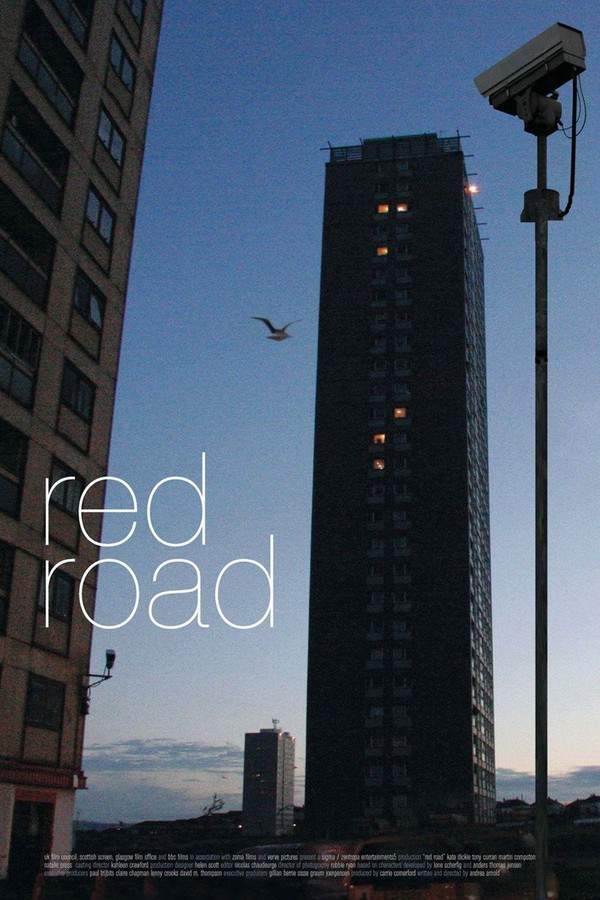
What Is Red Road About?
The premise of Red Road in 290 words, with nothing given away. The full story follows below.
In the muted shadows of Glasgow’s high‑rise flats, the city is watched from countless lenses that turn night into a silent ledger of movement. The Red Road estate, with its concrete corridors and flickering streetlights, feels both a community and a cage, a place where ordinary lives are rendered into grainy fragments. The omnipresent surveillance creates an atmosphere of quiet tension, suggesting that every glance could be recorded, every secret already half‑exposed.
Jackie Morrison occupies the night shift in this world of glass and monitors, a solitary figure who has built a life of careful distance. Living alone and maintaining only fleeting connections, she spends her hours tracing the rhythm of the streets from a darkened control room. Her routine is methodical, her demeanor restrained, yet there is an undercurrent of longing that surfaces whenever the cameras capture another heartbeat of the city’s nocturnal pulse.
Among the faces that drift across her screens, Clyde Henderson—a man newly released from prison—captures Jackie’s attention. He moves through the same streets she observes, his everyday actions holding an unsettling allure that draws her gaze beyond professional duty. As her interest deepens, the line between watchful observer and active participant begins to blur, hinting at a personal quest that is as much about understanding another as it is about confronting the quiet void within herself.
The film unfolds with a cool, clinical visual style that mirrors the starkness of the surveillance footage, while an undercurrent of psychological suspense keeps the audience on edge. Themes of yearning, redemption, and the ambiguous nature of right and wrong echo through the corridors of the flats, suggesting that in a city where every movement is recorded, the most profound mysteries are those that remain hidden behind the lenses.
What Happens in Red Road?
The complete story of Red Road, from the first scene to the last, in 768 words (about 3 minutes). Spoilers throughout.
Spoilers ahead
In a Glasgow setting dominated by surveillance and uneasy quiet, Jackie Morrison works the night shift as a CCTV operator, watching the Red Road Flats and the lives that unfold within and around them. She lives alone and keeps a careful distance from romance, even as she engages in casual encounters with a married man named Avery. The film charts a careful, creeping tension as Jackie’s routine gaze on the city gradually turns inward, centered on one man who catches her attention.
The object of Jackie’s fixation is Clyde Henderson, a recently released prisoner who has earned early freedom for good behavior but knows his confidence can unravel with a single misstep. From the moment Jackie recognizes him on the monitor, she begins a quiet, persistent pursuit—tracking his movements, gathering fragments of his life from the edges of the frame, and letting the incidentals of his day-to-day existence pull her in. Clyde’s life, which seems ordinary at first—an ex-con trying to move forward—takes on a new, dangerous texture through Jackie’s disciplined curiosity.
Her investigation leads her to a cafe where Clyde is seen and then to the apartment he shares with another ex-con named Stevie, where a party signals a social life that feels both plausible and perilous. Jackie manages to slip inside the party, moving among guests with a careful blend of boldness and restraint, exchanging looks with a nervous, intoxicated Clyde. They share a dance, a moment of almost intimate possibility, but Jackie exits the room under a self-imposed constraint, leaving a spark of unresolved tension in her wake. The next clues appear as she spots Clyde at a local bar, where he steps between a fight and the other patrons with a surprising calm. The night continues as Clyde invites Jackie back to his apartment, hinting at a longer history and a daughter he regrets losing touch with.
In the apartment, the conversation deepens in a way that unsettles the viewer: Clyde opens up about his daughter, a fragile thread to a past he cannot fully repair, and the two of them become physically intimate. Yet the moment of closeness collapses into a planned turning point as Jackie, after seeking refuge in the emotional distance of the room, reemerges to cast a shadow over the memory of consent—she strikes Clyde in the face with a stone and escapes into the city’s watchful eye. The aftermath is swift and stark: police identify Clyde as the rapist, and the cameras document the arrest as Jackie looks on, a mix of fear and detachment marking her face. A new, silent tension unfolds as Clyde’s daughter approaches the apartment block, a sign that the past cannot remain severed.
The story then pivots to a confrontation from Stevie’s side. He gains entry to Jackie’s home and questions the motive behind the accusation, forcing Jackie to reveal a devastating secret: Clyde had killed her husband and daughter in a car accident. The revelation shifts the moral weight of the entire sequence, and Jackie chooses to withdraw the rape accusation, a decision that ripples through every relationship tied to the event. Clyde is released, and the two characters face each other again with old scores and new truths laid bare.
When Jackie finally confronts Clyde after his release, the exchange is less about guilt and more about the ruin left in its wake. Clyde speaks of the road traffic accident that took Jackie’s husband and daughter, describing how he lost control of the car, a confession that reframes their earlier encounter in the apartment. Jackie speaks of the final words she uttered to her daughter, words that now echo with regret, and she tells Clyde that his daughter had tried to reach him on the day of his arrest. The film closes on a cautious, unresolved note as they part ways, each carrying the heavy residue of choices made, consequences endured, and the sense that the city’s surveillance system only magnifies the distance between people who might have connected but end up separated by secrets and tragedy.
What lingers is a portrait of a city under constant observation, where the line between observer and observed blurs, and a single night reveals how private pain can collide with public accountability. The characters move through rooms and rooms of memory—cafes, bars, apartments—each space revealing another layer of motive, consequence, and unspoken regret. This is a story that feels both intimate and clinical, a study in how a single sequence of decisions can ripple outward to alter the course of lives tied together by circumstance, guilt, and the fragile hope for some form of redemption.
Red Road Timeline: Every Key Event in Order
12 key events in the order they happen, from “Jackie's CCTV routine at Red Road Flats” to “Clyde is released and the confrontation”. 12 events name a place, across 9 locations.
- 1
Jackie's CCTV routine at Red Road Flats
Jackie Morrison works as a CCTV operator in Glasgow, monitoring the Red Road Flats. She lives alone and maintains a routine of surveillance and recording. Her world is quiet and solitary, punctuated by occasional sexual encounters with a married man named Avery.
Where:Red Road Flats, Glasgow
- 2
Jackie spots Clyde Henderson on CCTV
While analyzing feeds, Jackie recognizes a man she has seen before on the monitors. She discovers he is Clyde Henderson, a recently released prisoner who could be sent back to jail if he steps out of line. The recognition triggers her obsession as she begins to monitor his movements.
Where:CCTV control room, Glasgow
- 3
Jackie follows Clyde to a cafe
Jackie tracks Clyde through the city, eventually spotting him at a local cafe. She gathers information about his routines and social circle from the distance, watching how he interacts with others. The moment deepens her fixation as she prepares for a more direct encounter.
Where:Local cafe, Glasgow
- 4
Clyde plans a party at his apartment
Following Clyde, Jackie learns he is throwing a party at the apartment he shares with another ex-con, Stevie. She gains entry to the party and observes the dynamics between Clyde and his companions. The scene builds a sense of looming danger.
Where:Clyde's apartment
- 5
Jackie mingles at the party and leaves
At the party, Jackie exchanges looks with a drunken Clyde and they share a fleeting moment on the dance floor. She makes an excuse to slip away, avoiding a direct confrontation. The encounter heightens the tension between her obsession and Clyde's world.
Where:Clyde's apartment
- 6
Jackie finds Clyde at the local bar
Later, Jackie spots Clyde heading to a local bar and witnesses him stepping in to break up a fight between Stevie and another man. It confirms that Clyde still moves in volatile circles. The event amplifies Jackie's resolve as she accelerates her plan.
Where:Local bar
- 7
Clyde invites Jackie back and reveals a daughter
After the bar, Clyde initiates a conversation and invites Jackie back to his apartment. During the exchange, he reveals that he has a daughter and regrets losing touch with her. The revelation adds a personal dimension to the increasingly tense dynamic.
Where:Clyde's apartment
- 8
The sexual encounter and the frame
Jackie and Clyde have passionate sex, but Jackie panics afterward and makes a plan to frame him for rape. She strikes her own face with a stone and flees the apartment, all seen on CCTV. The staged scene sets off a chain of consequences that will pull both of them into a public reckoning.
Where:Clyde's apartment
- 9
Clyde is identified and arrested; daughter's arrival
The police identify Clyde as the rapist, and Jackie watches the arrest unfold on CCTV. A few moments later, Clyde's daughter is seen approaching the apartment block, signaling the human cost of the unfolding events.
Where:CCTV room; apartment block
- 10
Stevie questions Jackie; revelation of murder
Stevie gains entry to Jackie's home and demands to know why she falsely accused Clyde. Jackie finally reveals a terrible truth: Clyde had killed her husband and daughter in a road accident. The confession reframes the earlier actions within a larger tragedy.
Where:Jackie's home
- 11
Jackie withdraws the accusation
Jackie tells the police she wishes to withdraw the rape accusation, acknowledging that her earlier manipulation was a lie. The admission complicates the investigation and shifts the moral balance of the narrative. The arrest record remains a matter of public record, even as she retracts her claim.
Where:Police interview
- 12
Clyde is released and the confrontation
After Clyde's release, Jackie confronts him in a tense confrontation. He recounts the road traffic accident, explaining how he lost control of the car. Jackie reveals that her last words to her daughter were harsh and tells him that his daughter tried to reach him on the day of his arrest, underscoring the lingering pain and unresolved grief.
Where:Outside Clyde's apartment
Who Are the Main Characters in Red Road?
5 characters, among them Jackie Morrison, Clyde Henderson and Stevie: who each one is and the part they play in the story.
- JM
Jackie Morrison
A Glasgow CCTV operator who becomes consumed with Clyde Henderson after spotting him on monitors. Her obsession drives her to manipulate events and attempt to frame him, motivated by personal trauma and a desire for control.
- 🕵️ Obsession
- 👁️ Surveillance
- 🧭 Morality
- CH
Clyde Henderson
An ex-prisoner released on good behaviour who becomes the object of Jackie's fixation. He has a complicated past, including a history with a daughter he has lost touch with, and becomes entangled in a central conflict that culminates in a dramatic revelation.
- 🗝️ Ex-convict
- 🧩 Complexity
- ⚖️ Justice
- S
Stevie
Clyde's fellow ex-con and flatmate who hosts gatherings at his apartment. He serves as a social connection point for Clyde and a backdrop to the events surrounding the central relationship.
- 🎭 Supporting
- 🧱 Urban life
- H(
Husband (deceased)
Jackie's husband, dead in a car accident that becomes a pivotal element of her motive and the story's emotional engine.
- 💔 Loss
- 🕯️ Tragedy
- D(
Daughter (deceased)
Jackie's daughter, also killed in the same car accident that ties Clyde to Jackie's personal tragedy.
- 💔 Loss
- 🕊️ Grief
Where and When Is Red Road Set?
Red Road is set in Glasgow and Red Road Flats. Here is why the place matters to the story.
Where
Glasgow, Red Road Flats
Set in Glasgow, the film centers on the Red Road Flats, a stark high-rise public housing estate that serves as the backdrop for a story about surveillance and obsession. The location underscores a bleak, industrial atmosphere where CCTV is omnipresent. The Red Road Flats are a recognizable landmark in the city, emblematic of social housing and urban isolation.
- 🏙️ Urban
- 🕵️ Surveillance
- 🧱 Brutalist architecture
What Are the Themes of Red Road?
3 ideas the story keeps returning to, among them Surveillance, Trauma and Truth & Deception.
-
01
Surveillance
The film uses Jackie's CCTV surveillance to probe how watching conditions both the watcher and the watched. Her obsessive tracking of Clyde turns intimate vulnerabilities into leverage, showing how information can be weaponized. The atmosphere emphasizes paranoia and the erosion of privacy in a surveilled urban setting. Surveillance itself becomes a central character that drives the plot.
-
02
Trauma
Jackie's past trauma, including the loss of her husband and daughter, fuels her actions and justifies escalating risk. The narrative centers on how grief can distort judgment and justify morally ambiguous choices. The revelation that Clyde is connected to her family tragedy reframes the chase as a cycle of blame and guilt. The car accident that severed her family acts as a catalyst for the film's emotional intensity.
-
03
Truth & Deception
Deception drives the central conflict: Jackie fabricates a rape accusation to trap Clyde, then wrestles with the moral cost of her lie. The film probes how individuals justify harmful acts in pursuit of closure or revenge. When the truth about the past comes to light, the characters confront the limits of forgiveness and the enduring impact of past violence.
What Kind of Film Is Red Road?
Dark in tone, with slow pacing and a moderate story, going by the plot summary.
- Tone
- Dark
- Pacing
- Slow
- Story
- Moderate
- Intensity
- High
- Ending
- Bittersweet
A slow-burning, tense, and claustrophobic thriller steeped in grief and moral ambiguity, where voyeuristic surveillance mirrors the characters' internal psychological burdens and unresolved trauma.
- tense
- melancholic
- claustrophobic
- voyeuristic
- somber
- unsettling
- surveillance
- grief and loss
- revenge
- guilt and atonement
Content notes: sexual assault accusation, death of a child, grief and loss, psychological trauma.
Where to Watch Red Road
Stream it on Kanopy. US availability and prices from JustWatch.
Stream 1
 Kanopy
 Streaming availability in the US, powered by