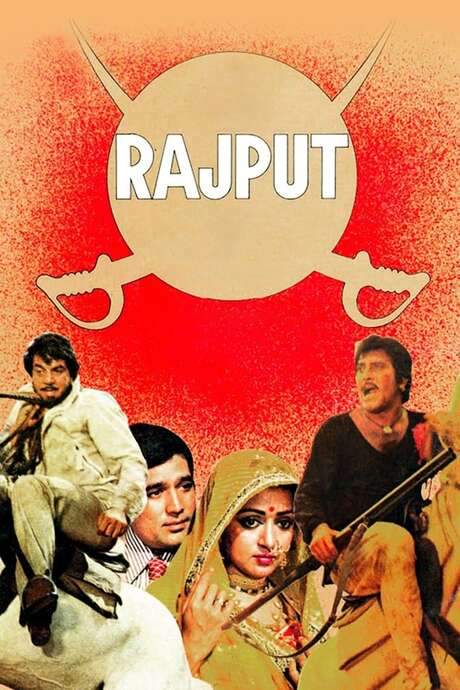



Rajput Plot Summary
Read the complete plot summary and ending explained for Rajput (1982). From turning points to emotional moments, uncover what really happened and why it matters.
An amendment in independent India reshapes the old order, stripping kingdoms of their rulers and forcing royal lines to adapt to a new reality. In one such province, Jaipal Singh, Ranjeet Bedi, clings to power, continuing to rule as king and compelling the people to pay taxes. The city streets stir with protests, and among the dissenters is Police Inspector Dhirendra Singh, Rajesh Khanna, whose sense of duty drives him to challenge the oppressive regime. His parents, aiming to secure a future for him, arrange his marriage with Janki, Hema Malini, the daughter of Dhirendra’s father’s childhood friend, a match meant to stabilize a troubled land. Yet Janki’s heart belongs elsewhere: she is in love with Manupratap Singh, Dharmendra, a man whose passion and courage pull her toward a more personal destiny.
The feud between two powerful families deepens as Janki’s aunty warns that her union with Manupratap will never be accepted by Janki’s father, Pratap Singh, a stern, traditional figure who guards his lineage’s honor. Meanwhile, Manupratap’s younger brother Bhanupratap, Vinod Khanna, harbors a secret ache for Kamli, an orphan girl who has found a fleeting happiness in their shared moment of quiet affection, the bond between them stirring a fragile hope for a better future. Kamli, Ranjeeta Kaur, dreams of a life beyond village borders, yet their path is soon torn asunder when Raja Jaipal Singh brutalizes Kamli, forcing a brutal wound into an already fragile world and sending Kamli fleeing from the village in confusion and fear.
Jaipal Singh’s hunger for control grows when he proclaims he wishes to marry Janki, a move that enrages her father and threatens the delicate balance of loyalties that hold the village together. Manupratap and Bhanupratap rise to oppose the king’s arrogance, and Bhanupratap’s defiance pushes him toward a life as a dacoit, a path born from anger and a wish to protect those who cannot defend themselves. The rift between the two families widens as Janki is forcibly wed to Dhirendra Singh, and she must leave her home to begin a marriage she did not choose. On the road to her new home, Janki is seized by Jaipal Singh’s nephew, who seeks to rape her; against this assault, Manupratap acts decisively, shooting the assailant dead as he falls onto Janki, leaving her momentarily unconscious from the fall.
Dhirendra, devastated by what he believes happened to Janki, withdraws at first, but a second truth soon unsettles the family: Janki is pregnant. He suspects that the child could be a product of rape, and he urges her to abort, a demand that would erase the boy or girl who would grow up under Jaipal’s shadow. Janki—confident that the child is Manupratap’s—refuses to end the life of her unborn baby and insists that she will find a way to live with the consequences of her choices. Yet Dhirendra’s love remains a living force, and he ultimately permits her to give birth to the child, carrying within him a quiet, complicated mercy.
Janki gives birth to a son, and she goes to jail to inform Manupratap of the child’s existence. In a gentler moment, Manupratap, recognizing Dhirendra as a decent man despite the chaos, advises Janki to live with her husband and forget him, even as the memory of their love lingers in the air. Janki complies, and Dhirendra, though reluctant, accepts the baby as his own, promising to nurture the child as part of his family.
As Jaipal’s power wanes and his grip tightens in other directions, he sends his daughter Jaya abroad for education to shield her from the growing dissent and to keep her away from the political storm. The older generation’s feud continues to ripple through time, and Bhanupratap, now a bandit who calls himself Bhavani, steals money to help the poor, a paradox of justice in a land ruled by fear. Kamli remains tethered to her son outside the village, her life shaped by choices born from the harsh realities of the world around her.
Jaya returns from abroad, and Bhanupratap abducts her as part of a vendetta against Jaipal Singh, who had once harmed Kamli. Jaya, understanding the complex dynamics around her, sides with Bhanupratap and sees him for the educated, principled man he has become. The two strike an uneasy alliance, rooted in a shared sense of justice and a mutual longing to see Jaipal’s tyranny undone. Meanwhile, Manupratap returns to the world outside his cell, released from jail but living with the burden of a past that refuses to stay buried. He spends a night at Dhirendra’s home, where he encounters his own son—an honest, affectionate boy who loves his father, even though the father cannot openly reveal his true identity.
Kamli continues to live with her son away from the village, while Jaya’s return deepens the plot’s emotional complexity. The memory of Jaipal’s tyranny drives Bhanupratap and Jaya to take bold steps: Bhanupratap kidnaps Jaya again to threaten Jaipal, and Jaya, moved by Bhanupratap’s sense of justice, begins to see him as a man who values education and kindness more than power. The two people find themselves drawn to one another, a testament to the way love can emerge amid turmoil and violence.
Meanwhile, Manupratap misreads the danger around him, assuming that his father and brother were killed by Bhavani, a realization that pushes him toward vengeance without recognizing that Bhavani and Bhanupratap are one and the same person. Dhirendra, acting as a conduit for the law, moves to arrest Bhavani on kidnapping charges, but Jaya steps forward to reveal that she was there by her own choosing, not coercion. Yet the broader struggle cannot be contained by law alone; Jaipal’s oppression of the people becomes undeniable to Dhirendra, who vows to bring him to justice through lawful means. He gathers evidence, only to learn that Jaipal himself has kidnapped his own son, throwing the web of loyalties into sharper relief.
A turning point arrives when Dhirendra discovers that Manupratap is the real father of the child, a truth that reframes loyalties and redefines family. Driven by a deep sense of justice and mercy, Dhirendra resolves to save the child and entrust him to Janki, so that she may live with Manupratap and their son. He sets out to arrest Jaipal, preparing to sever the king’s grip on the lives around him.
Manupratap promises Janki that their marriage will not be destroyed by the turmoil of the moment and sets out to help Dhirendra in his mission. In a climactic confrontation, Manupratap confronts Jaipal and kills him, a sacrifice born from love and the burden of truth. The hero is wounded in the exchange, a gunshot that injures him as he protects Dhirendra from Jaipal’s retribution. As he lies in his final moments, Manupratap imparts a profound truth: a man cannot truly be a father simply by siring a child; Dhirendra can be the father of Janki’s son, but the deeper bond rests with the life they have chosen to share.
Manupratap dies in Dhirendra’s arms, a moment of lasting tragedy and quiet grace. In the aftermath, the child is allowed to light the funeral pyre, a scene that seals the revelation for Bhanupratap and brings a difficult, painful clarity to Janki. With Bhanupratap understanding the truth of the child upon seeing Janki, Dhirendra chooses to unite with Manupratap’s child and Janki, creating a new family built on mutual sacrifice, forgiveness, and the courage to redefine family beyond the old divisions that once defined the land.
Rajput Timeline
Follow the complete movie timeline of Rajput (1982) with every major event in chronological order. Great for understanding complex plots and story progression.
Kingdoms seized in independent India
An amendment during independence results in kingdoms losing rulership. Jaipal Singh refuses to surrender, continuing to rule and extract taxes from his people. The move sparks resistance and sets a tense backdrop for the rest of the story.
Dhirendra transferred after protests
Police Inspector Dhirendra faces protests against Jaipal's tyranny and is transferred to a small village. The transfer places him at the center of a brewing conflict between the king's rule and the common people. The village becomes the stage for the coming drama.
Marriage arrangement to Janki
Dhirendra's parents arrange his marriage to Janki, the daughter of a childhood friend. The union is meant to stabilize alliances amid political turmoil. The arrangement foreshadows personal loyalties clashing with public duty.
Love rivalries and forbidden union
Janki loves Manupratap, and their romance fuels enmity between the two families. Both lovers confront disapproval from their kin, setting up future clashes and heartbreak. The feud underpins much of the forthcoming upheaval.
Kamli is raped by Jaipal
Jaipal rapes Kamli, forcing her to flee the village. The atrocity deepens the conflict and motivates Bhanupratap to seek revenge. The crime becomes a catalyst for shifting loyalties and violence.
Jaipal seeks Janki's hand; forced marriage ensues
Jaipal Singh declares he wants to marry Janki, provoking her father's anger and triggering a forced marriage to Dhirendra. The action intensifies the power struggle between Jaipal and the lovers. The union binds public authority to private turmoil.
Rape attempt and Manupratap's intervention
Jaipal's nephew tries to rape Janki during an abduction; Manupratap shoots him dead, saving Janki from immediate harm. Dhirendra misreads the incident as a rape, fueling bitter misunderstandings. The clash of perceptions deepens the rancor between families.
Pregnancy and the baby decision
Janki becomes pregnant and faces pressure to abort, but she insists the child is Manupratap's. Dhirendra, showing mercy, permits the birth and refrains from forcing an end to the pregnancy. The baby ties the fates of multiple families together.
Birth of the son and a difficult counsel
Janki gives birth to a son and goes to inform Manupratap in jail. Manupratap counsels Janki to live with Dhirendra and forget him, while Dhirendra initially resists but eventually accepts the child as part of the family. The reconciliation is fragile and tentative.
A killing, exile and new vigilantes
Jaipal and Bhanupratap's father are killed by Jaipal, and Bhanupratap becomes the dacoit Bhavani. Jaipal also sends his daughter Jaya abroad to prevent her from questioning him. The cycle of violence now spreads beyond a single village.
Seven years later: a new order emerges
Seven years pass and Dhirendra becomes Superintendent of Police, facing a wave of dacoits that Jaipal cannot control. Bhavani robs the countryside while Kamli lives with her son outside the village. Jaya returns from abroad, complicating the power balance.
Final confrontation and tragic sacrifice
Manupratap believes Bhavani killed his father and sets out to confront him. Dhirendra learns Jaipal has kidnapped his son and plans to act within the law, only to discover Manupratap is the father of Janki's child. In a climactic sequence, Manupratap kills Jaipal and dies in Dhirendra's arms, and Dhirendra unites with Manupratap's child and Janki.
Rajput Characters
Explore all characters from Rajput (1982). Get detailed profiles with their roles, arcs, and key relationships explained.
Manupratap Singh (Manu)
A chivalrous and principled noble who fights oppression and pursues a conflicted love. He stands up to Jaipal's tyranny, sacrifices for his beloved Janki, and ultimately dies a heroic death while protecting others, leaving a lasting impact on the lives involved.
Bhanupratap Singh (Bhanu)
Loyal brother to Manupratap who pivots into Bhavani, a dacoit, to challenge oppression. He embodies fierce protection for his lover Kamli and seeks revenge against the tyrant Jaipal, blurring lines between justice and violence.
Jaipal Singh
A power-hungry ruler whose oppressive regime fuels the conflict. He manipulates alliances, rapes Kamli, and manipulates Jaya's fate to maintain dominance over his kingdom and fear among his subjects.
Janki
Dhirendra's wife by arrangement, a woman who loves Manupratap and faces social pressure, betrayal, and resilience. She navigates a life split between her husband and her true love, ultimately choosing to live with Manupratap and their child.
Dhirendra Singh
The idealistic police inspector who ascends to Superintendent and seeks lawful action against the tyrant while protecting Janki and her child. He embodies mercy and a gradual shift from suspicion to acceptance of non-traditional fatherhood.
Kamli
A resilient orphan girl who suffers Jaipal's abuses and bears Bhanupratap's child, navigating stigma and hardship with strength and perseverance.
Jaya
Jaipal's daughter who, educated abroad, returns to the story and aligns with Bhanu in pursuit of a future free from her father's oppression.
Rajput Settings
Learn where and when Rajput (1982) takes place. Explore the film’s settings, era, and how they shape the narrative.
Time period
Late 1940s to early 1950s
The film takes place in the immediate post-independence period when princely states and royal titles lose political power. It contextualizes the amending era where rulers can no longer govern by hereditary privilege and subjects seek reform, shaping the tensions between old aristocracy and new democratic norms.
Location
Jaipal Singh's kingdom, a small Indian village
Set against the backdrop of a princely kingdom in independent India, the story unfolds in Jaipal Singh's domain and the nearby village where law and order struggle under royal privilege. The village life is depicted with tight hierarchies and social expectations, especially around marriage and duty. The unfolding political changes threaten the king's grip and catalyze the protagonists' quests for safety and justice.
Rajput Themes
Discover the main themes in Rajput (1982). Analyze the deeper meanings, emotional layers, and social commentary behind the film.
💖
Love and Duty
Romantic love collides with family obligation and social expectations. Janki's choices between her husband Dhirendra and her true love Manupratap drive the emotional core of the story. The lovers navigate arranged marriages, parental pressure, and sacrifices, revealing how loyalty to people can outlast social arrangements. The narrative shows love as a force that can heal or complicate loyalties.
⚖️
Power and Reform
Jaipal Singh's tyranny over his kingdom and the village setting demonstrates how unchecked authority oppresses the common people. The plot tracks a transition from autocratic rule toward lawful justice as the police inspector Dhirendra seeks evidence and legal action. The era's reforms are personified in the struggle between tradition and modernization, with acts of resistance and calls for accountability.
👨
Fatherhood and Kinship
The story centers on paternity and family bonds, notably the revelation of true paternity and the choice to nurture a child within competing households. Manupratap sacrifices his life but affirms a broader, non-biological fatherhood through Dhirendra's willingness to raise the child. The characters' decisions redefine what it means to be a father and a family beyond bloodlines.

Coming soon on iOS and Android
The Plot Explained Mobile App
From blockbusters to hidden gems — dive into movie stories anytime, anywhere. Save your favorites, discover plots faster, and never miss a twist again.
Sign up to be the first to know when we launch. Your email stays private — always.
Explore the mobile appRajput Spoiler-Free Summary
Discover the spoiler-free summary of Rajput (1982). Get a concise overview without any spoilers.
In the wake of India’s hard‑won independence, the old order of princely states is being dismantled, and the once‑proud kingdom at the heart of the story is forced to surrender. The tragic loss of its Maharaja sets the stage for a restless province where tradition collides with a new, bureaucratic nation‑state. Against this backdrop, the film breathes with the quiet intensity of a landscape still echoing with royal fanfare while confronting the inevitable march of modern law.
Jaipal Singh inherits the throne with a fierce determination to cling to the symbols of his ancestors, positioning himself as the living embodiment of a fading era. Opposite him, Dhirendra Singh, the newly appointed police superintendent, carries the weight of a government eager to impose order and justice across the shifting terrain. Their uneasy coexistence fuels a palpable tension that reverberates through streets buzzing with protest and doubt, painting a picture of a society caught between reverence for the past and the demands of a new future.
Amid the political turbulence, personal lives intertwine in equally compelling ways. Janki, a woman bound by an arranged marriage meant to cement fragile alliances, finds her heart drawn to Manupratap Singh, a charismatic figure whose own aspirations clash with the expectations placed upon him. Meanwhile, Bhanupratap wrestles with his sense of duty and hidden desires, while Kamli, an orphan with dreams beyond her village, embodies the yearning of a generation seeking freedom from entrenched customs.
The film’s tone is a rich tapestry of dramatic elegance and simmering unrest, where every conversation carries the weight of history and every glance hints at unspoken alliances. As the characters navigate loyalty, love, and the inexorable pull of change, the story invites the audience to contemplate what it means to redefine honor and identity when the very foundations of a world are being rewritten.
Movies with Similar Twists and Themes
Uncover films that echo the narrative beats, emotional arcs, or dramatic twists of the one you're exploring. These recommendations are handpicked based on story depth, thematic resonance, and spoiler-worthy moments — perfect for fans who crave more of the same intrigue.


Featured on this page

What's After the Movie?
Not sure whether to stay after the credits? Find out!
Check out our other apps:

SAT Sphere
Build confidence for the Digital SAT.

Mori Atlas
Discover wild places worth protecting.

Luntero
Search smarter for a home in Amsterdam.

Plot Explained
Unravel movie endings and hidden clues.

Pokechamp
Dive into Pokémon data and battle logic.

Driving Theory
Get ready for your European theory test.

Movie Dust
Plan your next cinema trip with ease.

Musemap
Find art and culture as you travel.

Selkobase
Compare credentials before committing.

Local Manual
Turn an unfamiliar country into practical next steps.

Lernavi
Compare school systems before your next move.

GymRoam
Find a workout stop wherever your plans take you.
Explore Our Movie Platform
New Movie Releases (2026)
Famous Movie Actors
Top Film Production Studios
Movie Plot Summaries & Endings
Major Movie Awards & Winners
Best Concert Films & Music Documentaries
Movie Collections and Curated Lists
© 2026 What's After the Movie. All rights reserved.
Privacy Policy