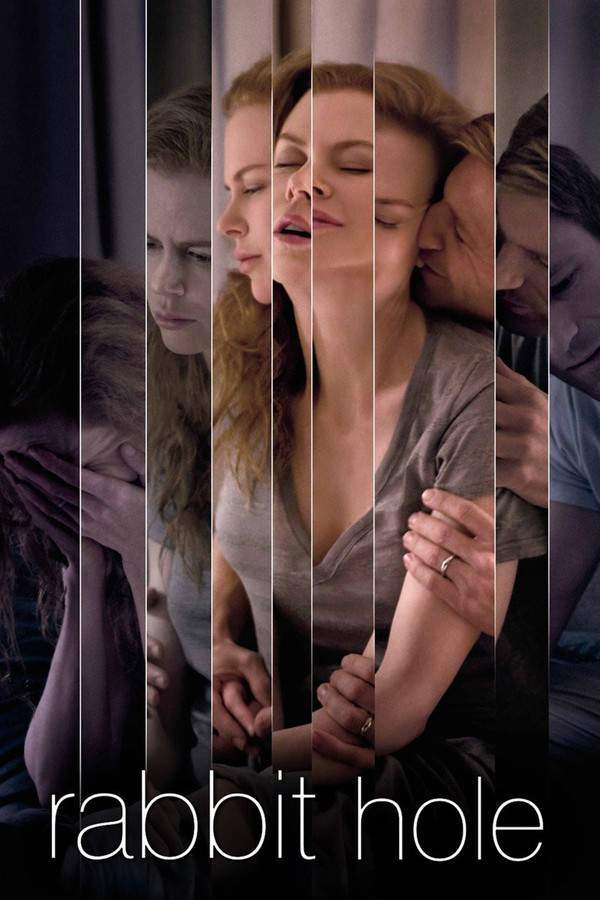
Rabbit Hole 2010


Directed by

John Cameron Mitchell
Made by

Lionsgate
Where to Watch Rabbit Hole
See current US streaming, rental, and purchase options for Rabbit Hole (2010) via JustWatch.

Lionsgate+ Amazon Channels
HD
Hoopla
SD
Kanopy
HD
Fandango at Home Free
HD
Plex
HD
Plex Channel
HD
Tubi TV
SD
YouTube Free
HD
Amazon Video
HD
Apple TV Store
HDFandango At Home
HD
Google Play Movies
SD
YouTube
SDStreaming availability powered by 
Rabbit Hole Plot Summary
Read the complete plot summary and ending explained for Rabbit Hole (2010). From turning points to emotional moments, uncover what really happened and why it matters.
Rebecca “Becca” Corbett Nicole Kidman and Howard “Howie” Corbett Aaron Eckhart are still learning to breathe eight months after the accident that took their four-year-old son Danny, who chased their dog into traffic. Becca yearns to reclaim control by removing Danny’s clothes, clearing his belongings, and eventually selling the house, while Howie bristles at removing every reminder of their child and clings to memories in an attempt to keep Danny close. Howie even longs for another child, a desire Becca does not share, setting up a friction that threads through their daily life and sleepless nights.
Becca’s mother, Nat Dianne Wiest, bears her own heavy grief, having lost her son Arthur to a drug overdose years earlier. Becca insists that these losses are not directly comparable, framing their pain as distinct experiences rather than a uniform template for mourning. Becca’s sister Izzy is pregnant, and Becca keeps offering sharp, passive-aggressive advice about motherhood that Izzy increasingly resents, widening the family rift even as love quietly remains in the background.
The couple tries to find footing in group therapy, a space that promises support but often exposes the raw edges of their grief. Becca’s irritation grows toward those who attribute their tragedy to “God’s will,” while Howie continues to attend, hoping to coax Becca back into the circle. A newer member, Gabby, attends alone and reveals her own painful backstory—that her husband left her. Gabby and Howie drift toward companionship—smoking in Gabby’s car before sessions and sharing casual afternoons away from the meetings—but Howie resists a drift toward anything that could threaten the fragile bond he still shares with Becca.
Meanwhile, Becca forms a fragile, unsettling connection with Jason, the teenage driver who struck Danny. She learns that Jason carries guilt and that he does not blame himself for the accident. He shares a spark of honesty with her about a comic book he’s writing, titled Rabbit Hole, a story about parallel universes where different choices create different lives. Becca asks to see the finished work, and Jason promises she can read it when it’s complete, opening a doorway to a conceptual release that mirrors Becca’s own struggle with what-ifs and alternate paths.
The house goes on the market as Becca and Howie attempt to reclaim a sense of normalcy. On the open-house day, Howie stays in Danny’s bedroom with a prospective buyer and voices the truth of his grief when asked about his son; the buyer’s awkward reaction underscores how others silently grapple with loss. After the showing, Jason arrives with the completed comic and enters through the open door, catching Howie’s attention and Becca’s attention split between anger and astonishment. Becca admits she has been seeing Jason, a disclosure that intensifies Howie’s anger and leads Jason to leave.
Becca and Jason reconnect, and their conversations spiral around the content of Rabbit Hole and the concept of parallel lives. Becca comes to a startling realization: she’s living as a version of herself defined by sorrow, a “sad” self among countless other possibilities in which grief does not have to own every moment. This recognition begins to loosen the grip of despair and invites fresh perspectives on life. Howie and Becca start to reengage with life through small, restorative activities—bowling, simple games, and shared routines—that hint at healing without erasing memory.
A pivotal shift arrives as they plan a garden lunch with a small circle of trusted friends. Howie orchestrates the scene as a careful, incremental step back toward normalcy, speaking in the background about how ordinary moments will gradually reinsert themselves into their days. The scene morphs from planning to quiet reality, and after the guest list dwindles and the last friend leaves, Becca and Howie sit together in the garden, stillness wrapping around them like a soft shawl. Becca reaches out to hold Howie’s hand, a subtle, intimate gesture that signals a tentative commitment to living alongside their grief rather than attempting to outpace it.
In the end, the film remains a testament to endurance rather than resolution. Becca and Howie discover that grief is not something to be conquered or forgotten, but something to be acknowledged and carried forward with new rituals, smaller joys, and a patient acceptance of the life that remains. The emotional landscape they navigate—of guilt, forgiveness, memory, and the possibility of renewed tenderness—resonates with a quiet honesty about what it means to heal without ever fully leaving a loved one behind.
Rabbit Hole Timeline
Follow the complete movie timeline of Rabbit Hole (2010) with every major event in chronological order. Great for understanding complex plots and story progression.
Becca starts clearing Danny’s belongings and considers selling the house
Becca begins reclaiming some control by removing Danny's clothes and packing away his belongings, and she even considers selling the house. Howie resists deleting reminders of Danny, clinging to memories in an attempt to keep their son close. The tension between moving on and staying connected to Danny threads through their daily life.
Nat's grief and the uniqueness of Becca's loss
Becca's mother Nat carries her own heavy grief, having lost her son Arthur years earlier. The conversation makes it clear that Nat's pain is not a simple parallel to Becca and Howie's loss. Becca insists that their grief is distinct, a stance that highlights the family's fragile balance of love and sorrow.
Izzy's pregnancy and sisterly rift
Izzy is pregnant, which sparks Becca's sharp, sometimes passive-aggressive commentary about motherhood. Izzy resents the unsolicited advice, and the dynamic widens the family rift. Yet beneath the friction, love remains quietly present.
Group therapy begins; grappling with grief and faith
Becca and Howie begin attending group therapy, hoping for support but finding raw edges exposed. Becca grows irritated by those who attribute their tragedy to God's will, while Howie keeps attending in hopes of drawing her back. The sessions reveal shared grief as well as fresh fault lines between them.
Gabby joins the group and links with Howie
Gabby, a newer member who reveals her husband left her, becomes a focal point in the circle. She and Howie drift toward companionship, sharing cigarettes in Gabby's car after sessions, though Howie resists anything that might threaten his fragile bond with Becca. The dynamic tests Becca's boundaries as she starts noticing Gabby's presence in her life.
Becca forms a connection with Jason, the driver who struck Danny
Becca forms a fragile connection with Jason, the teenage driver who struck Danny. Jason carries guilt but does not blame himself, and he shares a spark of honesty about a comic he's writing called Rabbit Hole. Becca asks to see the finished work when it's complete, which opens a doorway to contemplating alternate paths and possibilities.
Open-house day and the truth of grief surfaces
The house goes on the market and the open house becomes a window into each character's grief. Howie stays in Danny's bedroom with a prospective buyer and speaks the truth of his pain when asked about his son, prompting an awkward, silent reaction from the buyer. After the showing, Jason arrives with the completed comic and enters through the open door, a moment that electrifies Becca and unsettles Howie.
Jason arrives with Rabbit Hole; Becca reveals she’s seeing him
Jason arrives with the finished Rabbit Hole during the open-house aftermath and Becca's admission that she has been seeing him shocks Howie. The confrontation mixes anger with astonishment as Jason departs, leaving Becca to reflect on the pull of a second life. The moment deepens the rift but also signals a potential pivot in their grief.
Becca and Jason reconnect; parallel lives explored
Becca and Jason reconnect, and their conversations circle around the rabbit hole concept and the idea of parallel lives. Becca realizes she has been living as a version of herself defined by sorrow, a 'sad' self among countless other possibilities where grief does not own every moment. This insight begins loosening the grip of despair and invites new perspectives on life.
Small steps toward living again: restorative activities
Becca and Howie begin to reengage with life through small, restorative activities—bowling, simple games, and shared routines—that hint at healing without erasing memory. They test new rituals while honoring Danny's memory. The act marks a shift from avoidance to gradual acceptance.
Garden lunch plans signal tentative normalcy
Howie orchestrates a garden lunch with a small circle of trusted friends, a quiet step back toward normalcy. As guests arrive and depart, the house settles into a gentler rhythm and Becca and Howie share a quiet moment, signaling renewed tenderness. The scene closes on their tentative decision to live alongside their grief rather than outrun it.
Enduring grief and acceptance
The film ends as a testament to endurance rather than resolution. Becca and Howie learn that grief is something to acknowledge and carry forward through new rituals, smaller joys, and patient acceptance. They embrace the possibility of renewed tenderness while never fully leaving Danny behind.
Rabbit Hole Characters
Explore all characters from Rabbit Hole (2010). Get detailed profiles with their roles, arcs, and key relationships explained.
Becca Corbett — Nicole Kidman
Becca is a grieving wife who wants to purge Danny's belongings and create space for life after tragedy. She vacillates between practical distance and deep emotional pain, seeking solace through conversations with the teen driver and occasional therapy. Her journey centers on accepting that grief may be lifelong while learning to live alongside it.
Howard 'Howie' Corbett — Aaron Eckhart
Howie longs for normalcy and even another child, clinging to small acts of life to heal. He becomes frustrated with Becca's detachment and continues attending therapy, hoping to preserve their marriage while mourning their loss. Over time, he learns to balance support with independence and to rediscover shared moments.
Nat Corbett — Dianne Wiest
Becca's mother, who has also lost a son, offers a generational perspective on grief. Her presence highlights how pain can be carried across generations and how family members respond with a mix of tenderness and distance. Her memories and guidance influence Becca's emotional journey.
Jason — Teen Driver
The teenage driver who hit Danny, Jason feels guilty and gradually opens up to Becca. He introduces the idea of a comic project called Rabbit Hole, which becomes a catalyst for exploring parallel lives and potential futures.
Izzy Corbett — Becca's Sister
Izzy is pregnant and resents Becca's passive-aggressive attempts to offer motherhood advice. Her pregnancy becomes a focal point that tests family boundaries and supports Becca's reflection on motherhood and loss.
Gabby — Group member
Gabby is a long-time therapy group member who, along with others, navigates grief while seeking solace outside the meetings. She and Howie form a less stable bond that underscores how individuals cope with pain in different contexts, including moments of private risk.
Rabbit Hole Settings
Learn where and when Rabbit Hole (2010) takes place. Explore the film’s settings, era, and how they shape the narrative.
Time period
Mid-2000s
Set in the contemporary mid-2000s, the events unfold eight months after the accident that claimed Danny. The couple grapples with memories, guilt, and the different ways they grieve. The era’s social norms and therapy culture shape how they interact and attempt to rebuild their daily lives. The story treats grief as an ongoing process rather than a single moment.
Location
Suburban New York, USA
Set in a quiet suburban home in the New York area, Rabbit Hole follows Becca and Howie as they try to move on after their son's death. The house and neighborhood become a backdrop for memory, guilt, and the slow return to ordinary life. Local group therapy and community spaces frame their healing journey, contrasting with the private grief they each carry.
Rabbit Hole Themes
Discover the main themes in Rabbit Hole (2010). Analyze the deeper meanings, emotional layers, and social commentary behind the film.
🕊️
Grief
Becca and Howie navigate the long shadow of their son's death, as everyday routines clash with memories. The film treats grief as a living force that alters trust, intimacy, and future plans. It shows how individuals grieve differently, sometimes pulling apart, sometimes pulling toward each other.
🧭
Parallel Lives
Jason's Rabbit Hole comic becomes a vehicle for exploring alternate outcomes and the idea that multiple versions of a person exist. Becca sees that she may inhabit a 'sad' version of herself while others carry on in ordinary life. The motif suggests grief can coexist with possibility, not just memory. The film uses this concept to highlight choices that can lead to healing.
💞
Relationships
The couple's bond is tested as Becca distances herself and Howie searches for connection and new shared activities. Therapy, friends, and unexpected closeness shift their dynamic toward mutual support. The film shows that healing sometimes comes through small daily acts, like bowling or a garden lunch.
🎭
Identity
Becca's realization that she exists as many possible versions of herself frames her grief as a choice to live with loss and still engage with life. The idea of 'other selves' rejects the notion that one moment defines a person. The comic book and the discovery of alternate paths encourage accepting a changed self while moving forward.

Coming soon on iOS and Android
The Plot Explained Mobile App
From blockbusters to hidden gems — dive into movie stories anytime, anywhere. Save your favorites, discover plots faster, and never miss a twist again.
Sign up to be the first to know when we launch. Your email stays private — always.
Explore the mobile appRabbit Hole Spoiler-Free Summary
Discover the spoiler-free summary of Rabbit Hole (2010). Get a concise overview without any spoilers.
In a quiet suburban world where routine once felt like a sturdy safety net, a sudden tragedy tears the fabric of a family’s everyday life. The film moves with a restrained, almost lyrical pace, allowing the weight of grief to settle into each room and linger in the spaces between conversations. Light filters through windows, ordinary sounds become amplified, and the camera lingers on small gestures that hint at both fragility and resilience, setting a tone that is as meditative as it is emotionally raw.
At the heart of the story are Becca and Howie Corbett, a couple whose seemingly ideal marriage is now shadowed by the loss of their young son. Becca seeks control through order—clearing away reminders, considering the sale of their home—while Howie clings to lingering memories, reluctant to let go of the physical traces of their child. Their differing coping styles create a delicate tension that flashes between quiet affection and palpable strain, revealing how love can be both a refuge and a source of conflict when sorrow reshapes expectations.
Around them, a small network of family and strangers adds layers to their mourning. Nat, Becca’s mother, brings a generational perspective on loss, having endured her own tragedy years before. Izzy, Becca’s pregnant sister, navigates the uneasy space between supportive presence and the pressure of unsolicited advice. A fledgling support group introduces Gabby, whose own pain mirrors the Corbetts’ and whose tentative companionship offers both comfort and complication. Meanwhile, Jason, the teenager linked to the accident, appears in moments that suggest the possibility of unexpected connections and the unsettling honesty that can arise when strangers meet in the aftermath of grief.
The film rests on an intimate, introspective style, emphasizing ordinary moments—shared meals, quiet evenings, and the slow re‑learning of what it means to live alongside loss. Its atmosphere invites viewers to sit with discomfort, to notice how grief reshapes not only the grand narratives of life but also the smallest, most personal rituals. In doing so, it offers a quietly powerful meditation on how people strive to find meaning and tenderness in a world that has irrevocably changed.
Movies with Similar Twists and Themes
Uncover films that echo the narrative beats, emotional arcs, or dramatic twists of the one you're exploring. These recommendations are handpicked based on story depth, thematic resonance, and spoiler-worthy moments — perfect for fans who crave more of the same intrigue.





Featured on this page

What's After the Movie?
Not sure whether to stay after the credits? Find out!
Check out our other apps:

SAT Sphere
Build confidence for the Digital SAT.

Mori Atlas
Discover wild places worth protecting.

Luntero
Search smarter for a home in Amsterdam.

Plot Explained
Unravel movie endings and hidden clues.

Pokechamp
Dive into Pokémon data and battle logic.

Driving Theory
Get ready for your European theory test.

Movie Dust
Plan your next cinema trip with ease.

Musemap
Find art and culture as you travel.

Selkobase
Compare credentials before committing.

Local Manual
Turn an unfamiliar country into practical next steps.

Lernavi
Compare school systems before your next move.

GymRoam
Find a workout stop wherever your plans take you.
Explore Our Movie Platform
New Movie Releases (2026)
Famous Movie Actors
Top Film Production Studios
Movie Plot Summaries & Endings
Major Movie Awards & Winners
Best Concert Films & Music Documentaries
Movie Collections and Curated Lists
© 2026 What's After the Movie. All rights reserved.
Privacy Policy