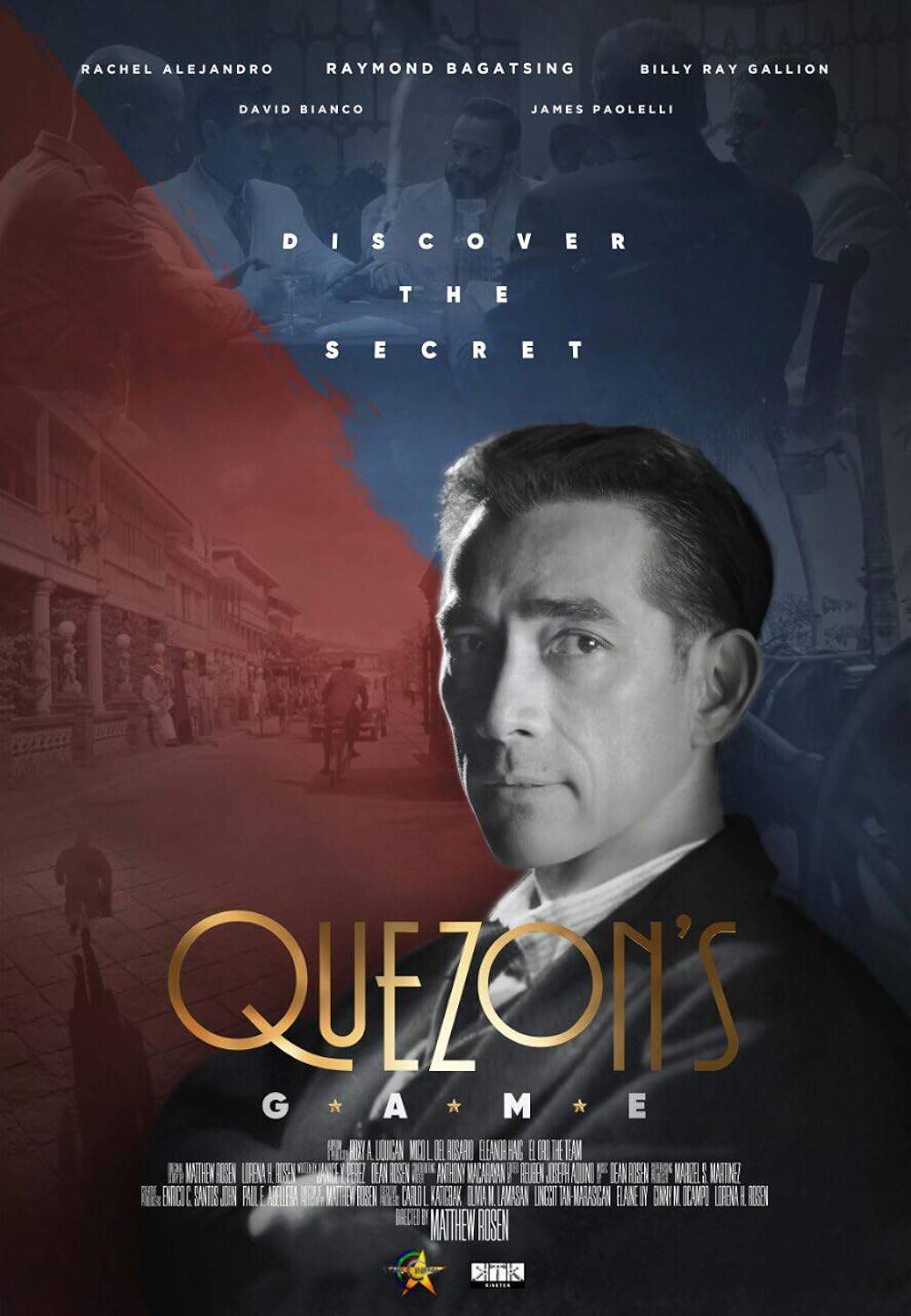
Quezon's Game 2019

Directed by

Matthew E. Rosen
Made by

Star Cinema
Where to Watch Quezon's Game
See current US streaming, rental, and purchase options for Quezon's Game (2019) via JustWatch.


Streaming availability powered by 
Quezon's Game Plot Summary
Read the complete plot summary and ending explained for Quezon's Game (2019). From turning points to emotional moments, uncover what really happened and why it matters.
The story unfurls at a therapeutic retreat in Saranac Lake, New York, where Manuel Quezon and his wife Aurora Quezon are captivated by a newsreel that showcases the momentous arrival of General MacArthur at Leyte, the significant liberation of Europe, and the harrowing revelations of the Holocaust. As the film reel concludes, Manuel ponders deeply, inquiring of himself, “Could I have done more?”
Fast forward to 1938 Manila, we meet Alex Frieder, a Jewish-American businessman, who receives an alarming confidential telegram from the Chinese consulate in Vienna regarding the escalating horror of the Holocaust. On this same fateful day, Consul-General Jonathan Cartwright briefs Paul McNutt, the High Commissioner to the Philippines, about the unsettling arrival of a new chief of security from the German Embassy, Lt. Ebner. This SS officer raises red flags, leading Cartwright to express his grave concerns about potential espionage. However, McNutt, dismissive of these apprehensions, insists that spies would be more clever in their approach, positing that they could appear inconspicuous in plain clothes.
At a lively gathering, Quezon seizes the moment to announce his ambitious project for the new Philippine capital, Balintawak. Alex Frieder, privately troubled by the telegram’s implications, confides his urgent request for assistance in rescuing Jewish refugees to Quezon, McNutt, and Colonel Eisenhower. With a heavy heart, Quezon agrees but emphasizes the necessity of awaiting approval from the U.S. Congress regarding additional exit visas. Meanwhile, the evening unfolds with the party singer, Vera, engaging in flirtation with Quezon, leading to a tumultuous confrontation with Aurora once the festivities draw to a close. That very night, Lt. Ebner confronts German Ambassador Kaiser, demanding the display of the Nazi flag while ominously alluding to the impending Kristallnacht.
As November 1938 dawns, the newsreels grimly report the onset of the Kristallnacht and the tragic return of the MS St. Louis to Germany. Amidst this turmoil, McNutt seeks clarity from Cartwright, who informs him that approximately 200 immigration visas remain available. The urgency of the situation weighs heavily as Alex, along with Quezon, Eisenhower, and McNutt, strategizes on how to secure additional visas for the growing number of refugees. McNutt obliquely hints at the political climate, citing the challenge posed by antisemitic officials. In a bold move, Alex places an advertisement in German newspapers to attract professionals willing to contribute to Quezon’s envisioned city. In response to their requests, Eisenhower turns to General MacArthur, seeking any individual who might assist Quezon’s humanitarian efforts; however, MacArthur expresses a vehement disapproval, foreseeing imminent Japanese invasion.
During this harrowing time, McNutt strives to compile reports for President Roosevelt while Cartwright enters their deliberations, fervently objecting to the rescue plans. He argues that the influx of Jewish refugees could pose a national security threat. In a tense and pivotal moment, Aurora uncovers Manuel’s deteriorating health when she discovers a blood-stained handkerchief. Despite receiving a staggering count of 10,000 names from the compiled lists, the group grapples with the ethical dilemma of exclusion without raising alarms. In a tense meeting outside the embassy, Quezon proposes bribing Kaiser for more visas, leading to a high-stakes interaction at a presidential gala, where Kaiser repels their bribe but ultimately offers a glimmer of hope by agreeing to supply the necessary exit papers. Unbeknownst to them, Lt. Ebner is covertly monitoring.
Faced with disappointment, McNutt relays the disheartening news that the U.S. Congress has categorically denied their requests for extra visas, leaving only 210 at their disposal. Alex is consumed by frustration and anguish at the failure of their mission. The subsequent day brings further tragedy when Quezon learns that the Secretary of State has scuttled all visa applications, leading him to break down in his office. His battle with tuberculosis reaches a critical juncture, yet he persists with his presidential duties against medical advice.
Manuel Quezon steps into the public eye to address deeply rooted issues of racial injustice and border control in the Philippines. The courageous stance incites protests in Manila, demanding action against the U.S. Congress’s denial of visas for the refugees. Ultimately, the concerted efforts yield a result: 210 visas, along with a miraculous approval of an extra 1,000 visas, leading to an emotional arrival of Jewish refugees one fateful night in Marikina, greeted passionately by Quezon, McNutt, Alex Frieder, and their families.
In a poignant flash-forward to 1944, the film circles back as Manuel Quezon reflects on his past inquiries to Aurora, who reassures him that his legacy of action against the tide of indifference will resonate deeply within the Filipino heart.
In a moving epilogue, it is revealed that over 1,200 Jewish refugees found sanctuary thanks to their efforts, although their brave mission was cut short amid the chaos of the Japanese invasion. The fates of the Quezon family, Eisenhower, McNutt, and Alex Frieder remain uncertain as the credits roll, featuring heartfelt testimonials from the surviving refugees whose lives were forever changed.
Quezon's Game Timeline
Follow the complete movie timeline of Quezon's Game (2019) with every major event in chronological order. Great for understanding complex plots and story progression.
Arrival of General MacArthur
The film opens at a cure cottage in Saranac Lake, New York, where Manuel and Aurora Quezon are watching a newsreel. The newsreel highlights significant events such as General MacArthur's return to Leyte, the liberation of Europe, and the discoveries of the Holocaust, prompting Quezon to reflect on his own actions.
Alex Frieder's Telegram
In 1938 Manila, Jewish-American businessman Alex Frieder receives an alarming confidential telegram from the Chinese consulate in Vienna regarding the ongoing Holocaust. This serves as a wake-up call for Frieder and leads him to seek help in rescuing Jewish refugees.
Concerns Over German Embassy Security
Consul-General Jonathan Cartwright raises suspicions about Lt. Ebner, who is an SS officer and the new chief of security at the German Embassy. High Commissioner Paul McNutt dismisses Cartwright's concerns regarding espionage, underestimating the threat posed by Ebner.
Quezon's Project Announcement
Manuel Quezon unveils his ambitious project for a new Philippine capital at a social gathering attended by political figures like McNutt and Eisenhower. During this party, Frieder discreetly shares his telegram news and seeks support for rescuing Jewish refugees.
Flirting and Tensions
After the party, a flirtation occurs between singer Vera and Quezon, which leads to a confrontation with his wife, Aurora. This incident highlights the personal and political tensions faced by Quezon as he juggles leadership duties and personal relationships.
News of Kristallnacht
A newsreel reports the horrors of Kristallnacht, emphasizing the urgency of the refugee situation. Concurrently, McNutt learns of the immigration visa shortages, increasing the pressure to act quickly for those seeking asylum.
Visa Challenges and Plans
In a meeting, McNutt informs Quezon that they need to persuade the State Department for an additional 2,000 exit visas, which will be met with resistance from antisemitic officials. Frieder's advertisement in German newspapers seeks skilled workers to support Quezon's vision.
Bribery Attempt
During a secret meeting, Quezon suggests bribing German Ambassador Kaiser for extra exit visas, displaying the desperate measures taken to save lives. However, Kaiser ultimately denies the bribe but agrees to provide exit papers due to pressure.
Denial of Additional Visas
McNutt informs the group that the U.S. Congress has officially rejected their request for additional visas, leaving only 210 available. This news devastates Frieder and the others involved in the rescue mission, forcing them to exclude many names from their list of refugees.
Press Conference on Racial Injustice
Manuel Quezon takes a bold stand by holding a press conference to speak against racial injustice and to criticize the U.S. Congress for rejecting refugee visas. His actions incite protests in Manila, highlighting his commitment to human rights.
Refugees Arrival
In a moment of triumph, 1,000 additional visas are approved, allowing Jewish refugees to arrive in Marikina. The Quezon family, along with McNutt and Frieder, warmly welcome the new arrivals, marking a significant achievement in their efforts.
Reflection and Legacy
The narrative returns to 1944, where Quezon asks Aurora if he could have done more. Aurora reassures him that his actions have made a difference at a time of widespread apathy, ensuring that the Filipino response to the refugee crisis will be remembered.
Epilogue on Rescued Refugees
The film concludes by revealing that over 1,200 Jewish refugees were saved despite the challenges faced during the Japanese invasion. The fate of key figures like the Quezons, Eisenhower, and Frieder remains uncertain, underscoring the tragedy of war.
Quezon's Game Characters
Explore all characters from Quezon's Game (2019). Get detailed profiles with their roles, arcs, and key relationships explained.
Manuel Quezon
Manuel Quezon is portrayed as the determined and compassionate President of the Philippines, who strives to provide sanctuary for Jewish refugees during a tumultuous time. He grapples with personal health issues while advocating for immigration visas, showcasing resilience and unwavering commitment to justice. His leadership is characterized by a blend of idealism and political navigation.
Alex Frieder
Alex Frieder is a Jewish-American businessman who plays a pivotal role in alerting Quezon about the plight of Jewish refugees. He embodies a spirit of urgency and resourcefulness, seeking creative solutions to political barriers. His commitment to helping others showcases his deep sense of empathy and moral courage.
Quezon's Game Settings
Learn where and when Quezon's Game (2019) takes place. Explore the film’s settings, era, and how they shape the narrative.
Time period
1938-1944
The film spans from 1938 to 1944, during a pivotal period marked by the rise of Nazi Germany and the beginning of World War II. Significant historical events, including Kristallnacht, influence the plot and the actions of the characters. Additionally, the time frame reflects the growing awareness and repercussions of the Holocaust on global politics and humanitarian efforts.
Location
Saranac Lake, New York; Manila, Philippines; Balintawak, Marikina
The movie takes place in various significant locations, including Saranac Lake, New York, known for its cure cottages and serene landscapes. Manila, the capital of the Philippines, is portrayed during a tumultuous time in the late 1930s, highlighting its political atmosphere and impending challenges. Balintawak is noted for Manuel Quezon's ambitious project for a new capital, while Marikina serves as a welcoming site for Jewish refugees.
Quezon's Game Themes
Discover the main themes in Quezon's Game (2019). Analyze the deeper meanings, emotional layers, and social commentary behind the film.
🤝
Compassion
The theme of compassion is central to the narrative, focusing on humanitarian efforts to save Jewish refugees from the Holocaust. Manuel Quezon's determination to grant refuge despite challenges highlights acts of kindness amid widespread apathy. The film showcases the moral responsibilities of individuals and nations during times of crisis.
⚖️
Justice
Justice emerges as a critical theme as the characters confront racial injustice and the moral dilemma of immigration policies. Quezon's advocacy for the displaced Jewish population signifies a fight against systemic discrimination. The film prompts viewers to reflect on national security versus humanitarian obligations.

Coming soon on iOS and Android
The Plot Explained Mobile App
From blockbusters to hidden gems — dive into movie stories anytime, anywhere. Save your favorites, discover plots faster, and never miss a twist again.
Sign up to be the first to know when we launch. Your email stays private — always.
Explore the mobile appQuezon's Game Spoiler-Free Summary
Discover the spoiler-free summary of Quezon's Game (2019). Get a concise overview without any spoilers.
In the ominous pre‑war years of the late 1930s, the Philippines stands at a crossroads between its own budding nationhood and the thunderclouds gathering over Europe. The film paints Manila as a vibrant, hopeful capital whose streets pulse with the promise of a new future, while the distant echo of persecution casts a shadow that the government can no longer ignore. Against this backdrop, a quiet urgency builds, hinting at the moral weight of decisions that could reshape lives far beyond the archipelago’s shores.
Manuel Quezon, the charismatic president, is defined by a blend of visionary optimism and stoic resolve. He carries the burden of leadership with a personal sense of duty that borders on the sacrificial, driven by the question of how far a nation can stretch its compassion. Beside him, Aurora Quezon offers both a grounding presence and a fierce emotional compass, their partnership underscoring the film’s intimate exploration of personal stakes amid public service.
The narrative introduces a small, determined circle of allies. Alex Frieder, a Jewish‑American businessman haunted by reports from a continent in turmoil, becomes the conduit for a desperate plea that reaches the highest echelons of power. Paul McNutt, the American High Commissioner, represents the intricate dance of diplomatic influence, while Colonel Eisenhower adds a military perspective that hints at the strategic complexities of humanitarian aid. Together they form a mosaic of conviction, each grappling with the clash between bureaucratic inertia and the urgency of mercy.
Tone‑wise, the drama balances measured, almost reverential scenes of political negotiation with moments of quiet humanity, all underscored by a lingering sense of suspense. The film invites the audience to linger on the weight of compassionate choice, the quiet heroism that blooms in boardrooms and private whispers, and the looming question of whether a nation can become a sanctuary when the world teeters on the edge of darkness.
Movies with Similar Twists and Themes
Uncover films that echo the narrative beats, emotional arcs, or dramatic twists of the one you're exploring. These recommendations are handpicked based on story depth, thematic resonance, and spoiler-worthy moments — perfect for fans who crave more of the same intrigue.







Featured on this page

What's After the Movie?
Not sure whether to stay after the credits? Find out!
Check out our other apps:

SAT Sphere
Build confidence for the Digital SAT.

Mori Atlas
Discover wild places worth protecting.

Luntero
Search smarter for a home in Amsterdam.

Plot Explained
Unravel movie endings and hidden clues.

Pokechamp
Dive into Pokémon data and battle logic.

Driving Theory
Get ready for your European theory test.

Movie Dust
Plan your next cinema trip with ease.

Musemap
Find art and culture as you travel.

Selkobase
Compare credentials before committing.

Local Manual
Turn an unfamiliar country into practical next steps.

Lernavi
Compare school systems before your next move.

GymRoam
Find a workout stop wherever your plans take you.
Explore Our Movie Platform
New Movie Releases (2026)
Famous Movie Actors
Top Film Production Studios
Movie Plot Summaries & Endings
Major Movie Awards & Winners
Best Concert Films & Music Documentaries
Movie Collections and Curated Lists
© 2026 What's After the Movie. All rights reserved.
Privacy Policy