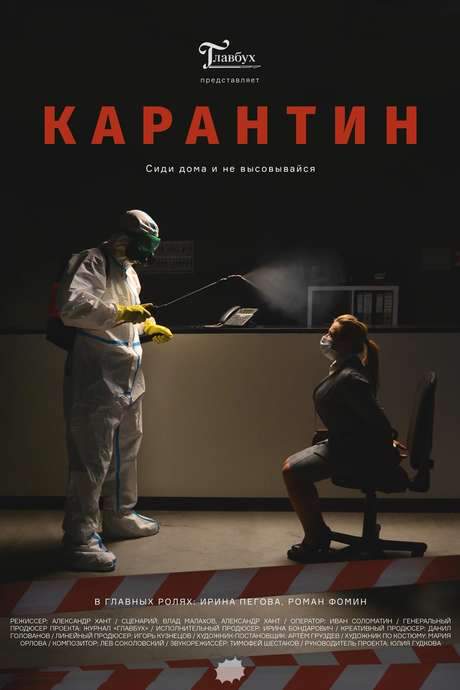
Quarantine 2020

Directed by

Alexandr Khant
Made by

Red Pepper Film
Quarantine Plot Summary
Read the complete plot summary and ending explained for Quarantine (2020). From turning points to emotional moments, uncover what really happened and why it matters.
The cast includes Roman Fomin and Irina Petrova. The story drops us into a restless, sunlit-but-dangerous Los Angeles in July 2017, where a mysterious virus begins to spread with alarming speed and mystery. In the space of just two weeks, the outbreak escalates into a catastrophe, killing more than three-quarters of the population and sparking a global wave of panic that no one saw coming. As fear spreads, the U.S. government isolates the entire affected zone, effectively sealing off the city from the outside world and leaving residents to confront the crisis on their own terms.
As September arrives, the virus stubbornly mutates, taking on a new, terrifying form. Those it infects become rotting, corpse-like hybrids with an overwhelming hunger that can’t be ignored. daylight becomes a deadly threat to them—sunlight burns and damages their bodies—while nightfall offers a brief, predatory window in which they prowl with primal determination. The world outside the quarantine watches in bleak disbelief, and every effort to locate survivors inside the zone is declared futile by authorities who insist the city is beyond saving.
Then, on November 26, a local news channel broadcasts an exclusive message from within the crisis. J.S.O.C. Chief Sergeant Jake Miller appears on screen, revealing that he and a small group of six survivors remain trapped inside the infected zone, eking out a precarious existence on scarce supplies and limited resources. The broadcast challenges the official narrative that there are no survivors left and that the only path forward is a drastic, nuclear intervention. In a shocking turn, the film shows a nuclear strike planned to decontaminate Los Angeles, a decision framed by some as a necessary battle against a city-wide epidemic and by others as a calculated cover-up meant to erase the catastrophe by portraying it as a nuclear accident.
From the outset, the movie centers on the palpable tension between the few who fight to endure and the larger, opaque machinery of a government determined to control the narrative. The claustrophobic atmosphere—streets emptied of routine life, the eerie quiet after sundown, and the constant reminder that danger lingers in every corner—drives the suspense as survivors and officials alike grapple with questions of loyalty, truth, and survival under impossible pressure. The narrative unfolds with a steady, almost documentary-like focus on how quickly social order unravels when fear, scarcity, and fearsome new adversaries collide in a city that was once a symbol of resilience and beauty. The film quietly emphasizes themes of resilience, moral ambiguity, and the heavy cost of secrecy, inviting viewers to weigh the price of concealment against the desperate need to protect a broader population.
- The tone remains restrained and factual, avoiding melodrama while still delivering a sense of dread and urgency. The central conflict is not only the threat of the infected but also the ethical dilemma facing those who hold the keys to the city’s fate. As the endgame looms, the story invites reflection on what is more dangerous: the virus itself or the choices made in its wake.
Quarantine Timeline
Follow the complete movie timeline of Quarantine (2020) with every major event in chronological order. Great for understanding complex plots and story progression.
Outbreak erupts in Los Angeles
July 18, 2017 marks the start of an unknown virus spreading through the Los Angeles area. In the first 14 days, the infection kills roughly three-quarters of the population, triggering a global panic. The U.S. government begins isolating the entire affected zone to contain the spread.
Global panic and zoning lockdown
As the virus sweeps across the region, the scale of death and chaos fuels a worldwide alarm. The U.S. government isolates the Los Angeles outbreak, fencing off the affected zone and stopping rescue and evacuation attempts. Border controls and emergency measures spread to other countries.
Virus evolves into a human-changing form
By the middle of September 2017, the virus evolves into a more deadly variant that turns the infected into rotting, corpse-like hybrids with an unquenchable hunger. The new form is slow under daylight and ferociously predatory at night, altering how the infection spreads and endangers survivors. The change marks a shift from mere infection to a sustained existential threat.
Infected exhibit day-night behavior
During the day, the infected hide from the sun to avoid burning, while at night they become active predators. This diurnal shift shapes when and where people can attempt to move through the city and how surveillance and containment must work. The hazard remains constant, just modulated by daylight.
Search for survivors deemed futile
All search efforts for survivors in the infected area are deemed futile as the hybrids guard the perimeter and the zone is effectively sealed. Rescue operations are suspended, and the area is treated as a lost cause. This verdict tightens the government's control over information and response.
Jake Miller’s exclusive video surfaces
On November 26, a local news channel receives an exclusive video from J.S.O.C. Chief Sergeant Jake Miller. The footage shows Miller and a group of six survivors trapped inside the infected zone, surviving on limited supplies. It contradicts earlier government statements that there were no survivors left.
Contradiction from the J.S.O.C. team
The J.S.O.C. special ops team responds skeptically to Miller's video, having previously claimed there were no survivors. The discrepancy fuels distrust in official communications and raises questions about what the authorities know and hide. The public begins to doubt the government's narrative.
Nuclear option considered to decontaminate LA
To manage the outbreak and preserve political cover, the government contemplates using a nuclear detonation to decontaminate Los Angeles. The plan would erase the city from existence and reframe the disaster as a nuclear accident rather than a biological epidemic. The optics of such a move create immeasurable fear and controversy.
Decontamination plan announced as safety measure
The official narrative frames the nuclear strike as a safety measure to prevent further spread, prompting confusion and fear among the public. Critics call it a cover-up and a drastic response to a crisis that remains poorly understood. The plan sets a timer on the fate of the infected city.
Survivors endure with dwindling supplies
Miller and the six survivors inside the infected zone struggle to maintain basic supplies while waiting for a resolution from the outside. Their video messages become rare lifelines for information and possible aid, if any can reach them. The tension inside the zone builds as resources thin out.
Global response to LA crisis
News of the LA outbreak and the looming nuclear plan dominates international headlines. Governments worldwide reassess biosecurity and travel policies while citizens react with fear and speculation. The event stretches into a broader conversation about crisis management and political responsibility.
Ambiguous ending: fate of LA uncertain
The summary closes with the looming possibility of a nuclear detonation and the unknown future of the survivors inside the zone. The story raises questions about truth, accountability, and whether the city can ever be restored. The timeline ends with a sense of unresolved tension around the city’s fate.
Quarantine Characters
Explore all characters from Quarantine (2020). Get detailed profiles with their roles, arcs, and key relationships explained.
Jake Miller (Chief Sergeant)
A pragmatic and resourceful leader among a small group of survivors trapped in the infected zone. He coordinates limited supplies and attempts to keep morale intact while navigating extreme danger. His actions reflect a balance of courage, duty, and the heavy burden of command.
Six Survivors
A tight-knit group adapting to the harsh conditions of the quarantine. They divide tasks, share scarce resources, and form improvised alliances to maximize their chances of staying alive. Their dynamics test loyalty and resilience as fear and desperation mount.
Quarantine Settings
Learn where and when Quarantine (2020) takes place. Explore the film’s settings, era, and how they shape the narrative.
Time period
July 2017 – November 2017
The outbreak begins in July 2017 and progresses through the following months. By mid-September, the virus evolves into a humanoid, corpse-like hybrid that hunts at night and burns in daylight. On November 26, a video reveals survivors trapped inside the zone, while a nuclear strike threatens to wipe the area off the map to conceal a government cover-up.
Location
Los Angeles area, Infected zone
The story is set in the Los Angeles area, which is evacuated and sealed off as an infected zone. The environment is a quarantined, urban landscape where daylight becomes dangerous for the infected and survival hinges on limited resources. The backdrop includes a looming nuclear decontamination plan designed to erase the city from existence.
Quarantine Themes
Discover the main themes in Quarantine (2020). Analyze the deeper meanings, emotional layers, and social commentary behind the film.
🛡️
Survival
The narrative centers on staying alive under extreme quarantine, with scarce supplies and constant danger. Characters must make hard moral choices and prioritize group safety over individual comfort. Trust and leadership under pressure become crucial as hope is tested by relentless threats.
🧬
Mutation
The virus evolves from a standard outbreak into a humanoid, zombie-vampire hybrid, escalating the threat beyond ordinary infections. This transformation challenges characters' sense of humanity and forces them to confront the monstrosity within. The day-night cycle intensifies the struggle for control and survival.
🔒
Conspiracy
The story hints at a government cover-up, as drastic measures like a nuclear decontamination are pursued to erase the city from existence. Survivors grapple with distrust of authorities and the moral cost of sacrificing a city for the sake of concealment. The tension between truth and power adds a chilling layer to the crisis.

Coming soon on iOS and Android
The Plot Explained Mobile App
From blockbusters to hidden gems — dive into movie stories anytime, anywhere. Save your favorites, discover plots faster, and never miss a twist again.
Sign up to be the first to know when we launch. Your email stays private — always.
Explore the mobile appQuarantine Spoiler-Free Summary
Discover the spoiler-free summary of Quarantine (2020). Get a concise overview without any spoilers.
In a near‑future Los Angeles, an invisible menace has turned the city into a sealed, hushed zone where the ordinary rhythm of life has been replaced by a climate of dread and restraint. Streets that once thrummed with traffic now echo with the faint hum of generators and the distant murmur of a population held in stasis. The air feels brittle, as if every breath could carry the threat that forced authorities to lock down the entire area. Within this strained atmosphere, the world feels both hyper‑real and surreal, a place where bureaucracy clashes with survival and where the ordinary becomes extraordinary.
Irina arrives at the massive, dimly lit office building at the heart of the quarantine district, her crisp ledger in hand and a quiet determination etched into her expression. As the chief accountant for a sprawling corporation, she feels a personal responsibility to ensure that the employees she has never met continue to receive their wages, a small but vital thread of normalcy in a chaotic reality. Her professional poise masks an undercurrent of anxiety, for stepping into the empty corridors feels like trespassing into a ghost town where the only sounds are the ticking of old clocks and the soft whir of ventilation systems.
Boris patrols the same building, a wiry security guard whose eyes never stop scanning, his nerves tightened by the lingering specter of infection. He has taken it upon himself to defend the premises not only from the obvious dangers of the virus but also from any human threat that might slip through the cracks. His hyper‑vigilance borders on paranoia, turning routine checks into intense standoffs, and his dedication to sealing the building creates an atmosphere charged with tension, as if each hallway could become a battlefield of wills.
When Irina pushes deeper into the labyrinthine office, she meets Boris standing at a crossroads of duty and dread. Their encounter is a study in contrast: her calm, methodical professionalism against his jittery, protective ferocity. The building itself becomes a character, its cold fluorescent lighting and echoing stairwells amplifying the uneasy dance between two people bound by a shared, unsettling responsibility. In this suspended world, the simple act of delivering a paycheck evolves into a fragile negotiation of trust, fear, and the stubborn hope that ordinary life might survive even the most extraordinary crisis.
Featured on this page

What's After the Movie?
Not sure whether to stay after the credits? Find out!
Check out our other apps:

SAT Sphere
Build confidence for the Digital SAT.

Mori Atlas
Discover wild places worth protecting.

Luntero
Search smarter for a home in Amsterdam.

Plot Explained
Unravel movie endings and hidden clues.

Pokechamp
Dive into Pokémon data and battle logic.

Driving Theory
Get ready for your European theory test.

Movie Dust
Plan your next cinema trip with ease.

Musemap
Find art and culture as you travel.

Selkobase
Compare credentials before committing.

Local Manual
Turn an unfamiliar country into practical next steps.

Lernavi
Compare school systems before your next move.

GymRoam
Find a workout stop wherever your plans take you.
Explore Our Movie Platform
New Movie Releases (2026)
Famous Movie Actors
Top Film Production Studios
Movie Plot Summaries & Endings
Major Movie Awards & Winners
Best Concert Films & Music Documentaries
Movie Collections and Curated Lists
© 2026 What's After the Movie. All rights reserved.
Privacy Policy