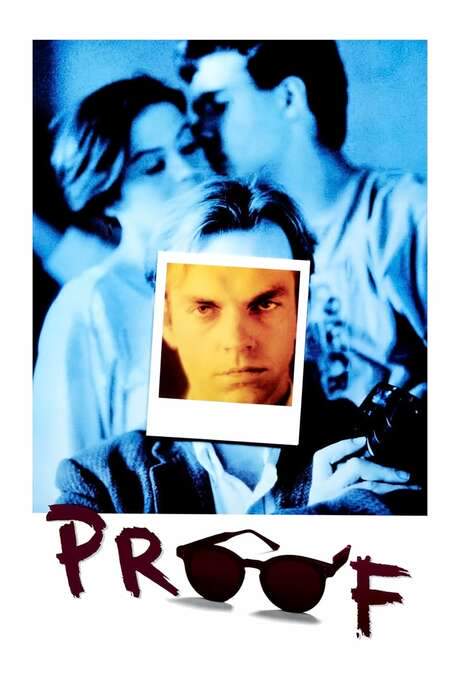
Proof 1991


Directed by

Jeffrey Walker
Made by

House & Moorhouse Films
Where to Watch Proof
See current US streaming, rental, and purchase options for Proof (1991) via JustWatch.

Shout! Factory Amazon Channel
HD
Fawesome
HD
Hoopla
SD
Plex
HD
Plex Channel
HD
Shout! Factory TV
HD
The Roku Channel
HD
Tubi TV
SD
Google Play Movies
SD
YouTube
SD
Apple TV Store
SD Streaming availability powered by 
Proof Plot Summary
Read the complete plot summary and ending explained for Proof (1991). From turning points to emotional moments, uncover what really happened and why it matters.
Martin is a blind photographer whose days are quietly edged by a troubling past. In his memory, a moment from childhood lingers: his mother describes the world outside his bedroom window and he cannot hear the sound she mentions. He grows convinced that she is lying or playing a trick on him when the truth doesn’t align with what he perceives. This early incident leaves a lasting scar, shaping how he experiences trust and sentiment as an adult. He carries out small photographic projects, then relies on others to describe what he has captured. He reads those descriptions alongside Braille captions and stamps the work as “proof” that the world is as others say it is. The tension between perception and description becomes a constant undercurrent in his life.
The story grounds itself in a tense domestic orbit centered on his home and the woman who tends to him. Celia is a housekeeper with an intense, almost obsessive attachment to him. She has decorated her space with countless photographs of him, a visible sign of her fixation, and she channels her frustration at his rejection into small, intimate acts of control—rearranging furniture and shaping his surroundings to keep him dependent, just enough to prevent pity from ever taking root in him. Her complicated mix of care and coercion keeps him tethered to a life where he neither fully trusts nor fully resents her.
Into this fraught arrangement comes a new voice and a growing sense of companionship. Young Martin learns to see the world again through the lens of another mind when he meets Andy. Andy discovers a depth in Martin’s photographs and offers detailed descriptions that seem to illuminate the images in a way the blind man has longed for. The two form a close bond, and Martin’s trust in Andy grows quickly—space that Celia watches with growing unease. Her fear of losing control intensifies as Andy’s presence in Martin’s life becomes more pronounced.
Celia’s insecurity erupts into action when she entangles [Andy] in a dangerous truce of truth and deceit. She seduces him, and Martin walks in on the forbidden moment. Andy lies to protect himself, and Celia seizes the chance to drive a deeper wedge between the pair. The unraveling trust is starkly witnessed by Martin, who is left to confront the reality that people can be flawed and that appearances can mislead. The tension escalates until Andy himself steps forward to speak to the fragility of human nature. In a pivotal moment, he confronts Martin with a blunt, unsettling truth about deception and perception.
“People lie,” he tells Martin, “but not all the time. And that’s the point.”
The fallout is heavy. Martin decides to end his working relationship with Celia, acknowledging his own role in stoking their tense dynamic. Celia, furious at the turn of events and the futility of her efforts, throws her house key into a sink full of water, a silent yet symbolic rejection of the life she had tried to shape around him.
Yet the story pivots on a final, intimate request. Martin asks for one last description of a photograph—one he has kept hidden away for years. This image is the childhood garden, the scene his mother painted with words on that fateful day. Andy’s description finally brings to light the figure that had stood behind the leaves all those years—the man raking leaves that Martin’s mother spoke of—and the revelation grants Martin a long-awaited emotional release. The truth, once a fragile thread, is now a clear line that allows him to see the world anew, not through weakness or fear, but with a tempered clarity born from memory, trust, and resolution.
Proof Timeline
Follow the complete movie timeline of Proof (1991) with every major event in chronological order. Great for understanding complex plots and story progression.
Childhood garden description
Young Martin, blind, is told by his mother about the garden outside his bedroom window. She describes someone raking leaves, but Martin cannot hear the sound and feels she is lying. This moment seeds a lifelong distrust of explanations that are simply described to him.
Adult worldview begins: mistrust of sighted people
In adulthood, Martin believes sighted people may lie or pity him. He photographs the world and relies on Braille descriptions as supposed proof that what others describe matches reality. This cynicism colors his daily life and his relationships.
Celia, the housekeeper, harbors a crush
Celia, Martin's housekeeper, harbors a deep, obsessive crush and fills her flat with photographs of him. She torments him in small ways, like rearranging furniture, to provoke a reaction. He keeps her around because her mix of affection and hatred prevents him from feeling pitied.
Martin meets Andy, trusted friend
Martin encounters Andy, who describes his photos with depth and precision, and Martin is impressed. The two quickly become close, with Martin trusting Andy more than most people. This friendship offers Martin a new way to see the world through someone else's honest gaze.
Celia's seduction of Andy
Celia senses the growing bond and seduces Andy to destabilize Martin. Martin catches them in the act, and Andy, uneasy, lies to him to avoid a confrontation. The encounter triggers Celia's sense that she can derail Martin's trust once again.
Discovery of dishonesty
Following Celia's manipulation, Martin discovers Andy's dishonesty. The revelation devastates him and he sinks into despair, breaking off their friendship. He retreats further into his own skeptical worldview.
Celia's continuing sabotage
Celia doubles down on her meddling, exploiting Martin's vulnerability and orchestrating events that reinforce his sense of isolation. Her actions keep him from relying on others and deepen his resentment. She remains a volatile presence in his life.
Andy confronts Martin (philosophy of flaws)
Andy confronts Martin again, arguing that people have flaws and that not everyone lies. He urges Martin to reconsider judging people by one faultful moment. Martin does not openly concede, but the seeds of doubt are planted.
Firing Celia
Martin decides to fire Celia, acknowledging his own role in their fraught relationship. She reacts with fury at losing her control over him. The emotional tension comes to a new peak as she demands retribution.
Celia's protest and the key incident
In a volatile display, Celia angrily throws the key to Martin's house into a sink full of water. The act symbolizes the collapse of their arrangement and her refusal to be dismissed simply. The moment crystallizes the fragility of Martin's trust.
Request for one last photograph
Martin asks Andy to describe one last photo—the garden as he remembered it from childhood. He hopes the description will validate his long-held memory. The moment marks a turning point toward reconciliation with his past.
The final revelation: the raking leaves
Andy's description includes the long-forgotten image of the garden and the man raking leaves his mother spoke of. This revelation provides Martin with proof and a sense of emotional release. He finally accepts that the world can be complex but not entirely untrustworthy.
Proof Characters
Explore all characters from Proof (1991). Get detailed profiles with their roles, arcs, and key relationships explained.
Martin (Hugo Weaving)
Martin is a blind photographer whose world is shaped by descriptions rather than sight. He distrusts the honesty of sighted people and uses photographs with Braille captions as 'proof' that reality matches description. He keeps Celia close to avoid pity, yet his defensiveness isolates him from others. A childhood memory of his mother describing a garden haunts him and informs his wary approach to relationships.
Andy (Russell Crowe)
Andy is a thoughtful describer who forms a close, trusting bond with Martin through detailed descriptions of photos. He offers a humane, nuanced view of people, challenging Martin's tendency to see only flaws. Their friendship is tested when Celia seduces him and he lies to protect himself, revealing the complexities of trust and self-interest. He attempts to persuade Martin that people are fallible, not purely pitiful or deceitful.
Celia (Geneviève Picot)
Celia is Martin's housekeeper with a deep, obsessive crush. Her love quickly veers into control, as she rearranges Martin's furniture and manipulates him to keep him within her orbit. She surrounds him with photos of herself and refuses to let Martin escape the dynamics of pity and anger that define their relationship. Her manipulation becomes the central tension that drives the conflict.
Martin's Mother (Heather Mitchell)
Martin's mother shapes his sense of reality by describing the garden and insisting someone is raking leaves—descriptions he cannot hear as he grows angry at the perceived lie. This moment seeds his lifelong suspicion of ordinary explanations and fuels his need for 'proof'. Her memory haunts Martin, coloring how he interprets every interaction with others. Her influence anchors the theme of memory versus truth.
Young Martin (Jeffrey Walker)
In flashbacks, Young Martin is a child who internalizes his mother's described garden as a potential deception. The scene reveals early signs of the distrust that defines his later adult life. His vulnerability in childhood explains why adult Martin clings to proof to guard against manipulation. The memory underscores the film's exploration of how early experiences shape perception.
Proof Settings
Learn where and when Proof (1991) takes place. Explore the film’s settings, era, and how they shape the narrative.
Location
Martin's house, Celia's flat, garden
Most of the story unfolds inside Martin's home and its surrounding spaces. The house becomes a quiet, controlled environment where photographs are taken, described, and stamped as 'proof'. Celia's flat appears as a tense counterpoint, reflecting her obsessive attachment and manipulation. The garden outside Martin's window functions as a memory-triggering locale central to Martin's revelation about truth.
Proof Themes
Discover the main themes in Proof (1991). Analyze the deeper meanings, emotional layers, and social commentary behind the film.
🔎
Perception vs Reality
The film probes how Martin's blindness shapes his need for 'proof' that the world exists as described. He relies on others' descriptions, testing the reliability of narrative against what he cannot see. Flashbacks complicate the idea of truth, showing how memory and interpretation influence present beliefs. The story suggests that perception can be as deceptive as it is revealing.
💔
Power & Control
Celia's affection mutates into controlling behavior, as she rearranges Martin's surroundings and uses emotional manipulation to keep herself indispensable. Martin's vulnerability makes him dependent, while Celia exploits that dependence to maintain influence over him. Jealousy and obsession fuel a dynamic where domestic spaces become instruments of power. Andy's arrival disrupts the balance, yet Celia's influence remains a central force.
🤝
Trust & Betrayal
Martin's bond with Andy offers a glimmer of genuine trust and a challenge to his black-and-white view of people. That trust is tested when lies and manipulation come to the surface, revealing the fragility of friendship. The climactic moment—Andy's description of the garden scene—forces Martin to confront the paradox of proof and truth. The narrative underlines how trust can be both healing and perilous.

Coming soon on iOS and Android
The Plot Explained Mobile App
From blockbusters to hidden gems — dive into movie stories anytime, anywhere. Save your favorites, discover plots faster, and never miss a twist again.
Sign up to be the first to know when we launch. Your email stays private — always.
Explore the mobile appProof Spoiler-Free Summary
Discover the spoiler-free summary of Proof (1991). Get a concise overview without any spoilers.
In a modest apartment that feels both sanctuary and cage, Martin lives his life through a camera lens that captures what his eyes cannot see. A talented photographer, he creates images that exist only in his mind until someone else translates them into words. The act of turning those verbal accounts into Braille captions has become his quiet ritual of confirming that the world is as others claim, a habit rooted in a childhood moment when his mother’s description of the outside clashed with a sound he could not hear. This lingering doubt colors every interaction, making trust a delicate commodity that must first be proven.
Celia fills the house with a steady, almost obsessive presence. As the caretaker of Martin’s daily life, she arranges furniture, tends the kitchen, and surrounds herself with photographs of him, each one a testament to a devotion that borders on possession. Her love is expressed through meticulous control of his surroundings, a blend of tenderness and restraint that keeps Martin dependent yet wary. The intimate confines of the home amplify the push‑and‑pull of their bond, casting a gentle but persistent undercurrent of tension that hints at deeper insecurities.
Enter Andy, a charismatic restaurant employee who discovers the depth behind Martin’s work and offers descriptions that seem to illuminate the photographs in a way that has long eluded him. Their connection blossoms into a quiet companionship, opening a new channel through which Martin can experience the world beyond his immediate walls. Andy’s insight and willingness to share his perspective introduce a fresh dynamic, suggesting that the boundaries of perception can expand when trust is extended to a new voice.
The film walks a tightrope between intimacy and unease, using muted colour palettes and soft lighting to mirror Martin’s internal landscape. It probes the fragile architecture of human connection, where love, control, and the need for proof intertwine. As each character navigates the spaces between what is seen, heard, and believed, the story invites viewers to contemplate how truth is constructed and how fragile the bridges of trust truly are.
Movies with Similar Twists and Themes
Uncover films that echo the narrative beats, emotional arcs, or dramatic twists of the one you're exploring. These recommendations are handpicked based on story depth, thematic resonance, and spoiler-worthy moments — perfect for fans who crave more of the same intrigue.




Featured on this page

What's After the Movie?
Not sure whether to stay after the credits? Find out!
Check out our other apps:

SAT Sphere
Build confidence for the Digital SAT.

Mori Atlas
Discover wild places worth protecting.

Luntero
Search smarter for a home in Amsterdam.

Plot Explained
Unravel movie endings and hidden clues.

Pokechamp
Dive into Pokémon data and battle logic.

Driving Theory
Get ready for your European theory test.

Movie Dust
Plan your next cinema trip with ease.

Musemap
Find art and culture as you travel.

Selkobase
Compare credentials before committing.

Local Manual
Turn an unfamiliar country into practical next steps.

Lernavi
Compare school systems before your next move.

GymRoam
Find a workout stop wherever your plans take you.
Explore Our Movie Platform
New Movie Releases (2026)
Famous Movie Actors
Top Film Production Studios
Movie Plot Summaries & Endings
Major Movie Awards & Winners
Best Concert Films & Music Documentaries
Movie Collections and Curated Lists
© 2026 What's After the Movie. All rights reserved.
Privacy Policy