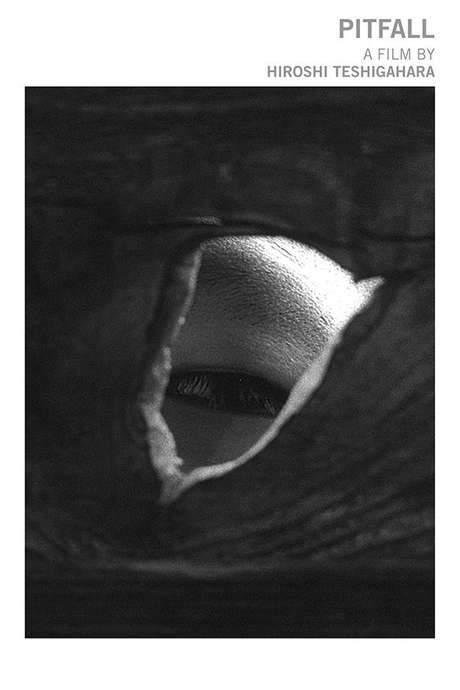
Pitfall 1962


Directed by

Hiroshi Teshigahara
Made by

Teshigahara Productions
Where to Watch Pitfall
See current US streaming, rental, and purchase options for Pitfall (1962) via JustWatch.

Streaming availability powered by 
Pitfall Plot Summary
Read the complete plot summary and ending explained for Pitfall (1962). From turning points to emotional moments, uncover what really happened and why it matters.
A single father, Otsuka, Hisashi Igawa escapes a grinding mining camp and steps into the quiet, uncertain countryside. From a nearby cemetery, a mysterious man in a white suit, Kunie Tanaka whose identity remains hidden, trains his camera on them, capturing the moment as dusk gathers. As they plan to board a bus the next morning, the unemployed miner clings to a hopeful dream of union solidarity, imagining what it would be like if he were reborn into a life dedicated to organizing workers within the mines.
They reach a boardinghouse and are sent toward a Kyūshū village in search of work, with Otsuka’s young son beside him—Kazuo Miyahara stepping into the role of the boy who walks alongside a father trying to keep faith in the promise of better days. Soon the road leads them to a ghost town, deserted save for a lone female shopkeeper who keeps watch over a place emptied by time. She, Sumie Sasaki, explains that the mine closed after a cave-in, and the men drifted away in the wake of the disaster. After she points them in the right direction, the miner presses on, only to be shadowed again by the same man in white, who brutally murders him and hurls the knife into the riverbank.
The killer returns to the ghost town, where he finds the shopkeeper and bribes her to frame Otsuka—the union leader who bears an uncanny resemblance to the miner—for the crime. Meanwhile, the miner’s ghost wanders the town, unseen by the living, a quiet echo of a life extinguished. Detectives later locate the corpse and study the knife wound, discovering a photograph tucked in the back pocket that bears a striking resemblance to Otsuka. It becomes clear that a faction within the labor movement has splintered, forming a second union at another pit, a split that Otsuka himself tries to explain.
Desperation drives Otsuka to contact Toyama, the old-pit union leader, Sen Yano, pleading his innocence and asking to help locate the shopkeeper. But the shopkeeper herself is killed by the man in white, and as Otsuka and Toyama learn of this murder, they blame one another and engage in a fatal confrontation that ends both men’s lives. The man in white watches with a cold satisfaction, mounts his motorcycle, and rides away, his mission seemingly complete. In the final image, the miner’s son, who witnessed everything, leaves the village and runs off toward the horizon, carrying the weight of what he’s seen into an uncertain future.
Pitfall Timeline
Follow the complete movie timeline of Pitfall (1962) with every major event in chronological order. Great for understanding complex plots and story progression.
Escape from the mining camp
A single father and his young son flee the harsh confines of a mining camp and venture into the countryside in search of a quieter life. The father clings to hopes of union solidarity, even as the present danger shadows their steps, and he speaks of boarding a bus the next morning. He dreams of being reborn into a labor union in the afterlife, a belief that gives him strength while they flee.
The white-suited photographer from the cemetery
A mysterious man dressed in a white suit appears in the distance, taking photographs of the father and son from a nearby cemetery. His identity remains unresolved, casting a strange, ominous aura over the escape. The encounter foreshadows a watching hand that will shape events to come.
The morning bus plan and pursuit
As dawn approaches and a bus is planned for departure, the enigmatic man in white tracks the family’s movements. The future depends on a single ride that could carry them toward safety or peril, and the tension between escape and pursuit tightens.
Arrival at a boardinghouse and assignment to a Kyushu village
The miner and his son reach a boardinghouse, where the elder is sent toward a Kyushu village in search of work. They face a step closer to hard labor and an uncertain future as the journey continues. The home away from home becomes a temporary waypoint on their precarious path.
Ghost town encounter with a lone shopkeeper
On the way, they arrive at a ghost town that is mostly deserted except for one female shopkeeper. She explains the mine closure and the departure of the men who once worked there, hinting at danger and abandonment. She points them toward their intended direction, offering a bleak map of the region.
The white-suited killer strikes
The man in white murders the miner and discards the knife by the riverbank. He then heads back to the ghost town to continue his unseen plan. The murder marks a turning point that shifts the focus from escape to frames and investigations.
The killer frames Otsuka
Back in the ghost town, the white-suited man bribes the shopkeeper to frame Otsuka, a union leader who bears an uncanny resemblance to the miner. The setup aims to sow distrust and incite a vicious power struggle within the union. The motive remains murky, but the plot thickens with the promise of a scapegoat.
The ghost miner haunts the living
The miner's ghost wanders unseen by the living, haunting the village as a quiet witness. The living cannot hear or see him, yet his presence deepens the tragedy and memory of the event. He returns to the ghost town and encounters spectral inhabitants.
Detectives discover the corpse and a telling photograph
Detectives arrive to locate the corpse and examine the fatal knife wound, uncovering a photograph in the body's back pocket that resembles Otsuka. This clue ignites suspicion and ties the crime to a larger rift within the union. The case escalates from personal tragedy to political intrigue.
Otsuka reveals the union split and seeks the truth
Otsuka explains that a faction within the labor union split away and formed a second group at another pit. He phones Toyama, the elder union leader, to plead his innocence and to locate the shopkeeper. The action moves the investigation from the field to the voices of leadership and loyalty.
The shopkeeper is killed
The shopkeeper herself is killed by the man in white, sealing her role in the conspiracy and eliminating a key witness. The sense of betrayal deepens as the murderer continues his unseen work. The town begins to unravel under the weight of fear and revenge.
Leaders blame one another and fight
When Otsuka and Toyama learn of the shopkeeper's death, they blame each other and a fierce fight ensues, ending in the deaths of both men. The conflict exposes the fragility of leadership and the manipulability of factional loyalties. The murderer's plan seems to reach its eerie completion.
The killer observes and departs
The man in white watches the chaos, then rides away on a motorcycle, satisfied that his mission is complete. He remains an enigmatic force rather than a single culprit, leaving behind a trail of ruined lives. The escape and the crime linger in the air as the killer vanishes.
The son witnesses everything and flees
The miner’s son witnesses the entire sequence and, burdened by memory, runs off into the distance. His flight marks the final leaving of the boy from the village and the end of a chapter of tragedy. The story closes on the boy's uncertain future.
Pitfall Characters
Explore all characters from Pitfall (1962). Get detailed profiles with their roles, arcs, and key relationships explained.
Otsuka (Hisashi Igawa)
A union leader who bears an uncanny resemblance to the murdered miner. His likeness becomes the centerpiece of a frame-up, placing him at the center of police suspicion and public doubt. He strives to prove his innocence while navigating volatile labor politics and personal danger. His resolve tests the boundaries between solidarity and self-preservation.
Dead Miner (Ton Shimada)
The miner who escapes the mining camp only to be murdered in the village, leaving behind a son. His death triggers the investigation and ignites the struggle over union leadership and blame. His memory haunts the living—seen in the aftermath and the desire for justice. His sacrifice underscores the human cost of labor conflict.
Miners Son (Kazuo Miyahara)
The miner's son who witnesses the events and ultimately continues toward an uncertain future. He embodies the vulnerability and resilience of a new generation caught between adult conflicts and the fallout of violence. His departure into the distance marks the film's lingering sense of unresolved endings.
Toyama (Sen Yano)
The old pit union leader who embodies the factional divides within the labor movement. He engages with Otsuka in a struggle over legitimacy and direction for the workers. His actions and eventual fate illuminate the perilous nature of intra-union politics in a time of economic strain.
Shopkeeper (Sumie Sasaki)
A female shopkeeper in the village who becomes entangled in the plot when she is bribed to frame Otsuka. She witnesses the mounting tension and ultimately is killed by the man in white. Her role shows how ordinary civilians become pawns in larger power plays and how fear can corrupt judgment.
Man in White Suit (Kunie Tanaka)
A mysterious figure whose identity remains hidden as he orchestrates murder and manipulation. He watches events unfold, using fear and deception to influence outcomes. His actions drive the plot toward tragedy and expose the fragility of truth in a world where appearances are weaponized.
Photographer (Kikuo Kaneuchi)
A photographer who captures the key moments from the cemetery, adding a layer of surveillance and memory to the story. The images he takes become symbolic records of violence, guilt, and the elusive search for truth. His presence reinforces the idea that witnessing can influence justice and perception.
Second Union Member (Tadashi Fukuro)
A participant in the union splits that divide the workers and complicate the search for accountability. His involvement highlights the broader fractures within the labor movement. The tensions among union members contribute to the film's theme of betrayal and factionalism.
Second Miner (Kanichi Ômiya)
A fellow miner whose presence underscores the shared labor reality and diversification within the mining community. His role reinforces the collective nature of the mining work and the dangers that shadow all workers. He contributes to the web of relationships that drive the narrative.
Farmer (Shigeru Matsuo)
A rural figure encountered along the journey from the camp to the village. His presence helps establish the contrast between industrial hardship and agricultural life in the countryside. A minor but steady reminder of the broader economy outside the mine.
Sanpei Asakura
A character encountered in the village, contributing to the texture of local life and the unfolding events. The role adds to the sense of a lived-in community where many lives are touched by the mining crisis. He participates in the village’s reactions to the unfolding violence.
Labor Boarding House Owner (Heiguro Matsumoto)
The boardinghouse owner who houses the miners along their uncertain path to work. The boardinghouse serves as a microcosm of the broader labor struggle, where rumors, alliances, and tensions simmer. His role anchors the miners’ day-to-day existence amid larger political turmoil.
Pitfall Settings
Learn where and when Pitfall (1962) takes place. Explore the film’s settings, era, and how they shape the narrative.
Location
Mining camp, Kyūshū village, Ghost town, Cemetery
Pitfall unfolds across a bleak mining camp and a Kyūshū countryside village, moving toward a deserted ghost town and its cemetery. The setting is defined by hard labor, rural isolation, and a looming sense of decay as work dries up. The remote landscape amplifies the tension between desperate workers, corrupt figures, and an unseen witness. The cemetery’s quiet becomes a stage for violence and unresolved grievances.
Pitfall Themes
Discover the main themes in Pitfall (1962). Analyze the deeper meanings, emotional layers, and social commentary behind the film.
🪧
Labor Struggle
The film centers on a miner's dream of joining a union and exposes fractures within union leadership. It shows how political maneuvering, personal vendettas, and economic desperation intertwine to threaten solidarity. Violence and manipulation underscore the fragility of worker organizing in a hostile environment. The narrative suggests that power can corrupt collective causes as easily as external forces can crush them.
👻
Memory and Ghosts
The miner's ghost haunts the living world, a presence felt but not heard by the townspeople. Memory surfaces through scenes in the cemetery and the ghost town, reminding characters of past grievances and missed chances. The haunting underscores the consequences of violence and deceit that continue to echo through the community. Images and memories drive lingering questions about guilt and innocence.
🎭
Identity and Deception
A brutal frame-up hinges on a deadly case of mistaken identity and visual deception. The look-alike of the murdered miner becomes a tool for manipulation, while a mysterious man in a white suit orchestrates events from the shadows. The shopkeeper’s betrayal and the slipping of truth reveal how appearances can mask brutal intent. The film probes how truth is constructed under pressure and who benefits from misleading narratives.

Coming soon on iOS and Android
The Plot Explained Mobile App
From blockbusters to hidden gems — dive into movie stories anytime, anywhere. Save your favorites, discover plots faster, and never miss a twist again.
Sign up to be the first to know when we launch. Your email stays private — always.
Explore the mobile appPitfall Spoiler-Free Summary
Discover the spoiler-free summary of Pitfall (1962). Get a concise overview without any spoilers.
Pitfall follows a single father, Otsuka, who escapes the crushing conditions of a mining camp with his young son, carrying with him the hope of a better life. An unemployed miner with dreams of worker solidarity, he steps into an uncertain countryside where every road seems to lead toward more questions than answers. His journey is one of persistence—walking alongside his son, trying to keep faith in promises that feel increasingly distant.
The world they enter is shaped by industrial decline and human absence. A Kyūshū village, once home to a thriving mine, now stands nearly deserted, its streets holding the silence of those who have already moved on. A lone shopkeeper remains, watching over a place emptied by time and circumstance, offering fragments of explanation about a disaster that drove people away. The atmosphere is heavy with what has been lost, and the town seems to exist in a state of suspension—waiting, perhaps, for something or someone to arrive.
As the film unfolds, the boundary between hope and despair grows thin. The miner’s search for work becomes entangled with something harder to name—a sense that the town holds more than just economic hardship. Pitfall explores the fragility of dreams in a world where the living and the lost exist side by side, and where the pursuit of dignity can lead into the shadows of an uncertain fate.
Movies with Similar Twists and Themes
Uncover films that echo the narrative beats, emotional arcs, or dramatic twists of the one you're exploring. These recommendations are handpicked based on story depth, thematic resonance, and spoiler-worthy moments — perfect for fans who crave more of the same intrigue.



Featured on this page

What's After the Movie?
Not sure whether to stay after the credits? Find out!
Check out our other apps:

SAT Sphere
Build confidence for the Digital SAT.

Mori Atlas
Discover wild places worth protecting.

Luntero
Search smarter for a home in Amsterdam.

Plot Explained
Unravel movie endings and hidden clues.

Pokechamp
Dive into Pokémon data and battle logic.

Driving Theory
Get ready for your European theory test.

Movie Dust
Plan your next cinema trip with ease.

Musemap
Find art and culture as you travel.

Selkobase
Compare credentials before committing.

Local Manual
Turn an unfamiliar country into practical next steps.

Lernavi
Compare school systems before your next move.

GymRoam
Find a workout stop wherever your plans take you.
Explore Our Movie Platform
New Movie Releases (2026)
Famous Movie Actors
Top Film Production Studios
Movie Plot Summaries & Endings
Major Movie Awards & Winners
Best Concert Films & Music Documentaries
Movie Collections and Curated Lists
© 2026 What's After the Movie. All rights reserved.
Privacy Policy