What Is Peacock About?
The premise of Peacock in 324 words, with nothing given away. The full story follows below.
In a modest town of mainland China during the late 1970s and early 1980s, daily life unfolds with a quiet rhythm that feels both particular and universal. The streets are lined with small factories, communal spaces, and the occasional burst of patriotic pageantry, while the homes echo with generations of hopes and routine rituals. The film’s tone is gentle and observant, inviting the audience to linger on the ordinary moments that shape a family’s inner world, and to hear the subtle hum of a society in quiet transition.
At the heart of the story is a middle‑aged couple and their three children, each navigating the space between personal longing and communal expectation. The narrative moves through the perspectives of the siblings, using their individual hopes and struggles as lenses through which the larger tapestry of the town is revealed. The atmosphere is one of understated resilience, where small victories are cherished and the weight of unspoken dreams hangs softly in the background.
Weihong is the eldest sister whose curiosity pulls her toward something beyond the familiar confines of the neighborhood. Drawn to the allure of flight and the notion of service, she carries a restless imagination that colors her interactions and shapes her sense of possibility. Her relationships with neighbors and strangers alike are tinged with the yearning to break free, even as the world around her remains steadfastly ordinary.
Weiguo, the middle child, faces the challenges of a physical disability within a community that is often unkind to difference. His story is one of quiet endurance, bolstered by familial care and a yearning for dignity. Weiqiang, the youngest, stands on the cusp of adolescence, caught between youthful curiosity and the pressing need to find his own footing. Together, the siblings embody a tapestry of aspiration and perseverance, their lives weaving an intimate portrait of a family that, despite the era’s constraints, discovers moments of beauty and hope in the most ordinary of places.
What Happens in Peacock?
The complete story of Peacock, from the first scene to the last, in 835 words (about 4 minutes). Spoilers throughout. Names in the text link to 4 cast member pages.
Spoilers ahead
Set in the late 1970s and early 1980s, in a small Mainland Chinese town, the story follows a middle‑aged couple and their three children as they navigate hopes, disappointments, and small victories that shape their lives. Each section centers on a different sibling, offering a close look at their dreams, struggles, and the quiet resilience that binds the family together.
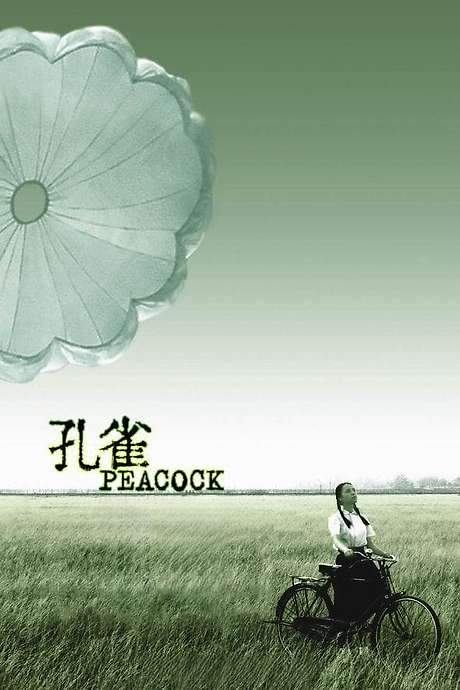
Gao Wei Hong Zhang Jingchu embarks on a path driven by curiosity and a longing for something beyond the everyday. Her mother arranges for her to work at a nursery, but a mishap—dropping a child—costs her the job. After witnessing soldiers parachuting from a plane, she becomes fascinated by the idea of flight and service. She develops a crush on a male officer and even contemplates joining the military, going so far as to steal her mother’s money to buy him gifts; in the end, she hesitates and does not enroll. The image of enlistees lingers, pushing her toward an imaginative impulse: she knits a makeshift parachute and attaches it to her bike, parading down the street as if she could soar away. Her mother, alarmed by the audacity, intervenes, and the moment draws the attention of Guo Zi Liu Guancheng, a boisterous factory worker who becomes part of her evolving story. Weihong later works at a factory washing bottles and encounters Guo Zi again, their meeting in the woods hinting at a tentative, unspoken exchange. She finds companionship in an elderly man who plays the accordion, forming a father‑daughter bond that her own family initially resents. Through her parents’ connections, she steps into a new life when a district leader’s driver offers marriage on the condition that she takes a new job. Before she departs, she entrusts her older brother with a watch and bids farewell to the family she loves.
Gao Weiguo Li Feng endures a harsher social landscape, where disability makes him a frequent target of bullying. His parents shower him with care, which sometimes strains his younger brother, who shoulder the burden of looking after him. A moment at a bathhouse—where a firecracker startled his cigarette triggers a seizure—exposes the fragility of his world. Weihong asks Guo Zi to help exact revenge on a bully, but the plan is messy and fraught. A pivotal incident occurs when Weiguo goes to school with an umbrella to bring Weiqiang an item, only to be accused of peeping at the girls’ bathroom. He is beaten and publicly humiliated, and Weiqiang condemns him in front of everyone, even stabbing his leg with the umbrella in a moment of spite. Ostracized by classmates, he loses the support of most peers, save for one girl who offers a quiet act of sympathy. When the family discovers the depths of the mistreatment, a strong counter‑move emerges: the brother attempts to push Weiguo toward revenge, but Weihong intervenes to prevent further harm. The family’s complex dynamics are tested, and a rare glimmer of hope appears when a match is arranged with a girl who has a disability, allowing him to start a small food stall with his partner, a venture that gradually attracts customers and stability.
Weiqiang Tian Xiaojie occupies the liminal space between two siblings’ quests for belonging. His story unfolds as a portrait of adolescence and curiosity, with a charged fascination for the same girl who helped Weiguo earlier. When his father notices drawings of naked women in his textbook, the consequence could be expulsion from the family’s house, so Weiqiang leaves on his own, vanishing for days. Guo Zi tracks him down, and with Weihong they follow him to an elderly care home where he finds work and a sense of purpose among the residents. The next day, he boards a train and travels away from the town, leaving his family to wonder about his fate. Weihong, looking ahead, imagines that her brother has achieved the army dream she once pursued for herself, even if the reality he encounters is far more ordinary.
A few years pass, and the siblings’ paths converge again in the rhythm of ordinary life. Weihong returns to live with her family after a separation, while Weiguo and his wife continue their bustling business, an enterprise that draws in more customers than before. Weiqiang returns later with a wife and a son, carrying the weight of a missing finger that he does not explain to his relatives. He does not work in the same way and leans on his wife, who supports him as a stage singer. Weihong encounters the former army officer in the street, only to find that the person she once idealized now wears simple clothes and behaves like an ordinary man. In the end, Weihong remarries, and the three siblings visit a peacock enclosure with their families. Their quiet reflections about the bird’s opened feathers—the moment when the peacock finally reveals its display only after they’ve left—serve as a final, symbolic reminder that beauty and longing can emerge in the most unexpected moments, even as life moves forward.
Peacock Timeline: Every Key Event in Order
15 key events in the order they happen, from “Family setup and siblings” to “Ending: the peacock enclosure”. 15 events name a place, across 15 locations.
- 1
Family setup and siblings
The film opens in a late 1970s small town, showing a middle-aged couple with three children. The eldest Weiguo is obese, mentally challenged, and a constant target for taunts, while Weihong is lively and determined. The youngest, Weiqiang, is an introvert who feels trapped by his family's misery.
When:late 1970s Where:Family home, small town
- 2
Weihong starts a nursery job and dreams of more
Weihong begins work at a nursery, but a few days later she loses her job after dropping a child. After watching army officers parachute from a plane, she walks to the landing field to watch them. Inspired by the sight, she develops a crush on one officer and contemplates enlisting, though she never follows through.
When:late 1970s Where:Nursery; field
- 3
Parachute bike plan and Guozi's interest
To recreate her dream of flight, Weihong knits a makeshift parachute and straps it to her bike. The bold stunt catches the eye of Guozi, a boisterous factory worker, who follows her with interest. She momentarily entertains the idea of giving him gifts bought with her mother's money but decides not to after seeing him with other classmates.
When:late 1970s Where:Streets; factory
- 4
Old accordion man and new marriage
Weihong forms a father-daughter bond with an old man who plays the accordion, whose presence gives her a sense of belonging. The old man's children suspect her motives and assault her at the factory, revealing hostile gossip surrounding her. Through her parents' connections, she meets a district leader's driver and marries him on the condition she secures a new job; before leaving, she gives her older brother a watch and says goodbye to her family.
When:late 1970s–early 1980s Where:Old man’s place; factory; district leader's driver
- 5
Weiguo's life and a seizure at the bathhouse
Meanwhile, Weiguo's life remains fraught with bullying, though his parents shower him with attention. At a bathhouse, a firecracker is set off in his cigarette, triggering a seizure. The incident underscores the family's fragile balance and foreshadows further conflicts.
When:late 1970s–early 1980s Where:Bathhouse
- 6
Weihong seeks revenge
After the seizure, Weihong asks Guozi to avenge Weiguo by beating the bully, placing pressure on Guozi to act. Guozi agrees at first but backs off, leaving Weihong frustrated and angered. The moment marks the beginning of the siblings' spiraling grievances within their community.
When:late 1970s–early 1980s Where:Town; informal gathering spots
- 7
School humiliation and the first ally
When Weiguo brings Weiqiang an umbrella to school, he is accused of peeping outside the girls' bathroom and is beaten by a group of boys. Weiqiang is publicly ridiculed as well, fueling resentment between the brothers. Despite the crowd, one girl helps Weiqiang out of pity.
When:late 1970s–early 1980s Where:School
- 8
The betrayal and the poison plan
Out of contempt, Weiqiang denounces Weiguo before everyone and stabs his leg with the umbrella. The ostracism that follows isolates Weiguo, while Weiqiang becomes increasingly alienated from his peers. The one benevolent girl’s aid is followed by a betrayal that deepens their family rift, leading Weiqiang to contemplate harming Weiguo with poison.
When:late 1970s–early 1980s Where:School; home
- 9
Mother's dramatic reveal
Weiqiang’s plan to poison Weiguo is halted when Weihong intervenes and stops him. That night, their mother publicly demonstrates the danger by making a duck drink the rat poison and watching it convulse and die, exposing the cruelty to the family. The episode leaves the siblings reeling from the violence of their actions.
When:shortly after the poisoning attempt Where:Home
- 10
Making amends and new alliances
Weiqiang tries to repair the rift by buying Weiguo a meal and a baby duck, while their parents arrange for Weiguo to meet a girl with a disability. They set up a small food stall, which gradually becomes popular with customers, signaling a fragile reconstruction of family ties.
When:following the poisoning episode Where:Home; street stall
Show the other 5 events of Peacock Hide the last 5 events
- 11
Weiqiang's obsession and escape
Weiqiang becomes fixated on the girl who helped him, and his father discovers drawings of naked women in his textbook, nearly expelling him. He runs away from home and disappears for days. Guozi later spots Weiqiang and, with Weihong, follows him to an elderly care home where he is found working there.
When:early 1980s Where:Home; elderly care home
- 12
A train departure and a dream deferred
Weiqiang boards a train and leaves the town, and Weihong imagines this departure as the realization of her dream that he would become an army officer. The family is left to contend with the absence and the unfulfilled dream.
When:a few years later Where:Train station; town
- 13
Years later: new lives and hidden scars
A few years pass and the parents share a meal again as Weihong returns after a separation from her husband. Weiguo and his wife run a thriving business, while Weiqiang comes back with a wife and son, having lost a finger but not explaining how. He does not work and relies on his wife, who becomes the family’s stage singer.
When:years later Where:Family home
- 14
The officer reappears as a regular person
Weihong spots the army officer she once idolized in the street, but he is now just a regular man in simple clothes. The moment recontextualizes her memories of the dream she chased and emphasizes the distance between fantasy and ordinary life.
When:years later Where:Street
- 15
Ending: the peacock enclosure
In the final scene, Weihong remarries and all three siblings visit a peacock enclosure with their families. They wonder why the peacock won’t display its feathers, and only after they depart does the bird unfurl its plumage, underscoring the gap between dreams and life’s ordinary pace.
When:ending Where:Peacock enclosure
Who Are the Main Characters in Peacock?
6 characters, among them Gao Weiguo (Li Feng), Gao Wei Hong (Zhang Jingchu) and Guo Zi (Liu Guancheng): who each one is and the part they play in the story. 5 of them link to the actor’s page.
- GW
Gao Weiguo (Li Feng)
Played by Li Feng
The oldest brother, he is obese and mentally challenged, making him the frequent target of teasing and ostracism. His parents’ unconditional protection creates tension with his siblings, while he finds occasional stability through family-driven efforts. A pivotal moment at school and a subsequent public incident test the family’s bond, but they persevere together.
- 💢 Bullying
- 👨👩👧 Family loyalty
- GW
Gao Wei Hong (Zhang Jingchu)
Played by Zhang Jingchu
The energetic and independent daughter who pursues dreams despite obstacles. She experiments with romance, seeks purpose through bold acts, and later adapts when life leads her toward marriage and new responsibilities. Her arc highlights resilience, resourcefulness, and the cost of pursuing ideals.
- 🎯 Ambition
- 💃 Independence
- GZ
Guo Zi (Liu Guancheng)
Played by Liu Guancheng
A boisterous factory worker who becomes entangled with Weihong’s schemes and later offers companionship in the youth’s ventures. His bold, sometimes reckless nature creates tension but also moments of camaraderie within the family’s circle. He represents the rough-hewn pathways through which the younger generation navigates desire and risk.
- 🔥 Hot-headed
- 🛠 Factory life
- ML
Master Liu (Bao Zhenjiang)
Played by Bao Zhenjiang
An elderly man who forms a fatherly bond with Weihong, offering warmth and guidance amid the village’s skepticism. He becomes a touchstone for care and memory, briefly offsetting the harshness of external judgments. His presence underscores the importance of chosen mentors in shaping a young person’s sense of self.
- 👨🦳 Father figure
- 📚 Elder
- M(
Mother (Huang Meiying)
Played by Huang Meiying
The family matriarch who orchestrates opportunities and enforces practical boundaries. She reveals hard-won knowledge of the world and commands difficult choices, including moments designed to propel the children toward stability. Her actions are driven by protective love, even when they appear stern or controversial.
- 🧡 Protective
- 👩👧 Family matriarch
- W
Weiqiang
The introverted youngest sibling who cultivates inner worlds through art and dreams of joining the army. He faces ostracism and a precarious path, eventually leaving the town and reappearing years later with a family of his own. His journey embodies escape, return, and reconciliation within a changing landscape.
- 🌟 Dreamer
- 🧭 Escape
Where and When Is Peacock Set?
Peacock is set in Mainland China and small town (Late 1970s to early 1980s). Here is why the time and place matter to the story.
When
Late 1970s to early 1980s
The narrative spans a transitional era in China when reform and opening were just beginning to take root. Rural communities grapple with new economic realities, shifting ambitions, and evolving gender roles. The setting uses this timeframe to heighten the contrast between dream and reality for each sibling.
Where
Mainland China, small town
Set in a small town in Mainland China, the story unfolds amid factory life, schools, and local markets that define daily life. The environment reflects the era’s social pressures, family duties, and communal judgments that shape the characters’ choices. The town serves as a microcosm of larger changes sweeping through rural China during this period.
- 🇨🇳 Mainland China
- 🌆 Small town
What Are the Themes of Peacock?
4 ideas the story keeps returning to, among them Family, Dreams and Stigma & Acceptance.
-
01
Family
The film centers on a tightly knit, conflicted family where love, duty, and rivalry coexist. Parental attention to one child often contrasts with the needs of others, revealing how affection can both unite and strain siblings. The parents’ protective instincts drive practical decisions that redefine each child’s path. Across trials, the family’s resilience becomes the bedrock of the siblings’ journeys.
-
02
Dreams
Dreams propel Weihong to seek adventure and recognition beyond the town’s confines. Her pursuit—whether through a crush on an army officer or a personal project like the parachute—reflects a longing for meaning and escape. The narrative tracks how aspirations clash with social limits and the compromises required to survive. Ultimately, dreams intersect with reality, shaping choices and future outcomes.
-
03
Stigma & Acceptance
Weiguo’s vulnerability exposes how disability and difference invite ridicule yet also reveal moments of care within the family. The town’s gossip and bullying contrast with acts of loyalty and responsibility from loved ones. The story examines how communities respond to those who don’t fit conventional norms, and how acceptance can emerge from steadfast, quiet support. The arc emphasizes dignity, resilience, and the cost of social exclusion.
-
04
Change & Modernization
The town becomes a lens for China’s broader transition from purely agrarian life to emerging industrial and social reforms. Economic ambitions, factory work, and education introduce new opportunities and tensions in traditional routines. The period’s shifts pressure characters to re-evaluate roles, relationships, and what it means to belong in a rapidly changing society.
What Kind of Film Is Peacock?
Bittersweet in tone, with slow pacing and a moderate story, going by the plot summary.
- Tone
- Bittersweet
- Pacing
- Slow
- Story
- Moderate
- Intensity
- Medium
- Ending
- Bittersweet
A quiet, slow-paced drama that intimately observes the bittersweet hopes and quiet disappointments of a Chinese family, where moments of small victory are interwoven with a pervasive, melancholic nostalgia.
- melancholic
- nostalgic
- quiet
- contemplative
- resilient
- intimate
- family dynamics
- small town life
- coming of age
- ordinary struggles
Content notes: bullying, seizure depiction, public humiliation.
Quiz
How well do you remember Peacock? Test yourself on the story.