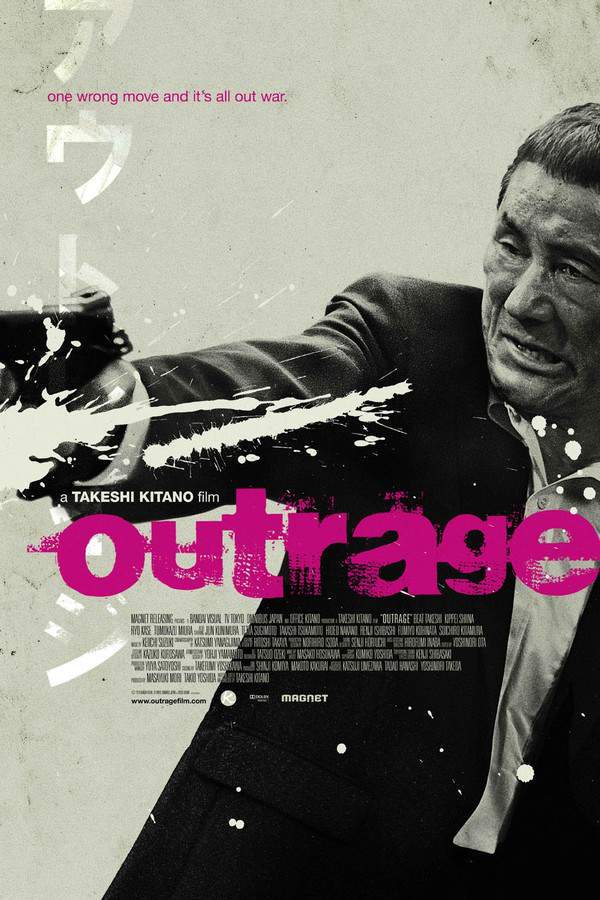
Outrage 2009


Directed by

Kirby Dick
Made by

Magnolia Pictures
Where to Watch Outrage
See current US streaming, rental, and purchase options for Outrage (2009) via JustWatch.

Amazon Prime Video
HD
Amazon Prime Video with Ads
HD
Philo
HD
Kanopy
HD
DistroTV
HD
Fandango at Home Free
HD
The Roku Channel
HD
Tubi TV
SD
YouTube Free
HD
Amazon Video
SD
Apple TV Store
HD Fandango At Home
SD
Google Play Movies
SD
YouTube
SD Streaming availability powered by 
Outrage Plot Summary
Read the complete plot summary and ending explained for Outrage (2009). From turning points to emotional moments, uncover what really happened and why it matters.
The film opens with a lavish banquet at the opulent estate of the Grand Yakuza leader Sekiuchi, the man at the helm of the Sanno-kai, a sprawling crime syndicate that holds sway over the Kanto region. The gathering brings together the many Yakuza leaders who bend the knee to his authority, setting the stage for a web of loyalties and grudges that will soon fracture.
After the toast and formalities, Kato—the underboss of the Sanno-kai—pulls aside a fellow leader who has just fallen out of favor. He makes it clear that he is displeased with the uneasy friendship that has blossomed between Ikemoto and a rival faction, Murase, during a time when the two were unexpectedly imprisoned together. The message is blunt: Ikemoto must bring the Murase-gumi in line. The weight of this order is then transferred to a trusted subordinate, Otomo, who runs his own crew and is expected to execute the plan.
Soon enough, a pivotal incident unfolds at Murase’s nightclub. A man posing as a customer is driven by a calculated scheme and shaken down for about one million yen. The shocking twist is that this supposed patron is actually a member of the Otomo family, planted into the venue to spark the spark that could ignite an all-out war against Murase’s faction. Murase remains largely ignorant of his falling out with Sekiuchi and believes he can repair the rift by leaning on a former prison friend, Ikemoto. He trusts this alliance without suspecting the treachery lurking behind Ikemoto’s advice, and each time he heeds that counsel, his position and resources weaken further, eroding the strength and stability of his crime family. The violence intensifies when Otomo leaves a cruel scar on the face of Murase’s chief lieutenant, Kimura, deepening the sense that the conflict is spiraling beyond repair.
As the days pass and the dust settles, the scheme reaches a brutal culmination: Ikemoto and Murase are killed, while Otomo finds himself confined in a maximum-security prison—unexpectedly sharing the same fate as Kimura in a brutal prison ambush, where Kimura drives a makeshift knife into Otomo’s belly. The inner workings of the gang world come into sharper focus as the betrayals, loyalties, and power moves collide and collide again, each move tightening the noose around those who believed they could navigate the maze of kinship and treachery.
In the final act, the power players circle back to where they began. Kato takes decisive action, pulling off a covert strike against Sekiuchi himself. The leader falls, and Kato steps into the void, seizing control as the new Grand Yakuza of the Sanno-kai. The film closes on a stark, unsettling note: the cycle of ambition and betrayal that defined the lives within this world continues, even as the old guard is toppled and a new order takes shape.
Across these twists and reversals, the story remains a careful study of how trust can be weaponized, how prison bonds can fracture under pressure, and how a single calculated move can redraw the map of power within a ruthless criminal empire. The tension is sustained through each calculated maneuver, each violence-laden confrontation, and every quiet moment where a character weighs a choice that could alter the course of an entire syndicate. The result is a dense, morally complex portrait of loyalty, control, and the high stakes of a world where survival hinges on who blinks first.
Outrage Timeline
Follow the complete movie timeline of Outrage (2009) with every major event in chronological order. Great for understanding complex plots and story progression.
Grand banquet at the Grand Yakuza estate
The film opens with a sumptuous banquet at the Sekiuchi estate, showcasing the power and prestige of the Sanno-kai. Leaders from the various factions mingle as toasts are made, setting the stage for looming tensions. After the formal conclave, Kato pulls Ikemoto aside and signals that something disturbingly misaligns within the alliance.
Kato reprimands Ikemoto and orders Murase to be brought in line
Kato makes plain his displeasure with Ikemoto’s friendship with Murase and orders him to bring the rival gang in line. He delegates the task to Ikemoto, reinforcing the line of authority within the Sanno-kai. Ikemoto immediately passes the assignment to his subordinate Otomo, initiating a covert power play.
Ikemoto assigns Otomo to subdue Murase’s gang
Ikemoto delegates the mission to Otomo, who runs his own crew under the Sanno-kai. The mission is framed as restoring order, but its hidden aim is to weaken Murase. Otomo accepts the assignment, signaling his rising importance within the organization.
Murase's nightclub shakedown engineered by a planted agent
At Murase’s nightclub, a customer is shaken down for about one million yen by a man planted by Otomo’s side, a calculated move to spark an all-out war. Murase remains unaware that his falling out with Sekiuchi has already begun. The orchestrated extortion exposes the fragility of Murase’s grip and invites further retaliation.
Murase seeks help from Ikemoto via old prison friendship
Murase, unaware of Ikemoto’s orders to terminate him, seeks aid from his former prison friend. He trusts Ikemoto’s influence to resolve the trouble, not realizing the manipulation behind the scenes. This reliance deepens Murase’s vulnerability as the facade of loyalty collapses.
Ikemoto’s manipulations chip away at Murase’s strength
Ikemoto’s guidance is misdirected, steadily eroding Murase’s resources and leverage. Each mirage of strategic help results in another loss for Murase’s gang. The pattern accelerates Murase’s decline and heightens the pressure from the Sanno-kai.
Otomo’s brutality leaves Kimura scarred
In an escalation of violence, Otomo’s men leave vicious scars on Kimura, Murase’s chief lieutenant. The assault marks a brutal turn in the feud and tests Murase’s loyalty to his banner. The confrontation underscores the widening rift between allies and rivals alike.
Escalation leads to the downfall of Ikemoto and Murase
As the conflict spirals, Ikemoto and Murase are killed in the ensuing clashes, removing two major obstacles to Sekiuchi’s power. Their deaths shift the balance, triggering a scramble for control as Otomo remains a key player with his own ambitions. The city becomes a chessboard for the Sanno-kai’s internal warfare.
Otomo jailed in a maximum-security prison; Kimura ambushes him
Otomo survives the purge only to be imprisoned in a maximum-security facility, where he unexpectedly shares confinement with Kimura. In a brutal prison ambush, Kimura stabs Otomo in the belly with a makeshift knife. The incident reveals how treacherous the underworld can be, even within walls meant to contain violence.
Kato conducts a secret coup against Sekiuchi
Kato makes his move in secret to claim the Grand Yakuza title by killing Sekiuchi, removing the old guard and seizing leadership of the Sanno-kai. The assassination is framed as a quiet coup, several steps behind the front lines of the feud. Kato’s victory marks a dramatic reordering of the syndicate’s hierarchy.
Kato consolidates power and restructures the Sanno-kai
With Sekiuchi dead, Kato consolidates power and begins restructuring the Sanno-kai’s leadership. He faces the daunting task of quelling remaining rivals and stabilizing the fractured organization. The new era begins under the shadow of past betrayals and a fragile peace on the horizon.
A new era looms as power shifts and loyalties remain fragile
The final turn shows how one secret kill can reshape the underworld, as Kato claims the throne and the game of loyalty pivots around personal ambition. The Sanno-kai’s grip on the Kanto region remains strong but visibly frayed by betrayal and revenge. The ending hints at future conflicts under a new leader.
Outrage Characters
Explore all characters from Outrage (2009). Get detailed profiles with their roles, arcs, and key relationships explained.
Sekiuchi
The Grand Yakuza leader who commands the Sanno-kai and rules the Kanto region with a ruthless, calculating mind. His opulent estate hosts lavish banquets that mask brutal political games. His displeasure at internal alliances triggers a deadly chain of betrayals that reconfigure the underworld's power map.
Kato
Underboss of the Sanno-kai, he orchestrates moves to bring Ikemoto's faction into line and crush rival factions. He moves quietly, calculating every consequence before acting. His ability to orchestrate alliances and betrayals sets the stage for his final act of seizing control after killing Sekiuchi.
Ikemoto
Chief lieutenant to Sekiuchi who plays a dangerous game of loyalty and manipulation. He delegates the task of curbing Murase to Otomo while maneuvering behind the scenes. His scheme to weaken Murase ultimately leads to his own demise alongside Murase.
Otomo
A capable captain under Ikemoto who carries out the plan to destabilize Murase’s faction. He oversees the nightclub ruse that triggers the wider conflict and ends up imprisoned after a brutal ambush. His arc culminates in prison violence as Kimura fatally wounds him.
Murase
Rival gang leader whose Murase-gumi is drawn into conflict by Ikemoto’s schemes. He relies on past prison friendships for support, but those bonds prove fragile in the merciless world of power politics. His downfall comes as his resources dwindle and he is killed along with Ikemoto.
Kimura
Murase’s chief lieutenant who sustains Murase’s organization until the endgame. He bears scars from Ikemoto’s manipulation and strategically engages in the prison ambush that leads to Otomo’s demise. His actions push the narrative toward the final power shift.
Outrage Settings
Learn where and when Outrage (2009) takes place. Explore the film’s settings, era, and how they shape the narrative.
Time period
Modern-day Japan
Set in contemporary Japan, the story unfolds in a yakuza landscape where power is negotiated through violence and strategic maneuvering. Privilege and fear govern the hierarchy, while betrayals are used as instruments to reshape the balance of influence. The modern setting amplifies the stakes, with lavish feasts and high-stakes confrontations serving as the theater for gang politics.
Location
Sekiuchi's opulent estate, Murase's nightclub
The action centers on Sekiuchi's opulent estate, a fortress of wealth where power is negotiated behind closed doors. The world also moves through Murase's nightclub, a glamorous venue that doubles as a frontline in the gang war. Together these locations anchor the film's brutal politics and the shifting loyalties of the Sanno-kai and its rivals in the Kanto region.
Outrage Themes
Discover the main themes in Outrage (2009). Analyze the deeper meanings, emotional layers, and social commentary behind the film.
🗡️
Betrayal
Loyalties are constantly tested as orders from higher-ups destabilize friendly fronts. Ikemoto uses his position to undermine Murase, exploiting old ties to chip away at his strength. Murase's trust in former prison friends proves costly, accelerating the collapse of his faction. The cycle culminates in the secret killing of Sekiuchi and a shift in power.
🏛️
Power
The film traces the rise and fall of leaders within the Sanno-kai as the balance of fear, influence, and violence determines who holds the reins. Kato maneuvers from the shadows, coordinating betrayals to position himself as the new head. The leadership transition is marked by calculated moves, assassinations, and a ruthless consolidation of authority.
🤝
Loyalty
Loyalty is explored as a shifting construct—old bonds collide with new interests and practical survival. Ikemoto's pragmatic loyalty to the Sanno-kai masks his true agenda, while Murase clings to fragile alliances to keep his gang afloat. The film exposes how loyalty can be a weapon or a vulnerability, depending on who wields it.

Coming soon on iOS and Android
The Plot Explained Mobile App
From blockbusters to hidden gems — dive into movie stories anytime, anywhere. Save your favorites, discover plots faster, and never miss a twist again.
Sign up to be the first to know when we launch. Your email stays private — always.
Explore the mobile appOutrage Spoiler-Free Summary
Discover the spoiler-free summary of Outrage (2009). Get a concise overview without any spoilers.
In a world where public advocacy often masks private truth, Outrage delves into the uneasy paradox at the heart of modern politics. The documentary follows a series of candid conversations with prominent figures who publicly champion policies that undermine the very community they belong to, revealing a dissonance that is both startling and quietly pervasive. Through intimate interviews, the film sets up a landscape where personal identity and political strategy clash, inviting viewers to question the motivations that drive such contradictions.
The tone balances investigative rigor with a contemplative, almost elegiac mood, allowing the subject matter to breathe without descending into sensationalism. Cinematic choices—muted lighting in interview rooms, lingering close‑ups on weary faces, and a restrained musical score—create an atmosphere of quiet tension. This stylistic restraint underscores the gravity of the topic, suggesting that the real drama unfolds not in headlines but in the nuanced, often unseen spaces between belief and action.
At its core, Outrage is a study of the psychological forces that can compel individuals to adopt positions harmful to their own community. It probes the allure of power, the fear of alienation, and the complex role of media in amplifying or obscuring these contradictions. By weaving personal testimony with broader social analysis, the film offers a layered portrait of identity as both a source of empowerment and a potential weapon in the arena of public policy.
Ultimately, the documentary invites audiences to contemplate the fragile boundary between authenticity and performance, urging a deeper reflection on how personal narratives intersect with collective struggles. It is a thought‑provoking exploration that remains as much about the unseen influences shaping public discourse as it is about the individuals who live within that tangled web.
Movies with Similar Twists and Themes
Uncover films that echo the narrative beats, emotional arcs, or dramatic twists of the one you're exploring. These recommendations are handpicked based on story depth, thematic resonance, and spoiler-worthy moments — perfect for fans who crave more of the same intrigue.


Featured on this page

What's After the Movie?
Not sure whether to stay after the credits? Find out!
Check out our other apps:

SAT Sphere
Build confidence for the Digital SAT.

Mori Atlas
Discover wild places worth protecting.

Luntero
Search smarter for a home in Amsterdam.

Plot Explained
Unravel movie endings and hidden clues.

Pokechamp
Dive into Pokémon data and battle logic.

Driving Theory
Get ready for your European theory test.

Movie Dust
Plan your next cinema trip with ease.

Musemap
Find art and culture as you travel.

Selkobase
Compare credentials before committing.

Local Manual
Turn an unfamiliar country into practical next steps.

Lernavi
Compare school systems before your next move.

GymRoam
Find a workout stop wherever your plans take you.
Explore Our Movie Platform
New Movie Releases (2026)
Famous Movie Actors
Top Film Production Studios
Movie Plot Summaries & Endings
Major Movie Awards & Winners
Best Concert Films & Music Documentaries
Movie Collections and Curated Lists
© 2026 What's After the Movie. All rights reserved.
Privacy Policy