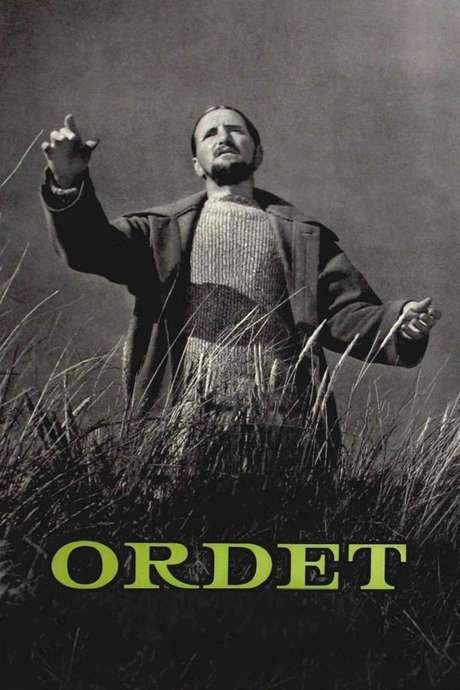
Ordet 1955


Directed by

Carl Theodor Dreyer
Made by

Palladium
Where to Watch Ordet
See current US streaming, rental, and purchase options for Ordet (1955) via JustWatch.


Streaming availability powered by 
Ordet Plot Summary
Read the complete plot summary and ending explained for Ordet (1955). From turning points to emotional moments, uncover what really happened and why it matters.
In the autumn of 1925, a tight-knit farming family known as the Borgens anchors life in a quiet corner of rural Denmark. The family revolves around the devout patriarch, Morten Henrik Malberg Borgen, a widower who remains deeply dedicated to faith, his church, and the community that leans on him. He shares the household with his three sons: Mikkel Emil Hass Christensen Borgen, the eldest who carries a quiet disbelief in dogma; Johannes Preben Lerdorff Rye Borgen, who wanders the farm after a surge of spiritual conviction inspired by Søren Kierkegaard and who claims to be Jesus Christ; and Anders Cay Kristiansen Borgen, the youngest, who is consumed by love for a young woman from the village. The farmer’s domestic world is completed by Inger Birgitte Federspiel Borgen, Morten’s wife who embodies piety and carries a growing expectancy as she nears the birth of their third child.
Anders’ heart leans toward Anne Petersen, the daughter of Peter Petersen, the village tailor. The romance curtains are half-drawn as Anders asks his father’s blessing for the union, and the family sets about persuading Peter Ejner Federspiel to approve the match. Anne is a figure of hope, but her future hinges on the acceptance of the boy she loves by her own father, who insists on conditions that test the entire clan. The path to approval grows rocky as Peter demands that Morten and Anders convert to his orthodox church before he will consent to the engagement.
In the tense negotiation that follows, the family’s old certainties clash with a churchly divide. Peter’s hard line becomes a wedge that strains old loyalties, and the insistence on theological conformity accents the rift between faiths that runs through this household. Amid the mounting tension, Inger steps forward to advocate for the match, urging her husband to soften his stance for the sake of love and harmony. Morten, torn between family, faith, and communal duty, refuses at first, but a pivotal moment arrives when he learns that Peter himself has refused the betrothal. This discovery nudges Morten toward compromise; he and Anders set out to meet Peter to negotiate the terms of the betrothal.
A crucial turn of events occurs when the village doctor arrives as Inger goes into labor. The scene unfolds with sharp, human anxieties: the doctor does what he can to save the mother, while Peter, with a stern moral posture, expresses cynical hopes that Inger’s death might trigger Morten’s conversion. The disagreement erupts into a heated clash, and Morten lashes out in anger, storming away with Anders as they race back toward home. The baby’s life hangs in the balance as the doctor’s efforts to save both mother and child unfold, though the infant does not survive, and Inger’s life is saved only by the swing of a medical intervention.
The moment of tragedy gives way to a fragile reconciliation. As the family gathers for Inger’s wake, a painful but poignant moment of reconciliation unfolds: Peter recognizes his misjudgment and seeks to repair the rift, agreeing to permit Anne and Anders to marry. Then, as if summoned by a child’s faith, Johannes interrupts the wake, approaching Inger’s coffin and declaring that miracle is possible if the family simply prays with faith. The young girl of Inger’s daughter gently pulls Johannes into a moment of childlike belief, and she asks for her mother to be raised. Johannes exhales a note of faith and prays, and the room holds its breath as Inger’s body begins to move—breathing, twitching, and showing signs of life. The sight of what seems to be a resurrection fills Morten and Peter with renewed joy, their old arguments dissolving in a shared sense of wonder. In the quiet reconciliation that follows, Mikkel finally feels the weight of faith settle within him, and Inger is rejoined with the living world.
This tale centers on a family and a village wrestling with faith, doubt, and the power of belief to knit together broken bonds. It follows a man’s struggle to balance a stern orthodoxy with a love for his family, a son’s prophetic yet destabilizing sense of vocation, and a daughter’s future that depends on her father’s openness to change. Through sorrow, confrontation, and a fragile, hopeful miracle, the Borgen family discovers that faith can both divide and heal, and that sometimes the deepest miracles lie not in a supernatural reversal alone, but in the slow, stubborn work of choosing to believe in one another again.
Ordet Timeline
Follow the complete movie timeline of Ordet (1955) with every major event in chronological order. Great for understanding complex plots and story progression.
The Borgen family on the farm
Autumn 1925 sets the scene on a rural Danish farm. Morten is a devout widower and patriarch, a prominent parish patron who oversees his three sons: Mikkel, who has no faith; Johannes, who believes himself to be Jesus; and Anders, who loves Anne Petersen. The family grapples with faith, duty, and the prospect of marriage within a tight-knit community.
Anders confesses his love for Anne Petersen
Anders tells Mikkel and Inger that he loves Anne Petersen, the daughter of the village tailor. The family agrees to try to persuade Morten to consent to the match. The tension sets up a clash between personal longing and communal expectations.
Inger presses Morten to approve the engagement
Inger urges Morten to permit the marriage, appealing to his sense of family and future grandchildren. Morten initially refuses, but his stance softens when he learns that Peter the Tailor has refused Anders’s proposal as well. The scene highlights the stakes of faith and obedience in the village.
Morten and Anders seek Peter’s blessing
Morten and Anders go to Peter in hopes of a betrothal agreement. Peter insists that the men join his orthodox church as a condition of acceptance. The negotiation is tense and religious lines are drawn, threatening the betrothal even before it begins.
Inger’s labor and a bitter moment
As the discussion collapses into sectarian bickering, Inger goes into a difficult labor. The doctor cannot save the baby but can save Inger’s life, while Peter outwardly hopes for tragedy to sway Morten toward his church. The household is plunged into fear and anger as the family faces loss.
Johannes prophesies death; Inger dies
Johannes tells his father that death is near and that only true faith can spare Inger. Morten refuses to listen, clinging to his beliefs. Inger dies suddenly, shattering the fragile peace of the family and community.
Inger's funeral wake and a fragile reconciliation
Before Inger’s funeral, Peter realizes he has wronged Morten and reconciles with him at Inger’s open coffin. He agrees to permit Anne and Anders to marry, seeking a peaceful resolution despite previous conflicts. The family gathers with mixed emotions as the town prepares for the wake.
Johannes declares a resurrection through faith
Johannes interrupts the wake and proclaims that the dead can be raised if the family has faith. A childlike belief from Inger’s daughter begs him to try, pushing the moment toward a miraculous test of faith. The family watches with cautious hope as spiritual fervor fills the room.
The miracle begins as Inger breathes again
As the faith-filled moment unfolds, Inger suddenly breathes and twitches in her coffin. Johannes praises the daughter’s faith and wins the moment, while Morten and Peter rejoice despite their earlier disagreements. The line between miracle and belief becomes a turning point for the community.
Reconciliation and renewed faith
With Inger alive, Morten embraces his faith, and even Mikkel begins to believe. The brothers and villagers realize that personal conviction can coexist with community tradition. The film closes on a note of hope as faith is reaffirmed and the family begins anew.
Ordet Characters
Explore all characters from Ordet (1955). Get detailed profiles with their roles, arcs, and key relationships explained.
Morten Borgen (Henrik Malberg)
The devout patriarch of the Borgen clan, Morten embodies traditional authority and religious devotion. He negotiates between his family's needs and his community's expectations, often torn between skepticism from the younger generation and pressure to maintain orthodox loyalty. His stubbornness gradually yields to moments of humility and reconciliation.
Inger Borgen (Birgitte Federspiel)
A devout and compassionate wife and mother, Inger anchors the family with her faith and practical care. She acts as a mediator within the household, seeking harmony while supporting her husband and children. Her experience of labor and loss shapes the emotional core of both family and community.
Johannes Borgen (Preben Lerdorff Rye)
The eldest son who believes he has found a divine calling, inspired by Kierkegaardian angst. Johannes challenges the family’s complacency and exposes the fragility of faith when confronted with doubt. His proclamations push others to confront mortality, belief, and pride within the community.
Anders Borgen (Cay Kristiansen)
The lovesick youngest son whose romance with Anne Petersen tests family authority and tradition. Anders’ desires reveal the tension between personal longing and communal expectations. He becomes a bridge between generations, catalyzing negotiations and eventual reconciliation.
Peter Petersen (Ejner Federspiel)
The local tailor whose staunch stance on orthodoxy complicates the betrothal and family dynamics. Peter embodies the community’s sectarian friction, initially resisting arrangements unless religious loyalties are aligned. He participates in the wake and ultimately seeks reconciliation with Morten.
Anne Petersen (Gerda Nielsen)
Daughter of Peter Petersen, she becomes the object of Anders’ affection and a focal point for marital negotiations. Anne represents the next generation’s place within traditional structures, balancing duty with personal choice as the plot unfolds.
Mikkel Borgen (Emil Hass Christensen)
The eldest son who lacks faith, embodying a rational or secular perspective within the religiously charged family. His perspective contrasts with his father’s piety and reinforces the central theme of belief versus doubt. He eventually finds a place within the family’s evolving faith.
Ordet Settings
Learn where and when Ordet (1955) takes place. Explore the film’s settings, era, and how they shape the narrative.
Time period
Autumn 1925
Set in the autumn of 1925 on a Danish farm, the film situates its characters within a transitional era where traditional agrarian life meets emerging religious tensions. Social norms and religious conviction guide choices, often clashing with younger generations’ desires. The season’s harvest atmosphere underscores themes of life, death, and renewal.
Location
Borgen Farm, rural Denmark
The story unfolds on a family farm in rural Denmark, anchored by the local parish church. The autumn countryside frames a tight-knit community rooted in tradition and faith. The farm and village church are the centers of daily life, where family bonds, obligation, and belief intersect and collide.
Ordet Themes
Discover the main themes in Ordet (1955). Analyze the deeper meanings, emotional layers, and social commentary behind the film.
🕊️
Faith
Religious belief drives many decisions, from betrothal negotiations to conflicts between old and new forms of worship. Johannes’ proclaimed insight jeopardizes family harmony and exposes how faith can unite or divide. The film probes how personal conviction shapes communal life and individual fate.
🏡
Family
The Borgen family sits at the emotional core, bound by duty and affection even as disagreements strain them. Inger’s piety anchors the household while Morten’s authority clashes with youth and modern influences. Anders’ longing and the love interests test loyalties, forcing reconciliation or rupture within kin.
✨
Miracle
Johannes’ claim of divine power and the coffin moment test the boundaries between faith and doubt. The near-resurrection becomes a crucible that forces characters to choose between sectarian pride and shared humanity. Trust, fear, and hope collide as the family confronts life, death, and what faith can accomplish.

Coming soon on iOS and Android
The Plot Explained Mobile App
From blockbusters to hidden gems — dive into movie stories anytime, anywhere. Save your favorites, discover plots faster, and never miss a twist again.
Sign up to be the first to know when we launch. Your email stays private — always.
Explore the mobile appOrdet Spoiler-Free Summary
Discover the spoiler-free summary of Ordet (1955). Get a concise overview without any spoilers.
In the autumn of 1925 a modest farm in rural Denmark pulses with the rhythms of harvest, prayer, and the unspoken weight of tradition. At its heart stands Morten Borgen, a widowed patriarch whose life is woven from the threads of devout faith, community responsibility, and a steadfast adherence to the doctrines of his church. The land around the farmhouse is both a literal and figurative foundation, grounding the family while also echoing the quiet tensions that linger beneath the surface of daily life.
The Borgen household is defined by three very different sons. The youngest, Anders, embraces his father’s piety and carries a gentle hopefulness that colors his every action. The eldest, Mikkel, has turned his back on religious certainty, adopting a skeptical distance that sets him apart at family gatherings. Between them walks Johannes, a wandering soul whose recent immersion in the writings of Kierkegaard has led him to proclaim a startling conviction: that he is the living embodiment of Christ. Their diverging paths create a delicate balance, each brother embodying a distinct facet of belief, doubt, and yearning.
Against this backdrop, Inger, the matriarch, bears the quiet anticipation of a new child, a hopeful promise that magnifies the family’s emotional stakes. Simultaneously, Anders nurtures a tender romance with the village tailor’s daughter Anne, whose father Peter insists on a strict conformity to his own congregation as a condition for the union. This demand fuels a subtle clash between personal desire, familial loyalty, and the rigid expectations of faith, hinting at the larger questions that will test the Borgen household.
The film unfolds in a measured, lyrical tone, inviting viewers into a world where the ordinary and the spiritual intertwine. Through the lenses of love, duty, and the restless search for meaning, the story probes how devotion can both unite and unsettle, leaving each character poised on the brink of choices that may reshape the very fabric of their lives.
Movies with Similar Twists and Themes
Uncover films that echo the narrative beats, emotional arcs, or dramatic twists of the one you're exploring. These recommendations are handpicked based on story depth, thematic resonance, and spoiler-worthy moments — perfect for fans who crave more of the same intrigue.


Featured on this page

What's After the Movie?
Not sure whether to stay after the credits? Find out!
Check out our other apps:

SAT Sphere
Build confidence for the Digital SAT.

Mori Atlas
Discover wild places worth protecting.

Luntero
Search smarter for a home in Amsterdam.

Plot Explained
Unravel movie endings and hidden clues.

Pokechamp
Dive into Pokémon data and battle logic.

Driving Theory
Get ready for your European theory test.

Movie Dust
Plan your next cinema trip with ease.

Musemap
Find art and culture as you travel.

Selkobase
Compare credentials before committing.

Local Manual
Turn an unfamiliar country into practical next steps.

Lernavi
Compare school systems before your next move.

GymRoam
Find a workout stop wherever your plans take you.
Explore Our Movie Platform
New Movie Releases (2026)
Famous Movie Actors
Top Film Production Studios
Movie Plot Summaries & Endings
Major Movie Awards & Winners
Best Concert Films & Music Documentaries
Movie Collections and Curated Lists
© 2026 What's After the Movie. All rights reserved.
Privacy Policy