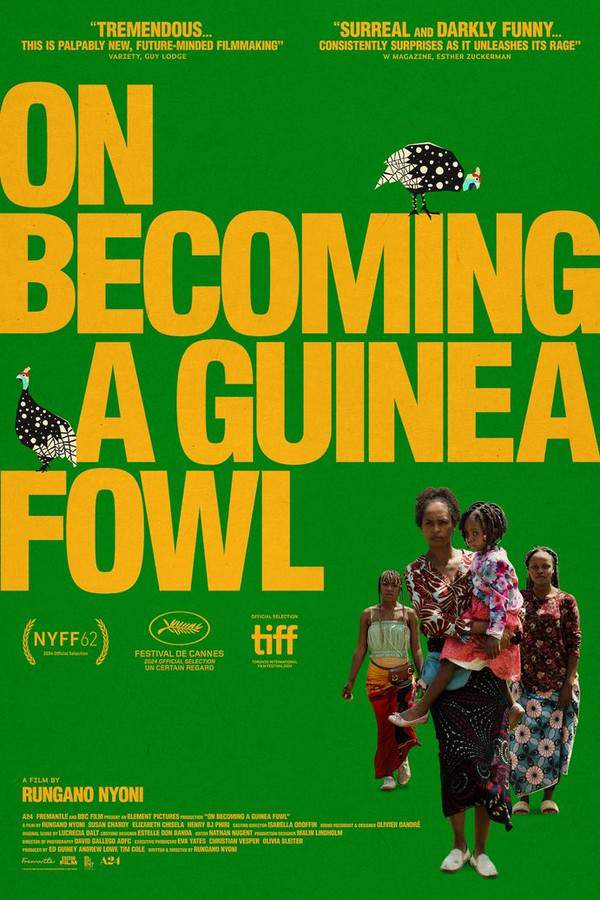
On Becoming a Guinea Fowl 2025


Directed by

Rungano Nyoni
Made by

A24
Where to Watch On Becoming a Guinea Fowl
See current US streaming, rental, and purchase options for On Becoming a Guinea Fowl (2025) via JustWatch.

Cinemax Amazon Channel
HD
Cinemax Apple TV channel
HD
HBO Max
HD
HBO Max Amazon Channel
HD
Amazon Video
4K
Fandango At Home
4K
Google Play Movies
SD
YouTube
SD Streaming availability powered by 
On Becoming a Guinea Fowl Plot Summary
Read the complete plot summary and ending explained for On Becoming a Guinea Fowl (2025). From turning points to emotional moments, uncover what really happened and why it matters.
On the drive home from a party, Shula discovers Uncle Fred dead in the road near a brothel, and has a brief vision of herself as a young girl. She calls Shula’s Father, who tells her to stay near the body until the police come in the morning, and also asks her for money. Her cousin Nsansa, who is drunk, also happens across the body, but Shula is reluctant to let her into her car.
The next day she goes home to rest, but her relatives come to empty out the house in preparation for the funeral. She is harangued by her aunties for washing on a funeral day and pressured to pick up Shula’s Mother from the airport.
As the funeral goes on, Shula becomes increasingly distressed by the hostility toward Fred’s widow. She is forbidden from bringing the widow food, as Fred’s family believes that he died because she did not take proper care of him. Shula and Nsansa go to Bupe, their cousin, who is staying at a college dorm. On the way, Nsansa recollects how Fred attempted to abuse her but couldn’t get an erection; she says she hit him and made him run away. They arrive at the dorm and find Bupe has taken an overdose.
Bupe is hospitalised, and Shula finds a confession on her phone saying that Fred had been serially abusing her. Bupe’s mother says to keep quiet about Fred’s behaviour. Shula struggles to sleep as she remembers an educational children’s TV show that talked about the guinea fowl.
The next day, Shula is sent to dictate an obituary, but she is haunted by Bupe’s confession. She returns home and is shocked to find that Bupe has discharged herself and is now making food for the family. Bupe shrugs off the confession, saying that Fred is dead and it’s in the past. Shula tries to find Bupe’s mother, but is waylaid by various men demanding her to serve them food. She finds Bupe has overdosed again and is taken to the hospital. Back at the house, Nsansa admits that her story was a lie — Fred did actually abuse her. Shula goes for a walk and talks to Fred’s widow. The widow says that she cannot charge her cellphone because it’s an old model with a rare cable, and she left it at Fred’s home.
The following morning, Shula goes to retrieve the cable, and meets Fred’s seven children, who are being looked after by their maternal grandmother. Shula realises from the children’s ages that Fred’s widow was only 11 or 12 when she first got pregnant. When the grandmother learns that Shula is on Fred’s side of the family, she falls to her knees and begs Shula to tell them not to take the house from Fred’s widow, as they have nowhere to raise the children.
Shula goes to her father, who is having a party. She asks him why nobody is speaking up about Fred, but he is unconcerned, and says since he is dead there is no point. He asks her for more money. As she walks away, a thought occurs to him — he calls her cellphone and asks if Fred abused her. She says he did not. She goes to her mother and asks why she told all of Shula’s aunties about the abuse, but not her dad. Her mother says that the aunties talked to Fred and he assured them he wouldn’t do it again. Her mother, seemingly unbothered by any of this, tells her to gather more food for the funeral dinner.
Shula is drinking in the kitchen cupboard with Nsansa when the aunties step in and assure her that they love her and they do not want harm to come to her. Outside, the widow and her family have been made to sleep in the empty swimming pool. Nsansa mentions Shula watching a children’s TV show about guinea fowl one day while holding a hot water bottle to her belly. Nsansa says that was the day Shula decided she hated Uncle Fred. She asks if Shula is all right, and Shula just nods. Shula and Nsansa go to Bupe’s hospital window, climb in and hug her to sleep.
Shula remembers watching the TV show about the guinea fowl. In it, the host explains that the guinea fowl is very important in protecting the other animals, because it makes a loud noise when predators are near.
At the house, the men of the family hold a court in which Fred’s relatives tell the widow that she failed him. The widow says she tried to stop him drinking after he was hospitalised, but he didn’t listen to her. The men decide that her family should pay a sum of money and give up the house and Fred’s possessions. The family members begin to fight over ownership of the items. Outside, Shula arrives with Fred’s children and begins to screech the sound of a guinea fowl.
On Becoming a Guinea Fowl Timeline
Follow the complete movie timeline of On Becoming a Guinea Fowl (2025) with every major event in chronological order. Great for understanding complex plots and story progression.
Fred found dead on the road near a brothel
Driving home from a party, Shula discovers Uncle Fred's body in the road beside a brothel. The moment triggers a brief vision of her childhood. She phones her father, who later instructs her to stay by the body until the police arrive in the morning.
Father tells Shula to stay by the body and asks for money
In the morning, Shula's father tells her to remain by Fred's body until the police come. He also asks her for money, revealing a cold practicality amidst the tragedy. She must hold the scene alone until help arrives.
Nsansa arrives drunk and Shula blocks her from the car
Nsansa unexpectedly arrives at the scene, drunk from the party. Shula is reluctant to let her cousin into her car, fearing trouble or danger. The tension between them underscores the fragility of family bonds in crisis.
Relatives descend on Shula's home to empty it ahead of the funeral
The following day, relatives come to strip Shula's home of possessions in preparation for the family gathering for Fred's funeral. The atmosphere is tense as they move through her space. Shula is overwhelmed by the sudden turnover and the expectations placed on her.
Aunties pressure Shula to wash on a funeral day and fetch the widow
Aunties harangue Shula for washing on a funeral day and pressure her to pick Fred's widow up from the airport. The ritualized duties fall heavily on Shula as the family tries to control the mourning process. The pressure highlights the hostility toward the widow.
Funeral day intensifies hostility toward the widow
During the funeral, Shula becomes increasingly distressed by the animosity directed at Fred's widow. She struggles with the idea that the family blames her for his death. The confinement of the ceremony amplifies the tension around her.
Shula and Nsansa visit Bupe; Bupe overdoses and is hospitalised
Shula and Nsansa go to Bupe, who is staying at a college dorm, on the way Nsansa recalls Fred's attempted abuse. They discover Bupe has taken an overdose and she is hospitalised. The crisis adds to the family's burden during the mourning period.
Bupe's confession about Fred's abuse; mother urges silence
Bupe has a confession about Fred's serial abuse, revealed on her phone. Bupe's mother urges the family to keep quiet about the abuse to protect the family from scandal. The revelation fractures trust within the extended family.
Shula's insomnia and the guinea fowl memory
Shula struggles to sleep and is haunted by the memory of an educational TV show about the guinea fowl. The show becomes a motif for protection and warning in the midst of the turmoil. The memory blurs with her ongoing grief.
Shula dictates obituary; Bupe discharges herself and overdoses again
Shula is tasked with dictating Fred's obituary while haunted by Bupe's confession. Bupe discharges herself from the hospital and begins cooking for the family, but soon suffers another overdose and is readmitted. The family's fragility surfaces under the stress of the funeral.
Nsansa admits Fred abused her
Back at home, Nsansa finally admits that Fred did abuse her. The admission shatters Shula's previous belief and changes how the family perceives Fred's legacy. The truth unsettles the already fragile family dynamics.
Shula confronts the widow about the missing cellphone cable
Shula talks to Fred's widow, who explains she cannot charge her cellphone because she uses an old model with a rare cable. She says she left the cable at Fred's home. This small detail becomes a symbolic thread linking the living and the dead.
Morning discovery: the children, the cable, and the grandmother's plea
The following morning, Shula retrieves the cable and meets Fred's seven children, who are under the care of their maternal grandmother. From the children's ages, she realises that the widow was only 11 or 12 when she got pregnant, which deepens the sense of injustice. The grandmother begs Shula to prevent the family from taking the house from the widow.
On Becoming a Guinea Fowl Characters
Explore all characters from On Becoming a Guinea Fowl (2025). Get detailed profiles with their roles, arcs, and key relationships explained.
Shula — Susan Chardy
Shula is the central protagonist, grappling with trauma from Uncle Fred's alleged abuse and the expectations of a judgmental family. She is emotionally guarded, trying to protect herself and others while navigating conflicting loyalties. Her steadfast sense of duty clashes with her desire for truth and justice.
Uncle Fred — Roy Chisha
Uncle Fred is depicted as controlling and abusive, whose actions unravel the family's cohesion. The film presents him through rumors and the multi-layered memories of relatives, illustrating the long shadow of his behavior. His presence is felt even after death as the family reclaims or confronts his impact.
Nsansa — Elizabeth Chisela
Nsansa is Shula's cousin who oscillates between fear, humor, and distress. Her reactions reveal how trauma is distributed across generations, and how truth contests family loyalty. She embodies the tension between telling the truth and protecting kin.
Shula's Father — Henry B.J. Phiri
Shula's father is pragmatic and self-interested, prioritizing money and social standing over addressing the harm in the family. He embodies a patriarchal attitude that silences uncomfortable truths. His actions reflect the commodification of family reputation.
Shula's Mother — Doris Naulapwa
Shula's mother reveals family secrets selectively and negotiates with relatives. Her actions reflect the pressures of maintaining appearances and protecting loved ones. She embodies the morally gray space where care and complicity collide.
Bupe
Bupe is a troubled cousin whose overdose and later confession become pivot points in the family’s reckoning with Fred's abuse. Her presence amplifies the consequences of trauma and the fragility of coping mechanisms.
Joseph — Benson Mumba
Joseph provides a practical voice in the family dynamics; his role surfaces during the funeral period as money and possessions are contested. He anchors the economic dimension of the family’s crisis.
Aunty Ruth — Gillian Sakala
Aunty Ruth represents the bustling, judgmental cluster of relatives whose comments and expectations shape Shula’s experience during the funeral and discussions of the estate.
Aunty Catherine — Carol Natasha Mwale
Aunty Catherine personifies the intertwined care and pressure of a matriarchal elder, balancing support with admonition as the family navigates the aftermath of abuse revelations.
Aunty Linda — Loveness Nakwiza
Aunty Linda contributes to the web of relatives who weigh in on the funeral arrangements and the rightful ownership of Fred's estate, highlighting the politics of inheritance.
Aunty Bukata — Bwalya Chipampata
Aunty Bukata is part of the chorus of relatives who enforce social norms and boundaries around the family’s handling of the trauma and the inheritance.
Musonda — Esther Yobe
Musonda represents a maternal line within the family, whose presence at the funeral ties together generations and the ongoing thread of memory and judgment.
Gossiping Woman 1 — Faustina Tembo
Gossiping Woman 1 embodies communal chatter that surrounds private pain, contributing to the atmosphere of judgment and rumor that accompanies the proceedings.
Gossiping Woman 2 — Justina Mudenda
Gossiping Woman 2 adds another perspective to the murmur of family talk, highlighting how shared stories can both connect and harm individuals in fragile moments.
On Becoming a Guinea Fowl Settings
Learn where and when On Becoming a Guinea Fowl (2025) takes place. Explore the film’s settings, era, and how they shape the narrative.
Time period
Set in a contemporary era, the narrative includes modern devices like mobile phones and a dated cable, anchoring events in present-day life. The sequence of hospital visits, dorm life, and funeral ceremonies places the drama squarely in the current social milieu.
Location
Roadside near a brothel, family home, hospital, college dorm, funeral venue
The story moves across several settings: a roadside scene where the body is found, the family home filled with tension, the hospital where Bupe is treated, and a college dorm where Burpe’s confession emerges. The funeral and surrounding domestic spaces become stages for conflict, memory, and confrontation. These locations illustrate the tension between public ritual and private trauma in a tightly-knit family.
On Becoming a Guinea Fowl Themes
Discover the main themes in On Becoming a Guinea Fowl (2025). Analyze the deeper meanings, emotional layers, and social commentary behind the film.
🕊️
Family secrets
Family secrets drive the plot, exposing abuse, guilt, and the pressure to protect appearances. Shula's journey threads through memory, shame, and the search for truth within a tight-knit clan. Relative silence weaponizes tradition, complicating justice and healing. The guinea fowl motif nods to the danger and protection that emerge when truth is finally raised.
🗣️
Truth vs Silence
Truth versus silence is tested as Shula confronts relatives who urge discretion over disclosure. The film shows how social expectations and fear of discord suppress accountability. Speaking out disrupts power dynamics but can also endanger vulnerable people. The act of naming abuse becomes a fragile act of resistance.
💭
Memory and Trauma
Trauma surfaces through fragmented memories and flashbacks, shaping Shula's decisions. The story frames memory as both a burden and a guide for navigating present dangers. The community's memory of past wrongs informs how forgiveness or punishment unfolds.

Coming soon on iOS and Android
The Plot Explained Mobile App
From blockbusters to hidden gems — dive into movie stories anytime, anywhere. Save your favorites, discover plots faster, and never miss a twist again.
Sign up to be the first to know when we launch. Your email stays private — always.
Explore the mobile appOn Becoming a Guinea Fowl Ending Explained
Unravel the ending of On Becoming a Guinea Fowl (2025) with our detailed explanation. Understand the final scenes, character fates, and unresolved questions.
The film concludes on a somber and unresolved note, emphasizing the ongoing cycle of silence and denial surrounding sexual violence within the family and society. After the revelation of Uncle Fred’s heinous acts, the family members seem more focused on protecting their own interests, such as inheritance, rather than seeking justice or confronting the trauma. The involuntary widow, now free from her marriage, faces the difficult reality of figuring out how to support her children while society turns a blind eye to her suffering. The film does not offer a neat resolution; instead, it leaves viewers with a reflective space to consider how such issues persist in many communities. The silence, much like the loud, constant calls of the guinea fowl, underscores how many people are aware of abuse but choose to remain silent to avoid conflict or shame. The ending challenges viewers to think about their own role in breaking the cycle of denial and advocating for change, highlighting that justice remains elusive for many victims of sexual violence. Ultimately, the story closes with a haunting reminder that the problems of secrecy, complicity, and suppressed trauma are deeply ingrained, and that real progress requires ongoing awareness and action.
On Becoming a Guinea Fowl Spoiler-Free Summary
Discover the spoiler-free summary of On Becoming a Guinea Fowl (2025). Get a concise overview without any spoilers.
In the quiet hours of a barren Zambian road, Shula stumbles upon a startling scene that pulls her back into a world she thought she had left behind. The night’s chill and the solitary stretch of highway set a tone of uneasy stillness, hinting at the hidden currents that run through the family’s past. That moment of discovery becomes the catalyst for a convergence of relatives whose lives have drifted apart, each carrying their own unspoken burdens.
When the news of Uncle Fred’s passing spreads, the family gathers in a modest home that quickly becomes a pressure cooker of tradition, grief, and whispered expectations. The ritual of the funeral—washing, food preparation, and the relentless chatter of older women—creates a vivid tapestry of Zambian customs, while an undercurrent of tension suggests that not all stories will remain buried. The house, filled with familiar smells and the hum of distant traffic, feels both a sanctuary and a stage for long‑held secrets to surface.
Among the relatives, Nsansa arrives with a blend of bravado and vulnerability, while Bupe is caught in the middle of academic life and family duty. Shula’s Father and Shula’s Mother embody the pragmatic yet weary pillars of the family, each navigating their own responsibilities and unspoken loyalties. As Shula moves between kitchen counters, sleeping rooms, and the open road, she is forced to confront the weight of expectations placed upon her as the youngest voice in a lineage that rarely pauses to listen.
Throughout the gathering, a modest children’s television programme about the guinea fowl echoes in the background, its lesson about the bird’s vigilant cry serving as a subtle metaphor for the family’s need to hear what has been silenced. The film’s tone balances gritty realism with moments of quiet introspection, inviting viewers to feel the pull of duty, memory, and the uneasy promise that some truths, like the sharp call of a guinea fowl, cannot remain hidden forever.
Movies with Similar Twists and Themes
Uncover films that echo the narrative beats, emotional arcs, or dramatic twists of the one you're exploring. These recommendations are handpicked based on story depth, thematic resonance, and spoiler-worthy moments — perfect for fans who crave more of the same intrigue.



Featured on this page

What's After the Movie?
Not sure whether to stay after the credits? Find out!
Check out our other apps:

SAT Sphere
Build confidence for the Digital SAT.

Mori Atlas
Discover wild places worth protecting.

Luntero
Search smarter for a home in Amsterdam.

Plot Explained
Unravel movie endings and hidden clues.

Pokechamp
Dive into Pokémon data and battle logic.

Driving Theory
Get ready for your European theory test.

Movie Dust
Plan your next cinema trip with ease.

Musemap
Find art and culture as you travel.

Selkobase
Compare credentials before committing.

Local Manual
Turn an unfamiliar country into practical next steps.

Lernavi
Compare school systems before your next move.

GymRoam
Find a workout stop wherever your plans take you.
Explore Our Movie Platform
New Movie Releases (2026)
Famous Movie Actors
Top Film Production Studios
Movie Plot Summaries & Endings
Major Movie Awards & Winners
Best Concert Films & Music Documentaries
Movie Collections and Curated Lists
© 2026 What's After the Movie. All rights reserved.
Privacy Policy