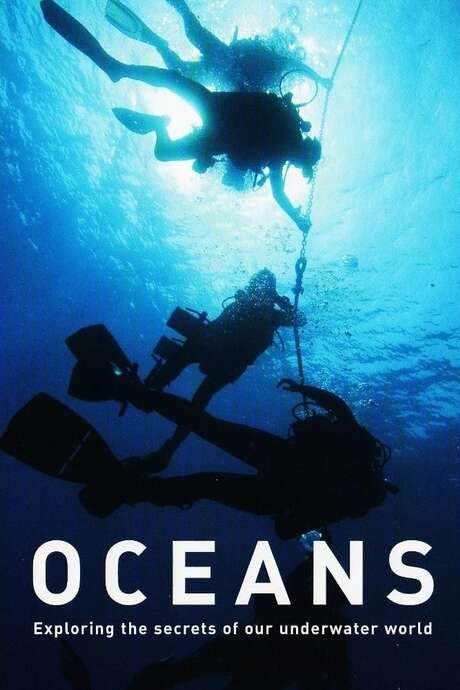
Oceans 2008


Directed by

Matthew Gyves
Made by

Where to Watch Oceans
See current US streaming, rental, and purchase options for Oceans (2008) via JustWatch.







Oceans Plot Summary
Read the complete plot summary and ending explained for Oceans (2008). From turning points to emotional moments, uncover what really happened and why it matters.
Oceans invites you into a sweeping, up-close exploration of the sea’s vast journey, guided by Mark Halliley the narrator, who patiently threads together the rhythms of life both above and below the surface. The film opens on a sunlit beach where children dash toward the waves, and one curious boy pauses to wonder what the ocean truly is. From there, the voyage unfolds across blue horizons and hidden depths, inviting viewers to observe how ecosystems connect across continents and scales.
The voyage first lands in the Galápagos, where a small clan of marine iguanas and wandering horseshoe crabs exist in a delicate balance with the tides and thermals. Night brings a dramatic interruption as an Ariane rocket launches into the sky, a startling beacon that momentarily disrupts two distant clans and then climbs outward toward the cosmos, reminding us of humanity’s reach far beyond the shoreline. The journey then dives beneath the surface to a trench where the tiny larvae of sea urchins and delicate crustacean eggs drift in the cold currents, illustrating the steady, secret birth of oceans’ creatures.
A swarm of moon jellyfish glides through the water, its bodies pulsing with the sea’s timeless tempo. By day, another colony of jellyfish drifts along the current, reminding us of the ocean’s ceaseless choreography and the many forms that life can take within it. Moving to the coast of South Africa, a busy scene unfolds: dolphins, gannets, bronze whalers, and bryde’s whales converge to hunt sardines, while manta rays sweep in to snatch a few fish from the fray. A quiet blanket octopus glides along the current, and the sardines themselves begin to twist and coil in unusual patterns, a sign of a living, breathing ocean in constant motion.
On a sun-warmed beach, sea lions bask before the sea leans back into deeper waters, where a humpback whale and her calf perform flipper slaps, spyhops, and breaches that punctuate the rhythm of life. The hunters’ chorus intensifies as some sea lions return home, only to face predation from a great white shark and a killer whale lurking in nearby currents. In deeper seas, a blue whale fattens itself on krill, a reminder of the immense chains of feeding that sustain even the largest creatures. As twilight settles, birds rotate between nests and the surface, while at night carnivores emerge to hunt along reef edges, including a mantis shrimp that demonstrates a remarkable display of predation.
Crossing to Australia, a Spanish dancer—an eye-catching sea creature—emerges from its hidden home, adding color and drama to the underwater panorama. By day, bottlenose dolphins leap along the swells, and a dugong along with a green sea turtle graze on seagrass, highlighting the quiet, steady abundance of coastal ecosystems. On the beach, baby sea turtles begin their perilous journey to the ocean, a harrowing climb that pits them against frigatebirds circling above; only one young turtle survives this perilous passage. In the open sea, sailfish chase prey with lightning speed, adding to the display of marine hustle that characterizes life on and around the reef.
Back at a thriving coral reef, the daily rhythms persist as creatures mind their own business in a busy social order. A cuttlefish stalks crabs with precision, garden eels and razorfish glide through their sandy lanes, and spider crabs engage in a dramatic, slow-motion skirmish. Large migrations fill the oceans as humpback whales, blue whales, sunfish, blue sharks, sperm whales, and whale sharks travel across wide distances, while spinner dolphins, yellowfin tuna, and manta rays share the open waters for long stretches of time. A pair of Asian sheepshead wrasse engage in mating, and a sea otter smashes on clams with practiced ease, demonstrating the varied tools life uses to feed and thrive. In Alaska, humpback whales arrive at their rich feeding grounds, and the documentary cuts to netted fleets and the perilous global reach of fishing as countless species appear in nets—tuna, whale sharks, sailfish, sea turtles, and sunfish among them.
A satellite image reveals ocean trash drifting across the seas, a stark reminder of human impact on marine life. Underwater, mounds of debris threaten fur seals’ habitats, illustrating another pressing challenge facing the world’s oceans. The journey then shifts toward the polar realms of the Arctic and Antarctica, where divers approach the peril and wonder of the cold seas and one diver even swims with a great white shark, a moment that captures the raw, unpredictable beauty of life in the far north. As the film closes, the narrator invites a provocative reflection: we shouldn’t ask what exactly is the ocean, we should ask what exactly are we.
“we shouldn’t ask what exactly is the ocean, we should ask what exactly are we”
The documentary is presented with a panel of voices and specialists, among them Philippe Cousteau Jr., Paul Rose, Lucy Blue, and Tooni Mahto, whose perspectives guide the viewer through the marvels and the fragilities of Earth’s seas, linking distant scenes with a shared thread of curiosity, wonder, and responsibility. The film’s rhythm—alternating between intimate wildlife moments and broad, planetary-scale overviews—creates a cohesive, immersive portrait of life in the oceans, inviting both awe and reflection without losing sight of the real-world stakes at stake.
Oceans Timeline
Follow the complete movie timeline of Oceans (2008) with every major event in chronological order. Great for understanding complex plots and story progression.
Beach awakening
The film opens on a sunlit beach where children run toward the sea and a curious boy wonders what the ocean really is. This moment hints at the vast world just beyond the shore and sets the stage for the film's interconnected life. The tone blends wonder with a call to explore.
Galapagos shore life
A glimpse of the Galapagos reveals a clan of marine iguanas and horseshoe crabs navigating the shoreline. The scene introduces the keen variety of life that thrives at this edge of land and sea. It foreshadows the broader global habitats shown later.
Night rocket surprise
At night, an Ariane rocket launches and startles both coastal clans. Its ascent arcs into space, linking the ocean to a wider universe. The moment broadens the film’s sense of scale.
Deep trench life begins
The narrative moves to a deep trench where larvae of sea urchins and eggs of crustaceans lie in wait. These early life stages remind viewers that survival begins long before the visible adult forms. The camera emphasizes the quiet importance of the deep sea.
Moon jellyfish swarm
A moon jellyfish swarm drifts through the water, moving with the currents in a striking display of delicate, translucent bodies. The scene highlights a floating tier of ocean life that many viewers rarely notice. Their presence signals the constant cycles of life in the sea.
Daytime jellyfish drift
During the day another type of jellyfish floats along the current, adding color and motion to the surface world. The juxtaposition with other creatures emphasizes the ocean's rich diversity. The jellyfish move in a serene yet essential part of the ecosystem.
South Africa coastal feast
Along the coast of South Africa a hungry mix of dolphins, gannets, bronze whaler sharks, and brydes whales hunt sardines. The coordinated chase demonstrates the complexity of marine predation in a single landscape. The sardine shoal becomes a focal point of the ecosystem.
Manta rays join the hunt
After the initial pursuit, manta rays move in to snatch some sardines, showing how larger gentle swimmers participate in the same feeding event. The addition of manta rays broadens the visual narrative of the ocean's food web. The moment blends spectacle with ecological function.
Blanket octopus glides
A blanket octopus swims quietly along the current, offering a contrast to the bustle of the feeding frenzy nearby. Its solitary glide highlights the ocean's quieter corners. The scene reinforces the diversity of life strategies in the sea.
Sardines and shore predators
Sardines form odd shapes as sea lions rest on the beach and predators emerge from the shallows. Some sea lions fall to a great white shark and a killer whale, illustrating the harsh balance of plenty and peril. The sequence ties abundance to risk across coastal waters.
Blue whale feast
In deeper waters a blue whale feeds on krill, its massive mouth shaping a slow, ocean wide feast. The scene underscores the scale of life in the open sea and connects micro and macro levels of the ecosystem. It sits alongside the surface level action to paint a complete panorama.
Polar exploration and closing thought
The film shifts to the Arctic and Antarctica where divers discover the ocean and one even swims with a great white shark. The polar sequences juxtapose extremes with earlier tropical imagery, highlighting the ocean's global reach. The narrator closes with the line that we should ask what we are, not what the ocean is.
Oceans Characters
Explore all characters from Oceans (2008). Get detailed profiles with their roles, arcs, and key relationships explained.
Mark Halliley
Mark Halliley serves as the documentary’s narrator, guiding viewers through diverse oceanic landscapes with a steady, informative voice. He anchors the film's journey from the Galápagos to the polar regions and connects disparate sequences with clear explanations. His narration provides context and reinforces the film’s message about our relationship with the sea.
Philippe Cousteau Jr.
Philippe Cousteau Jr. appears as a presenter offering insights into marine ecosystems and conservation. He helps frame the scenes with broader ecological context and emphasizes the importance of protecting ocean life. His presence lends authority to the film’s global conservation message.
Paul Rose
Paul Rose contributes as a presenter, sharing knowledge about marine habitats and the creatures within them. He explains complex ecological interactions and highlights the interconnectedness of ocean life across different environments. His segments help translate scientific detail into accessible storytelling.
Lucy Blue
Lucy Blue guides viewers through scenes that contrast abundance with fragility, bringing a relatable perspective to scientific content. She helps translate data-heavy moments into engaging narratives and encourages empathy for marine ecosystems. Her role supports the film’s aims of awareness and conservation.
Tooni Mahto
Tooni Mahto acts as a presenter, connecting audiences with ocean topics through approachable explanations and outreach-oriented messages. Her portions emphasize practical conservation opportunities and how everyday actions can impact marine environments. She helps make the film’s scientific insights accessible to a broad audience.
Oceans Settings
Learn where and when Oceans (2008) takes place. Explore the film’s settings, era, and how they shape the narrative.
Location
Galápagos Islands, coast of South Africa, Australia, Alaska, Arctic, Antarctica, Coral reefs
The film spans multiple iconic marine regions: the Galápagos Islands with unique wildlife, and the busy coasts of South Africa. It then moves to Australia’s shores where hatchlings face predators, and further into Alaska, the Arctic, and Antarctica to show feeding grounds and polar life. Coral reefs and open seas are depicted as the vast stages where marine life—from whales to jellyfish—interacts daily. The journey also highlights the fragility of coastlines and reefs in the face of human activity and debris.
Oceans Themes
Discover the main themes in Oceans (2008). Analyze the deeper meanings, emotional layers, and social commentary behind the film.
🌊
Interconnectedness
Oceans demonstrates how life across vast distances is connected through migration, nutrient cycles, and shared habitats. The film ties together creatures from reef communities to open-ocean predators, illustrating a global web of relationships. By crossing from corals to whales to seabirds, it shows that the fate of one region affects others.
♻️
Human Impact
The documentary reveals the presence of ocean trash and its harm to wildlife, such as fur seals and other inhabitants of the sea. It juxtaposes natural beauty with the threats of fishing gear, nets, and pollution that disrupt ecosystems. The message moves toward responsibility and mindful stewardship of oceans.
🐋
Biodiversity
From dolphins and whales to jellyfish and sea turtles, Oceans paints a broad portrait of marine life and its dynamic interactions. Predator-prey encounters, feeding frenzies, and migrations illustrate the richness and complexity of ocean ecosystems. The film also highlights survival challenges faced by vulnerable species, like hatchling turtles.
🗺️
Planetary Responsibility
The closing frame reframes the question from what the ocean is to what we are, inviting viewers to reflect on human identity and our role in protecting the seas. It encourages global awareness and practical actions to preserve marine environments for future generations.

Coming soon on iOS and Android
The Plot Explained Mobile App
From blockbusters to hidden gems — dive into movie stories anytime, anywhere. Save your favorites, discover plots faster, and never miss a twist again.
Sign up to be the first to know when we launch. Your email stays private — always.
Explore the mobile appOceans Spoiler-Free Summary
Discover the spoiler-free summary of Oceans (2008). Get a concise overview without any spoilers.
The series follows a team of four marine experts as they embark on a sweeping investigation of Earth’s greatest wilderness—the oceans. Guided by the measured voice of Mark Halliley, the documentary weaves together the perspectives of archaeology, geology, marine biology and anthropology to reveal how sea‑life, climate and human history are intertwined. From sun‑warmed coastlines to the darkest oceanic trenches, the journey paints a portrait of a planet‑wide ecosystem that is at once fragile and astonishingly resilient.
The tone is simultaneously scientific and poetic, inviting viewers to linger on the quiet choreography of waves, the hidden dramas of coral reefs, and the vast migrations that span continents. The experts, supported by a panel that includes Philippe Cousteau Jr., Paul Rose, Lucy Blue and Tooni Mahto, share their curiosity and concern, turning each vignette into a meditation on the past, present and future of the seas. Their observations blend rigorous data with moments of pure wonder, offering a sense of awe that is balanced by an urgent call to stewardship.
Through sweeping aerial shots, intimate underwater glimpses and reflective narration, the series creates a living map of the ocean’s rhythms. It highlights the delicate connections between distant habitats, the subtle cues that drive marine life, and the growing imprint of humanity on this blue world. By the close of the opening arc, the audience is left with a resonant question: rather than asking what the ocean is, we are encouraged to ask what we are in relation to it.
Featured on this page

What's After the Movie?
Not sure whether to stay after the credits? Find out!
Check out our other apps:

SAT Sphere
Build confidence for the Digital SAT.

Mori Atlas
Discover wild places worth protecting.

Luntero
Search smarter for a home in Amsterdam.

Plot Explained
Unravel movie endings and hidden clues.

Pokechamp
Dive into Pokémon data and battle logic.

Driving Theory
Get ready for your European theory test.

Movie Dust
Plan your next cinema trip with ease.

Musemap
Find art and culture as you travel.

Selkobase
Compare credentials before committing.

Local Manual
Turn an unfamiliar country into practical next steps.

Lernavi
Compare school systems before your next move.

GymRoam
Find a workout stop wherever your plans take you.
Explore Our Movie Platform
New Movie Releases (2026)
Famous Movie Actors
Top Film Production Studios
Movie Plot Summaries & Endings
Major Movie Awards & Winners
Best Concert Films & Music Documentaries
Movie Collections and Curated Lists
© 2026 What's After the Movie. All rights reserved.
Privacy Policy