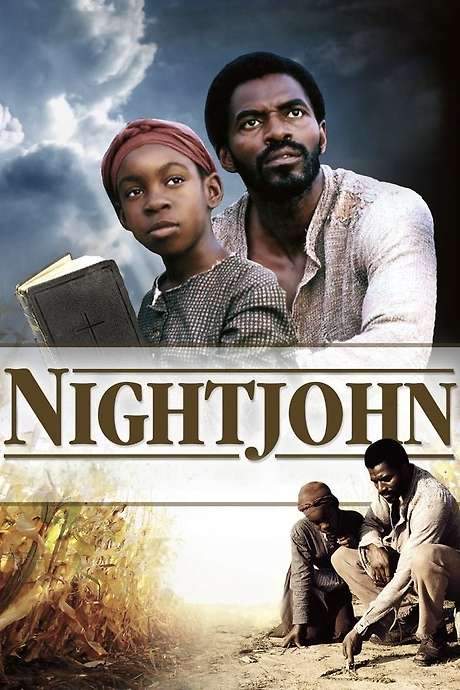
Nightjohn 1996

Directed by

Charles Burnett
Made by

Hallmark Entertainment
Nightjohn Plot Summary
Read the complete plot summary and ending explained for Nightjohn (1996). From turning points to emotional moments, uncover what really happened and why it matters.
In a powerful drama set on a Southern plantation, Sarny is born in a slave cabin under the stern eye of her master, Clel Waller. He mutters that a boy would be worth more, but a promise keeps Sarny from immediate sale, while her mother is sold a few years later. Sarny is cared for by a devoted slave named Delie, who keeps a quiet watch over the girl as she grows.
As Sarny moves toward pre-teen years, she is sent to the Big House to help with Homer, the master’s young son who isn’t yet toilet-trained. Back at the cabins, Outlaw strives to win the permission of Mr. Waller so he can marry Egypt, a slave on another plantation. Delie finds herself sewing a dress for Sarny so she can begin working inside the master’s home, a move that deepens the girl’s exposure to the household’s complicated rules and temptations.
After a Sunday church service attended by both slaves and masters, the Wallers host a midday gathering that includes a doctor who will later form a romance with Callie, Clel’s wife. At the luncheon, Callie questions why money seems to drive much of their world—why a baby’s birth could shift wealth from one plantation to another. Clel’s sharp reply makes it clear that love isn’t the only factor in their decisions, and Callie wonders why things can’t be about love alone. The tension spills over when Sarny, in a moment of accident, drops a plate of food and is punished; Clel forces Callie to slap her. That night, Delie warns Sarny to mind her steps, or she’ll face hard labor in the fields. Sarny leaves the encounter vowing that she will find a way to resist.
The next day, Callie asks Sarny to carry a letter to the doctor’s place, and on the way she observes the slave trader Tom moving chains of people toward the Waller household. At the doctor’s home, the doctor asks Sarny to deliver a secret love letter to Callie, paying her a penny for the trouble. Back at the plantation, Tom tries to sell a slave to Clel for five hundred dollars, but Clel insists on a different bargain—he would buy John, a slave with a brutal scarred back, for fifty dollars rather than pay more and leave him unclothed. That night, John and Sarny strike a deal to trade tobacco for lessons in reading, and Sarny learns the letter “A” as she reads between the lines in the doctor’s correspondence with Callie.
The following morning, Outlaw is punished for slipping out to see Egypt. When Clel is about to whip him, Jeffrey, Clel’s son, pleads for mercy, but Clel reminds him that slaves are not friends and that the family’s wealth must be protected. Sarny narrates that Clel’s vigilance is focused on appearances, not the true danger in his world: the mistress, his wife. During a party that evening, Delie discovers John teaching Sarny the alphabet and grows furious, asking about the scars on John’s back. He explains they came from two escape attempts, the third succeeding only in his forced return to teach reading. Delie forbids further instruction for Sarny, citing safety, but John warns that Delie is teaching something worse—fear.
With a growing sense of agency, Sarny devises a plan: Callie will visit the Doctor in secret, and Sarny will care for Homer while she steals his alphabet blocks. John proclaims that words are freedom—the white folks keep them to themselves, and if the slaves had the right words, they might be free. He even writes Sarny’s name in the dirt to show that letters carry power. The two of them share quiet moments of learning, and Delie softens enough to begin studying with Sarny, while still aware of the dangers.
As a season of hard work unfolds, Clel gathers the family to harvest cotton, promising a feast if they succeed. Sarny reads the Bible and is baptized, and she discovers that she had secretly taken a Bible that Jeffrey was supposed to guard. The revelation shakes the plantation’s fragile lies, but many slaves resist the shift toward literacy. Sarny also reads a Gazette article about a slave rebellion, Nat Turner’s uprising, which further stirs the slave population to dream about collective resistance. She even sneaks back to Clel’s record book to learn more, and the feast becomes a cover for Outlaw and Egypt’s marriage.
Egypt is found to be pregnant, and Outlaw and Egypt must flee. John forges Clel’s signature to help them escape, and Jeffrey discovers the stolen Bible, with Delie taking the blame at first. Clel suspects who was involved, and when John confesses, Clel cuts off John’s fingers as punishment. Before they can finish him, John writes his name in the dirt and tells Sarny that she must forge a second note to carry their message. He whispers a grim lesson: “when you lose one hand, the other gets stronger,” urging Sarny to continue teaching others to read. Sarny forges the second note and instructs Outlaw and Egypt to name their baby John if it is a boy.
The next morning, the doctor tries to smooth over the crisis by claiming he taught Egypt to read basic things. Clel discovers two notes bearing his signature in two different hands, a sign that another slave can write and has weaponized that knowledge. Sarny insists that Clel would not shoot his own wealth, and she explains that literacy is the true threat—and the key to freedom. In the end, Sarny is sold, and she narrates that the story centers on her and Nightjohn, with a hint of John living in every enslaved person.
when you lose one hand, the other gets stronger
Thus the tale remains a careful balance of cruelty and resilience, a living memory of those who fought to read, to dream, and to survive. Nightjohn, the man who helped her learn to read, remains a quiet, guiding presence in the background, embodying the idea that literacy can persist even under the harshest conditions.
Nightjohn Timeline
Follow the complete movie timeline of Nightjohn (1996) with every major event in chronological order. Great for understanding complex plots and story progression.
Sarny is born in a slave cabin
Sarny arrives into the world on the Waller plantation, where a master's harsh priorities shape her early life. Her mother is sold a few years later, leaving Sarny in the care of Delie and the slave community. Her childhood is defined by fragile family bonds and the constant threat of separation.
Sarny grows and starts working in the Big House
As she reaches pre-teen years, Sarny is taken to the Big House to care for Homer, Clel Waller’s son who isn’t potty-trained yet. Delie remains the steady caregiver in the slave cabins, maintaining a fragile ties between worlds. The arrangement sets up the power dynamic that will define Sarny’s daily life.
Sunday service and luncheon reveal tensions
A Sunday church service brings slaves and masters together, followed by a family lunch with guests including a doctor. Conversation circles around Outlaw’s plan to court Egypt, with Clel insisting that wealth and leverage matter more than love. The scene exposes how marriage and family are negotiated for profit on the plantation.
Sarny’s punishment after the luncheon
When Sarny accidentally drops a plate, Clel forces Callie to slap her, illustrating the brutality of slave discipline. Delie warns Sarny to behave, threatening hard labor in the fields if she missteps again. Sarny vows revenge as she endures the public humiliation.
Sarny delivers a letter and encounters Tom
Callie asks Sarny to carry a letter to the doctor, and on the way she sees slave trader Tom herding enslaved people toward the Waller property. At the doctor's house, the doctor asks Sarny to deliver a love letter to Callie and rewards her with a penny for the trouble. Back at the plantation, Tom contemplates selling a slave for a pittance, highlighting the commodification of people.
Clel buys John for a bargain and Sarny learns to read
Clel buys John off of Tom for fifty dollars, bypassing the more valuable slave Tom showed him earlier. John and Sarny strike a secret bargain: she will learn to read in exchange for tobacco. John teaches her the alphabet, starting with A, planting the seed of literacy as a path to freedom.
Outlaw is whipped; Jeffrey pleads; Clel’s lesson about ownership
Outlaw is whipped after sneaking out to see Egypt, despite Jeffrey’s attempt to intervene. Clel tells Jeffrey that slaves exist to pick his cotton, not to be his friends, underscoring the raw calculus of power on the plantation. The moment deepens Sarny’s understanding of who wields control and why.
Delie discovers John teaching Sarny the alphabet
During a party, Delie discovers John teaching Sarny to read and is outraged. John explains that his scars come from past escapes, including a failed attempt and a successful one to the North before returning to teach others. Delie forbids further lessons, warning that knowledge is dangerous and could put them all at risk.
Sarny devises a plan for Callie to visit the Doctor
Sarny devises a plan for Callie to visit the Doctor secretly, even swiping the Doctor’s alphabet blocks to help with learning. Old Man, a slave who once lost a finger for reading, warns of the consequences of defying the masters. John proclaims that words are freedom and that literacy could empower the enslaved.
Sarny deepens literacy and baptism
John continues to teach numbers as Sarny reads the Bible and is baptized, marking a moment of spiritual and intellectual awakening. The act stirs tension among slaves who fear punishment for embracing literacy. The community’s debate over reading grows louder on the plantation.
Sarny steals a Bible and discovers God’s justice
Sarny admits stealing a Bible that Jeffrey was supposed to care for, triggering trouble with his father. She learns that God may be on the side of the enslaved, while many masters resist such revelations. The newly discovered readings also draw the attention of others who read a Nat Turner piece in the Gazette.
The reading revolution unfolds amid a harvest feast
Sarny reads Clel’s record book during a party, while a plentiful harvest justifies a plantation feast. The moment shows literacy beginning to empower the enslaved, even as the walls of oppression remain intact. In the shadows, Outlaw and Egypt manage to finalize their marriage at the celebration.
Egypt is pregnant and must flee; John’s defiance escalates
Egypt’s pregnancy forces her to run away, and John forges Clel’s signature to help Outlaw escape with his wife. Jeffrey discovers the stolen Bible, and Delie takes the blame, risking punishment to protect her. Clel confronts John, ultimately chopping off John’s fingers as punishment before turning his focus back to the forged notes and control.
Two notes reveal literacy exists; Sarny is sold
Sarny objects to the reveal that Clel has found two notes in his handwriting, proving that another slave can write and threatens the plantation’s secrecy. The Doctor tries to cover for the slaves, but the truth persists: Sarny’s knowledge makes her valuable and dangerous. Facing pressure, Clel ultimately sells Sarny, ending her immediate bondage but preserving Nightjohn's influence in the slaves' memory and in her narration.
Ending: the legacy of literacy
In the final narration, Sarny explains that the story is about her and Nightjohn, and that a part of John lives in every slave. The act of teaching and reading remains a quiet rebellion against oppression. The movie closes with the hope that literacy and solidarity endure beyond the plantation walls.
Nightjohn Characters
Explore all characters from Nightjohn (1996). Get detailed profiles with their roles, arcs, and key relationships explained.
Nightjohn (Carl Lumbly)
A literate enslaved man who survived and learned to read despite brutal punishment. He uses teaching as a dangerous act of resistance, passing the alphabet and basic literacy to Sarny. His scars reveal the price of disobedience, and his relationship with Sarny frames the story’s central argument: words can free the mind.
Sarny (Allison Jones)
A young enslaved girl who becomes a determined learner and the narrator of the tale. She moves from the cabins toward the master's house, driven by a hunger to read and understand the world beyond her limits. Her courage and persistence drive the plot and inspire others to seek knowledge and autonomy.
Clel Waller (Beau Bridges)
The plantation master who values wealth and control above all else. He enforces discipline, guards his family’s status, and profits from the labor of enslaved people. His relentless focus on money and status drives much of the cruelty and moral corrosion in the story.
Delie (Lorraine Toussaint)
An elder slave who caretakes the younger slaves and attempts to shield them from danger. She guards the lines around literacy for safety, yet she ultimately bears responsibility when trouble arises. Her complicity and strength reveal the complexities of loyalty within the plantation system.
Callie Waller (Kathleen York)
Clel’s wife, who carries a tension between love and loyalty to wealth and status. She engages with the doctor and questions the fairness of the plantation world, offering moments of human longing amid the cruelty. Her stance highlights the personal conflicts that arise within slaveholding households.
Dr. Chamberlain (Tom Nowicki)
The plantation doctor who becomes entangled in romance with Callie and serves as a conduit for information and secrets. He plays a role in the exchange of letters and the manipulation surrounding Egypt’s situation. His presence adds nuance to the plantation’s social web.
Outlaw (Gabriel Casseus)
A enslaved man who seeks to marry Egypt and escape the plantation’s bounds. He faces risks and punishment, but his determination is sustained by the help of others who believe in a life beyond slavery. His plight threads through the plan to secure a future for himself and Egypt.
Egypt (Monica Ford)
A pregnant enslaved woman owned by Clel’s brother, whose fate becomes entwined with Outlaw’s escape plan. Her pregnancy raises the stakes of resistance and underscores the human cost of the plantation system. She represents the vulnerable who still fight for chance at a different life.
Old Man (Bill Cobbs)
An older slave whose presence underscores the plantation’s long memory of cruelty. His experiences and cautions reflect the generational impact of slavery and the shared knowledge among the enslaved community. He embodies resilience within a harsh system.
Joseph (Gerald Brown)
A slave on the Waller plantation who participates in communal life and shares in the daily toil and social dynamics of the enslaved community. His presence helps illustrate the broad spectrum of enslaved experience and solidarity among workers.
Lethe (Deborah Duke)
A slave whose presence adds depth to the enslaved community and its interwoven stories. Lethe’s role hints at the layered histories and memories that linger beneath plantation life. She stands as part of the collective memory that sustains the group.
Nightjohn Settings
Learn where and when Nightjohn (1996) takes place. Explore the film’s settings, era, and how they shape the narrative.
Time period
Antebellum South, 19th century
The story unfolds in the pre-Civil War era when slavery was legally sanctioned and plantation life dictated daily existence. Enslaved people endure brutal discipline and a rigid hierarchy that defines their world. Literacy and religion become charged, dangerous tools for both subjugation and subtle resistance.
Location
Clel Waller's plantation (Big House and slave cabins), doctor's house, church
The primary setting is a Southern cotton plantation where enslaved people live in cabins and labor in the fields, with the Big House as the center of power. The doctor’s house and the church provide interludes that reveal social networks beyond the fields. These locations anchor the drama around control, community, and the constant threat of punishment.
Nightjohn Themes
Discover the main themes in Nightjohn (1996). Analyze the deeper meanings, emotional layers, and social commentary behind the film.
📚
Literacy as Freedom
Literacy is portrayed as a pathway to personal agency and collective empowerment. Nightjohn's decision to teach Sarny the alphabet becomes a risky act of defiance against the enslavers' control. Writing, whether on dirt or with ink, emerges as a means to remember, communicate, and imagine a future beyond enslavement. The film positions words as a form of power that can loosen the grip of oppression.
⛓️
Oppression and Control
Slavery's cruelty pervades every aspect of life: punishment, surveillance, and the stripping of identity. Wealth and lineage are used to maintain a brutal social order, while family bonds are exploited to enforce obedience. The masters' public facades conceal a system designed to extract labor and wealth from the enslaved. The story exposes how control is exercised through fear and economic power.
🕊️
Resistance and Hope
Small acts of defiance accumulate into a larger movement toward freedom. Sarny, Nightjohn, and their peers forge letters, share knowledge, and plan escapes to challenge the system. The narrative emphasizes resilience, solidarity, and the belief that literacy and community can undermine oppression. Even in dire circumstances, hope persists through collective courage and remembered stories.

Coming soon on iOS and Android
The Plot Explained Mobile App
From blockbusters to hidden gems — dive into movie stories anytime, anywhere. Save your favorites, discover plots faster, and never miss a twist again.
Sign up to be the first to know when we launch. Your email stays private — always.
Explore the mobile appNightjohn Spoiler-Free Summary
Discover the spoiler-free summary of Nightjohn (1996). Get a concise overview without any spoilers.
In the heat‑baked world of a 19th‑century Southern plantation, the daily rhythm is dictated by labor, fear, and a strict hierarchy that denies the humanity of those it holds. The air is heavy with the clatter of cotton, the murmur of whispered prayers, and the unspoken yearning for something beyond the endless cycle of work. Within this oppressive environment, quiet acts of defiance flicker like candlelight, suggesting that even the most controlled lives can harbor secret hopes.
John arrives as a solitary figure, marked by both his physical scars and the forbidden gift of literacy. Though bound by the same chains as his fellow enslaved people, his ability to read sets him apart, offering a glimpse of a world beyond the plantation’s walls. He moves through the courtyard with a guarded purpose, aware that knowledge is both a weapon and a liability in a place that hoards words as tightly as it does land.
When the young slave girl Sarny is entrusted with new responsibilities inside the master’s house, her curiosity draws her toward the quiet presence of John. Their growing connection is built on whispered lessons, stolen moments, and the shared understanding that language can be a pathway to freedom. Their secret collaboration hints at a broader, unspoken resistance among the enslaved, where the simple act of forming letters becomes an act of rebellion. The film’s tone balances the stark cruelty of its setting with an undercurrent of quiet bravery, inviting viewers to wonder how far a single spark of knowledge can travel in the darkest of places.
Movies with Similar Twists and Themes
Uncover films that echo the narrative beats, emotional arcs, or dramatic twists of the one you're exploring. These recommendations are handpicked based on story depth, thematic resonance, and spoiler-worthy moments — perfect for fans who crave more of the same intrigue.


Featured on this page

What's After the Movie?
Not sure whether to stay after the credits? Find out!
Check out our other apps:

SAT Sphere
Build confidence for the Digital SAT.

Mori Atlas
Discover wild places worth protecting.

Luntero
Search smarter for a home in Amsterdam.

Plot Explained
Unravel movie endings and hidden clues.

Pokechamp
Dive into Pokémon data and battle logic.

Driving Theory
Get ready for your European theory test.

Movie Dust
Plan your next cinema trip with ease.

Musemap
Find art and culture as you travel.

Selkobase
Compare credentials before committing.

Local Manual
Turn an unfamiliar country into practical next steps.

Lernavi
Compare school systems before your next move.

GymRoam
Find a workout stop wherever your plans take you.
Explore Our Movie Platform
New Movie Releases (2026)
Famous Movie Actors
Top Film Production Studios
Movie Plot Summaries & Endings
Major Movie Awards & Winners
Best Concert Films & Music Documentaries
Movie Collections and Curated Lists
© 2026 What's After the Movie. All rights reserved.
Privacy Policy