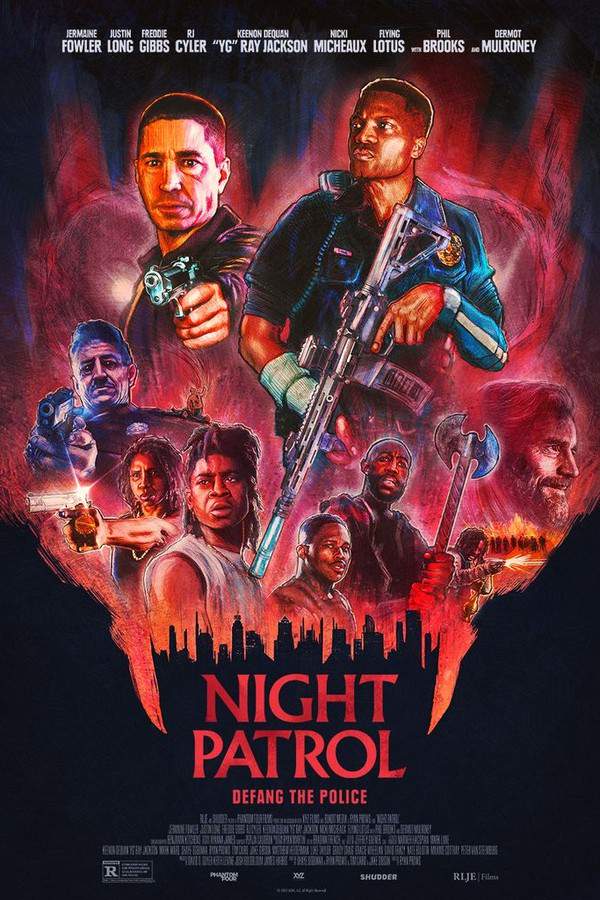
Night Patrol 2026


Directed by

Ryan Prows
Made by

BondIt Media Capital
Where to Watch Night Patrol
See current US streaming, rental, and purchase options for Night Patrol (2026) via JustWatch.

AMC Plus Apple TV channel
HD
AMC+ Amazon Channel
HD
AMC+ Roku Premium Channel
HD
Philo
HD
Shudder
HD
Shudder Amazon Channel
HD
Shudder Apple TV channel
HD
Amazon Video
4K
Apple TV Store
4K
Fandango At Home
4K
Google Play Movies
SD
YouTube
SD Streaming availability powered by 
Night Patrol Plot Summary
Read the complete plot summary and ending explained for Night Patrol (2026). From turning points to emotional moments, uncover what really happened and why it matters.
Xavier Carr, Jermaine Fowler, a Black LAPD officer and former Crip, patrols the Colonial Courts housing projects where he grew up, trying to navigate the difficult line between duty and loyalty to the community he calls home. His days are spent meditating on the delicate balance of keeping people safe while facing the pressure of a system that often overlooks the neighborhoods he protects.
His partner, Ethan Hawkins, Justin Long, the son of a legendary but deceased sergeant, yearns to join the Night Patrol, an elite, secretive unit that operates exclusively after dark, a prospect that fills him with ambition and a touch of doubt about what he is willing to become in order to belong.
The truth of the Night Patrol comes into sharp focus when Xavier’s brother, Wazi, RJ Cyler, witnesses a Night Patrol officer brutally murdering his girlfriend. Wazi discovers that the unit is not what it seems—it’s a coven of vampires who wield their authority to feed on marginalized residents, disguising their killings as the violence of gang conflicts. The operation is led by the enigmatic Sarge, Dermot Mulroney, and his brutal enforcer, Deputy, Phil Brooks, whose methods blur the lines between order and brutality.
As the Night Patrol closes in on Wazi to silence him, Xavier is forced to choose between his blue-blood loyalty and his biological family. He finds purpose with his mother Ayanda, Nicki Micheaux, a local mystic who wields ancient Zulu magic and ancestral lore to shield the community from harm, offering a spiritual counterbalance to the violence around them.
In the film’s climactic showdown, Xavier and Wazi rally together the Crips and Bloods to defend their neighborhood. They face off against the vampiric officers in a high-stakes, supernatural battle, blending heavy weaponry with African mysticism to repel the Night Patrol’s alleged cleansing of the projects. The struggle is brutal, poetic, and deeply personal, forcing them to redefine loyalty and family in a city where power corrupts and faith can be a weapon.
The story closes on a cliffhanger, hinting that the conspiracy within the LAPD runs deeper than a single unit and leaving audiences with questions about who truly controls the streets—and who has the right to call themselves protectors.
Night Patrol Timeline
Follow the complete movie timeline of Night Patrol (2026) with every major event in chronological order. Great for understanding complex plots and story progression.
Xavier Carr patrols the Colonial Courts
Xavier Carr, a Black LAPD officer and former Crip, patrols the Colonial Courts housing projects where he grew up. He faces tense loyalties between the community he serves and the neighborhood he once belonged to. The scene sets the fragile balance he must maintain between duty and belonging.
Ethan Hawkins pursues Night Patrol
Ethan Hawkins, the son of a legendary sergeant, is desperate to join the Night Patrol—an elite unit that operates after dark. He pursues advancement within the force and echoes the secrecy that surrounds the group. His ambition foreshadows the danger of unchecked loyalty to a covert authority.
Wazi witnesses a brutal Night Patrol murder
Wazi Carr, Xavier's brother, witnesses a Night Patrol officer brutalize and murder his girlfriend. The horror reveals the unit's true nature as vampires preying on the city's marginalized and masking the deaths as gang violence. The revelation shatters the image of the Night Patrol as protectors.
Night Patrol unmasked as a vampiric faction
The true nature of the Night Patrol is exposed as a vampiric faction that uses LAPD authority to feed on the vulnerable. Their killings are framed as gang violence to maintain fear and control, corrupting justice from within. The revelation reframes Xavier and the community’s struggle as a fight against supernatural police corruption.
Leadership and brutality of Sarge and Deputy
Sarge leads the Night Patrol with brutal enforcer Deputy, enforcing silence through fear and violence. Their control over the unit is reinforced by intimidation and loyalty to a hidden cause. The dynamic establishes the terrifying threat that Xavier and Wazi must confront.
Xavier faces a family-vs-blue-blood dilemma
Xavier wrestles with loyalty to the LAPD versus loyalty to his family and community. He confronts a choice between upholding blue-blood policing and protecting Ayanda and the neighborhood he grew up in. The internal conflict anchors his eventual alliance with mysticism and community defense.
Ayanda wields Zulu magic to protect the community
Ayanda, Xavier and Wazi's mother, uses ancient Zulu magic and ancestral lore to shield the neighborhood from Night Patrol predation. Her rituals connect current action to a long lineage of protection. The mystical approach introduces an unconventional weapon in the fight against a vampiric police force.
Night Patrol targets Wazi to silence him
To silence the brother who witnessed the murders, the Night Patrol hunts Wazi with relentless pursuit. Xavier fights to protect him, realizing the conspiracy reaches into the LAPD itself. The threat escalates the urgency of uniting the community against the hidden enemy.
Xavier and Wazi unite Crips and Bloods
In a bold move, Xavier and Wazi broker a fragile alliance between rival Crips and Bloods to defend their neighborhood. The unlikely coalition shows that shared trauma can override old feuds. This collaboration reframes gang conflict as a civil defense against a common, supernatural threat.
Supernatural showdown with vampiric officers
The defense escalates into a supernatural clash as vampiric officers confront the coalition. The heroes deploy heavy weaponry alongside African mysticism to counter the Night Patrol’s ritual cleansing. The battle raises the stakes and sets up the final confrontation.
Showdown ends with repulsion of the cleansing
Xavier, Wazi, and the allied residents push back against the vampiric officers, stalling the cleansing mission. The fight leaves casualties and revelations that shake trust in the LAPD and the neighborhood’s future. Victory comes at a cost, and the ending remains unsettled.
Cliffhanger: deeper LAPD conspiracy hinted
The film closes with a hint that the conspiracy within the LAPD runs deeper than a single unit. The alliance between residents and reform-minded insiders implies a wider rot within the system. Audiences are left wondering who else is compromised and how the fight will continue.
Night Patrol Characters
Explore all characters from Night Patrol (2026). Get detailed profiles with their roles, arcs, and key relationships explained.
Xavier Carr (Jermaine Fowler)
A Black LAPD officer and former Crip who must navigate the tension between his policing duties and his roots in the Colonial Courts. His loyalty is tested as he confronts a deadly secret within the Night Patrol and must decide where his true allegiance lies. He finds an unexpected ally in his mother Ayanda, blending police world with ancestral protection.
Ethan Hawkins (Justin Long)
Xavier’s partner and the son of a legendary but deceased sergeant, hungry to prove himself and join the Night Patrol. His ambition drives him toward the unit’s elusive prestige, even as the true nature of the group begins to unravel. He faces a hard choice when the vampiric truth comes to light.
Wazi (RJ Cyler)
Xavier’s brother who witnesses the Night Patrol brutally murdering his girlfriend, triggering a chain of events that exposes the unit’s true form. His experience as a survivor pushes him to confront the violence consuming their neighborhood. His actions help catalyze the community’s stand against oppression.
Ayanda (Nicki Micheaux)
Xavier’s mother and a local mystic who uses ancient Zulu magic to shield and guide the community. Her knowledge of ancestral lore provides a practical counterbalance to the LAPD’s power and offers spiritual protection amid violence. She embodies a bridge between cultural heritage and contemporary struggle.
Sarge (Dermot Mulroney)
The enigmatic leader of the Night Patrol who exerts brutal control over the unit. He embodies the corrupt power at the heart of the conspiracy, steering actions that prioritize fear and domination over justice. His presence intensifies the conflict as Xavier and Wazi push back.
Deputy (Phil Brooks)
The brutal enforcer of the Night Patrol, carrying out the unit’s most violent orders. His role highlights the human cost of the vampiric unit’s predatory regime and the willingness to crush dissent. He stands as a key obstacle to the protagonists’ attempt to resist.
Night Patrol
A secretive, post-dark unit that operates under a veneer of law and order but is revealed to be vampiric in nature, preying on marginalized residents and manipulating violence to maintain control. Their nocturnal operations and intimate knowledge of the community drive the central mystery. The confrontation with Xavier, Wazi, and the community exposes a deeper conspiracy within the LAPD.
Night Patrol Settings
Learn where and when Night Patrol (2026) takes place. Explore the film’s settings, era, and how they shape the narrative.
Location
Colonial Courts housing projects, Los Angeles
The Colonial Courts housing projects in Los Angeles form a dense, marginalized urban backdrop where community bonds struggle under mounting police pressure and gang rivalries. The area is depicted as a tight-knit, high-tension neighborhood that becomes the battleground for power plays between authorities and residents. This setting grounds the film’s conflict in a real, lived urban environment.
Night Patrol Themes
Discover the main themes in Night Patrol (2026). Analyze the deeper meanings, emotional layers, and social commentary behind the film.
🤝
Loyalty
Xavier’s conflict between his loyalty to the LAPD and his responsibility to his biological family drives the character arc. The story probes how duty to a badge clashes with personal ties, forcing choices that can redefine one’s sense of right and wrong. The climax shows the cost of choosing alliance over blood, and vice versa.
🪄
Mysticism
Ayanda’s use of Zulu magic and ancestral lore introduces a supernatural layer that protects the community. This mystic tradition sits alongside modern policing, challenging the notion that science and policy alone govern justice. The mysticism acts as a counterforce to the vampiric oppression. It also links cultural heritage to communal resilience.
💀
Corruption
The Night Patrol is revealed to be a vampiric unit feeding on marginalized residents and framing deaths as gang violence. The scale of abuse exposes a deeper LAPD conspiracy that goes beyond a single unit. The film uses this corruption to critique systemic violence and the illusion of order maintained by fear. The community must navigate a dangerous network of power to survive.

Coming soon on iOS and Android
The Plot Explained Mobile App
From blockbusters to hidden gems — dive into movie stories anytime, anywhere. Save your favorites, discover plots faster, and never miss a twist again.
Sign up to be the first to know when we launch. Your email stays private — always.
Explore the mobile appNight Patrol Ending Explained
Unravel the ending of Night Patrol (2026) with our detailed explanation. Understand the final scenes, character fates, and unresolved questions.
The climax of Night Patrol transforms from a gritty crime thriller into a supernatural showdown rooted in ancestral power. After the vampire police unit decimates the Bloods and leaves Wazi’s mother, Ayanda, mortally wounded, she reveals their family’s Zulu heritage before dying. In the burning apartment, Wazi discovers a warrior’s suit, his glowing green ring, and a magical spear—artifacts that transform him from a terrified witness into a formidable fighter. He emerges to face the Night Patrol, killing several officers before confronting Ethan, his brother’s former partner who has been forcibly turned into a vampire. Though Ethan attacks him from the air, Wazi drives the Zulu spear through him and survives the fall, though he is left gravely injured.
The film’s final moments carry heavy thematic weight. Wazi awakens inside the police station with the spear tip embedded in his chest, facing a Black officer who delivers a chilling reality: Wazi will be blamed for everything because the vampires wear uniforms. The system protects its own, regardless of the atrocities committed. This sets up the film’s haunting conclusion, where Wazi is locked in a room surrounded by the remaining vampire cops. As the spear tip begins to glow once more, the warrior spirit inside him stirs, leaving viewers with a powerful image of resistance against institutional darkness.
Ethan’s arc serves as a tragic counterpoint to Wazi’s empowerment. Throughout the film, Ethan exists in a moral gray area—he joins the Night Patrol to honor his deceased father, unaware that his father is actually alive and leading the vampire unit. When Ethan hesitates to kill Primo during his initiation, Marcus forces his hand, and later, his own father turns him into a vampire against his will. Ethan becomes a puppet, killing Xavier to quench his newfound thirst. Yet the remnants of his conscience emerge when he kills Marcus, suggesting that Ethan was never fully lost to the darkness. His final confrontation with Wazi is less a battle between hero and villain than a collision of two young men destroyed by a corrupt system—one wielding ancestral power, the other consumed by it.
The ending resonates far beyond its supernatural elements. Director Ryan Prows uses the vampire metaphor to explore real-world issues of police brutality and systemic racism. The Night Patrol’s indiscriminate violence against Black residents—targeting the elderly, women, and even infants—mirrors historical and contemporary injustices. Ayanda’s distrust of Xavier, her own son who joined the LAPD, speaks to the complicated relationship between Black communities and law enforcement. When Wazi stands alone against a room full of officers, the film crystallizes its message: the fight against institutional oppression often falls on individuals who must draw strength from their heritage and community to survive. The glowing spear represents more than magical weaponry—it embodies the enduring power of cultural identity in the face of erasure and violence.
Night Patrol Spoiler-Free Summary
Discover the spoiler-free summary of Night Patrol (2026). Get a concise overview without any spoilers.
In the shadowed streets of Los Angeles’ “Colonial Courts,” a housing project that has long lived on the edge of the city’s polish, an unofficial war of loyalties swirls beneath the neon glow. The LAPD’s elite Night Patrol operates after dark, its motives hidden behind an aura of authority and a promise of order, yet rumors whisper of a terrifying secret that could upend everything the community depends on. The film watches this fragile balance teeter as the precinct’s official mandate clashes with the neighborhood’s own code.
Xavier Carr walks that line daily. Once a member of the Crips and now a Black LAPD officer, he carries the weight of his past while patrolling the very blocks that raised him. Beside him is Ethan Hawkins, the eager son of a legendary sergeant whose ambition to join the Night Patrol fuels a tension that feels both personal and professional. Their partnership is a study in contrast: Xavier’s lived‑in experience versus Ethan’s desire for approval within the force’s upper echelons.
Family ties pull Xavier in another direction. His brother, Wazi, remains a constant reminder of the streets’ raw reality, and their mother, Ayanda, offers a different kind of strength—a mystic rooted in ancient Zulu traditions who safeguards the community with stories and rituals passed down through generations. This triad of blood, duty, and heritage forces Xavier to weigh his sworn oath against the unspoken code of his neighborhood.
The tone drifts between gritty urban realism and a low‑key, almost noir‑ish dread, hinting that the Night Patrol’s concealed agenda could ripple far beyond a single precinct. As alliances shift and old rivalries simmer, the film suggests that confronting the hidden menace may require more than badge and gun—perhaps a unifying force that bridges the gap between rival gangs, family legacies, and the unseen powers that linger in the night.
Featured on this page

What's After the Movie?
Not sure whether to stay after the credits? Find out!
Check out our other apps:

SAT Sphere
Build confidence for the Digital SAT.

Mori Atlas
Discover wild places worth protecting.

Luntero
Search smarter for a home in Amsterdam.

Plot Explained
Unravel movie endings and hidden clues.

Pokechamp
Dive into Pokémon data and battle logic.

Driving Theory
Get ready for your European theory test.

Movie Dust
Plan your next cinema trip with ease.

Musemap
Find art and culture as you travel.

Selkobase
Compare credentials before committing.

Local Manual
Turn an unfamiliar country into practical next steps.

Lernavi
Compare school systems before your next move.

GymRoam
Find a workout stop wherever your plans take you.
Explore Our Movie Platform
New Movie Releases (2026)
Famous Movie Actors
Top Film Production Studios
Movie Plot Summaries & Endings
Major Movie Awards & Winners
Best Concert Films & Music Documentaries
Movie Collections and Curated Lists
© 2026 What's After the Movie. All rights reserved.
Privacy Policy