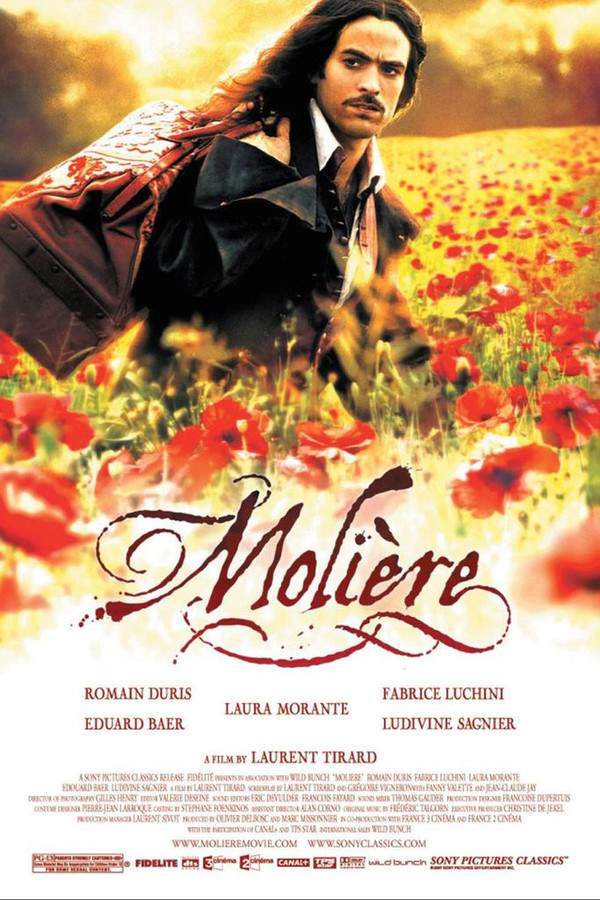
Molière 2007

Directed by

Laurent Tirard
Made by

Sony Pictures Classics
Where to Watch Molière
See current US streaming, rental, and purchase options for Molière (2007) via JustWatch.






Molière Plot Summary
Read the complete plot summary and ending explained for Molière (2007). From turning points to emotional moments, uncover what really happened and why it matters.
The film opens in 1658 with Molière, Romain Duris, returning to Paris with his theatrical troupe to perform in a theatre the king’s brother has granted him, signaling a triumphant return to the stage.
Most of the narrative unfolds as a flashback to 1645, tracing the precarious path that leads the young actor from debt to opportunity.
Molière is freed from debtor’s prison by Monsieur Jourdain, a wealthy but socially ambitious commoner who agrees to cover the actor’s debts if Molière agrees to teach him how to act. The arrangement pits a man eager to elevate himself against a man who wields performance as both craft and weapon.
Jourdain, a married man with two daughters, hopes to use this new talent to win the affection of Célimène, a recently widowed aristocrat with whom he has become obsessed, and he imagines presenting a short play he has written for the occasion. The irony thickens as Molière, instead, is introduced to the Jourdains as Tartuffe, a fictional priest who is to tutor the younger daughter, a deception that foreshadows the troupe’s later explorations of truth, power, and theater.
As the story advances, Molière finds himself drawn to Jourdain’s neglected wife Elmire, unlocking a dangerous attraction that complicates loyalty, art, and ambition. Subplots sharpen the tension: the elder daughter’s budding romance, and the sharp, cynical Dorante’s schemes against the gullible Jourdain, a web of desire and deception that tests everyone involved.
The tale remains largely fictional, yet it mirrors and echoes actual scenes and lines from Molière’s own plays, including Tartuffe, Le Misanthrope, Le Malade imaginaire and Le Bourgeois gentilhomme, whose principal character shares the name Jourdain. It is implied that these “real-life” threads fed profoundly into the playwright’s mature works, blending a biographical glimmer with the timeless theater he would come to define.
The film features a notable ensemble, with Duris in the title role alongside Laura Morante and Fabrice Luchini, whose performances anchor the saga’s humor, tension, and introspective spark.
Molière Timeline
Follow the complete movie timeline of Molière (2007) with every major event in chronological order. Great for understanding complex plots and story progression.
1645: Molière's release from debtor's prison
Molière, a struggling young actor, has just been released from debtor's prison after a failed run as a tragic performer. Monsieur Jourdain, a wealthy and socially aspirational man, offers to pay his debts if Molière will teach him to act. This bargain marks the start of a life-changing professional and personal alliance.
Jourdain's plan to woo Célimène with a short play
Jourdain hopes to use Molière's talents to ingratiate himself with Célimène, a recently widowed aristocrat he obsesses over. He plans to perform a short play he has written for the occasion, hoping it will win her favor. Molière becomes the instrument of this social strategy.
Molière is introduced as Tartuffe to the family
To serve as tutor for the younger daughter, Molière is secretly presented to the Jourdains as Tartuffe, a pious priest figure. The deception positions him at the center of the family’s ambitions and lies. This ruse sets the stage for later conflicts.
Molière falls in love with Elmire
As he tutors the family, Molière becomes drawn to Elmire, Jourdain's neglected wife, creating a personal conflict with the masquerade he must maintain. The romance introduces emotional stakes that complicate his professional duties. The affair hints at the deeper themes of hypocrisy that inform his later work.
The older daughter's love life subplot
The Jourdains' older daughter's romantic life unfolds as a parallel thread, adding social pressure and creating opportunities for dramatic irony. Her pursuits intersect with her father’s ambitions and Molière's precarious position in the household. This subplot enriches the social satire underpinning the story.
Dorante's intrigues against Jourdain
Dorante, a penniless and cynical aristocrat, schemes at the expense of Jourdain, manipulating situations to test or profit from his gullibility. His maneuvers expose the fragility of social pretensions in the world around them. The interactions foreshadow the kinds of social games Molière would later satirize.
The bargain deepens as performances loom
Jourdain continues to pursue acting lessons from Molière, and the household becomes a theatre where personal and social ambitions are staged. The dynamic tightens as both mentor and pupil navigate fame, love, and deception. The tension points toward the double life that Molière will lead.
Molière returns to Paris with his troupe (present)
The film cuts to 1658, with Molière returning to Paris alongside his acting troupe to perform in a theatre granted by the king's brother. The move signals Molière's rising prominence and the start of his public career. It reframes the earlier events as memories informing the present.
A theatre project is set for the audience
The troupe prepares a production to appeal to the Paris audience, seizing the opportunity to showcase Molière's talents. The theatre project becomes a hinge point in his career, blending personal history with his literary ambitions. The event marks a transition from personal entanglements to public achievement.
The narrative interleaves Tartuffe, Le Misanthrope, and more
The film intermittently stages moments from Tartuffe, Le Misanthrope, Le Malade imaginaire, and Le Bourgeois gentilhomme, with their principal character named Jourdain echoing the real-life patron. These inserts connect Molière's life to his works and suggest that his experiences fed his mature plays. The line between life and art becomes a central theme.
Romance and deception threaten the balance
The double life Molière leads—teacher and lover amid a web of social games—begins to push against the boundaries of honesty. Elmire’s presence and the other household intrigues threaten to unravel the masquerade. The outcomes foreshadow confrontations that will define his career.
Legacy: the events inspire Molière's maturity
Although the film blends history with fiction, it implies that the experiences—the love, the deception, and the social satire—helped shape Molière's later plays. The audience is invited to see how personal life and theatrical craft intertwine. The story ends by linking life to art.
Molière Characters
Explore all characters from Molière (2007). Get detailed profiles with their roles, arcs, and key relationships explained.
Molière (Romain Duris)
A gifted but indebted actor and playwright who maneuvers debt, patronage, and artistic ambition. He engineers his own social ascent by tutoring Jourdain in acting while navigating forbidden feelings for Elmire. His wit and craft fuel both the troupe’s survival and the rebirth of a legendary playwright’s voice.
Elmire (Laura Morante)
Jourdain’s neglected wife, whose quiet strength and intelligence become a catalyst for the story. She becomes entangled in Molière’s affection and the family’s schemes, balancing duty with desire. Her presence exposes the fragility of domestic life within a corrosive social web.
Monsieur Jourdain (Fabrice Luchini)
A wealthy, socially ambitious commoner with grand pretensions who seeks to use theatre to win favor and status. He hires Molière, hoping to master acting and impress Célimène, while his own gullibility and vanity drive comic and dramatic tension. His scheming exposes the fragility of social climbers when confronted with authentic art.
Molière Settings
Learn where and when Molière (2007) takes place. Explore the film’s settings, era, and how they shape the narrative.
Time period
1645–1658
The narrative shifts between 1645 and 1658, placing the drama in mid‑17th‑century Paris. It reflects a period when debt, patronage, and prestige shaped a playwright’s career and opportunities for stage success. The year 1658 anchors the return to Paris as Molière reclaims the stage with his troupe.
Location
Paris, France
The action unfolds in Paris, a 17th‑century capital known for its theatre culture and patronage networks. We see the royal and bourgeois circles intersect through Jourdain’s ambitions and Molière’s troupe. The film moves between the city’s theatres and the Jourdains’ domestic spaces, illustrating the urban stage where art and society collide.
Molière Themes
Discover the main themes in Molière (2007). Analyze the deeper meanings, emotional layers, and social commentary behind the film.
🎭
Theatre & Identity
The film blurs actor, character, and life as Molière performs a role both on stage and off. The boundary between artist and persona is porous, with Tartuffe and other plays echoing in the plot. Characters reinvent themselves through performance, shaping reputation and fate.
🏛️
Social Pretensions
Jourdain’s appetite for status drives the plot, using theater as a tool to climb socially. The film pokes at aristocratic vanity and the hollow glamour of wealth, showing how appearances can mask insecurity. The tension between old social orders and rising ambition is a central engine.
💘
Love & Deception
Romantic desire complicates loyalties; Molière’s affection for Elmire risks scandal and jeopardizes debts and loyalties. Deception is a weapon and a shield, used to gain advantage or protect secrets. The plot uses romance to expose vulnerabilities in both performers and patrons.
📜
Creative Legacy
The story explicitly nods to Molière’s real plays, citing Tartuffe, Le Misanthrope, Le Malade Imaginaire and Le Bourgeois Gentilhomme. The fictional events are presented as possible inspirations for his mature works. The film frames these connections as a mythic bridge between life and literature.

Coming soon on iOS and Android
The Plot Explained Mobile App
From blockbusters to hidden gems — dive into movie stories anytime, anywhere. Save your favorites, discover plots faster, and never miss a twist again.
Sign up to be the first to know when we launch. Your email stays private — always.
Explore the mobile appMolière Spoiler-Free Summary
Discover the spoiler-free summary of Molière (2007). Get a concise overview without any spoilers.
In the gilded yet precarious world of Restoration France, a young playwright returns to Paris with a troupe barely clinging to survival. The streets hum with the restless energy of a society eager for spectacle, while the theatres echo with both grand ambition and the quiet desperation of those who dare to shape it. Amid candle‑lit rehearsal rooms and bustling boulevards, the film captures a mood that is at once lively, satirical, and tinged with the uncertainty of a dreamer striving for recognition.
When the affluent yet socially restless Monsieur Jourdain offers to settle the playwright’s debts in exchange for a private lesson in the art of performance, a delicate partnership begins. Jourdain, a man of means longing to master the nuances of stagecraft, seeks more than mere technique; he craves the respect and relevance that the theatre can confer. Their interactions unfold with a blend of humor and tension, each lesson a mirror reflecting both the teacher’s talent and the patron’s yearning to belong to a world that often feels just out of reach.
The narrative soon widens its gaze to the glittering salons of the aristocracy, where Climène presides over gatherings rich with conversation, wit, and an undercurrent of unspoken danger. Her salon becomes a micro‑cosm of the era’s intricate social dance, a place where art, politics, and personal ambition intersect beneath polished surfaces. As the playwright steps further into this realm, he encounters the paradoxes and pretensions that define the elite, all while sensing the subtle currents of intrigue that flow through each polite exchange.
Through these encounters, the young dramatist begins to see the absurdities that underpin his society, prompting a quiet but profound shift in his creative vision. The film teases the emergence of a distinctive artistic voice—one that will later echo across the stages of history—while immersing the audience in a world where comedy and critique intertwine, and every performance holds a mirror up to the foibles of its time.
Movies with Similar Twists and Themes
Uncover films that echo the narrative beats, emotional arcs, or dramatic twists of the one you're exploring. These recommendations are handpicked based on story depth, thematic resonance, and spoiler-worthy moments — perfect for fans who crave more of the same intrigue.
Featured on this page

What's After the Movie?
Not sure whether to stay after the credits? Find out!
Check out our other apps:

SAT Sphere
Build confidence for the Digital SAT.

Mori Atlas
Discover wild places worth protecting.

Luntero
Search smarter for a home in Amsterdam.

Plot Explained
Unravel movie endings and hidden clues.

Pokechamp
Dive into Pokémon data and battle logic.

Driving Theory
Get ready for your European theory test.

Movie Dust
Plan your next cinema trip with ease.

Musemap
Find art and culture as you travel.

Selkobase
Compare credentials before committing.

Local Manual
Turn an unfamiliar country into practical next steps.

Lernavi
Compare school systems before your next move.

GymRoam
Find a workout stop wherever your plans take you.
Explore Our Movie Platform
New Movie Releases (2026)
Famous Movie Actors
Top Film Production Studios
Movie Plot Summaries & Endings
Major Movie Awards & Winners
Best Concert Films & Music Documentaries
Movie Collections and Curated Lists
© 2026 What's After the Movie. All rights reserved.
Privacy Policy