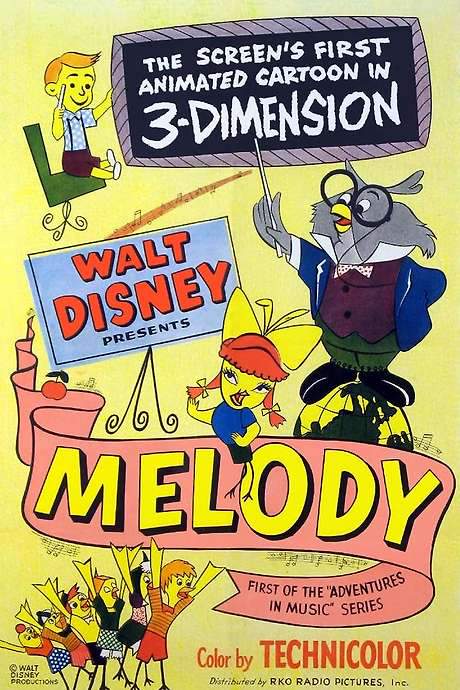
Melody 1953

Directed by

Charles August Nichols
Made by

Walt Disney Productions
Melody Plot Summary
Read the complete plot summary and ending explained for Melody (1953). From turning points to emotional moments, uncover what really happened and why it matters.
Professor Owl guides his class of birds through a gentle lesson about how melodies surround the natural world around them. He demonstrates by playing a simple tune on a small piano, inviting the students to listen as notes weave together to shape sound. After the demonstration, the flock takes to the skies, curious about the many melodic sounds that nature has to offer, a journey that unfolds under the professor’s calm instruction. The chorus recites the sounds of nature, including the line The Bird and the Cricket and the Willow Tree, echoing the harmony of creature and environment. Professor Owl notes that in his view, only birds and humans can truly sing.
Next, a later scene uses melody as a storyboard for a life cycle. The film marks birth with Rock-a-bye Baby, school with The Alphabet Song, college with Far Above Cayuga’s Waters, courtship with Drink to Me Only with Thine Eyes, and the wedding moment with Here Comes the Bride (and there goes the groom). The later stages are colored by Home! Sweet Home!, Happy Birthday to You, Silver Threads Among the Gold, The Old Gray Mare, Auld Lang Syne, and Oh, Dem Golden Slippers, each tune acting as a cue for memory and mood. The narration ties these melodies together, showing how music tracks a life story.
The piece also demonstrates how a simple melody can grow into a full symphonic idea: the opening tune is expanded into a more ornate version, illustrating development through variation while preserving the original motif. The cartoon then circles back to its starting moment with a reprise of The Bird and the Cricket and the Willow Tree, leaving the viewer with a sense of cyclical harmony. The mood and texture are enriched by the performance of the Bass Singer in Canoe and Ship within the soundtrack, adding depth to the vocal tapestry.
Melody Timeline
Follow the complete movie timeline of Melody (1953) with every major event in chronological order. Great for understanding complex plots and story progression.
Lesson kickoff and demonstration
Professor Owl begins the lesson by instructing his class of birds on how melodies are formed. He demonstrates on a small piano, showing how notes become a tune. The class watches and prepares to explore melodies in their world.
Birds venture into nature to find melodies
The birds take to the skies in search of natural sounds that form melodies. They listen to wind, water, and rustling leaves, shaping their understanding of music. The moment emphasizes that music can be found all around them.
Chorus captures nature's sounds
The chorus sings about the sounds of nature, including 'The Bird and the Cricket and the Willow Tree'. The scene links musical ideas to the living world and reinforces the lesson's theme. Professor Owl reminds the class of the harmony between creatures and song.
Only birds and humans can sing
Professor Owl notes a key idea: only birds and humans have the capacity to sing. The observation sets a boundary for the musical exploration and invites the class to reflect on their own voices. It underscores the special role of singing in human culture.
Birth depicted with Rock-a-bye Baby
The lesson illustrates birth through the lullaby 'Rock-a-bye Baby'. A gentle melody accompanies the first stage of life, introducing how music marks a major life event. The simple tune acts as the seed for later musical growth.
School journey with The Alphabet Song
The next sequence uses 'The Alphabet Song' to represent schooling. It follows a child's path from early learning to literacy, tying education to a familiar tune. The moment shows how melodies map life milestones.
College years with Far Above Cayuga's Waters
As life advances, the tune 'Far Above Cayuga's Waters' stands for college years. The melody underscores intellectual growth, friendship, and the pursuit of knowledge. The sequence links higher education to a traditional college anthem.
Courtship with Drink to Me Only with Thine Eyes
The film uses 'Drink to Me Only with Thine Eyes' to symbolize courtship and romantic beginnings. The melody accompanies courtship rituals and early love, flowing with lighthearted scenes. It emphasizes music's role in human relationships.
Wedding moment with Here Comes the Bride
The wedding moment brings 'Here Comes the Bride (and there goes the groom)' to the forefront. The tune marks the formal union and the next life chapter. The sequence ties song to celebration and social ceremony.
Later life songs: Home, Birthday, and more
The montage covers later life with 'Home! Sweet Home!' and 'Happy Birthday to You'. The melodies signal home, family, and personal milestones, blending nostalgia with celebration. The sequence continues to map time through familiar refrains.
Aging reflections with Silver Threads, The Old Gray Mare, and more
Older years are represented by 'Silver Threads Among the Gold' and 'The Old Gray Mare'. These tunes evoke memory and the passing of time. The songs connect aging to shared musical heritage and sentiment.
Farewell and reminiscence with Auld Lang Syne and Oh, Dem Golden Slippers
The sequence moves toward reminiscence with 'Auld Lang Syne' and ends with 'Oh, Dem Golden Slippers'. The tunes reflect friendship, reminiscence, and joyful retirement. Music acts as a bridge between past and present.
From simple tune to symphony
The cartoon demonstrates how a simple melody can be expanded into a symphony. An elaborate version of the opening tune expands harmonies and structure, illustrating the growth of musical ideas. The transformation emphasizes creativity and orchestration within the lesson.
Return of the willow-tune and final reprise
The film ends with a reprise of 'The Bird and the Cricket and the Willow Tree'. The final notes echo the opening lesson, bringing the exploration full circle. The closing moment ties together the journey from observation to musical synthesis.
Melody Characters
Explore all characters from Melody (1953). Get detailed profiles with their roles, arcs, and key relationships explained.
Professor Owl (Bill Thompson)
Professor Owl leads the class of birds, guiding them through the discovery of melody. He is patient, insightful, and enthusiastic about teaching listening and composition. His observations that birds and humans are the two singing species frame the film's concept of cross-species harmony.
Bass Singer in Canoe and Ship (Harry Stanton)
A deep-voiced chorus member who anchors the ensemble with a bass line during the nature-inspired songs. Though not the focal point, his singing provides emotional weight and a sense of communal rhythm within the chorus.
Melody Settings
Learn where and when Melody (1953) takes place. Explore the film’s settings, era, and how they shape the narrative.
Location
Bird classroom, Nature landscapes
A classroom of birds guided by Professor Owl where melodies are taught. A small piano anchors the lesson as Professor Owl demonstrates how tunes are assembled from simple sounds. Afterward, the class and audience venture into the natural world to discover the melodic voices of nature in various landscapes.
Melody Themes
Discover the main themes in Melody (1953). Analyze the deeper meanings, emotional layers, and social commentary behind the film.
🎵
Music Education
Melody is framed as a tool for learning as Professor Owl leads a class of birds. The lesson shows how tunes are built from simple sounds and how listening shapes understanding. A piano demonstration anchors the concept and invites curiosity about sound.
📜
Life Through Song
The film maps life stages to familiar melodies, from birth to old age. Each song acts as a mnemonic for different life moments like school, courtship, and celebration. This musical journey links human and avian experiences through shared tunes.
✨
Creativity and Transformation
A simple melody expands into a full symphony, illustrating how ideas grow through variation. The animation uses repetition and development to show artistic transformation. The idea that small beginnings can become grand works runs through the lesson.
🍃
Nature's Chorus
Nature's sounds are celebrated as musical material, with birds and humans sharing the stage. The chorus sings about the sounds of the world, emphasizing harmony between living beings. The piece ends by circling back to the opening melody, emphasizing unity with the natural world.

Coming soon on iOS and Android
The Plot Explained Mobile App
From blockbusters to hidden gems — dive into movie stories anytime, anywhere. Save your favorites, discover plots faster, and never miss a twist again.
Sign up to be the first to know when we launch. Your email stays private — always.
Explore the mobile appMelody Spoiler-Free Summary
Discover the spoiler-free summary of Melody (1953). Get a concise overview without any spoilers.
In a world where music weaves through every corner of nature, Professor Owl prepares to guide his eager class through an exploration of melody that promises to reshape how they hear the world around them. As the screen’s first 3-D animated cartoon, this whimsical short invites audiences into a classroom perched among the branches, where learning takes flight — quite literally. The professor’s calm demeanor and patient instruction set the tone for a journey that begins with the simplest of tunes played on a small piano, demonstrating how individual notes can weave together to shape sound itself.
The professor’s conviction that only birds and humans possess the gift of true song adds a layer of wonder to the proceedings, suggesting there is something special waiting to be discovered in the harmonies that fill the air. His students, a flock of curious birds, seem ready to take their understanding beyond the classroom and into the skies, where the natural world offers a symphony of sounds waiting to be understood. The promise of hearing nature’s music — from creatures to environment — hints at lessons that extend far beyond simple tunes.
The film appears poised to connect melody to the very rhythm of existence itself, suggesting that music accompanies life’s many stages and experiences. Through Professor Owl’s guidance, what begins as a simple lesson seems destined to grow into something richer, as variations on a theme promise to demonstrate how music develops and transforms while preserving its essential character. The classroom’s recitation of natural harmonies echoes a philosophy that music is not separate from life but woven deeply into it.
With its cyclical structure and gentle humor, the cartoon creates an atmosphere where education and entertainment blend seamlessly. The vocal performances add texture to this musical tapestry, ensuring that every note resonates with purpose. For audiences young and old, the film offers an invitation to pause and listen — to discover the melodies that have been surrounding them all along, waiting to be heard.
Movies with Similar Twists and Themes
Uncover films that echo the narrative beats, emotional arcs, or dramatic twists of the one you're exploring. These recommendations are handpicked based on story depth, thematic resonance, and spoiler-worthy moments — perfect for fans who crave more of the same intrigue.
Featured on this page

What's After the Movie?
Not sure whether to stay after the credits? Find out!
Check out our other apps:

SAT Sphere
Build confidence for the Digital SAT.

Mori Atlas
Discover wild places worth protecting.

Luntero
Search smarter for a home in Amsterdam.

Plot Explained
Unravel movie endings and hidden clues.

Pokechamp
Dive into Pokémon data and battle logic.

Driving Theory
Get ready for your European theory test.

Movie Dust
Plan your next cinema trip with ease.

Musemap
Find art and culture as you travel.

Selkobase
Compare credentials before committing.

Local Manual
Turn an unfamiliar country into practical next steps.

Lernavi
Compare school systems before your next move.

GymRoam
Find a workout stop wherever your plans take you.
Explore Our Movie Platform
New Movie Releases (2026)
Famous Movie Actors
Top Film Production Studios
Movie Plot Summaries & Endings
Major Movie Awards & Winners
Best Concert Films & Music Documentaries
Movie Collections and Curated Lists
© 2026 What's After the Movie. All rights reserved.
Privacy Policy