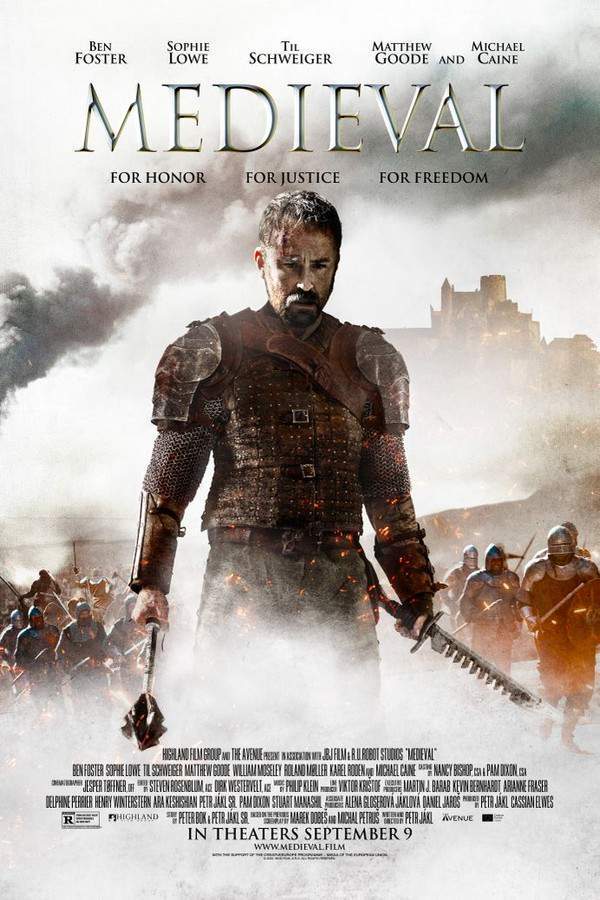
Medieval 2022



Where to Watch Medieval
See current US streaming, rental, and purchase options for Medieval (2022) via JustWatch.







Medieval Plot Summary
Read the complete plot summary and ending explained for Medieval (2022). From turning points to emotional moments, uncover what really happened and why it matters.
In the 14th century, Wenceslaus IV from the House of Luxembourg sits on the thrones of Bohemia, Germany, and the Holy Roman Empire, but his rule is weak and debt-ridden, threatening to tear the kingdom apart. The true power lies with Michael Caine as Lord Boresh, the most formidable noble in the land, who pulls the strings behind the scenes. Against this backdrop, the film follows Jan Žižka, Ben Foster in the title role, a skilled knight, mercenary, and future Hussite commander who leads a rough-and-tumble band of fighters drawn from ex-nobles, cutthroats, and hardened veterans who now fight for coin.
Žižka’s mercenary company includes Ulrich, a German veteran knight played by Roland Møller; the greedy soldier Conrad, the archer Freddy, the Norse berserker Lars, the spearman Cyril, and their most senior member, the Italian knight Giovanni, with Mick recently added after a skirmish where Žižka saves Lord Boresh from brigands at the cost of a fallen comrade. After this clash, Žižka escorts Boresh to Prague for a political debate about bringing Wenceslaus to Rome for his coronation, and he soon finds himself entangled in a web of ambition, ransom, and rebellion.
Žižka’s plan hinges on Rosenberg’s (the powers of the realm) support, but when that support proves elusive, he is given a dangerous assignment: kidnap Rosenberg’s fiancée, Katherine, to force the nobleman to keep his word and back the coronation. The mission brings Žižka back to his beginnings, as he visits his childhood home, where he reunites with his brother Jaroslav and his nephew, learning that they’re aiding rebels and funding the cause with money from Žižka’s own mercenary work. This revelation drags Žižka into high politics as his crew executes the kidnapping and smuggling operation—staging Katherine’s capture at the Cathedral and conveying her away in a cart filled with cadavers.
Katherine’s abduction triggers a chain of retaliations, drawing in Sigismund, Wenceslas’s half-brother, and Milan Rosenberg’s guards, as well as Torak and his Cumans—led by Žižka’s cunning mentor, Torak, who are dispatched to recapture the prisoners. In the resulting mêlée, Torak’s men ravage Žižka’s homeland at Trocnov, burn his village, and torture his family members, capturing Jaroslav to swap him for Katherine. The assault spares Barbara, who becomes a cautious ally, and Katherine makes several escape attempts only to be recaptured, their fates intertwined with the looming political decision over Bohemia and the emperor’s crown.
A tense hostage exchange spirals into catastrophe as Torak and Martin intensify the pursuit, and Jaroslav blames Jan for the loss of his son. Torak seizes a trap-laden mountain pass, but Žižka, employing his tactical genius and the rebels’ backing, defeats Torak’s men and reclaims Katherine, though Giovanni is mortally wounded in the fighting. The pursuit continues, resulting in ambushes, shattered loyalties, and brutal casualties: Cyril is mortally wounded; Torak’s forces assault the rebels; Jan sustains injuries while Katherine nurses him back to health, and their memories of lost friends, including Anna, weigh heavily on them all.
Katherine refuses to return to Rosenberg after witnessing his cruelty, even as Torak’s lieutenant Ajdar is decapitated in a brutal display and Ajdar’s head is left as a warning. The struggle intensifies as Rosenberg and his guards close in, and the couple learns that Captain Martin’s men stand ready to execute David, a young rebel. Katherine’s intervention proves pivotal when she kills Martin and the peasants rise up, trampling Martin’s troops in a violent, spontaneous insurrection. Traitors among Žižka’s ranks—specifically Conrad, who has betrayed the cause—are eliminated as Freddy shoots him in reprisal.
Reunited with his men, Žižka broadens the rebellion’s scope, and the rebels agree to escort Katherine to Wenceslaus’s hunting castle. Yet Jan refuses to let the journey end there, insisting on returning Katherine to her father in France, even as his companions refuse to abandon their leader. In a fateful turn, Žižka and his followers are overpowered and Katharine is seized again; she and Jan are separated from the others as Katherine grows fond of Žižka. Boresh, gravely wounded, reveals a pivotal truth: Sigismund has kidnapped King Wenceslas and seized the castle, and with his dying breath Boresh laments that the world cannot be changed for the better if kings can do such things.
With time running out, Žižka rallies the peasants to assault the castle and rescue Katherine. The battle erupts in a chaotic clash of swords and siege warfare, while Jan uses a clever ploy—employing Wenceslas’s pet lion—to cover their escape. Žižka faces Torak in a climactic duel as the peasants and rebels collide with Torak’s forces. Jaroslav survives a dramatic stumble from the castle wall into the river, and Katherine, desperate to save Žižka, throws herself from the battlements into the water. Jan leaps after her, and in a brutal underwater fight, bludgeons Torak to death with a rock, dragging Katherine to the riverbank. The lovers share a final kiss and Katherine dies, leaving Žižka to carry her ring back to the rebels as a solemn memento.
The film’s closing epilogue places the events in the broader arc of history: Sigismund ascends to the Bohemian throne after his brother’s death, but popular revolt thwarts his power, and he launches crusades against Bohemia while Žižka continues to lead outnumbered peasants during the Hussite Wars. The movie ends with Žižka at the head of a Hussite wagon fort, a testament to his tactical genius and to the enduring spark of resistance he personified. The narrative closes by noting that Žižka was one of the greatest military tacticians of all time and that he never lost a fight, while commemorating those who fight for freedom.
Medieval Timeline
Follow the complete movie timeline of Medieval (2022) with every major event in chronological order. Great for understanding complex plots and story progression.
Mercenary band formed on the road to Prague
Žižka saves Lord Boresh from brigands and consolidates a diverse mercenary outfit, recruiting Mick to his ranks. The new squad includes veterans and rough fighters who will become central to his campaigns. They head toward Prague, where the coronation debate for Wenceslaus is unfolding.
Katherine kidnapping plan to force Rosenberg’s support
After failing to win Rosenberg’s backing by other means, Jan Žižka is tasked with kidnapping Rosenberg’s fiancée Katherine to pressure him into keeping his word. The aim is to coerce Rosenberg to help secure Wenceslaus’s crowning. The move shows how personal vendettas fuse with royal politics.
Jan returns home; rebels funded by his brother
Žižka travels to his childhood home and discovers that his brother Jaroslav and his nephew are secretly aiding the rebels with money. The revelation ties his personal history to a larger rebellion against the crown. He realizes the cost of loyalty is now measured in blood and coins.
Katherine captured at the Cathedral
Katherine is seized at the Cathedral and smuggled away in a cart full of cadavers to disguise the kidnapping. The bold move deepens the political crisis surrounding Wenceslaus’s coronation. The rebel movement gains urgency as a royal hostage now binds Rosenberg to the plot.
Barbara warns Žižka and joins the rebels
Barbara survives a brutal assault and warns Žižka of the mounting danger. She chooses to accompany Žižka’s mercenaries to the rebel camp, where she helps train the rebels in combat. Her presence strengthens the insurgent coalition and ties local civilians to the cause.
Trocnov attacked; Jaroslav captured for Katherine swap
Torak and his Cumans ravage Žižka’s home village of Trocnov, torching the village and torturing his nephew. They abduct Jaroslav to use him as leverage for Katherine’s return, escalating the personal stakes for Žižka. The assault demonstrates how quickly loyalty fractures under pressure.
Hostage swap plan at the mountain pass
Torak and Martin organize a hostage exchange with Žižka at a mountain pass, aiming to force a surrender. Jaroslav is used as a pawn, and blame for his death falls on Jan in the fracas that follows. Žižka senses the trap and prepares a counter-move with rebel aid.
Žižka defeats the ambush and recaptures Katherine
Despite being outnumbered, Žižka’s tactical acumen helps him turn the tide and recapture Katherine. Giovanni is mortally wounded in the fighting, underscoring the price of rebellion. The group escapes with Jaroslav and Katherine, but the victory is costly.
Ambush in a cave; Žižka loses an eye
Žižka and his men hide in a nearby cave only to be ambushed by Torak and Martin. The battle ends with Žižka narrowly escaping and losing an eye in the clash. The injury becomes a stark symbol of his relentless leadership under perpetual danger.
Katherine retaken by Ajdar; Ajdar killed; head impaled
Torak’s lieutenant Ajdar captures Katherine, who is later killedifying in the pursuit of control. Žižka’s forces kill Ajdar, and his head is displayed on a tree as a grim warning. The back-and-forth capture underscores the ruthlessness of rival power blocs.
Katherine refuses to return to Rosenberg
Rosenberg and his guard close in, but Katherine refuses to return to him after witnessing his cruelty. Jan contemplates a rescue, yet the power imbalance and moral complexity keep him from acting. The moment marks a shift in loyalties and the cost of political expediency.
Village massacre; Martin killed; betrayal and bloodshed
Captain Martin and his men prepare to hang a rebel named David before the village. Katherine intervenes and Jan fights back, resulting in Martin’s death and a purge of his men by the peasants. Conrad’s betrayal by Tovak ends with Freddy killing him, signaling brutal political payback.
Final siege to rescue Katherine; tragedy at the river
Žižka rallies peasants to rescue Katherine at the king’s hunting castle, but the assault falters under heavy resistance. Katherine sacrifices herself, leaping into the river to save Žižka, with Jan following and killing Torak as he drags Katherine away. He retrieves Katherine’s ring as she dies, sealing their doomed romance.
Epilogue: Sigismund and the Hussite Wars
Sigismund becomes king, but many Bohemians revolt against his cruelty and the church’s crusades. Žižka leads outnumbered peasants in what will become the Hussite Wars, remembered as a conflict fought for freedom by a brilliant tactician who never lost a battle. The tale ends with Žižka still cherishing Katherine’s ring as a symbol of unfulfilled love.
Medieval Characters
Explore all characters from Medieval (2022). Get detailed profiles with their roles, arcs, and key relationships explained.
Jan Žižka (Ben Foster)
A knight-turned-mercenary who becomes the emerging leader of a Hussite fighting force. He is pragmatic, fiercely loyal to Katherine, and renowned for his tactical genius that unites diverse fighters. His courage is matched by a respect for the people fighting for a cause beyond personal gain.
Katherine (Sophie Lowe)
A noblewoman drawn into high-stakes politics through forceful abduction. She displays resolve and compassion, influencing alliance choices and moral decisions. Her relationship with Žižka adds a personal dimension to the political upheaval surrounding Wenceslaus's coronation.
Torak (Roland Møller)
A ruthless Cumans' leader who conducts raids against Žižka's group. He embodies a dangerous, cunning adversary whose tactics force Žižka to adapt and improvise. Torak's presence escalates the conflict and tests the mercenary band's resolve.
Rosenberg (Til Schweiger)
A powerful Bohemian nobleman who manipulates events to protect his own interests. He orchestrates attacks and seeks to secure Rosenberg’s influence through deals with key players. His scheming exemplifies the era's political ruthlessness.
King Sigismund (Matthew Goode)
Wenceslaus IV's rival and half-brother who becomes a central antagonist in the struggle for Bohemia. He drives political plotting and responds to threats to his power with calculated moves. His influence amplifies the stakes of the coronation and the war.
Jaroslav (William Moseley)
Jan's brother who is drawn into the rebel cause and suffers as the conflict intensifies. His loyalty to his family and to the rebels adds a personal cost to the broader war. He endures captivity and threats that test his resilience.
Ulrich (Werner Daehn)
A veteran German knight who serves as a seasoned member of Žižka's mercenary company. He contributes battlefield experience and steadiness under pressure. Ulrich's presence anchors the group’s discipline and combat sense.
Conrad (Vinzenz Kiefer)
A greedy mercenary who betrays Žižka's outfit to further his own interests. His actions illustrate how treachery can fracture alliances and jeopardize lives. He ultimately pays for his duplicity in the ensuing confrontations.
Medieval Settings
Learn where and when Medieval (2022) takes place. Explore the film’s settings, era, and how they shape the narrative.
Time period
14th century
Set in the late 1300s during the reign of Wenceslaus IV, a period of political fragmentation in Bohemia within the Holy Roman Empire. The era pits rival nobles, kings, and evolving religious factions against each other, setting the stage for upheaval that would echo into the Hussite Wars. Court intrigue, coronation plans, and military expeditions dominate daily life in this medieval setting.
Location
Bohemia, Prague, Trocnov, Wenceslaus's hunting castle
The action unfolds across 14th-century Bohemia, with Prague serving as a political hub and royal seat. The story moves from royal courts to rural Bohemian villages, thick forests, and mountainous passes, ending near the hunting castle of Wenceslas. Key events pivot around Trocnov, its siege, and the perilous journeys of Katherine and the mercenary band through a war-torn landscape.
Medieval Themes
Discover the main themes in Medieval (2022). Analyze the deeper meanings, emotional layers, and social commentary behind the film.
⚔️
Power
Power is shown as a scarce resource that shifts with court intrigue and royal ambition. Jan Žižka navigates a landscape of betrayals, abductions, and alliances to influence who sits on the throne and who gains legitimacy. The film questions whether leadership rooted in coercion can bring lasting stability. Personal loyalties are routinely sacrificed to advance political goals.
🕊️
Freedom
Freedom is pursued by peasants and rebels who resist the control of a centralized monarchy and mercenary forces. Žižka unites diverse fighters into a coherent resistance, giving ordinary people a voice in a turbulent era. The narrative emphasizes sacrifices made for a larger cause, often at great personal cost. The ending hints at a broader struggle for autonomy in Bohemia.
🛡️
Strategy
Strategy drives the conflict, with Žižka employing tactical gambits, ambushes, and the use of wagon fort defenses to offset superior numbers. The mercenary band and their enemies demonstrate how planning and deception can decide battles as much as brute force. Key confrontations occur at churches, mountain passes, and castles, showcasing battlefield improvisation. The climactic clash underscores how excellence in strategy can shape a nation's fate.

Coming soon on iOS and Android
The Plot Explained Mobile App
From blockbusters to hidden gems — dive into movie stories anytime, anywhere. Save your favorites, discover plots faster, and never miss a twist again.
Sign up to be the first to know when we launch. Your email stays private — always.
Explore the mobile appMedieval Ending Explained
Unravel the ending of Medieval (2022) with our detailed explanation. Understand the final scenes, character fates, and unresolved questions.
The film “Medieval” culminates in Jan Zizka leading an outnumbered peasant army in a final, brutal battle to protect Katherine, who is essentially a political pawn caught in the power struggles of the time. Despite the chaos and violence, Zizka’s unwavering leadership turns the tide, showing that his true heroism lies in his ability to inspire others and stand against corruption and tyranny. During the chaos of the battle, Katherine falls from the castle, and Zizka, witnessing her peril, manages to pull her out of the water just in time. Before she dies, she hands him her mother’s ring, symbolizing her trust and her hope for a better future. Her death marks a painful yet meaningful moment, emphasizing the sacrifices made in war and the tragic costs of political conflict.
In the end, King Sigismund is crowned King of Bohemia, but revolutionary discontent brews among the people who eventually revolt against him. Zizka’s final act of leading the peasants in battle and the recurring motif of him never being defeated underscore his legacy as a fearless leader who fights for justice. The closing scenes, with Zizka on horseback leading the victorious army, reinforce that he remains a symbol of resilience and resistance. The film’s ending leaves viewers with the idea that true heroism doesn’t lie in winning, but in fighting for what is right, even at great personal cost. Katherine’s death highlights the tragic reality of war and political upheaval, while Zizka’s unwavering spirit endures as a testament to the enduring power of hope and resistance. There’s a suggested possibility of a sequel, but ultimately, the story of Zizka’s heroism concludes here, solidifying his place as a legendary figure in history.
Medieval Spoiler-Free Summary
Discover the spoiler-free summary of Medieval (2022). Get a concise overview without any spoilers.
In a sprawling 14th‑century kingdom where crowns are contested and whispers of rebellion echo through stone‑cobbled streets, the world of Medieval feels both grand and oppressive. The realm is ruled by fragile monarchs whose courts are riddled with intrigue, and powerful nobles move unseen like chess pieces, each maneuver shaping the fate of entire provinces. The atmosphere is thick with the smoke of burning hearths, the clang of armor, and the restless murmur of peasants yearning for something more than servitude. Sunlight filters through cathedral windows, casting long shadows that mirror the uncertain loyalties of those who walk beneath them.
At the heart of this turbulence stands Jan Žižka, a seasoned mercenary commander whose reputation is forged on countless battles and a code that balances personal honor with the mercenary’s need for coin. He leads a ragtag band of hardened fighters, each bearing scars that tell stories of past conflicts, and together they navigate the precarious line between loyalty to their employers and the growing sense that they are being drawn into something larger than any single contract. Žižka’s skill with strategy and his pragmatic outlook make him both respected and feared in a world where alliances shift as quickly as the wind.
When a high‑ranking noblewoman, Katherine, becomes the focus of a perilous assignment, Žižka is compelled to protect her against forces that would see her used as a pawn in the ongoing power struggle. Their partnership forces Žižka to confront the murky morality of his trade, questioning whether his sword should serve the whims of kings or a higher cause that might free ordinary people from endless exploitation. The dynamic between the battle‑hardened mercenary and the poised aristocrat creates a tension that drives the story’s core, hinting at deeper motivations and the possibility of a new purpose emerging from the chaos.
Movies with Similar Twists and Themes
Uncover films that echo the narrative beats, emotional arcs, or dramatic twists of the one you're exploring. These recommendations are handpicked based on story depth, thematic resonance, and spoiler-worthy moments — perfect for fans who crave more of the same intrigue.


Featured on this page

What's After the Movie?
Not sure whether to stay after the credits? Find out!
Check out our other apps:

SAT Sphere
Build confidence for the Digital SAT.

Mori Atlas
Discover wild places worth protecting.

Luntero
Search smarter for a home in Amsterdam.

Plot Explained
Unravel movie endings and hidden clues.

Pokechamp
Dive into Pokémon data and battle logic.

Driving Theory
Get ready for your European theory test.

Movie Dust
Plan your next cinema trip with ease.

Musemap
Find art and culture as you travel.

Selkobase
Compare credentials before committing.

Local Manual
Turn an unfamiliar country into practical next steps.

Lernavi
Compare school systems before your next move.

GymRoam
Find a workout stop wherever your plans take you.
Explore Our Movie Platform
New Movie Releases (2026)
Famous Movie Actors
Top Film Production Studios
Movie Plot Summaries & Endings
Major Movie Awards & Winners
Best Concert Films & Music Documentaries
Movie Collections and Curated Lists
© 2026 What's After the Movie. All rights reserved.
Privacy Policy