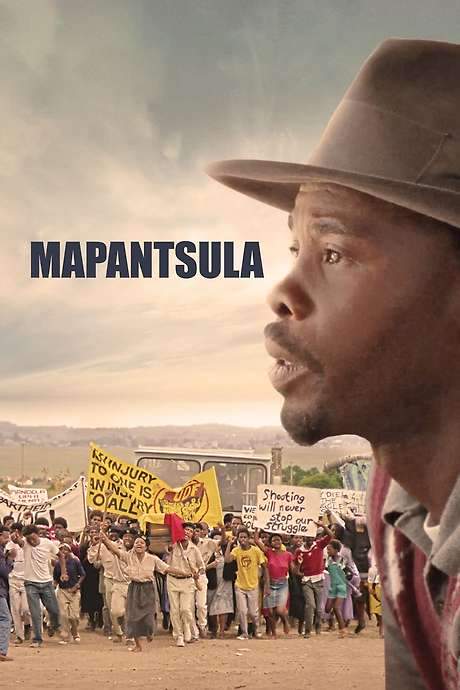
Mapantsula 1988

Directed by

Oliver Schmitz
Made by

David Hannay Productions
Where to Watch Mapantsula
See current US streaming, rental, and purchase options for Mapantsula (1988) via JustWatch.

Film Movement Plus
HD
Film Movement Plus Amazon Channel
HD
Hoopla
SD
Kanopy
HD
Amazon Video
SD
Apple TV Store
HD
Fandango At Home
SD
Google Play Movies
SD
YouTube
SD Streaming availability powered by 
Mapantsula Plot Summary
Read the complete plot summary and ending explained for Mapantsula (1988). From turning points to emotional moments, uncover what really happened and why it matters.
Mapantsula opens with a raw, image-heavy sequence: protests surge through the streets and police vehicles haul away Black South Africans, a stark reminder of the Internal Security Act being weaponized to break up gatherings. In the middle of this tension, Panic Thomas Mogotlane and his partner in crime, Dingaan Darlington Michaels, stage a bold theft, slipping a wallet from a wealthy white man under the threat of a knife. Their adrenaline-fueled victory is quickly checked as they retreat to a corner store to recount the night, sharing a moment of laughter that owes more to luck than to any grand plan. Dingaan’s casual remark—“Eh man, we should stop this.”—lands as a chilling reminder of how easily desperation can blur the line between thrill and risk. > Eh man, we should stop this.
The film then shifts to Panic’s life in Soweto, where he rents a cramped one-room home from Ma Mobise Dolly Rathebe. She is patient but practical, warning him that the neighborhood is already buzzing with rent hikes and grievances, and urging him to stay out of trouble. Panic’s relationship with work, money, and responsibility threads through his days: Pat, his girlfriend, is a housemaid who is pulled into the white world’s rhythms, and Panic’s attempt to connect with her is continually blocked by economic realities and social hierarchies. Ma Mobise’s insistence on paying the rent and her son Sam Eugene Majola listening in on the street time together with escalating tension—that rent is more than money; it’s the city’s demand that people like Panic keep navigating a system that rarely lets them breathe easy.
When Panic’s past catches up with him, the film cuts to a prison cell filled with other inmates, where an officer interrogates Panic about a long list of alleged crimes. The officer’s line—“I see you’ve been working for us”—lands as a chilling insinuation that the state’s surveillance extends far beyond the moment. The narrative then spirals through a series of flashbacks that reveal Panic’s earlier escapades, the thrill of stealing and the lure of quick money, punctuated by dangerous nearly-confrontations with people who doubt his loyalty and harder moments of confrontation with authority.
A key thread runs through Panic’s days: a simmering tension with Pat and a persistent sense of being watched. He recalls a day when he followed a would-be thief, only to be recognized by another man who claims Panic has already sold out to the authorities. A confrontation in a bar follows, a moment in which Panic feels he must defend his own name against accusations that he’s become a paid informer. The moment serves as a touchstone for the film’s exploration of trust, loyalty, and the murky moral gray areas that people inhabit under an oppressive regime.
The narrative expands to the social and political foreground: Pat becomes involved with Duma, a vocal critic who stands against the mayor’s policies and the city’s broader power structure. Duma’s voice resonates at gatherings where the African National Congress’ hopes come to life, especially as Sam insists on action against rents and the injustices faced by Soweto’s residents. Panic’s world continues to collide with Joyce, the white employer who employs Pat, and whose house and expectations become another stage for the power dynamics at play. The tension escalates when Panic, in a bid to see Pat again, clashes with Joyce and is forced to retreat, breaking a window with a brick in a moment of impulsive desperation.
Duma’s presence deepens the plot’s political resonance, and the tension between the state and anti-apartheid activists intensifies. Panic’s attempts to safeguard Pat and to protect his own fragile sense of identity become entwined with the community’s struggle to survive under constant police scrutiny. The film returns to the office of a police inspector where Panic’s fate seems increasingly bound to the agency’s need to control dissent. The moment is punctuated by a haunting sensation of surveillance and coercion that pervades every scene.
Meanwhile, life in Soweto hosts a funeral that is halted by the police, a moment that becomes a microcosm of the larger fight for rights and dignity. Panic learns that Sam has drifted into close company with Duma, who is hiding from the authorities. Panic’s instinct to protect his friends and his future leads him to Lucky’s place, hoping to find some leverage or a path to safety, but the result is a dead end, with police detectives staking out the area. The tension between loyalty to friends and fear for one’s own safety becomes a constant drumbeat.
In the prison’s dim light, Panic endures humiliation as Stander—an emblem of the state’s surveillance apparatus—pressures him, attempting to coerce a confession. Panic’s resolve hardens as flashbacks reveal the riot that followed Sam’s death: Ma Mobise leads the crowd in a cry for justice, a moment that shatters control and invites chaos. The riot erupts, Sam is hauled away, and Panic and Duma scatter through the confusion, trying to stay ahead of soldiers who are bent on ending dissent by force. The city’s mood shifts from protest to clashes, from quiet fear to raw, unfiltered anger.
As the film nears its conclusion, Panic confronts the deeper truth of his situation. In a tense sequence inside Lucky’s house, he discovers Duma’s presence once again, but the moment ends in a frantic chase, with detectives closing in and panic and Duma forced to flee. The closing sequence ties together the riot, the personal betrayals, and the battered sense of trust that has been eroded by years of state oppression. The papers Stander asks Panic to sign—meant to be a confession of aiding Duma—lie before him, and he faces a stark moment of moral choice. In a powerful close, Panic looks straight into the camera and refuses to sign the confession, choosing a path of personal integrity in the face of systemic coercion.
Mapantsula is a densely woven portrait of a man navigating the pressures of poverty, loyalty, and the political forces that seek to define who belongs and who must disappear. Its texture is built from small, telling moments—the rent notices that feel like fines on life itself, the quiet conversations in bar rooms, the uneasy glances in crowded streets, and the small acts of rebellion that accumulate into a larger demand for dignity. The film uses Panic’s journey to illuminate Soweto’s everyday resistance, showing how ordinary people become agents of change when confronted with overwhelming odds. It is a meditation on how a life can be shaped by the competing claims of love, survival, and the fight for justice, and how a moment of quiet defiance can become a powerful statement against a system designed to keep people subdued.
Note: The first-time mentions of the cast characters include direct references to the actors: Panic Thomas Mogotlane, Dingaan Darlington Michaels, Ma Mobise Dolly Rathebe, Pat Thembi Mtshali, Sam Eugene Majola, and Duma Peter Sephuma.
Mapantsula Timeline
Follow the complete movie timeline of Mapantsula (1988) with every major event in chronological order. Great for understanding complex plots and story progression.
Arrest during protest
The film opens with a heated protest and a brutal police crackdown. A voiceover reminds viewers that those detained violated the Internal Security Act by gathering without permission. Panic, along with other prisoners, is herded into a crowded cell, marking the beginning of his perilous life under apartheid.
First robbery with Dingaan
Panic and his partner Dingaan ambush a white man on a busy Johannesburg street, wielding a knife as the victim resists. They loot his wallet and later celebrate at a corner store, trading bravado about their misdeeds. Dingaan even suggests they quit, but Panic's temperament remains reckless.
Soweto home life and Ma Mobise’s warning
Panic returns to the Soweto township and rents a small one‑room home from Ma Mobise. She warns him to stay out of trouble, noting his tsotsi image and the burden of rising rents. Her son Sam listens as the talk unfolds.
Stander’s first interview with Panic
Panic is brought into Stander’s orbit as the police begin to interrogate him. In the office, Stander asks whether Panic speaks Afrikaans, and Panic replies that he does not. The exchange signals the growing scrutiny Panic will face from the authorities.
Prison interrogation begins
Back in prison, Panic is interrogated about his extensive criminal history as cells overflow with detainees. Stander implies Panic has been working for the police, highlighting the uneasy lines between informant and suspect. Panic resists, but the pressure mounts as the system tightens around him.
Pat and money; Joyce’s rejection
Pat, Panic’s girlfriend, works as a housemaid for Joyce, a white employer. Panic asks Joyce for money, but she sends him away, deepening his financial precarity. Ma Mobise lectures Panic about rising rents and the need to stay out of trouble.
Bar confrontation and terrorism accusation
Panic and Dingaan reconvene in a bar after a failed theft, where a thief confronts Panic about his jail record. A white officer arrives and accuses the group of terrorists, underscoring the state’s punitive framing of Black suspects. Panic is eventually hauled to Stander’s office for questioning.
Second theft attempt and escalation
Panic dresses in a suit and visits Joyce’s house to see Pat, who sends him away in anger. Joyce brings a dog to threaten him, and Panic retaliates by throwing a brick through her window. The incident further destabilizes his precarious ties to Pat and Joyce.
Pat fired; Sam and the ANC gathering
Pat is fired from her job as a housemaid. Sam takes Pat to a local African National Congress gathering where residents press the mayor to curb rent increases. Duma speaks out against the mayor and the current order, widening Panic’s political stakes.
Mall trouble and Dingaan’s exit
Panic and Dingaan target a wealthy shopper in a mall, but the man resists. Panic stabs him, and the duo flee to a movie theater. Afterward, Dingaan tells Panic he wants nothing more to do with him, deepening Panic’s isolation and resolve.
Funeral riot and Sam’s fate
A funeral in Soweto provokes a violent police response, and Sam is taken away as the crowd riots. Ma Mobise runs into the street to demand justice and is shot in the chaos. Panic and Duma slip through the turmoil, hunted by soldiers.
Final confession and Panic’s stand
In Stander’s office a record- and riot-based confession is placed before Panic, accusing him of aiding Duma. Panic refuses to sign the confession, staring straight at the camera as the film ends.
Mapantsula Characters
Explore all characters from Mapantsula (1988). Get detailed profiles with their roles, arcs, and key relationships explained.
Panic - Thomas Mogotlane
A young Soweto resident and petty criminal who survives through street-level theft and scams. His life is defined by tension with the authorities, a fraught relationship with Pat, and an uneasy bond with Duma. He navigates loyalty, risk, and the pressure of a system that labels him a terrorist.
Stander
A police inspector who uses intimidation and surveillance to extract information. His interactions with Panic reveal a morally grey world where coercion masks power. He embodies the state’s reach and the pressure applied on Black communities.
Ma Mobise
A landlady and mother figure who anchors Panic’s world in Soweto. She pushes him to pay his rent and stay out of trouble, grounding the story in daily caretaker responsibilities within a segregated economy. Her guidance and frustration highlight the personal costs of political turmoil.
Dingaan
Panic’s partner in crime who is more willing to push the edge of the criminal path. Their relationship shows competing impulses between thrill-seeking and pragmatism, and Dingaan’s desire to disengage foreshadows a rift in their alliance.
Pat
Panic’s girlfriend, a housemaid who balances love, economic precarity, and political awareness. Her job and life in a white household expose the social divides of apartheid-era South Africa and influence Panic’s decisions.
Duma
A politically active figure in the ANC-linked circle, he becomes a focal point around whom Panic’s loyalty and fear rotate. His presence heightens the film’s tension between personal survival and political obligation.
Sam
Ma Mobise’s son, a youth drawn into political life who is killed during a riot, becoming a catalyst for community anger and protests. His death motivates the crowd and escalates the conflict in Soweto.
Joyce
Pat’s employer, a white woman whose household embodies the racial and economic divides of the era. Her interactions with Panic reflect the broader social hierarchy that shapes character choices.
Mapantsula Settings
Learn where and when Mapantsula (1988) takes place. Explore the film’s settings, era, and how they shape the narrative.
Time period
1980s, Apartheid South Africa
The story unfolds during the late 1980s, a period of intensified anti-apartheid protests and state crackdowns. The Internal Security Act is invoked to arrest Black South Africans for gathering or inciting riots, highlighting the regime’s reach. Riots and police responses punctuate everyday life in the townships and city streets.
Location
Johannesburg, Soweto
Mapantsula is set in late-1980s Johannesburg and the Soweto township, where crowded streets, markets, and a heavy police presence shape daily life. The city is a stage for protests, rent struggles, and street-level crime under apartheid. The social divide between wealthy white areas and impoverished townships forms a stark backdrop to Panic’s world.
Mapantsula Themes
Discover the main themes in Mapantsula (1988). Analyze the deeper meanings, emotional layers, and social commentary behind the film.
✊
Resistance
Panic's criminal street actions, his ties to Duma, and the broader struggle around Sam’s death show how ordinary people push back against an oppressive system. The film presents resistance as a moral choice shaped by loyalty, fear, and the demand for dignity. Protests, confrontations, and the funeral riot underscore the collective urge for justice.
💥
Oppression
Stander’s intimidation, surveillance, and the use of confinement reveal the brutal tools of the apartheid state. The Internal Security Act and police raids illustrate how power is exercised to suppress dissent and control Black communities. The film portrays oppression as a pervasive, intrusive force in daily life.
💼
Socioeconomic Struggle
Rent increases, precarious work, and economic exploitation frame the personal lives of Panic and Pat. Ma Mobise’s concerns about keeping a roof over her family’s head and Pat’s job as a housemaid highlight class tensions within a segregated society. The struggle to survive intersects with political conflict, shaping choices and loyalties.

Coming soon on iOS and Android
The Plot Explained Mobile App
From blockbusters to hidden gems — dive into movie stories anytime, anywhere. Save your favorites, discover plots faster, and never miss a twist again.
Sign up to be the first to know when we launch. Your email stays private — always.
Explore the mobile appMapantsula Spoiler-Free Summary
Discover the spoiler-free summary of Mapantsula (1988). Get a concise overview without any spoilers.
In the cramped streets of Sowoto during the height of apartheid, the city pulses with protest, police intimidation, and the daily grind of survival. The film opens with a stark visual collage of demonstrations and the ever‑present threat of the Internal Security Act, establishing a world where every breath feels monitored. Within this pressure cooker lives Panic, a quick‑witted petty gangster whose talent for navigating the urban underbelly is matched only by his yearning for a life beyond constant danger. The atmosphere is gritty and unflinching, a raw portrait of a community caught between oppression and resistance.
Around Panic swirl a cast of familiar faces that anchor his world. Dingaan, his partner in minor schemes, offers a cynical counterpoint that hints at the thin line between survival and self‑destruction. The modest one‑room flat he rents from Ma Mobise is a microcosm of the larger struggle, her pragmatic concerns about rent hikes and collective dignity echoing the neighborhood’s simmering unrest. Pat, his girlfriend, works as a housemaid, and her everyday interactions with the white household she serves reveal the stark social hierarchies that define personal relationships. Their younger brother Sam and the outspoken activist Duma embody the growing anti‑apartheid movement, bringing political urgency into the personal spaces where Panic roams.
Caught between the lure of easy money and the magnetic pull of a united stand against an unjust system, Panic faces a quiet but powerful dilemma. The tone remains taut, balancing moments of dark humor with the ever‑present dread of surveillance, while the city’s rhythm—a mixture of street chatter, distant drums of protest, and the clatter of everyday life—keeps his options in constant flux. As the community’s push for dignity intensifies, Panic must weigh his instinct for individual gain against the dawning realization that true survival may lie in collective resistance. This tension sets the stage for a compelling exploration of loyalty, identity, and the price of defiance.
Movies with Similar Twists and Themes
Uncover films that echo the narrative beats, emotional arcs, or dramatic twists of the one you're exploring. These recommendations are handpicked based on story depth, thematic resonance, and spoiler-worthy moments — perfect for fans who crave more of the same intrigue.





Featured on this page

What's After the Movie?
Not sure whether to stay after the credits? Find out!
Check out our other apps:

SAT Sphere
Build confidence for the Digital SAT.

Mori Atlas
Discover wild places worth protecting.

Luntero
Search smarter for a home in Amsterdam.

Plot Explained
Unravel movie endings and hidden clues.

Pokechamp
Dive into Pokémon data and battle logic.

Driving Theory
Get ready for your European theory test.

Movie Dust
Plan your next cinema trip with ease.

Musemap
Find art and culture as you travel.

Selkobase
Compare credentials before committing.

Local Manual
Turn an unfamiliar country into practical next steps.

Lernavi
Compare school systems before your next move.

GymRoam
Find a workout stop wherever your plans take you.
Explore Our Movie Platform
New Movie Releases (2026)
Famous Movie Actors
Top Film Production Studios
Movie Plot Summaries & Endings
Major Movie Awards & Winners
Best Concert Films & Music Documentaries
Movie Collections and Curated Lists
© 2026 What's After the Movie. All rights reserved.
Privacy Policy