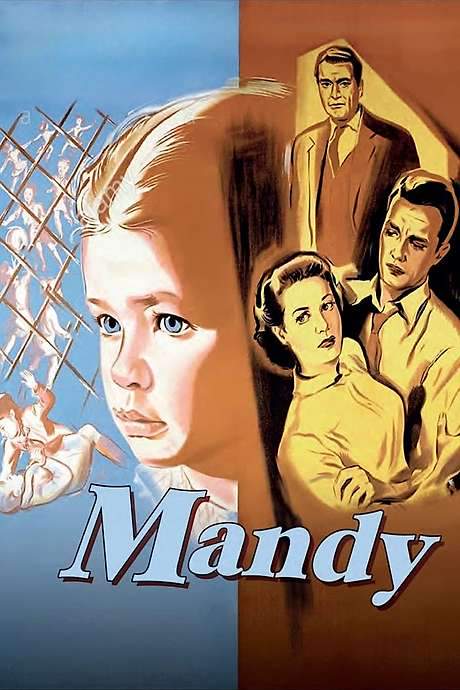
Mandy 1952

Directed by

Alexander Mackendrick
Made by

Ealing Studios
Mandy Plot Summary
Read the complete plot summary and ending explained for Mandy (1952). From turning points to emotional moments, uncover what really happened and why it matters.
Christine Garland, Phyllis Calvert, has a young deaf daughter, Mandy. Her husband Harry Garland, Terence Morgan, is away from home, and the family is trying to adjust to Mandy’s needs. As they confront the challenge of Mandy’s communication, they enroll her in special education classes in hopes she will learn to speak. The process places pressure on their marriage, stirring arguments and strain between Christine and Harry, and it opens up the possibility of additional tension as Christine and the school’s headmaster, Dick Searle, Jack Hawkins, grow closer in the care and attention Mandy receives.
Mandy’s journey toward speech begins in a creative moment: a balloon helps her feel the vibrations of sound, proof that she has produced something audible. This breakthrough marks a turning point for the family, even as it complicates the adults’ relationships. When Harry returns and suggests pulling Mandy out of the school for a private alternative, Christine refuses to give up on the public program that has begun to unlock her daughter’s voice.
Dick Searle’s steady, patient guidance helps Mandy progress, and the moment of real progress arrives when she finally articulates the word that has been eluding her for so long. The scene underscores the professional commitment of Searle, but it also heightens the unease felt by Ackland, Searle’s superior, played by Edward Chapman, who is unhappy about the potential personal entanglement between Searle and Christine.
The tension reaches a breaking point as word of the personal relationship travels. Harry Garland, still staying with his parents in a grand London townhouse, confronts Ackland with the implications of the affair. The confrontation leads to a decisive family moment: Harry takes Mandy out of the school and brings her to the family home. In the back garden that overlooks a bombed-out area, Mandy experiences a scene full of hesitation and hope as children nearby invite her to join them in play. The parents watch as Mandy is coaxed to rejoin the world of children, and, with her parents behind her, she speaks the name that matters most to her, a first victory shared by the whole family.
In the end, the film remains intimate and focused on Mandy’s voice and the resilience of a family navigating loss, learning, and new beginnings. The quiet triumph of a child finding a way to say her own name—“Mandy”—becomes a poignant moment of connection for everyone involved, a small but powerful reminder of how perseverance, support, and patience can open doors that words alone cannot immediately unlock.
Mandy Timeline
Follow the complete movie timeline of Mandy (1952) with every major event in chronological order. Great for understanding complex plots and story progression.
Realisation of Mandy's deafness and decision to seek help
Christine and Harry Garland realise Mandy is deaf and in need of specialized help. They enroll her in special education classes to encourage speech. The process puts a strain on their marriage and raises questions about their relationship with Dick Searle, the school headmaster. Hope and tension mingle as the family adjusts to Mandy's new reality.
School enrollment begins; marital strain grows
Mandy's enrollment in the school for the deaf marks a turning point for the family. Therapy and daily routines spark disagreements between Christine and Harry about Mandy's future. The hints of an affair between Christine and Searle complicate the dynamic further. The household remains tense as Mandy begins her training.
Hints of an affair between Christine and Searle
The film hints at a possible affair between Christine and Dick Searle, the headmaster, fueling distrust. The couple navigates professional boundaries while rumors swirl around the school. The pressure from the situation weighs on Mandy's progress.
First breakthrough: Mandy learns to vocalize using a balloon
During therapy, Mandy achieves her first speech by using a balloon to feel sound vibrations. She senses the sound she has made, marking a breakthrough in her speech development. Searle continues patient, focused training to build on the moment. The moment gives the family guarded optimism.
Harry returns home and opposes the school option
Harry returns home and demands Mandy be withdrawn from the school and placed in a private setting. Christine resists, arguing that the school offers the best chance for Mandy's future. The couple's disagreement highlights how the child's education splits their already fragile marriage. Mandy remains engaged in the process, not fully understanding the tension.
Searle's determined training continues
Searle perseveres with the training despite resistance from others and the strain of personal rumors. He maintains focus on Mandy's progress and pushes forward with exercises and speech drills. Mandy shows incremental improvements under his guidance. The professional boundary line becomes a source of tension behind the scenes.
Progress toward the word 'Mama'
The training reaches a pivotal milestone as Mandy articulates the word 'Mama'. The moment confirms the effectiveness of Searle's methods and Mandy's capacity for speech. Christine and Searle share a charged moment, masked by the surrounding scrutiny.
Ackland's disapproval about the relationship
Ackland, Searle's boss, grows unhappy about the perceived relationship between Christine and Searle. Word reaches Searle about the concerns, complicating his position at the school. The professional environment becomes strained as rumors circulate.
Harry learns of the affair and confronts Ackland
Word reaches Harry that there may be more to Christine and Searle than professional respect. He travels to speak with Ackland to address the situation. The confrontation foregrounds a broader clash between duty, marriage, and ambition.
Harry takes Mandy away to his parents' house
Harry takes Mandy out of the school and brings her to his parents' large London townhouse. The move marks a family decision to change Mandy's environment. Mandy experiences sadness as she leaves the known therapy and classmates behind.
Mandy adapts to the new environment
The new arrangement leaves Mandy unsettled, missing the school routines and the bond with Searle. Her parents wrestle with how to maintain progress without the structured therapy she received at the school. The emotional strain on Mandy grows as the family navigates their options.
Final moment: Mandy says 'Mandy' with parents behind
In the back garden overlooking a bomb-site where children play, Mandy is invited to join in. With her parents standing behind her, she speaks the name 'Mandy' for the first time. The scene captures a long-awaited moment of recognition and a hopeful note for her future.
Mandy Characters
Explore all characters from Mandy (1952). Get detailed profiles with their roles, arcs, and key relationships explained.
Christine Garland (Phyllis Calvert)
A devoted mother whose vulnerability and determination drive the family’s search for Mandy’s voice. She resists removing Mandy from school despite mounting pressures and the strain on her marriage, while navigating hints of an affair with the headmaster.
Mandy Garland (Mandy Miller)
A young deaf girl whose progress in speech therapy marks the emotional heart of the story. She learns to sense sound through vibration and, in a pivotal moment, speaks her first word, 'Mama,' underscoring resilience amid family turmoil.
Harry Garland (Terence Morgan)
Mandy’s father, largely away at first and then returning to challenge the school’s role in his daughter's life. He pushes to pull Mandy out of the school and into a private setting, adding pressure to a fragile marriage.
Dick Searle (Jack Hawkins)
Headmaster of the deaf school who perseveres with Mandy’s training but becomes entangled in a potential affair with Christine. His professional commitment clashes with personal dynamics surrounding the family.
Ackland (Edward Chapman)
Ackland, Searle’s superior, disapproves of the personal relationship developing between Searle and Christine and acts as a pressure point in the power dynamics between the school and Mandy’s family.
Mandy Settings
Learn where and when Mandy (1952) takes place. Explore the film’s settings, era, and how they shape the narrative.
Time period
Early 1950s
Postwar Britain provides the backdrop, a time of rebuilding and tightened social mores. Bomb-sites dot the urban landscape, underscoring a city in transition. Education for the deaf is a central concern, and the era shapes how relationships and authority are navigated. The period's mix of resilience and restraint frames the characters' choices.
Location
London, School for the Deaf
The story is set primarily in London, anchored by the Garlands' large townhouse and the deaf school where Mandy receives therapy. The back garden overlooks a bomb-site, a stark reminder of postwar Britain. Scenes move between the domestic space and Mandy's education, with the school acting as a focal point for family tension. The settings reflect the era's social pressures and the hope of rehabilitation through communication.
Mandy Themes
Discover the main themes in Mandy (1952). Analyze the deeper meanings, emotional layers, and social commentary behind the film.
🗣️
Communication
Mandy's deafness drives the plot and reveals how language, or the lack of it, shapes family bonds. The film highlights speech therapy and nonverbal cues as pathways to connection, culminating in Mandy's first clear word, 'Mama.' The balloon demonstration shows sound as vibration, illustrating the patience and persistence needed to teach new voices. Communication becomes a battleground for love, hope, and frustration.
💔
Family Strife
The marriage is tested as Mandy's condition alters family priorities and trust. Hints of an affair between Christine and Searle intensify the tension and threaten domestic stability. Harry's insistence on pulling Mandy from the school clashes with Christine's resolve to maintain her daughter's education. The family fights to preserve unity amid competing loyalties.
🏫
Education & Ethics
The school for the deaf is portrayed as both a beacon of progress and a site of ethical tension. Searle's dedication to Mandy's training collides with personal boundaries and professional propriety, observed by Ackland. Mandy's progress—culminating in a hopeful vocal milestone—meets the costs of the characters' choices. The narrative probes how educators balance care, ambition, and moral responsibility.

Coming soon on iOS and Android
The Plot Explained Mobile App
From blockbusters to hidden gems — dive into movie stories anytime, anywhere. Save your favorites, discover plots faster, and never miss a twist again.
Sign up to be the first to know when we launch. Your email stays private — always.
Explore the mobile appMandy Spoiler-Free Summary
Discover the spoiler-free summary of Mandy (1952). Get a concise overview without any spoilers.
Set against the backdrop of early-1950s London, the story explores the quiet struggles and profound resilience of a family facing an isolating challenge. At the heart of the narrative is young Mandy, a girl born deaf who has remained mute throughout her early childhood. Her silence casts a shadow over the lives of her parents, Christine and Harry Garland, shaping the emotional climate of a household where communication is a constant hurdle and the future feels uncertain.
As Mandy approaches school age, the fabric of the family begins to fray under the weight of differing perspectives on how best to raise her. With her husband often away, Christine shoulders the burden of finding a way to reach her daughter, a quest that leads her to a residential school dedicated to teaching oral communication to deaf children. This discovery offers a glimmer of hope, promising a chance for Mandy to find her voice and engage with a world that has largely been closed to her.
The introduction of the school and its headmaster, Dick Searle, brings new energy to Mandy’s life but also introduces complex dynamics for the adults involved. As the parents navigate the educational system and the emotional toll of their decisions, the film captures the delicate balance between professional guidance and personal attachment. The narrative remains intimate and focused, observing how the pursuit of a single voice can ripple through the lives of an entire family.
Movies with Similar Twists and Themes
Uncover films that echo the narrative beats, emotional arcs, or dramatic twists of the one you're exploring. These recommendations are handpicked based on story depth, thematic resonance, and spoiler-worthy moments — perfect for fans who crave more of the same intrigue.






Featured on this page

What's After the Movie?
Not sure whether to stay after the credits? Find out!
Check out our other apps:

SAT Sphere
Build confidence for the Digital SAT.

Mori Atlas
Discover wild places worth protecting.

Luntero
Search smarter for a home in Amsterdam.

Plot Explained
Unravel movie endings and hidden clues.

Pokechamp
Dive into Pokémon data and battle logic.

Driving Theory
Get ready for your European theory test.

Movie Dust
Plan your next cinema trip with ease.

Musemap
Find art and culture as you travel.

Selkobase
Compare credentials before committing.

Local Manual
Turn an unfamiliar country into practical next steps.

Lernavi
Compare school systems before your next move.

GymRoam
Find a workout stop wherever your plans take you.
Explore Our Movie Platform
New Movie Releases (2026)
Famous Movie Actors
Top Film Production Studios
Movie Plot Summaries & Endings
Major Movie Awards & Winners
Best Concert Films & Music Documentaries
Movie Collections and Curated Lists
© 2026 What's After the Movie. All rights reserved.
Privacy Policy