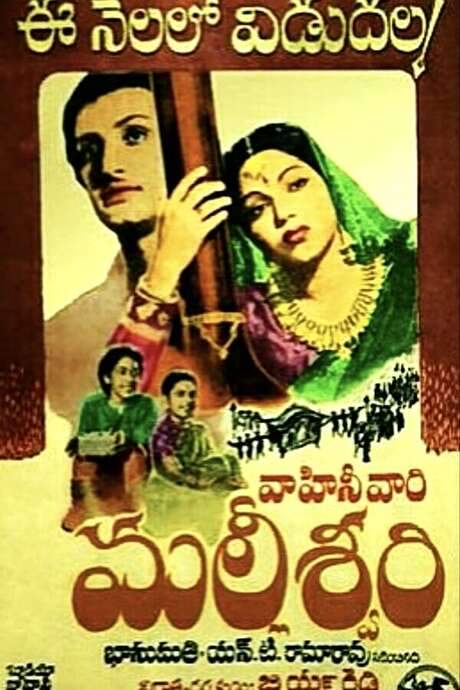
Malliswari 1951

Directed by

B.N. Reddi
Made by

Vauhini
Where to Watch Malliswari
See current US streaming, rental, and purchase options for Malliswari (1951) via JustWatch.

Streaming availability powered by 
Malliswari Plot Summary
Read the complete plot summary and ending explained for Malliswari (1951). From turning points to emotional moments, uncover what really happened and why it matters.
During the reign of the Vijayanagara Empire, Rani Vasam was a long-standing tradition described as a boon for young women. Under this system, breaking news of a palanquin arriving at a family’s doorstep could seal a future for a daughter as the official resident of the royal palace. Large sums in gold and jewellery were offered to parents in exchange for their consent, but once chosen, these women were isolated from contact with men and required permission for visits. Breach of the rule carried a severe penalty, including execution.
Nagaraju N.T. Rama Rao and Malliswari Bhanumathi of Veerapuram are cross-cousins who grew up as close friends, sharing joys and troubles from childhood. The bond between them irks Malliswari’s mother, Nagamma, who views Nagaraju and his family with resentment rooted in class differences. Nagamma’s disapproval is echoed by the village round, as Narappa—Malliswari’s father and village head—stands as a quiet observer, while Hanumanthappa, Malliswari’s uncle, wields influence as a minister in Krishnadevaraya’s court. The young duo’s friendship becomes a point of tension within the family, especially as Nagamma pushes for Malliswari’s future within the palace walls, which would sever their kinship.
One day, a chance visit to a nearby village leads Nagaraju and Malliswari to shelter in a mandapa during a rainstorm. In the same sheltered space, Krishnadevaraya and Allasani Peddana, along with a contingent of soldiers, discover Malliswari’s striking talent as both a singer and dancer. Unaware of each other’s royal identities, Nagaraju and Malliswari exchange thoughts, and Nagaraju seizes the moment to suggest Malliswari be recommended to Krishnadevaraya for the fabled Rani Vasam. Malliswari views this as a prank, while Nagamma presses for her daughter’s removal to the palace, and Narappa quietly hopes for Malliswari’s marriage to Nagaraju.
Driven by a growing sense of duty and aspiration, Nagaraju decides to leave Veerapuram to earn wealth and win Nagamma’s approval for marriage to Malliswari. His path takes him to Vijayanagara, where he trains as a sculptor and eventually finds success. Yet the reunion with Malliswari remains on hold, for Krishnadevaraya and Tirumaladevi appoint Malliswari as the official resident of the palace, granting her the status of Rani Vasam. This turn of events throws Malliswari into a life of opulence and danger, while Nagamma’s cravings for wealth and status push her to increase the pressure on Malliswari. As Malliswari is drawn deeper into palace life, Nagaraju returns, only to be confronted with the consequences of these political moves and the aching ache of separation.
The narrative thickens as Nagamma aggressively pushes Malliswari toward the palace, and Nagaraju, upon discovering what has happened, sinks into depression. Govindamma, Nagaraju’s mother, begins to falter under the weight of his withdrawal into a life of retreat, haunted by memories of Malliswari. A group of sculptors eventually invites Nagaraju to accompany them back to Vijayanagara to construct a special mandapa for dancers, and he agrees. It is there, at last, that he encounters Malliswari again.
However, their romance faces another obstacle: Malliswari’s maid, Jalaja, fears the severe punishment for any breach of the Rani Vasam rules. Jalaja secretly arranges a midnight meeting for the lovers on the banks of the Tungabhadra river, hoping to safeguard them by arranging a private moment away from prying eyes. The lovers’ path once again crosses the center of power when Krishnadevaraya and his ministers attend the newly built dance hall, and they learn that Nagaraju is among the commissioned sculptors.
That night, Malliswari wishes to meet Nagaraju but is delayed because the palace plans a formal performance of Usha Parinayam, with Krishnadevaraya and Tirumaladevi in attendance. Nagaraju, waiting near the Tungabhadra, slips into the palace and is pursued by soldiers, while Malliswari spots him from afar and calls out his name. To save Malliswari from a death sentence under Rani Vasam, Nagaraju pretends not to recognize her, but the pair soon find themselves jailed for violating the palace’s strict rules.
In the tension that follows, Jalaja reveals the lovers’ true story to Tirumaladevi, and she admits that Malliswari once refused any help and chose to face death with Nagaraju rather than bow to the palace’s demands. The next morning, as the nooses are prepared, the lovers confront Krishnadevaraya. A passionate confrontation ensues in which Nagaraju blames the king for orchestrating Malliswari’s forced entry into Rani Vasam, while Krishnadevaraya defends his actions and champions the lovers’ bond. Ultimately, the emperor forgives both Nagaraju and Malliswari, and their union is celebrated in a grand royal ceremony within the palace, marking a hopeful end to a tale woven from tradition, loyalty, and the enduring pull of true love.
Malliswari Timeline
Follow the complete movie timeline of Malliswari (1951) with every major event in chronological order. Great for understanding complex plots and story progression.
Origins of Rani Vasam and childhood bond
In Veerapuram, the Rani Vasam tradition is described as the palace's official residence for selected women, with wealth offered to families. Nagaraju and Malliswari grow up as close cross-cousins and friends. Krishnadevaraya and others later notice Malliswari's singing and dancing talent, prompting Nagaraju to seek her Rani Vasam.
Family conflict over Malliswari's future
Nagamma presses for Malliswari to enter Rani Vasam, while Narappa hopes she will marry Nagaraju. Nagamma insults Nagaraju and Govindamma, deepening class tensions. Nagaraju resolves to leave Veerapuram to earn money and win approval from Nagamma.
Nagaraju becomes a sculptor in Vijayanagara
Nagaraju travels to Vijayanagara and becomes a successful sculptor, building wealth and status. He plans to return to Veerapuram to marry Malliswari, but fate intervenes.
Malliswari appointed as Rani Vasam
Krishnadevaraya and Tirumaladevi appoint Malliswari as the official resident of the palace, granting her Rani Vasam. The decision changes her life from a village girl to a royal ward.
Nagamma sends Malliswari to the palace
Nagamma forcibly sends Malliswari to the palace to begin her role as Rani Vasam. Nagaraju returns to Veerapuram and discovers Malliswari is gone, leaving him crushed and confused.
Govindamma's instability and Nagaraju's withdrawal
Govindamma grows unstable as Nagaraju withdraws into a life of solitude, clinging to memories of Malliswari. The family grief deepens while the future of Malliswari's fate looms over Veerapuram.
Nagaraju joins Vijayanagara sculptors
A group of sculptors invites Nagaraju to Vijayanagara to build a new mandapa for dancers. There, he encounters Malliswari again, though their love must be kept secret.
Midnight meeting at Tungabhadra
Jalaja, Malliswari's maid, learns of the danger the lovers face and arranges a clandestine meeting on the banks of the Tungabhadra at midnight. She fears the Rani Vasam rules could seal their fate.
Dance hall revelation
Krishnadevaraya and his ministry attend the newly built dance hall and discover Nagaraju among the sculptors. The two lovers plan to meet again that night, despite the palace's watchful eyes.
Palace entry and pursuit
Nagaraju, waiting near the Tungabhadra, slips into the palace and is chased by soldiers. Malliswari sees him and calls out, yet the guards pursue them.
Jailed for Rani Vasam violation
To save Malliswari from hanging, Nagaraju pretends not to recognize her, and the two are jailed for violating Rani Vasam's rules. Jalaja's fears heighten the danger.
Jalaja reveals the love story
Jalaja reveals the lovers' story to Tirumaladevi, including Malliswari's choice to refuse help and to die with Nagaraju. The revelation heightens the pressure on the royal court.
Morning confrontation with the king
The next morning, hanging nooses are prepared as the lovers face execution. They meet Krishnadevaraya, who defends his actions and reminds Nagaraju that he himself urged Malliswari to Rani Vasam.
Forgiveness and grand wedding
Krishnadevaraya forgives both Nagaraju and Malliswari, and their marriage is celebrated in a grand ceremony at the palace. The forgiveness brings relief to their families and marks the tale's hopeful ending.
Malliswari Characters
Explore all characters from Malliswari (1951). Get detailed profiles with their roles, arcs, and key relationships explained.
Nagaraju (N.T. Rama Rao)
A cross-cousin from Veerapuram who pursues a hopeful rise in life through artistry and ambition. He becomes a skilled sculptor in Vijayanagara, planning to win Malliswari's hand, and remains steadfast in his love despite social obstacles. His passion drives him to risk everything for a future with Malliswari, even as he wrestles with duty to family.
Malliswari (Bhanumathi)
A talented singer and dancer from Veerapuram who is sent to the palace as part of the Rani Vasam tradition. She embodies grace and resilience, torn between her romantic bond with Nagaraju and the pressure of palace life. Her journey reveals the struggle between personal desire and the expectations of wealth and status.
Krishnadevaraya
King of Vijayanagara, a powerful ruler who patronizes the arts and presides over the palace's intricate politics. He orchestrates the arrangements around Malliswari's Rani Vasam and later offers forgiveness, navigating between mercy and authority. His actions reveal the complexities of leadership and duty.
Nagamma
Malliswari's mother, a forceful matriarch who wields wealth and status to push her daughter into royal life. Her ambitions create tension within the family and drive the fate of Malliswari and Nagaraju. She embodies the social pressures and greed that threaten personal happiness.
Tirumaladevi
Queen of Vijayanagara and Krishnadevaraya's wife, she becomes a key mediator who understands the human side of the palace's rigid rules. She helps reveal the lovers' true feelings and participates in the moral resolution of the tale. Her presence adds nuance to the courtly balance of power and compassion.
Malliswari Settings
Learn where and when Malliswari (1951) takes place. Explore the film’s settings, era, and how they shape the narrative.
Time period
Early 16th century
The events take place during the Vijayanagara Empire, a period known for majestic courts and rich patronage of arts. King Krishnadevaraya's reign frames palace life and the strict rules surrounding royal residences. The era is marked by cultural flourishing, yet gendered constraints that underpin the central conflict of the plot.
Location
Veerapuram, Vijayanagara, Tungabhadra River
The story unfolds in the rural village of Veerapuram and the royal capital Vijayanagara. Palace courtyards, mandapas, and the grand dance halls anchor the drama, while the Tungabhadra river provides a quiet, reflective backdrop. The Rani Vasam tradition sets the stage for the social and political pressures that drive the characters.
Malliswari Themes
Discover the main themes in Malliswari (1951). Analyze the deeper meanings, emotional layers, and social commentary behind the film.
❤️
Love vs Tradition
Nagaraju and Malliswari's bond challenges the rigid expectations of family, class, and palace protocol. Their relationship must navigate the perilous line between personal happiness and public duty. The tale tests whether love can endure when tradition demands obedience and sacrifice.
⚖️
Tradition & Control
The Rani Vasam ritual embodies social control over young women, turning personal autonomy into political leverage. The film examines the costs of strict customs on families and individual futures. Characters confront the tension between ceremonial duty and humane compassion.
🏛️
Power & Court Life
Palace politics, family rivalries, and the king's authority shape the characters' choices and fates. Nagamma's scheming and Tirumaladevi's mediation illustrate how power networks influence love, wealth, and reputation. The story shows both the grandeur and peril of ruling circles.

Coming soon on iOS and Android
The Plot Explained Mobile App
From blockbusters to hidden gems — dive into movie stories anytime, anywhere. Save your favorites, discover plots faster, and never miss a twist again.
Sign up to be the first to know when we launch. Your email stays private — always.
Explore the mobile appMalliswari Spoiler-Free Summary
Discover the spoiler-free summary of Malliswari (1951). Get a concise overview without any spoilers.
In the glittering courts of the Vijayanagara Empire, a centuries‑old custom known as Rani Vasam determines the fate of young women deemed worthy of palace residence. The tradition promises wealth and prestige to families who offer a daughter, yet it also encloses the chosen woman within a world of rigid protocol, forbidding unsanctioned contact with men and binding her to the emperor’s gaze. Against this backdrop of opulent ceremony and austere rule, the film paints a portrait of a society where duty and desire constantly collide, its tone a sumptuous blend of historic grandeur and intimate drama.
Malliswari arrives from the modest village of Veerapuram under the weight of her mother Nagamma’s ambitions. A talented singer and dancer, she is swept into the palace’s luminous yet confining sphere, while her father Narappa watches silently, torn between pride and an unspoken yearning for his daughter’s happiness. The presence of her uncle Hanumanthappa—a trusted minister in Krishnadevaraya’s court—adds a layer of political nuance, hinting at the delicate balance between personal aspirations and the expectations of empire.
Across the fields, Nagaraju shares a bond with Malliswari that began in childhood, their friendship deepening into a love that defies ordinary village ties. A gifted sculptor, he dreams of gaining the respect and resources needed to win Nagamma’s approval, yet the very tradition that could elevate Malliswari also threatens to keep them apart. Their intertwined paths are marked by whispered plans, quiet resistance, and the ever‑present eyes of a court that values order above all.
The story unfolds with a lyrical sense of longing, set against the sweeping architecture and vibrant culture of a golden age. As Malliswari navigates palace life and Nagaraju pursues his art, the film teases the tension between the glittering promise of Rani Vasam and the unspoken yearning of two souls bound by love, duty, and the unyielding tides of history.
Movies with Similar Twists and Themes
Uncover films that echo the narrative beats, emotional arcs, or dramatic twists of the one you're exploring. These recommendations are handpicked based on story depth, thematic resonance, and spoiler-worthy moments — perfect for fans who crave more of the same intrigue.




Featured on this page

What's After the Movie?
Not sure whether to stay after the credits? Find out!
Check out our other apps:

SAT Sphere
Build confidence for the Digital SAT.

Mori Atlas
Discover wild places worth protecting.

Luntero
Search smarter for a home in Amsterdam.

Plot Explained
Unravel movie endings and hidden clues.

Pokechamp
Dive into Pokémon data and battle logic.

Driving Theory
Get ready for your European theory test.

Movie Dust
Plan your next cinema trip with ease.

Musemap
Find art and culture as you travel.

Selkobase
Compare credentials before committing.

Local Manual
Turn an unfamiliar country into practical next steps.

Lernavi
Compare school systems before your next move.

GymRoam
Find a workout stop wherever your plans take you.
Explore Our Movie Platform
New Movie Releases (2026)
Famous Movie Actors
Top Film Production Studios
Movie Plot Summaries & Endings
Major Movie Awards & Winners
Best Concert Films & Music Documentaries
Movie Collections and Curated Lists
© 2026 What's After the Movie. All rights reserved.
Privacy Policy