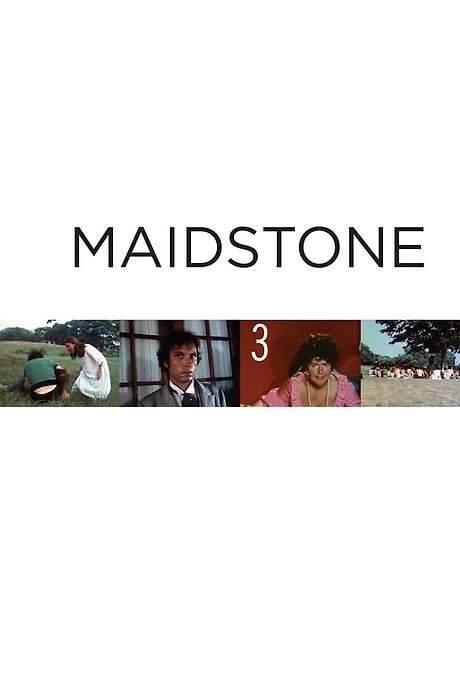
Maidstone 1970

Directed by

John de Menil
Made by

Supreme Mix Productions
Where to Watch Maidstone
See current US streaming, rental, and purchase options for Maidstone (1970) via JustWatch.

Streaming availability powered by 
Maidstone Plot Summary
Read the complete plot summary and ending explained for Maidstone (1970). From turning points to emotional moments, uncover what really happened and why it matters.
Norman T. Kingsley, Norman Mailer, is a filmmaker often described as the “American Buñuel,” and he sets out to craft a sexually provocative drama about a brothel. On his estate in East Hampton, New York, he gathers a circle of friends, actors, aspiring actresses, and others to audition for and contribute to the project. The story of the film, aptly titled Maidstone, unfolds in twelve chapters and is presented in a documentary style, offering a granular, almost behind-the-scenes view of Kingsley’s daily life as both actor and director.
The narration centers on Kingsley’s hands-on approach to directing. He places himself within the movie he’s making, stepping in front of the camera to demonstrate exactly what he wants from the performances. His method is blunt and unflinching, and his self-assured, hyper-realistic acting blurs the line between creator and creation. As he critiques the auditioning women and guides the participants toward his vision, the viewer witnesses a relentless insistence on control, a portrait of a man who treats the production as an extension of his own personality.
Beyond the filmmaking, Kingsley’s life takes on a second, equally public project: a political campaign in which he aspires to become president. The art-world milieu he inhabits becomes a forum where journalists, scholars, and a range of political observers press him with questions about his motives, his temperament, and his ideas for the nation. The documentary lens captures these exchanges with a steady, observational gaze, revealing how the spectacle of a controversial artist-turned-candidate unsettles conventional boundaries between art, politics, and power.
As the attention around Kingsley grows, a faction emerges within the broader discourse. A group identified as PAX,C starts to debate the implications of his celebrity and rhetoric, with some within the circle suggesting drastic measures. The conversations they have are unsettling, probing whether violence could ever be a legitimate tool in service of art or political influence. The film thus threads together themes of ambition, manipulation, media attention, and the ethical costs of charisma.
Throughout Maidstone, the atmosphere on the estate is saturated with tension and fragility. Kingsley’s insistence on realism, his willingness to insert his own presence into the film, and the constant scrutiny from an expanding audience create a claustrophobic sense of spectacle. The documentary format preserves moments of candor and confrontation, along with the awkwardness, vanity, and bravado that accompany a high-stakes creative enterprise. The result is a provocative, uncompromising portrait of a man who views art as a battlefield where personal conquest, public perception, and political theater collide.
Ultimately, the film presents a complex, unflinching snapshot of a controversial figure at the intersection of cinema, celebrity, and public life. It invites viewers to consider how art and personality can shape reality, and how the pressures of performance—whether on screen or in the political arena—reveal deeper questions about authenticity, influence, and responsibility.
Maidstone Timeline
Follow the complete movie timeline of Maidstone (1970) with every major event in chronological order. Great for understanding complex plots and story progression.
Arrival at the East Hampton estate
Kingsley arrives at his East Hampton estate with friends, actors, and aspiring actresses to begin the provocative drama. The setting is established as a documentary-like workspace where participants are both making and observing the process. The atmosphere is charged with anticipation as auditions and conversations set the stage for the film’s meta-narrative.
Auditions begin for the provocative drama
Actresses audition for the role in Kingsley’s sexually charged drama, and Kingsley scrutinizes each performance with biting critique. He uses caustic commentary to shape expectations and reveal his aesthetic standards. The process blends genuine auditioning with performative judgment that mirrors his controlling artistic style.
Kingsley inserts himself into the film’s action
Kingsley places himself within the film’s narrative to demonstrate exactly what he is looking for from the actresses. He directs scenes from inside the action, showing a self-constructed vision of authenticity and power. This blurs the line between director, actor, and subject, making the process visibly theatrical.
Kingsley proclaims himself a narcissist
In dialogue and monologue, Kingsley declares his own narcissistic perspective as part of his artistic persona. The film uses this self-portrait to challenge viewers and participants alike. The admission sets the tone for his interactions with the cast and the viewers of the production.
Campaign for president begins within the project
Kingsley launches a fictional or symbolic presidential campaign as part of the narrative. He leverages the production to draw attention, turning the estate into a stage for political spectacle. The campaign intertwines with the filmmaking process, amplifying tensions around power and influence.
Media and scholars probe Kingsley’s aims
Journalists and scholars arrive to question Kingsley about his campaign and artistic intentions. They scrutinize his rhetoric, ethics, and the relationship between his art and politics. The scrutiny increases the pressure on Kingsley and exposes competing interpretations of his work.
African-American radicals challenge the campaign
Some African-American radicals join the discussion, probing the politics of Kingsley’s campaign. They question his understanding of race, power, and representation within his provocative project. Their critique adds another layer of tension to the escalating spectacle.
PAX-C forms in response to the attention
A group known as PAX-C emerges in reaction to the public interest around Kingsley. They become a voice within the orbit of the project, signaling that the production has outgrown a private rehearsal and entered a charged political arena. Their involvement foreshadows darker undercurrents in the narrative.
Assassination is discussed as a possible course
Within the circles drawn to Kingsley, members of PAX-C discuss the possibility of assassinating him. The conversation reveals how threat and danger begin to color the atmosphere around the production. The idea underscores the extreme consequences that the film’s power dynamics may invite.
The twelve chapters unfold in documentary form
The film presents itself as twelve chapters filmed in a documentary style, detailing Kingsley’s everyday life as both actor and filmmaker. The structure emphasizes process over traditional plot, inviting viewers to observe a self-referential creative world. The chapters function as a window into his methods and personality.
Kingsley’s on-camera performance deepens
Kingsley’s performance grows increasingly convincing, and he uses the boundary between reality and fiction to reinforce his artistic vision. The act of performance becomes a means to illustrate what he wants from others and from the world around him. The line between director, actor, and subject becomes more porous.
A sense of looming danger lingers as the film closes
As tensions rise, ambiguity remains about what will come of Kingsley’s project and the threats surrounding him. The documentary-style approach leaves viewers with an unsettled impression of power, art, and politics intersecting in unsettling ways. The ending emphasizes the fragility of art when confronted by real-world hostility.
Maidstone Characters
Explore all characters from Maidstone (1970). Get detailed profiles with their roles, arcs, and key relationships explained.
Norman T. Kingsley (Norman Mailer)
A renowned but ruthless filmmaker who sees himself as a modern genius and literally places himself into his own film. He is intensely controlling, self-justifying, and unafraid to push boundaries to achieve his vision. His narcissism drives both his art and his political ambitions as he stages auditions and manipulates people around him.
Joy Broom (Joy Bang)
An attractive actress auditioning for a role in Kingsley's drama. She embodies the tension between performance and autonomy as she navigates the demands and judgments of the filmmaker and the onlookers. Her presence highlights the power dynamics on the estate.
Raoul Rey O'Houlihan (Rip Torn)
A formidable figure within Kingsley's circle who adds a foil to the filmmaker's obsession. He is outspoken and unconstrained, providing a counterpoint to Kingsley's control while becoming entangled in the film's web of influence and politics.
Jeanne Cardigan (Jeanne Campbell)
A member of the cast or circle around Kingsley, participating in the audition process or the project. Her interactions illustrate the social dynamics and power play present on the estate.
Chula Mae Kingsley (Beverly Bentley)
A figure connected to Kingsley on the estate, potentially a partner or close associate. She participates in the social world around the project, contributing to the aura of prestige and spectacle surrounding the production.
Maidstone Settings
Learn where and when Maidstone (1970) takes place. Explore the film’s settings, era, and how they shape the narrative.
Location
East Hampton, New York
East Hampton is a wealthy seaside town on Long Island, famous for its exclusive estates and summer homes. The story centers on Norman T. Kingsley's estate there, turning the property into a stage for his provocative film and social circle. The location's upscale, airy atmosphere contrasts with the film's raw, controversial content.
Maidstone Themes
Discover the main themes in Maidstone (1970). Analyze the deeper meanings, emotional layers, and social commentary behind the film.
🎭
Narcissism
Kingsley presents himself as a genius filmmaker and magnetic personality, using the camera to manipulate how others see him. The narrative punctures his grandiose self-image as he orchestrates situations to satisfy his creative control. This theme explores the glamor and danger of self-obsession within the art world.
🎬
Art vs Exploitation
The screenplay within the film is provocative and sexual, and Kingsley uses auditions to pull power from the actresses. The tension between artistic ambition and exploitation is a through-line as participants must navigate his demands. The documentary-style structure heightens the feeling that art is inseparable from personal and ethical boundary-pushing.
📰
Media & Public Persona
Kingsley's campaign draws journalists and scholars who dissect his image and ambitions. The presence of the press turns the estate into a stage for public performance, blurring lines between art, publicity, and politics. It questions how media constructs celebrity and political power.
⚖️
Power and Danger
As Kingsley campaigns to become president, radical groups discuss his assassination, revealing the volatility of celebrity-driven politics. The plot uses this threat to probe themes of influence, control, and the cost of dissent. The narrative suggests that a life built on controversy can invite real-world peril.

Coming soon on iOS and Android
The Plot Explained Mobile App
From blockbusters to hidden gems — dive into movie stories anytime, anywhere. Save your favorites, discover plots faster, and never miss a twist again.
Sign up to be the first to know when we launch. Your email stays private — always.
Explore the mobile appMaidstone Spoiler-Free Summary
Discover the spoiler-free summary of Maidstone (1970). Get a concise overview without any spoilers.
In the sprawling confines of an East Hampton estate, a chaotic creative experiment unfolds over five booze‑fueled days. Norman T. Kingsley, a filmmaker of provocative sensibilities often dubbed the “American Buñuel,” gathers a motley collection of friends, actors, and aspiring performers to craft a drama centered around a brothel. The production is less a traditional movie set and more a living, breathing extension of Kingsley’s own personality, captured in a raw, documentary style that refuses to look away from the vanity, bravado, and blurred identities on display.
Kingsley’s presence dominates the frame as he steps in and out of his role, erasing the distinction between the director and the subject. His method is blunt and intrusive, demanding a hyper‑realism that pushes his participants to their limits. Simultaneously, the estate transforms into a political stage as Kingsley announces a run for the U.S. presidency, inviting journalists and scholars to probe his volatile temperament and grand ambitions. The result is a disorienting spectacle where art, politics, and ego collide in a single, relentless gaze.
Beneath the surface of this surreal “gonzo narrative,” tensions simmer as the lines between performance and reality dissolve. Conversations within the group take a darker turn, questioning the ethics of influence and the potential necessity of drastic measures in service of art or political change. As the atmosphere grows increasingly claustrophobic, the film captures the unsettling fragility of a world where a charismatic leader’s whims dictate the rules, leaving the audience to wonder just how far the boundaries of cinema—and sanity—will be pushed before the illusion shatters.
Movies with Similar Twists and Themes
Uncover films that echo the narrative beats, emotional arcs, or dramatic twists of the one you're exploring. These recommendations are handpicked based on story depth, thematic resonance, and spoiler-worthy moments — perfect for fans who crave more of the same intrigue.



Featured on this page

What's After the Movie?
Not sure whether to stay after the credits? Find out!
Check out our other apps:

SAT Sphere
Build confidence for the Digital SAT.

Mori Atlas
Discover wild places worth protecting.

Luntero
Search smarter for a home in Amsterdam.

Plot Explained
Unravel movie endings and hidden clues.

Pokechamp
Dive into Pokémon data and battle logic.

Driving Theory
Get ready for your European theory test.

Movie Dust
Plan your next cinema trip with ease.

Musemap
Find art and culture as you travel.

Selkobase
Compare credentials before committing.

Local Manual
Turn an unfamiliar country into practical next steps.

Lernavi
Compare school systems before your next move.

GymRoam
Find a workout stop wherever your plans take you.
Explore Our Movie Platform
New Movie Releases (2026)
Famous Movie Actors
Top Film Production Studios
Movie Plot Summaries & Endings
Major Movie Awards & Winners
Best Concert Films & Music Documentaries
Movie Collections and Curated Lists
© 2026 What's After the Movie. All rights reserved.
Privacy Policy