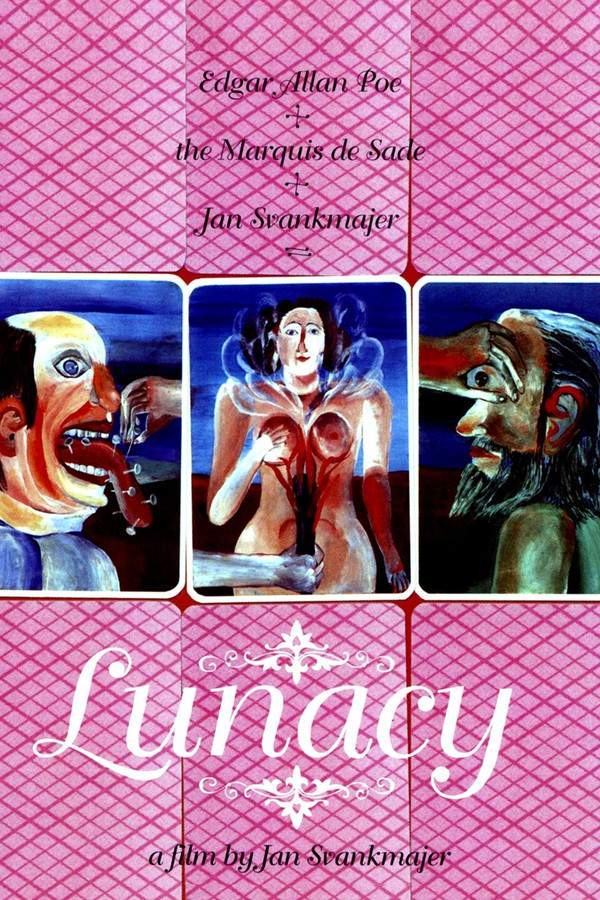
Lunacy 2006

Directed by

Jan Svankmajer
Made by

Zeitgeist Films
Lunacy Plot Summary
Read the complete plot summary and ending explained for Lunacy (2006). From turning points to emotional moments, uncover what really happened and why it matters.
Jean Berlot (Liska) is a deeply troubled man who has been haunted by violent hallucinations of being stuffed into a straitjacket by two orderlies since his mother’s death, a time when she was committed to a mental institution before she died. While arranging his mother’s funeral, Jean Berlot encounters a man who insists he is the Marquis de Sade (Triska) and who behaves as if he lives in 18th-century France rather than in the 21st-century Czech Republic. An uneasy alliance forms between them, even though their relationship is more tense provocation than friendship, and Jean is repelled by the Marquis’ debauched ways, including a blasphemous orgy he glimpses through an open window. The next day, the Marquis drops dead after choking on a banana, and Jean is forced at gunpoint to help the servant Dominik (Nový) bury the coffin in the family mausoleum. The following morning, a bell rings and, after the tomb’s stone is opened, the Marquis reveals that it had all been an elaborate prank. He explains that his mother died after being buried alive, and that this memory haunts him as a peculiar form of therapy—revisiting the trauma as if it were still unfolding.
The Marquis then proposes a path that could ease Jean’s nightmares: voluntary commitment to an asylum run by his friend Dr. Murlloppe (Dusek), who offers what he calls “Purgative Therapy” for people who are not mad now but could become so in the future. Drawn to the idea, Jean falls for a beautiful nurse named Charlota (Geislerova), who insists she is being held at the hospital against her will. Charlota also reveals that Murlloppe and the Marquis were previous patients who led a revolt and managed to lock the real asylum staff in the basement. The Marquis adds that Charlota is a nymphomaniac who enjoys weaving elaborate fictional tales as a form of foreplay. On the one-year anniversary of their revolt, Murlloppe, the Marquis, and Dominik take Charlota with them for a ritual orgy, and Charlota tells Jean that this is his only chance to free the staff. When Jean uncovers the aftermath, he finds the trio tarred and feathered in the basement, and he releases the others, who quickly overpower the patients and push them back into their cells.
Dr. Coulmiere thanks Jean for freeing them and shares a stark philosophy: bodily discipline is essential to balancing the mind, and Murlloppe’s idea of curing with “freedom” is an illusion. The chase and consequences follow as Murlloppe, the Marquis, and Dominik are hunted down and punished. Charlota is rescued, and Jean believes he can leave with her and start a life together, but Dr. Coulmiere forbids departure until 8 a.m., following a strict routine. Jean struggles to sleep and seeks Charlota for comfort, only to find her gone from her room and later discovered in Dr. Coulmiere’s chamber, preparing for a night of sexual indulgence. This triggers one of Jean’s violent hallucinations, prompting Dr. Coulmiere to intervene. The doctor orders the first round of corporal punishment: two orderlies stuff Jean into a straitjacket and haul him away, sealing the night with a brutal, inescapable consequence.
Lunacy Timeline
Follow the complete movie timeline of Lunacy (2006) with every major event in chronological order. Great for understanding complex plots and story progression.
Mother's death and funeral arrangements
Jean is haunted by his mother's death, noting she had been committed to a mental institution before she died. He must arrange her funeral, a grim ritual that foreshadows his fixation with confinement and mortality. The scene establishes the emotional weight that carries into the strange events to follow.
Meeting the Marquis de Sade
At the funeral arrangements, a man claims to be the Marquis de Sade and their uneasy bond begins. The Marquis lives in an 18th-century persona within the modern Czech Republic, drawing Jean into a dangerous alliance. Jean is pulled toward this provocative companionship despite his misgivings.
Spying the Marquis' orgy
Jean witnesses through an open window the Marquis's blasphemous orgy, a sight that horrifies and unsettles him. The debauched display foreshadows the moral chaos that will surround Jean. The Marquis's libertine world clashes with Jean's fragile sense of reality.
Marquis dies and burial pressure
The following day, the Marquis chokes on a banana and dies. Jean is dragged at gunpoint to assist in burying the coffin in the family mausoleum. This forced task binds Jean to the macabre drama and its consequences.
The mausoleum prank unfolds
The next morning, the bell wakes them and, after opening the mausoleum stone, the Marquis reveals it was all an elaborate prank. He uses the staged burial to force Jean to confront his childhood trauma. The prank introduces a therapeutic twist that will haunt Jean.
Revelation of the mother’s death
The Marquis explains that Jean's mother died after being buried alive, a memory he relives as a therapeutic exercise. The revelation links Jean's trauma to the past and frames the events as a controlled psychodrama. This moment deepens Jean's vulnerability to suggestion and manipulation.
Therapy proposal and asylum introduction
The Marquis proposes therapy: Jean should voluntarily commit himself to an asylum run by Dr. Murlloppe, who offers 'Purgative Therapy' for people who could become mad. This marks a shift from haunted memory to institutional treatment. Jean is drawn toward this option by the chance to end his nightmares.
Charlota enters Jean's life
Jean meets a beautiful nurse named Charlota, who claims she is being held at the hospital against her will. Her allure pulls him in as she hints at the asylum's secrets. This connection sets the stage for further revelations and danger.
Charlota's revolt tale
Charlota tells Jean that Murlloppe and the Marquis were previous patients who led a revolt and locked the real asylum employees in the basement. This paints the facility as chaotic and dangerous. Jean's trust in the institution is increasingly tested.
One-year revolt anniversary and kidnapping
On the one-year anniversary of the revolt, Murlloppe, the Marquis, and Dominik take Charlota for a ritual orgy, and she informs Jean that this is his only chance to free the staff. The conspirators still hold power within the asylum. The moment raises Jean's urgency to intervene.
Basement uprising and release
Jean finds Charlota and the others tarred and feathered in the basement and frees them. The released men immediately attack and beat the other patients to shove them back into their cells. The basement scene signals a brutal collapse of order within the asylum.
Coulmiere’s punitive philosophy
Dr. Coulmiere thanks Jean for releasing the men and explains his philosophy: corporal punishment balances mind and body, while Murlloppe's idea of curing through freedom is absurd. The exchange anchors the film in a stark view of treatment. Jean's actions are interpreted as disobedience to a harsh medical doctrine.
Punishments for the conspirators
Murlloppe, the Marquis, and Dominik are tracked down and subjected to severe punishments for their roles in the revolt. The authorities reassert control over the chaotic asylum. This punitive response reinforces Dr. Coulmiere's harsh treatment philosophy.
Charlota rescued; plans to leave
Charlota is rescued, and Jean hopes to leave with her and marry. Dr. Coulmiere refuses to permit departure until 8am, per protocol. The stubborn rule highlights the hospital's rigid control over its patients.
Final confrontation and punishment
Jean searches for Charlota and finds her in Coulmiere's room preparing for a night of sexual pleasures, triggering a violent hallucination. Coulmiere orders the first round of corporal punishment: two orderlies stuff Jean into a straitjacket and carry him away. The denial of escape culminates in a brutal, destabilizing punishment.
Lunacy Characters
Explore all characters from Lunacy (2006). Get detailed profiles with their roles, arcs, and key relationships explained.
Jean Berlot (Liska)
A deeply troubled man haunted by violent hallucinations of being stuffed into a straitjacket by two orderlies since his mother's death. The trauma of his mother's institutionalization and death drives his actions, leaving him vulnerable to the Marquis's influence while yearning for a path to peace. He becomes entangled in the revolt and the hospital’s dangerous politics, seeking a way to escape his terrifying memories.
Marquis de Sade (Triska)
A flamboyant, debauched aristocrat who lives as if in 18th-century France, manipulating Jean with his provocative, decadent presence. He embodies a corrosive freedom that intimidates and mesmerizes, and his actions drive much of the film's surreal tension. His sudden death from choking on a banana exposes a larger dynamic of manipulation and ritualized cruelty.
Dominik (Nový)
A pragmatic servant who aids in burying the coffin and participates in the revolt’s schemes. He embodies loyalty and streetwise pragmatism, acting as a foil to the Marquis's lavish rhetoric. His actions reveal the complexities of complicity within a system of control and rebellion.
Charlota (Geislerova)
A nurse who claims she is being held at the hospital against her will, Charlota becomes a catalyst for the revolt and a potential beacon of hope for the staff. Her presence adds layers of manipulation and alliance, as she reveals the true extent of the asylum’s power dynamics. Her relationship with Jean sparks both attraction and danger.
Dr. Murlloppe (Dusek)
A physician who advances the idea of 'Purgative Therapy' and orchestrates the revolt among patients and staff. He embodies a controversial belief in balancing mind and body through drastic means, challenging conventional medical ethics. His alliances with other rebels threaten the hospital's stability and threaten Jean's chance at genuine healing.
Dr. Coulmiere
An authoritative figure who defends corporal punishment as a legitimate form of treatment. He enforces protocol and stands as a rigid counterpoint to the revolting inmates and reformist ideas. His control and mindset create ongoing conflict and test Jean's resolve to leave the institution.
Lunacy Settings
Learn where and when Lunacy (2006) takes place. Explore the film’s settings, era, and how they shape the narrative.
Time period
21st century; 18th century (fantasy)
Most of the action takes place in the present-day Czech Republic within a contemporary psychiatric facility. The Marquis embodies a fantasy of 18th-century France, constantly contrasting with the modern world. The narrative also uses memories and dreamlike sequences to blur the lines between past and present, highlighting how time shapes perception and trauma.
Location
Czech Republic, Family mausoleum, Mental asylum
Primarily set in the Czech Republic in the present day, the story unfolds across a modern psychiatric asylum and the grounds of a family mausoleum. The hospital environment features a controversial program called Purgative Therapy, led by Dr. Murlloppe. The mausoleum and manor grounds provide a gothic counterpoint to the clinical setting, anchoring the characters in a space haunted by the past.
Lunacy Themes
Discover the main themes in Lunacy (2006). Analyze the deeper meanings, emotional layers, and social commentary behind the film.
🧠
Mental Illness
The film centers on Jean's haunted mind and violent hallucinations stemming from childhood trauma. His perception of reality is unstable, influenced by memories of his mother's death and the fear surrounding confinement. The storyline probes how mental illness is treated, including controversial methods like purgative therapy, and the boundaries between care and coercion.
🕰️
Reality vs Fantasy
The Marquis's persona as a living relic of 18th-century France creates a persistent fantasy that invades Jean's present. This blurred line between reality and illusion drives the tension and keeps the audience questioning what is true. The story uses these overlaps to explore how memory and imagination can distort behavior and choices.
⚖️
Power and Control
The asylum's hierarchy legitimizes control through punishment and oversight, framing corporal measures as treatment. The revolt led by Murlloppe, the Marquis, and Dominik exposes the dangers of unchecked authority in the pursuit of ‘freedom.’ The film questions whether the end of cure justifies the means of domination and coercion.
🗝️
Trauma and Memory
Central trauma—the death of Jean's mother and her burial—drives the narrative and shapes his nightmares. The past is locked away like a mausoleum secret that continually influences present actions. The story uses confinement motifs and symbolic spaces to show how unresolved memory persists and dictates behavior.

Coming soon on iOS and Android
The Plot Explained Mobile App
From blockbusters to hidden gems — dive into movie stories anytime, anywhere. Save your favorites, discover plots faster, and never miss a twist again.
Sign up to be the first to know when we launch. Your email stays private — always.
Explore the mobile appLunacy Spoiler-Free Summary
Discover the spoiler-free summary of Lunacy (2006). Get a concise overview without any spoilers.
In the shadowed valleys of 19th‑century France, a crumbling castle looms over a landscape thick with fog and forgotten whispers. The film dwells in a world where aristocratic elegance clashes with a palpable sense of dread, and every stone corridor seems to pulse with the memory of long‑suppressed secrets. Night itself becomes a restless character, blurring the line between the tangible and the nightmarish as the story unfolds within these oppressive walls.
Jean Berlot arrives burdened by a lifetime of haunting visions and the lingering grief of a mother lost to institutional confinement. His mind is haunted by vivid hallucinations that flare at the most ordinary moments, casting a perpetual twilight over his perception of reality. While arranging his mother’s funeral, he encounters a stranger who insists he is the Marquis de Sade, a figure who speaks and acts as though plucked from an earlier century, bringing with him an unsettling fascination for the macabre and the taboo. Their connection is fragile, marked more by provocation than camaraderie, and it draws Jean deeper into a maze of psychological intrigue.
Around them move Dominik, a silent servant whose presence hints at hidden loyalties, and Dr. Murlloppe, a physician whose unconventional methods promise a form of “therapy” that teeters between cure and further descent. Charlota, a nurse whose allure masks a complex inner life, becomes another point of tension, while Dr. Coulmiere embodies a colder, disciplinary philosophy that treats the body as a conduit to mental equilibrium. Each character is a mirror reflecting Jean’s own fractured psyche, and together they weave a tapestry of whispered conspiracies and surreal rituals.
The atmosphere is drenched in gothic melancholy, punctuated by moments of stark, unsettling humor that keep the audience guessing which reality is authentic. As darkness deepens, the castle becomes a crucible where inner demons surface and the thin veneer of sanity threatens to shatter. The film invites viewers to linger in the uneasy space between fear and fascination, promising a descent into madness that feels both intimate and inexorably inevitable.
Movies with Similar Twists and Themes
Uncover films that echo the narrative beats, emotional arcs, or dramatic twists of the one you're exploring. These recommendations are handpicked based on story depth, thematic resonance, and spoiler-worthy moments — perfect for fans who crave more of the same intrigue.



Featured on this page

What's After the Movie?
Not sure whether to stay after the credits? Find out!
Check out our other apps:

SAT Sphere
Build confidence for the Digital SAT.

Mori Atlas
Discover wild places worth protecting.

Luntero
Search smarter for a home in Amsterdam.

Plot Explained
Unravel movie endings and hidden clues.

Pokechamp
Dive into Pokémon data and battle logic.

Driving Theory
Get ready for your European theory test.

Movie Dust
Plan your next cinema trip with ease.

Musemap
Find art and culture as you travel.

Selkobase
Compare credentials before committing.

Local Manual
Turn an unfamiliar country into practical next steps.

Lernavi
Compare school systems before your next move.

GymRoam
Find a workout stop wherever your plans take you.
Explore Our Movie Platform
New Movie Releases (2026)
Famous Movie Actors
Top Film Production Studios
Movie Plot Summaries & Endings
Major Movie Awards & Winners
Best Concert Films & Music Documentaries
Movie Collections and Curated Lists
© 2026 What's After the Movie. All rights reserved.
Privacy Policy